

Lu Daopei Medical Group Files IPO Prospectus, Offering Comprehensive Hematology Care to Nearly 100,000 Outpatients Annually
In January 2024, Lu Daopei Medical Group, a leading provider of hematological medical services, filed its prospectus with the Hong Kong Stock Exchange for the third time, with CITIC Securities, CMB International, and Macquarie serving as joint sponsors.
In 2012, Lu Daopei, a hematologist, expert in hematopoietic stem cell transplantation, and academician of the Chinese Academy of Engineering, founded the Lu Daopei Medical Group, focusing on medical services for blood disorders. Benefiting from the prestige of being “founded by an academician,” Lu Daopei Medical has been highly favored by capital markets, with shareholders including prominent investment institutions such as Temasek, Xiamen C&D, CBC Group, and Investcorp.
After 14 years of development, Lu Daopei Medical Group operates three hospitals—Hebei Yanda Lu Daopei Hospital, the Yizhuang Campus of Beijing Lu Daopei Hospital, and the Shunyi Campus of Beijing Lu Daopei Hospital—serving patients in China and more than 20 countries and regions overseas. With this fundraising IPO, Lu Daopei Medical plans to expand and relocate Hebei Yanda Lu Daopei Hospital, as well as open new facilities such as Shanghai Lu Daopei Hospital.
In terms of specific revenue, the prospectus shows that Lu Daopei Medical Institution generated total revenue of approximately RMB 5.63 billion from 2020 to 2022 and the first three quarters of 2023. However, it has not yet achieved profitability, accumulating a net loss of nearly RMB 1.2 billion over the three-and-a-half-year period.
What Are the Reasons for Continued Growth Despite Ongoing Losses? How Will Lu Daopei Medical Group Strategically Position Itself Post-IPO? VCBeat Seeks Answers in the Prospectus.
The entrepreneurial journey of Lu Daopei Medical began in 2001. At that time, Academician Lu Daopei, having retired from Peking University People’s Hospital, leased two floors at Beijing Aerospace General Hospital to provide hematological treatment in a ward-based setting. This marked the inception of what would become Lu Daopei Medical Hospital. In 2012, upon the expiration of the lease, Academician Lu relocated the facility to Yanjiao, Hebei Province, where he established Lu Daopei Biotechnology Co., Ltd., the predecessor of Lu Daopei Medical, and subsequently launched a physical hospital.
It is worth noting that Lu Daopei Medical Group specializes in hematologic diseases, providing clinical treatment and specialized diagnostic testing services for these conditions. From an industry perspective, the medical service sector for hematologic diseases is characterized by high capital investment, long payback periods, and significant barriers to entry. Among market participants such as large public hospitals, specialized hematology hospitals, and hemodialysis centers, large public hospitals hold a dominant position.
For private healthcare institutions, medical service capabilities and expert resources are of paramount importance. As of September 30, 2023, Lu Daopei Medical Group possesses235 full-time physicians and 1,087 other healthcare professionals, offering various treatment modalities including hematopoietic stem cell transplantation, chemotherapy, targeted therapy, immunotherapy, and combination therapies, as well as providing specialized hematology testing services throughout the entire diagnostic and therapeutic process.Established full-cycle specialized service capabilities for hematologic diseases.
As of the same period, Lu Daopei Medical Group had completed a total of 8,966 hematopoietic stem cell transplants (HSCT), with 99% being allogeneic HSCT and 71.8% being haploidentical HSCT. The five-year survival rate for its allogeneic HSCT exceeded the industry average for major indications. In comparison, in China’s HSCT procedures performed in 2022, only 69.2% were allogeneic HSCT and 45.1% were haploidentical HSCT.
According to Frost & Sullivan data, as of the end of 2022, Lu Daopei Medical was China’s largest hematology healthcare service provider in terms of the number of patient-registered beds and hematopoietic stem cell transplantation suites.
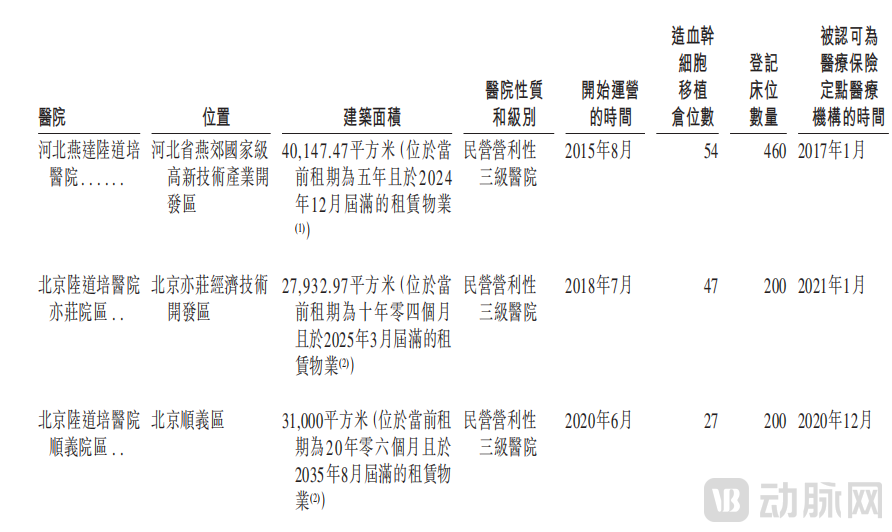
Furthermore, to benefit more patients with hematologic disorders, Lu Daopei Medical Group has established a new facility, Shanghai Lu Daopei Hospital, which commenced operations in the first quarter of 2024. Additionally, Lu Daopei Medical Group plans to relocate its Hebei Yanjiao Lu Daopei Hospital in its entirety. The new hospital is designed with at least 800 registered beds and 70 to 80 hematopoietic stem cell transplantation suites, thereby significantly enhancing its medical service capacity.
In the first three quarters of 2023, Lu Daopei Medical Group demonstrated strong performance in its key business indicators. The outpatient visits at its affiliated hospitals exceeded 94,800, the number of hematopoietic stem cell transplantation cases reached 1,114, and the volume of specialized tests for hematologic diseases totaled 478,774. The average registered bed occupancy rate exceeded 90%, showing an upward trend compared with previous years.
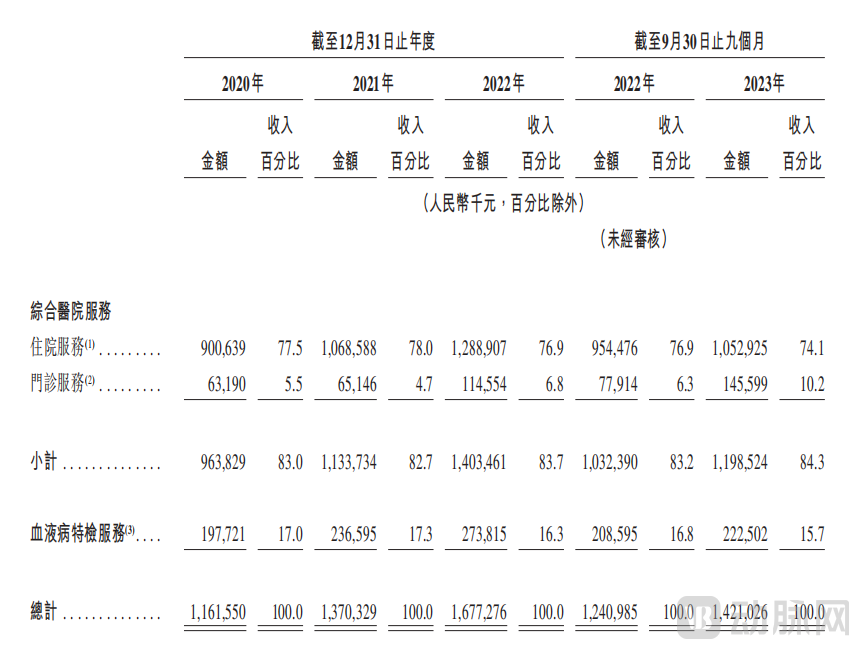
Focusing on financial performance, Lu Daopei Medical Group reported revenues of RMB 1.162 billion, RMB 1.37 billion, RMB 1.677 billion, and RMB 1.421 billion for 2020, 2021, 2022, and the first three quarters of 2023, respectively, with a compound annual growth rate (CAGR) of 20.2%. However, its net losses amounted to RMB 122 million, RMB 408 million, RMB 547 million, and RMB 88 million during the same periods, resulting in cumulative losses of nearly RMB 1.2 billion over the three-and-a-half-year period.
By service category, its revenue is primarily derived from two sources:Comprehensive hospital services focusing on outpatient and inpatient care, as well as specialized testing services for hematologic diseases.General hospital services account for over 80% of total revenue, with inpatient services being the primary revenue source, contributing more than 70% of the total.
Lu Daopei Medical offers 320 specialized diagnostic tests for hematologic diseases, serving not only its own patients but also third-party clients.In terms of revenue generated from specialized hematological testing services in 2022, Lu Daopei Medical was the third-largest provider of such services in China, with a market share of 7.8%.
By service hospital, Hebei Yanda Lu Daopei Hospital, as the earliest-established and most operationally mature flagship hospital, is the primary service entity and revenue source for Lu Daopei Medical Group. In the first three quarters of 2023, the hospital served 65,848 outpatient visits and 129,998 inpatient admissions, completed 564 hematopoietic stem cell transplants, and generated RMB 860 million in revenue, accounting for 60.59% of the company’s total revenue.
During the reporting period, Hebei Yanda Lu Daopei Hospital demonstrated an upward trend in key sustainability indicators, including annual actual bed utilization days, number of hematopoietic stem cell transplantation cases, outpatient visits, and volume of specialized tests for hematologic diseases, indicating that it has become a mature hospital. Beijing Lu Daopei Hospital’s Yizhuang and Shunyi campuses opened in 2018 and 2020, respectively; however, their overall operational performance remains to be strengthened, contributing limitedly to the company’s total revenue.
Lu Daopei Medical Group’s revenue has grown continuously for many years, but it has yet to achieve profitability, incurring a net loss of nearly RMB 1.2 billion over the past three and a half years. The reasons are as follows:
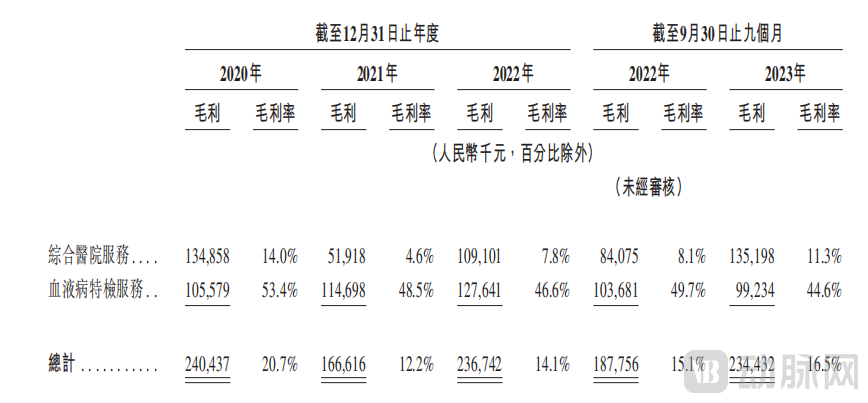
First, the gross profit margin is low.During the reporting period, comprehensive medical service revenue, which accounted for more than 80% of total revenue, exhibited relatively low gross profit margins of 14.0%, 4.6%, 7.8%, and 11.3%, respectively. In contrast, specialized hematological testing services, with gross profit margins approaching 50%, contributed a relatively small proportion to total revenue, remaining below 20% throughout the reporting period.
Next, the operation of new hospitals and the expansion of new campuses require substantial financial support.During the reporting period, the Yizhuang and Shunyi campuses have not yet demonstrated profitability. Meanwhile, the opening of Shanghai Ludaopei Hospital and the expansion of new campuses pending relocation require substantial working capital injections, thereby increasing the Company’s financial pressure. The prospectus also notes that the Company expects to incur significant expenditures and general and administrative expenses in the future; failure to enhance profitability will adversely affect its operating performance.
It also includes factors related to changes in the carrying amount of financial instruments.Lu Daopei Medical attributed its net loss in the prospectus primarily to the impact of changes in the carrying amount of financial instruments issued to investors.
In addition to continuing to expand its own network of hematology hospitals, Lu Daopei Medical has formulated a three-pronged growth strategy. First, it aims to enhance service capabilities by strengthening scientific research and clinical studies, thereby expanding disease indications and the patient base to benefit more patients. Second, it seeks to broaden its business and service scope through investments or joint ventures with local hospitals. Third, it is establishing talent development mechanisms in collaboration with higher education institutions and supporting multi-site practice models to attract more specialized medical professionals.
Medical services for hematologic diseases encompass disease diagnosis and treatment. Diagnostic procedures include general screening and specialized hematologic testing, while therapeutic approaches consist of hematopoietic stem cell transplantation, chemotherapy, targeted therapy, and immunotherapy.
Due to the complex and rare symptoms of hematologic diseases, patients require highly specialized diagnosis and treatment; however, specialized medical resources for hematology are scarce and unevenly distributed, and qualified medical resources for hematopoietic stem cell transplantation are limited. According to Frost & Sullivan data, the 5-year overall survival (OS) rate in China for major hematologic malignancies and refractory/relapsed non-malignant hematologic disorders lags significantly behind that of the United States.
Unmet medical needs among a large patient population have fueled a vast and rapidly growing market for hematological disease healthcare services in China. The total size of China’s hematological disease healthcare services market increased from RMB 20.5 billion in 2018 to RMB 26.4 billion in 2022, representing a compound annual growth rate (CAGR) of 6.5%. It is projected to reach RMB 80.9 billion by 2030, outpacing the growth of China’s overall healthcare services market during the same period.
Although operating in a high-demand industry, Lu Daopei Medical still faces numerous potential risks, such as market competition, technological barriers, and physician workforce challenges. The company’s business is heavily dependent on its affiliated hospitals’ ability to identify, recruit, and retain a sufficient number of qualified physicians, particularly in terms of service quality, reputation, accessibility, medical professionals, medical equipment, and pricing.
Finally, a defining characteristic of the healthcare services industry is its frequent improvements and technological advancements. Given the rapid and continuous technological innovation in this sector, new services and equipment are introduced from time to time. The success of Lu Daopei Medical Group depends on its affiliated hospitals’ ability to adapt to such technological changes, which will also entail significant expenditures. We await with anticipation the future development of Lu Daopei Medical Group.