

Intuitive Surgical's da Vinci 5 Robotic System Receives FDA Clearance with 10,000x Computing Power Boost and Over 150 Enhancements

Intuitive
Surgical Robot Developer
On March 15, 2024, Intuitive Surgical announced that its next-generation multi-arm robotic system, the da Vinci 5, had received U.S. Food and Drug Administration (FDA) 510(k) clearance.
“Intuitive Surgical is dedicated to meaningful surgical improvements that benefit patients, enhance the experience for both patients and care teams, and ultimately reduce total healthcare costs. After more than a decade of meticulous research, design, development, and testing, we believe the da Vinci 5 will achieve these goals and help drive the future of robot-assisted surgery,” commented the CEO of Intuitive Surgical.
Over the past year, Intuitive Surgical has faced numerous challenges. Although its financial performance remained respectable, intensifying competition across multiple fronts has pushed this industry leader into a premature “midlife crisis.” At this critical juncture, Intuitive Surgical unveiled its latest product, the da Vinci 5, delivering a strong rebuttal to external skepticism. This new offering also provides insight into the company’s strategic thinking on the future development of surgical robots.
The da Vinci 5 demonstrates significant improvements across all aspects; compared to the da Vinci Xi, the two systems are products of entirely different eras.
Intuitive Surgical particularly emphasized that this upgrade is built upon data from over 7 million procedures performed with the previous-generation da Vinci Xi system. After years of refinement and improvement, more than 150 components were ultimately upgraded.
The most striking aspect is the enhancement in computational power, with Da Vinci 5 boasting over 10,000 times the computing power of Da Vinci Xi.
This enables the da Vinci 5 to leverage Intuitive Surgical’s latest system features and advanced digital experiences, while seamlessly integrating with Intuitive’s My Intuitive app, SimNow (virtual reality simulator), Case Insights (computational observer), and Intuitive Hub (edge computing system) to deliver platform-level capabilities.
The da Vinci 5 is no longer just a surgical tool, but a comprehensive solution that provides preoperative planning, intraoperative guidance, and postoperative analysis.
Taking Case Insights as an example, this AI-powered digital tool enables surgeons to analyze their own surgical data and refine operative plans, while also providing unique insights by leveraging video, kinematic, and system-level data from hospitals. Furthermore, Intuitive Surgical is working to establish multiple objective metrics for various stages of the surgical process.
Through collaboration with the academic community, Intuitive Surgical aims to quantitatively deconstruct surgeries into multiple key steps. By conducting associative analyses that integrate surgical types, objectively quantified surgical workflows, and actual patient clinical outcomes, the company seeks to identify critical objective metrics and establish foundational standards for surgical robots. Intuitive Surgical attempts to combine these objective metrics with historical case data to predict treatment outcomes for current patients, thereby providing more valuable recommendations during surgery. This enables physicians to integrate these insights with the specific conditions of each patient to select optimal surgical approaches.
These capabilities are all underpinned by computational power. With enhanced computing performance, the Da Vinci 5 is equipped with a next-generation 3D imaging system that not only enables surgeons to access more information but also supports future generations of new endoscopic systems.
The da Vinci 5 also introduces haptic feedback technology and optional instruments, enabling the system to measure and sense subtle movements applied to tissues during surgery—a capability unmatched by any other surgical modality. In preclinical trials conducted by experienced surgeons, the integration of haptic feedback technology reduced the force applied to tissues by 43%, effectively minimizing excessive tissue trauma.
Meanwhile, the measurement and accumulation of these subtle forces can add a new standard data stream to robotic surgery, enabling greater analytical insights through artificial intelligence in the future. Currently, the da Vinci 5 force feedback technology has been approved for the same procedures as the da Vinci Xi system, with the exception of pediatric, cardiac, and a limited number of gynecological surgeries.
Furthermore, the da Vinci 5 system focuses on enhancing operational efficiency by granting surgeons greater autonomy through system integration and streamlining workflows for both surgical and nursing teams. By reducing operative time without compromising patient safety, it is poised to increase robotic utilization rates. Enhancements in ergonomics and user comfort are also integral to this advancement.
The launch of the da Vinci 5 has once again widened the gap between it and other soft-tissue surgical robots. Competitors now face not only the benchmark da Vinci Xi but also the more technologically advanced da Vinci 5, leaving them little time to respond.
For years, numerous industry competitors have benchmarked against the da Vinci system, striving to surpass it in certain aspects. However, da Vinci’s comprehensive self-upgrade will make the path forward even more challenging for its rivals.
“Robotics is hard; medical robotics is even harder,” said Hani Abouhalka, Chairman of Johnson & Johnson’s Robotics and Digital Surgery Group, at a public event. This sentiment reflects the reality faced by nearly all robotics companies attempting to compete with Intuitive Surgical in the field of soft-tissue surgical robotics. Despite the presence of numerous players, the da Vinci system remains the undisputed leader. Now that the industry incumbent has made its move, competitors naturally dare not take it lightly.
Seven years after the Senhance surgical robot system received market approval, Asensus Surgical has launched its next-generation Luna platform, with the aim of obtaining FDA clearance in 2025. Compared to its predecessor, the Luna platform has a 30% smaller footprint, enabling hospitals to configure operating spaces more flexibly and improve operating room utilization efficiency. Furthermore, the Luna platform is equipped with newly designed TrueWrist 5mm instruments, which offer high dexterity and are reusable, significantly reducing hospitals’ operational costs.
Furthermore, the more significant upgrade to Luna lies in ensuring that the platform can continuously support the iterative upgrades of new tools and software over the next decade. To achieve this goal, the R&D team has devoted substantial effort to establishing a brand-new device driver system. This desktop testing system lays a solid foundation for supporting a wider range of innovative tools in the future.
As a global leader in medical devices, Medtronic has naturally not missed the booming sector of surgical robots. In 2023, Medtronic received FDA approval to commence pivotal trials for its Hugo robot-assisted hernia surgery. Meanwhile, the Expand URO trial, focusing on prostatectomy, is also progressing steadily.
The Hugo system integrates wristed instruments, 3D visualization, and Medtronic’s cloud-based surgical video capture and management solution to provide a versatile platform for various soft-tissue surgeries, thereby enabling more flexible and precise surgical execution, improving operational efficiency, and enhancing patient safety.
During a conference call, Medtronic’s CEO stated externally: “Surgeons’ preference for open consoles and modular designs, combined with Medtronic’s leadership in minimally invasive surgery and instruments, will strongly drive the global adoption of Hugo. Equipped with advanced digital capabilities, Hugo will become a key growth driver for us in the coming years.”
It is evident that both industry giants like Medtronic and niche-focused companies such as Asensus have chosen to leverage digital capabilities to ensure compatibility with future innovative tools and to build software-based platforms. This underscores that, going forward, products lacking digital capabilities and artificial intelligence integration will fail to remain competitive.
Turning to the domestic market, it was nearly monopolized by the da Vinci system prior to 2021. Since 2021, with the successive market launches of domestically produced surgical robots, da Vinci’s dominance has gradually been broken. Meanwhile, alongside the rapid development of China’s surgical robot industry, the names of Chinese surgical robot companies have begun to appear in Intuitive Surgical’s financial reports.
In addition to the cost advantage, domestic robot manufacturers are also actively deploying strategies, aiming to explore innovations in technology and product forms to achieve differentiated competition. For example, in terms of the number of robotic arms, single-port versus multi-port systems, force feedback, and 3D display, while the da Vinci Xi adopts a 4-arm configuration (1 camera arm and 3 instrument arms), Chinese companies offer various alternatives, such as 3-arm systems (1 camera arm and 2 instrument arms), single-arm systems (integrating 1 camera arm and 3 instrument arms within one unit), and four independent surgical execution systems.
Furthermore, domestic companies have also begun to make strategic moves in the field of haptic feedback systems for the da Vinci 5.
Currently, most endoscopic surgical robots rely on visual feedback. When controlling robotic arms during surgery, surgeons must analyze visual information to make real-time assessments of the forces exerted by instruments on tissues and other tissue characteristics. In traditional surgical procedures, haptic feedback obtained through touch is equally important alongside vision. The incorporation of force feedback technology not only enhances the realism of the surgical experience but, more importantly, effectively improves surgical efficiency.
For instance, in vascular interventional surgical robots, companies have incorporated precise force sensing and feedback applications. Furthermore, through a remote control platform, sub-millimeter stepwise control of guidewires and catheters, intelligent retraction, and precise release of contrast agents can be achieved. These systems also feature integration capabilities with imaging equipment, surgical instruments, and navigation systems.
Some orthopedic surgical robot products not only incorporate the master-slave design of endoscopic surgical robots, adopting a multi-robotic-arm plus modular surgical instrument architecture, but also integrate force feedback technology, thereby assisting surgeons in safely and efficiently performing all core procedures of minimally invasive orthopedic surgery.
Furthermore, in the field of flexible gastrointestinal surgical robots, some companies have incorporated force feedback functionality into their products, enabling surgeons to achieve more agile, extensive, and precise manipulation. Meanwhile, the integration of force feedback technology into ophthalmic surgical robots allows for more accurate, real-time dynamic adjustments, thereby ensuring surgical safety.
Currently, several domestically produced surgical robots have received regulatory approval in China, but their commercialization remains in its early stages. On the other hand, it will take some time for the da Vinci 5 system to be launched in the Chinese market. For domestic robotic companies, in addition to keeping pace with Intuitive Surgical in terms of technology, it is also worthwhile to learn from Intuitive Surgical’s mastery of commercialization pacing.
Behind the 180-fold return over 20 years lies Intuitive Surgical’s continuous iteration and upgrades, always staying one step ahead of its competitors.
The first-generation da Vinci system was approved in 1999, and for the next two decades, it dominated the market by leveraging a robust and comprehensive patent moat. During this period, Intuitive Surgical introduced new generations of products every three to five years, optimizing and upgrading performance based on previous models. Notable innovations that captured attention at their launch included the four-arm system, the dual surgeon console, and the single-port robot. Meanwhile, continuous feedback from frontline clinical practice further drove product iteration, ensuring that the da Vinci system remained at the forefront of the industry throughout these years.
However, as time has passed, the market has begun to diverge in its views. Questions have arisen such as: After more than 20 years of development, does Intuitive Surgical, Inc. still have sufficient room for growth? How much competitive pressure will the company face from catching-up rivals around the world? And can the “robotics + consumables + services” model remain sustainable in the long run?
Perhaps we can find some answers in the financial reports.
In 2023, the global number of da Vinci surgical procedures increased by approximately 22% compared to 2022. Intuitive Surgical projects that the global volume of da Vinci surgeries in 2024 will grow by approximately 13%–16% relative to 2023. Intuitive Surgical’s preliminary revenue for 2023 was approximately $7.12 billion, representing a roughly 14% increase from $6.22 billion in 2022. As these are unaudited preliminary results subject to subsequent adjustments, figures may be revised in the future.
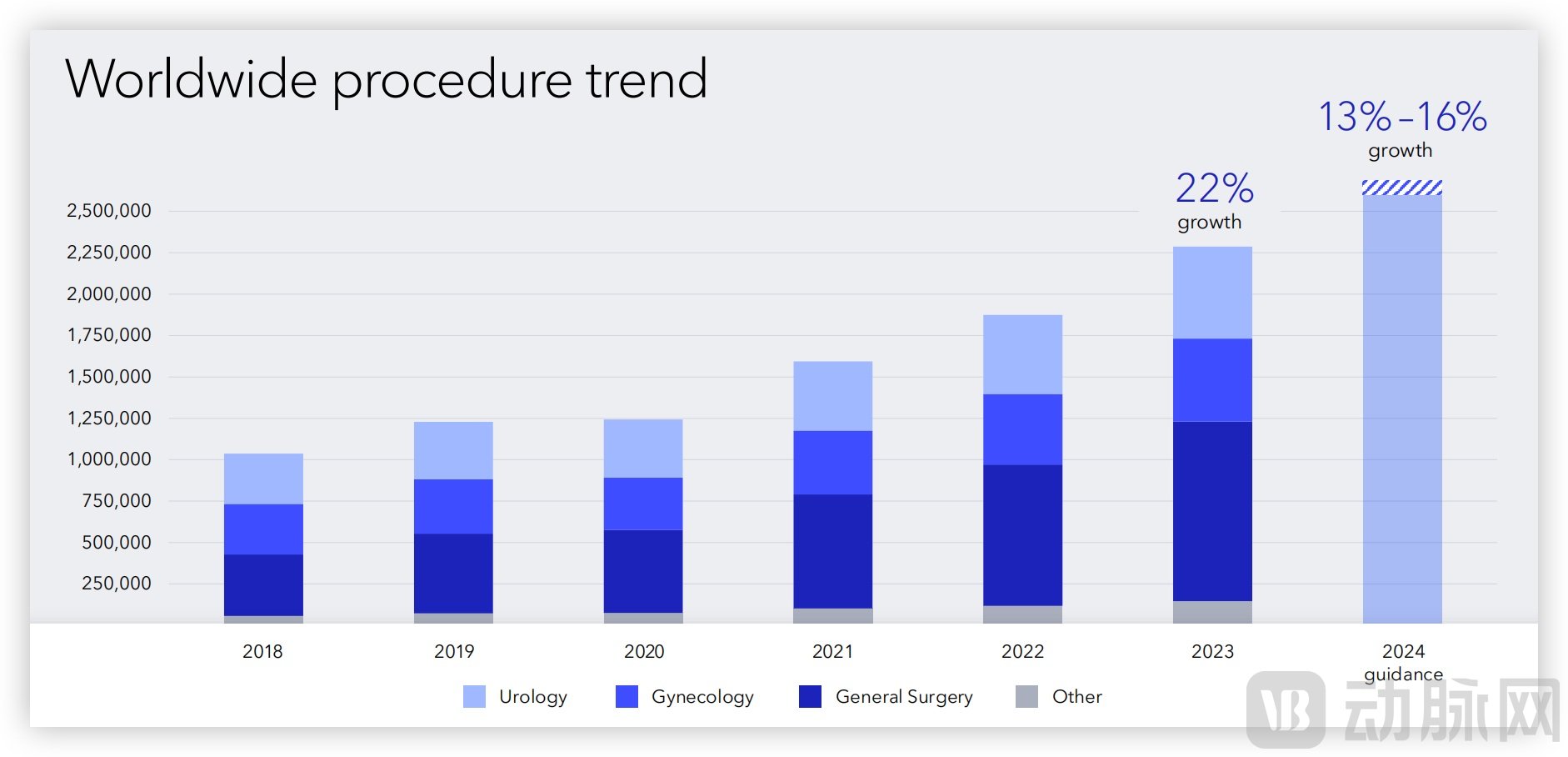
Da Vinci Surgical System Procedure Volume Continues to Rise, Source: Company Official Website
In 2023, a total of 1,370 da Vinci surgical robots were installed, representing an 8% increase from the 1,264 units installed in 2022. Excluding trade-in orders, the net placement of new systems in 2023 grew by 23% year-over-year, with the U.S. market seeing a 26% increase. Given that the 2022 figures were affected by the broader macroeconomic environment, the 2023 performance can be considered moderate and unremarkable.
Notably, among the 1,370 newly added units, 659 were acquired through leasing models, including 355 under a pay-per-use arrangement. These figures stood at 492 and 216 units, respectively, in 2022.
Over the past two decades, Intuitive has developed three business models: direct sales, trade-ins, and leasing, which also reflect Intuitive Surgical’s control over market pacing. For instance, trade-in orders for the third-generation da Vinci system, launched in 2009, began to emerge in 2014. Currently, the installed base of third-generation systems in the U.S. market is minimal.
In recent years, the outbreak of the pandemic and the weakening macroeconomic environment have tightened hospital budgets, while the leasing model introduced in 2013 has gradually gained momentum, stabilizing the company’s core business. Data show that the revenue share of the leasing model has been increasing since 2019.
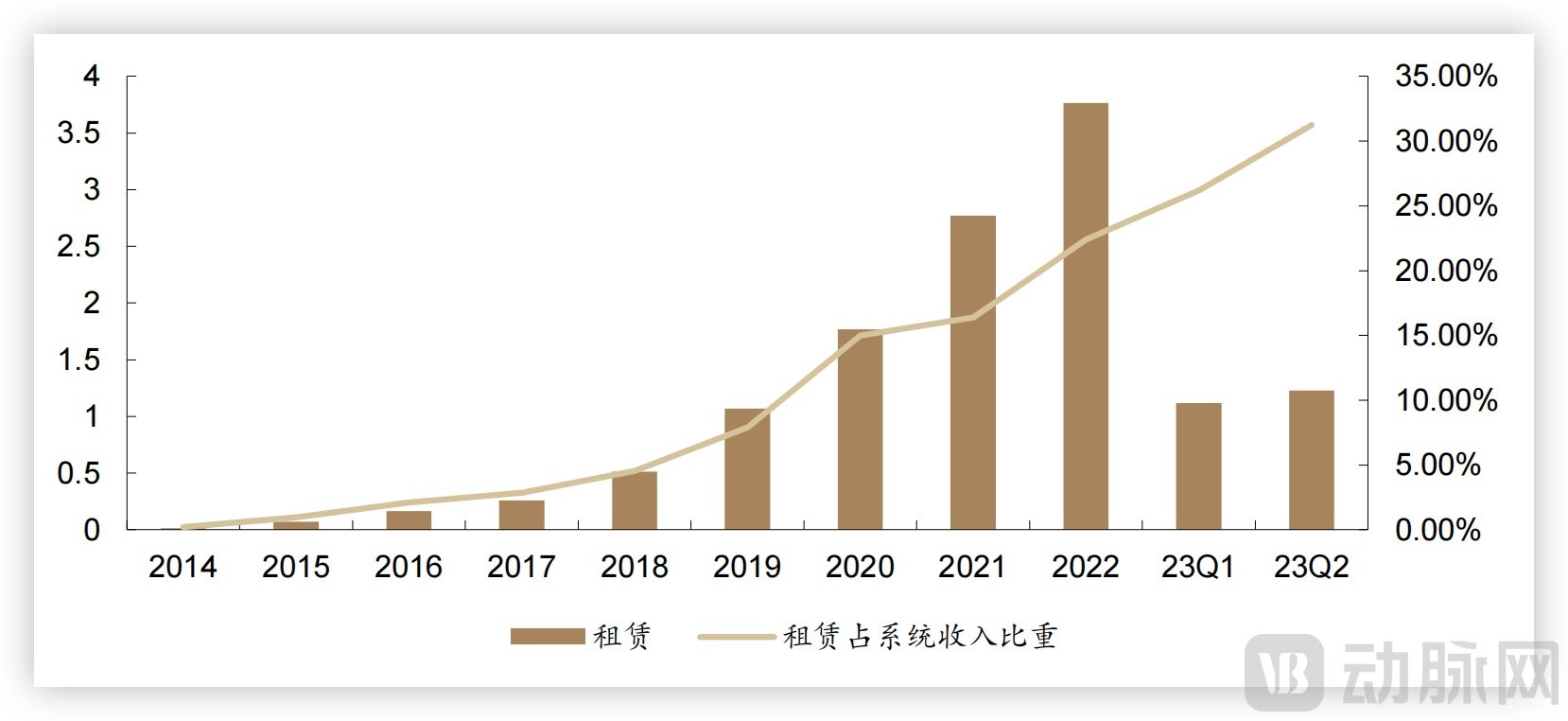
Lease Income and Its Proportion of Total Revenue, Source: Debon Research Institute
“Leasing is a thing of the past.” With its present position secured, what lies ahead? Intuitive Surgical’s answer: artificial intelligence.
At the J.P. Morgan Healthcare Conference held at the beginning of the year, Intuitive Surgical articulated its vision on how surgical data can assist hospitals. As highlighted in the preceding introduction to the da Vinci 5 system, data collection powered by AI applications has become a top priority in this new generation of systems. These applications extend beyond intraoperative assistance, enabling hospitals to operate more efficiently at a broader, macro level.
Whether it is leveraging data to make surgical plans more scientifically grounded, thereby ensuring patient safety; relying on data to provide personalized training for physicians, thus helping hospitals manage their workforce resources with greater ease; or building a hospital-wide software platform shared by all medical and nursing staff, thereby alleviating financial and cost pressures.
Intuitive Surgical is striving to forge deep, strategic partnerships with its customers, rather than merely serving as a tool in the operating room. For the many competitors following in its footsteps, the challenge is twofold: they must not only rival the da Vinci system on technological grounds but also contend with da Vinci’s first-mover advantage in commercialization. With the launch of the da Vinci 5, the da Vinci system is set to become even more deeply integrated with healthcare providers, leaving dwindling time for rivals to catch up.
References:
isrg.intuitive.com/news-releases/news-release-details/intuitive-announces-fda-clearance-fifth-generation-robotic
www.massdevice.com/10-surgical-robotics-companies-you-need-to-know-2024/