

Infervision Secures China NMPA Class III Approval for AI-Powered Liver and Kidney Surgical Planning System, Pioneering the Era of Intelligent Surgery

Infervision
Artificial Intelligence Product Developer
On March 13, Infervision’sLiver and KidneyThe surgical product has obtained approval as a Class III medical device from the National Medical Products Administration (NMPA).
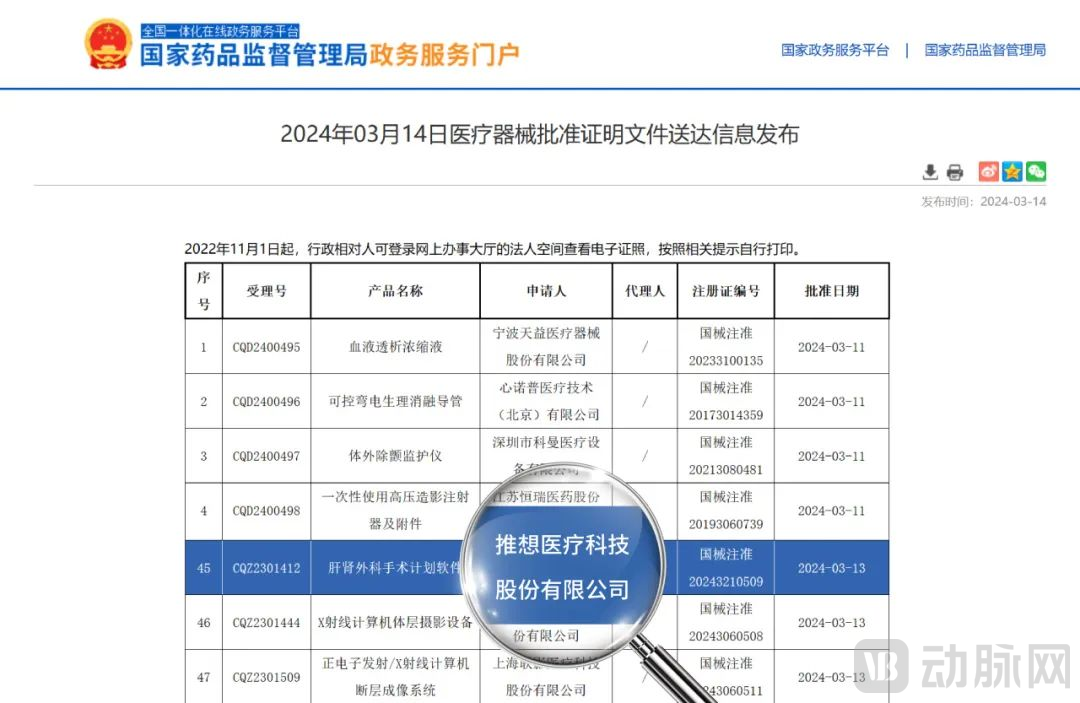
The surgical planning product approved this time isThe first and only surgical planning product in the liver and kidney fields to obtain an NMPA Class III certification, and the previously approved Infervision Lung Surgery Planning products, are allThe first AI application in its respective indication area to obtain a Class III medical device certificate from the NMPA. With this milestone, Infervision has secured both the first-ever certification for lung surgery planning and the first-ever certification for abdominal surgery planning, establishing a “gold-standard duo” of thoracic and abdominal surgical planning solutions that advance the intelligent and precise development of surgical care in China.
This product can fully automatically achieve three-dimensional reconstruction of important abdominal organs, tissues, and blood vessels in an extremely short time, providing the spatial relationship between target lesions and adjacent organ tissues and blood vessels. It assists surgeons in completing surgical simulation for liver and kidney lesions and visually displaying surgical pathways. Trials have demonstrated that, with the assistance of this product, surgeons show significantly improved accuracy in selecting surgical procedures for liver and kidney operations and in precisely defining the target resection range compared to the control group. Additionally, the trial group exhibited a substantial improvement in the time efficiency of surgical planning. Meanwhile, clinical results confirm that this product demonstrates superior performance in the accuracy of identifying anatomical structures and variant anatomical structures (including major abdominal blood vessels), as well as in reconstruction consistency.
Based on comprehensive clinical validation metrics,AI for Hepatic and Renal Surgical Planning can effectively improve the time efficiency, precision, consistency, and safety of preoperative planning, offering significant advantages in facilitating precise surgeries for liver and kidney cancers.
AI for Surgical Planning in Hepatic and Renal Surgery: Meeting the Practical Needs of Clinical Diagnosis and Treatment
Liver cancer is one of the most common malignant tumors worldwide. According to the latest Global Cancer Report 2020 released by the International Agency for Research on Cancer (IARC) of the World Health Organization, there were 906,000 new cases of liver cancer globally, ranking sixth in incidence, and 830,000 deaths, ranking third in mortality. China bears a disproportionate burden of liver cancer, with its new cases and deaths accounting for approximately half of the global totals; indeed, one out of every two patients who die from liver cancer is from China. Meanwhile, kidney tumors are also common diseases of the urinary system in China. Liver and kidney cancers pose a serious threat to people’s lives and health, while also imposing a significant socioeconomic burden on society as a whole.
Surgical resection is the primary curative treatment for primary liver cancer and one of the main therapeutic approaches for renal cell carcinoma. Preoperative diagnosis and surgical planning for liver and kidney cancers are predominantly based on conventional two-dimensional imaging modalities such as computed tomography (CT). Surgeons must rely on their spatial imagination and clinical experience to mentally reconstruct two-dimensional images into three-dimensional representations, thereby understanding the spatial relationships between the tumor and surrounding anatomical structures. However, this approach is inherently subjective and fails to generate stable, visually accessible three-dimensional data, which hinders the formulation of high-quality surgical plans.
Therefore, from the very inception of product development, Infervision has collaborated closely with top-tier hospitals and clinical experts both in China and abroad to gain an in-depth understanding of surgical clinical challenges, pain points, and the clinical requirements outlined in guidelines and consensus statements, thereby defining its product development direction. During the product development process, Infervision has trained its artificial intelligence algorithms using extensive clinical data while maintaining in-depth communication with clinical experts to integrate their expertise into product design. Through continuous iteration and upgrades, the company ensures that its solutions effectively meet the practical needs of clinical diagnosis and treatment.
The "Guidelines for the Treatment of Primary Liver Cancer" clearly state that completeness and safety are the fundamental principles of hepatectomy. This requires complete tumor resection with tumor-free margins, while preserving sufficient volume of functional liver tissue to ensure postoperative hepatic compensation, reduce surgical complications, and lower mortality.Infervision AI-4D Intelligent Hepatobiliary Surgical Planning System assists physicians in defining the resection margin to ensure complete tumor removal, displays the standardized future liver remnant ratio (remaining liver volume/standard liver volume), and helps evaluate whether the residual liver volume is sufficient, determine surgical eligibility, and precisely plan the surgical resection strategy.
The "Technical and Clinical Practice Guidelines for 3D Visualization in Primary Liver Cancer (2020 Edition)" clearly states that when surgeons face difficult decisions, repeated simulation of hepatectomy and volumetric calculations can help identify surgical opportunities, thereby expanding surgical indications while ensuring safety.Infervision AI-4D Intelligent Hepatobiliary Surgical Planning System supports two simulation modes for liver resection: segmental hepatectomy and curved-surface hepatectomy. Surgeons can simulate various resection strategies to maximize the preservation of healthy liver tissue.
The “Consensus on the Safety of Partial Nephrectomy” clearly states that preoperative patient evaluation, treatment indications, and regimens should be reasonably selected. It recommends contrast-enhanced CT of the kidney and suggests three-dimensional reconstruction of the renal arteries following contrast enhancement. The Infervision AI-4D Intelligent Urological Surgical Planning System supports fully automated segmentation and three-dimensional reconstruction of the kidneys, renal arteries, renal veins, and collecting system. This enables users to clearly and intuitively visualize the location and size of the target lesion, as well as its anatomical relationship with adjacent vessels and the collecting system, assess the extent of lesion involvement, and perform simulated resection of the target lesion.
From the perspective of surgeons, AI-driven liver and kidney surgical planning not only enhances standardized diagnosis and treatment capabilities in accordance with clinical guidelines, but also improves efficiency and strengthens safety and compliance controls. With AI empowerment, physicians can now perform 3D reconstructions independently within their hospitals, keeping data secure and standardized on-premises. This approach significantly boosts efficiency while substantially reducing reconstruction costs. Furthermore, it supports physicians in conducting scientific research and publishing papers using cases involving 3D reconstruction.
AI Healthcare Enters the Era of Precision Medicine 3.0: Deeply Empowering the Entire Cancer Diagnosis and Treatment Process
Not long ago, Infervision’s lung surgery planning product received approval from China’s National Medical Products Administration (NMPA) as a Class III medical device. Designed for lung surgery planning, this product is the world’s first AI application for cancer surgical treatment to obtain an NMPA Class III certification, and alsoThe first and only lung surgery planning product approved with an NMPA Class III certification,It can serve as a reference for thoracic surgeons in formulating pulmonary surgical plans.
With the inclusion of this newly approved surgical planning product for liver and kidney procedures,Infervision has become the world’s first AI healthcare technology company to hold regulatory approvals for AI-assisted diagnosis and treatment in three organ systems: lungs, liver, and kidneys., leveraging its extensive suite of AI surgical solutions, Infervision comprehensively empowers integrated, precision diagnosis and treatment across the entire cancer care continuum. This successful approval signifies that AI in healthcare has evolved from the 1.0 era of early disease screening and the 2.0 era of precision diagnosis toThe 3.0 Era of Precision Medicine。
As early as two years ago, Infervision pioneered the concept of the AI-4D Intelligent Surgical Planning System within the industry, aiming to establish InferOperate, an imaging AI-based oncology treatment ecosystem. This system performs fully automated reconstruction and surgical planning for organs and tissues such as the lungs, liver, kidneys, and bones based on CT imaging data. It plays a significant guiding role in early cancer screening, precise diagnosis, and assistance in precision surgery. The AI-4D system addresses the following clinical needs, including:
Data Security 数据安全
On-Premises Deployment, Direct Data Connection
Detailed Reconstruction Precise Reconstruction
Comprehensive Anatomy, Homogeneous Specifications
Delivery Speediness 快速交付
Auto-reconstruction for instant visualization
Diverse Features 功能丰富
Comprehensive Information, Diverse Scenarios
AI-4D Intelligent Surgical Planning System: On one hand, it deepens AI’s involvement across the entire disease diagnosis and treatment workflow, extending from screening and diagnosis into the therapeutic domain; on the other hand, it broadens the spectrum of covered diseases, expanding from the thoracic and pulmonary systems to include the hepatobiliary and urinary systems, among others. This enables AI technology to provide more profound and comprehensive empowerment throughout the entire clinical diagnosis and treatment process.
The “Action Plan for Promoting High-Quality Development of Public Hospitals (2021–2025)” clearly states, “Encourage public hospitals with the necessary conditions to accelerate the application ofSmart service software and hardware, such as AI-assisted diagnosis and treatment systems, enhance the intelligence and personalization of medical services, advance the standardization and normalization of hospital informatization, and implement national and industry IT standards.” The initiative to promote high-quality development in public hospitals requires collaborative efforts across the entire industry.
As Infervision continues to expand its comprehensive, multi-dimensional product portfolio, it will provide an increasing number of innovative, high-quality solutions to support the high-quality development of public hospitals. By achieving breakthroughs and advancing in tandem across multiple domains—including medical imaging, surgery, services, and scientific research—Infervision aims to enhance the quality and efficiency of the healthcare service system, tangibly improve patients’ healthcare experiences, and enable the public to access more precise and higher-quality medical services.