

Xushui Interconnect Secures Tens of Millions in Series A+ Funding to Advance AIoT-Driven Hospital Asset Management
HM CAPITAL
Healthcare Investment Institutions
Recently, in Beijing, China, a leading domestic AIoT technology company in the medical device sectorAquiferreAnnounces the completion of a financing round led byA+ round financing of tens of millions of yuan, led by Renai Capital and with continued participation from existing shareholder HM CAPITAL,Bairong Capital served as the exclusive financial advisor for this round of financing. The proceeds will be used to continuously develop innovative applications based on the underlying data from AI-enabled IoT medical devices, and to deepen business-side collaborations with leading companies in the healthcare industry.
Aquiferre, established in 2016, is a Beijing-based “Specialized, Refined, Differential, and Innovative” (SRDI) small and medium-sized enterprise. It focuses on developing foundational IoT hardware infrastructure for medical devices, digital operation management platforms, and innovative applications. Based on its independently developedThree Core AIoT Technologies: Data Heterogeneity, Edge Computing, and Digital Twins, by mining, cleaning, and analyzing the underlying raw data from medical devices, we achieve interoperability among medical devices, establish a normalized asset management platform covering all equipment for hospitals, drive the transformation towards intelligent asset management at the hospital level, and support high-quality, connotative development of hospitals.
China’s RMB 2 Trillion Medical Equipment Market Has Long Lacked Effective Digital Management Tools, Leaving Hospitals’ Core Goals of Quality Improvement and Efficiency Enhancement Unmet
“The core contradiction in China’s healthcare industry lies in the imbalance between the supply and demand of high-quality medical resources. Traditional solutions have focused on additive growth in productivity, such as expanding hospital campuses, purchasing more equipment, and training more medical professionals. However, in the current environment that emphasizes high-quality development and cost containment within medical insurance schemes, this additive approach has hit a bottleneck in terms of return on investment. There is an urgent need to shift toward a multiplicative model. Digital management represents this multiplicative approach, with Artificial Intelligence of Things (AIoT) serving as one of the essential infrastructures for digitalization. Investments in AIoT will yield significantly higher returns than the mere accumulation of production factors, making it a more cost-effective option for administrators,” said founder Peng Qibin.
Focusing on existing hospital operations, medical equipment accounts for over 50% of hospital assets, with the total asset stock exceeding RMB 2 trillion and 10 million units of equipment valued at over RMB 10,000 each. Hospital revenue primarily stems from four sources: pharmaceuticals, consumables, diagnostic examinations, and surgical procedures. With the implementation of policies such as the zero-markup policy for drugs and consumables, inspection and examination services provided by medical equipment have become an indispensable component contributing to hospital-side revenue. Although various types of equipment appear to be operating at full capacity, there is a paradoxical situation characterized by high idle rates and prolonged patient waiting times. On the policy front, standards such as the Level 5 Smart Hospital criteria and the Accreditation Standards for Tertiary Hospitals further emphasize quality management and benefit analysis and evaluation of medical equipment. Driven by the dual imperatives of prioritizing economic benefits and complying with policy requirements, how to address the challenge of high-quality development—shifting from a “revenue center” to a “benefit center”—has become a top priority for hospital administrators.
Aquiferre: A Six-Year Journey to Becoming a Leader in AIoT for Medical Devices, Safeguarding the Development of Smart Hospitals
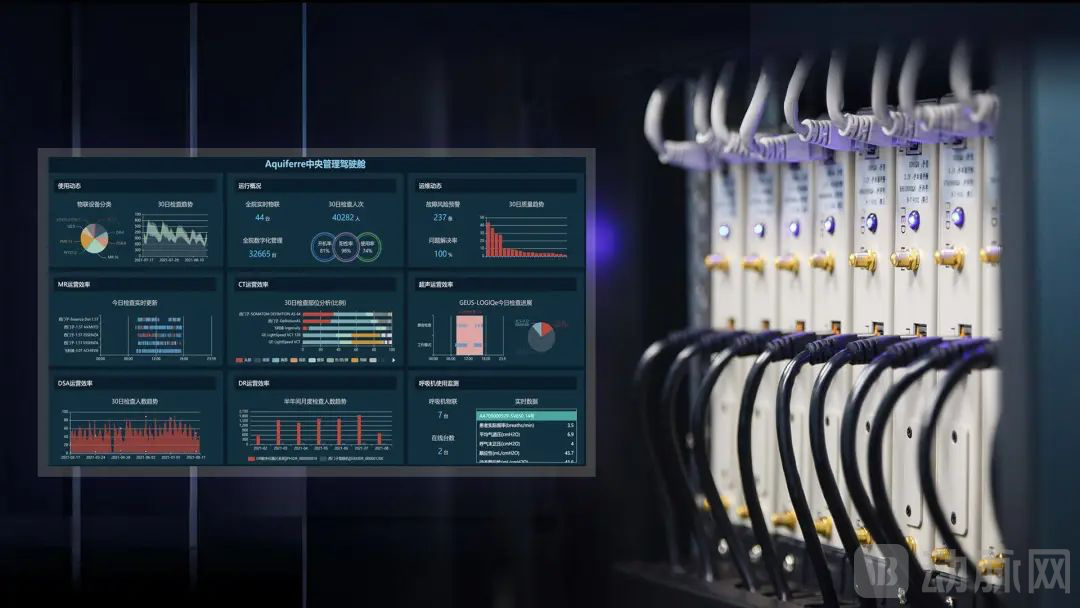
Aquiferre is a technology company that leverages integrated hardware as its core platform to provide data integration solutions and applications for a vast array of medical devices, thereby creating unique value for the healthcare system. Through five years of sustained and focused investment, it has grown into the service provider with the most extensive coverage of medical device types and brands connected via IoT technology. In 2023, the categories of devices supported by Aquiferre’s AIoT technologyBuilding on its existing coverage of categories such as radiology, ultrasound, life support, and endoscopy equipment, the company has further expanded into laboratory equipment, tool-type devices such as electrosurgical and ultrasonic surgical units, and pathology equipment, achieving a category coverage rate of over 80%.Capable of providing hospital-wide services for big data analytics-based configuration optimization and procurement decision-making for medical equipment, appointment system optimization and performance management, remote operational monitoring and fault early warning, as well as an integrated platform for standardized quality control and research translation.

When asked about the reasons for their firm decision to partner with Aquiferre, a startup, multiple hospital clients repeatedly cited “technological advancement” and “scalability” as the two key considerations.Unlike other suppliers, Aquiferre employs advanced AIoT-based data acquisition, cleaning, and processing methods,The most comprehensive data granularity, the highest accuracy, and the strongest timeliness,Not constrained by equipment updates and iterations,It can be developed into an infrastructure for the long-term development and multi-stage application of digital hospital management, providing sustained support for the high-quality development of hospitals and multiple departments.Each hospital utilizes equipment across 21 major categories, with at least 10 brands per category and more than 10 models per brand. Each device involves at least 12 key databases. Building a hospital-wide medical equipment management platform requires the development of underlying data protocols for no fewer than 30,000 cases. This endeavor demands professionals with R&D experience, robust development environments, support from clinical key opinion leaders (KOLs), and the persistent, cumulative spirit of digging deep.
Leveraging its years of accumulation in core AIoT technologies and the founding team’s profound understanding of commercialization, Aquiferre has successivelyHaving completed installation and delivery at dozens of Grade 3A hospitals, Aquiferre has collaborated with Peking Union Medical College Hospital since 2020 to build and deploy a smart management platform for medical equipment based on IoT digital twin technology. This initiative has enabled dynamic analysis of the operational status of medical devices across different categories and brands, leading to an overall improvement in the operational efficiency of imaging equipment, with phased achievements already realized.By 2023, the company’s business volume had doubled for three consecutive years. The number of hospital clients with newly installed systems in that year alone approached the total sum of the previous three years. Furthermore, some clients sequentially initiated Phase II projects, continuing to expand the variety and quantity of connected devices within their facilities. This trend fully reflects the surge in demand among hospital administrators for refined asset management and lean operations, as well as their recognition of the cost reduction and efficiency enhancement achieved through Aquiferre’s digital asset management platform.
Data flows like water. Aquiferre not only excels at “drawing water” but also collaborates with China’s leading hospitals, leveraging AI tools to develop innovative applications for “managing and utilizing water.”
Against the backdrop of the nationwide implementation of policies promoting mutual recognition of quality-based inspection results, maximizing the value of existing and newly acquired equipment involves more than just improving efficiency; at the county, provincial, and even national levels, there are significant challenges in enhancing overall imaging quality and diagnostic and treatment standards.Aquiferre, leveraging its years of experience in digital application development, has co-developed the innovative IDSS (Imaging Decision Support System) with West China Hospital.By leveraging IDSS to conduct retrospective statistical analysis of departmental and hospital-wide imaging quality control results, comprehensive oversight of image quality outcomes can be achieved. Furthermore, for the major special project on “Diagnostic and Therapeutic Equipment and Biomedical Materials” under the National Key R&D Program of the 14th Five-Year Plan initiated by the Ministry of Science and Technology, Aquiferre will collaborate with West China Hospital to carry out joint research on common key technologies for core subcomponents of domestically produced medical equipment, utilizing AIoT (Artificial Intelligence of Things) technology.
Renai Capital is the investment and operation platform of Renai Group, as well as a limited partner to many leading domestic investment institutions. Renai Capital primarily focuses its investments on sectors such as big health, semiconductor technology, artificial intelligence, new energy, and new materials, and has gradually expanded into direct investments in leading companies within these advantageous tracks in recent years. Founded by Mr. Ma Ruren in 1998, Renai Group is a diversified conglomerate integrating multiple business segments, including investment, real estate, education, consumer goods, and international trade.
HM CAPITAL is a professional fund manager specializing in healthcare investments. Leveraging the resource ecosystem advantages of the HM Healthcare Group and other partners, it invests multi-dimensionally and comprehensively across the healthcare ecosystem. With a profound understanding of the healthcare industry chain, HM CAPITAL has built an investment platform that empowers the entire industrial chain. It has invested in numerous “global-first” products along the industry value chain and is committed to providing strategic value-added services and systematic empowerment to its portfolio companies. HM CAPITAL boasts a professional team with both international vision and local execution capabilities, with offices in Beijing and Shanghai, China, as well as California and Minnesota, USA. Its funds under management adopt a dual-currency, multi-strategy investment model, primarily focusing on sub-sectors such as biopharmaceuticals, medical devices, pharmaceuticals and healthcare services, and diagnostics. Many companies in its portfolio have grown into industry leaders.
Bairong Capital is a research-driven financial advisory firm focused on the healthcare and medical sector. It aims to facilitate the rapid growth of healthcare enterprises through its extensive transaction experience, while providing investment institutions with insights into valuable investment opportunities through rigorous and in-depth research. Bairong Capital’s areas of focus span multiple healthcare sub-sectors, including healthcare services, medical devices and consumables, IVD and precision medicine, biopharmaceuticals, and healthcare informatics. The firm’s core team members come from top-tier consulting firms, renowned investment banks, and accounting firms.