

Huashan Hospital: A Rising 'Dark Horse' Driving Innovation Through Specialty Excellence
In August 2023, Huashan Hospital Affiliated to Fudan University (hereinafter referred to as “Huashan Hospital”) brought five cutting-edge projects to the seventh Fenglin Technology Salon.
The five projects presented at the roadshow are representative of Huashan Hospital’s nearly 300 valid patents. Hospital leaders stated on site, “We hope to leverage this opportunity to engage in exchanges with investors and enterprises, understand each other’s needs, spark innovative ideas, and effectively integrate and utilize resources, ultimately providing better services for patients.”
Two months later, two patents independently developed by Professor Du Jianjun of the Department of General Surgery at Huashan Hospital—the laparoscopic purse-string forceps and the multi-functional sealing cap—were successfully commercialized. Following the signing of an implementation license agreement with a corporate partner, the new generation of laparoscopic purse-string forceps and multi-functional sealing caps for laparoscopic surgery are poised to hit the market.
A friend who focuses on the transformation of achievements told Chengguo Bureau,Huashan Hospital has great potential for the future.
Building a "Major" Specialty
In April 2023, a team led by Professors Chen Liang and Hu Jie from the Department of Neurosurgery at Huashan Hospital successfully performed vagus nerve stimulation (VNS) system implantation in a 60-year-old male patient. According to publicly available reports, this marks the first successful case of VNS therapy for a patient with cerebral infarction in China, signaling the potential emergence of a new paradigm in motor function rehabilitation for post-ischemic stroke patients domestically.
As a flagship specialty of Huashan Hospital, the neurosurgery team has achieved numerous “firsts” in China, including performing the country’s first brain tumor resection, first cerebral aneurysm clipping, first resection of an endophytic hemangioblastoma of the brainstem, and first autologous stem cell intracerebral transplantation for open craniocerebral trauma. To date, the team has performed more than 100,000 neurosurgical procedures.
In the development of its neurosurgery specialty, Academician Zhou Liangfu, the discipline leader and Director of Neurosurgery, initiated top-level design and comprehensive strategic planning at an early stage—focusing on three major areas: cerebrovascular diseases, brain tumors, and craniocerebral trauma, while developing more than ten subspecialties, including minimally invasive neurosurgery, brain and spinal cord tumors, and vascular disorders. Over several decades, through surgical innovations and team optimization, Huashan Hospital’s Department of Neurosurgery has become one of the largest neurosurgical clinical centers in the world, with over 60% of its cases comprising complex and rare conditions that cannot be managed by other institutions.
In addition to Neurosurgery, Huashan Hospital has five other specialties ranked among the top three nationwide in the Specialty Reputation Ranking, including Infectious Diseases and Neurology. Furthermore, its Radiology, Laboratory Medicine, Nephrology, Urology, and Endocrinology departments are all ranked within the top ten.
Ma Xin, Vice President of Huashan Hospital, once summarized to the media as"Expand 'Small' Specialties."“It is very difficult for every specialty to become strong and large. Huashan Hospital should develop certain unique specialties, focusing on those that other hospitals are unwilling to undertake or have not developed strongly, thereby filling the gaps,” Ma Xin said at the time.
Focusing on specialized disciplines, Huashan Hospital has dedicated itself to a single field, pursuing depth and thoroughness. This approach not only establishes distinctive strengths that empower clinical diagnosis and treatment but also facilitates the translation of clinical innovations.
Clinical Practice and Clinical Innovation
In September 2021, Huashan Hospital’s “Institute of Medical Research” was launched.
The reason for naming it the “Institute of Medical Research” is that the hospital leadershipTo establish a hospital-wide platform that integrates clinical research, basic research, and translational research.From a clinical practice perspective, as the paradigm of medical innovation undergoes transformation, the task and requirements for tackling complex and major diseases have become more urgent. To achieve source innovation, hospitals need to establish research platforms oriented toward the needs of a broader base of clinicians.
At Huashan Hospital’s “Institute of Medical Research,” the platform first provides comprehensive, end-to-end, and modular support for research initiatives launched by medical staff across the hospital through its independently developed panoramic clinical research management system, thereby lowering the threshold for conducting clinical studies. Second, the platform enhances the data quality of clinical research by establishing a clinical research data management platform and a real-world data management platform accessible to all researchers within the hospital.
With the platform’s support, Huashan Hospital has produced a series of innovative achievements. Professor Mao Ying’s team in Neurosurgery systematically explored NeuroD1-mediated microglia-to-neuron reprogramming using multiple approaches, including live-cell imaging, rigorous lineage tracing, and pharmacological interventions; Professor Chen Shuang’s team in Radiology introduced deep learning technology to conduct a series of studies aimed at reducing joint scanning time while simultaneously improving image quality; Professor Yu Jintai’s team in Neurology identified key plasma biomarkers for predicting future dementia risk, leveraging large-scale population cohort plasma proteomics data and artificial intelligence algorithms...
In addition to platform support, talent development is also a crucial component of clinical innovation. Backed by Shanghai Medical College of Fudan University, Huashan Hospital enjoys a steady influx of new recruits each year. A large number of interns and visiting physicians come to Huashan Hospital for training, with the majority ultimately staying on as staff members. This continuous influx of clinical professionals constitutes one of the key advantages driving specialized innovation at Huashan Hospital.
We need talents for both clinical practice and clinical research.。
In April 2023, the Department of Neurosurgery at Huashan Hospital signed a memorandum of cooperation with the Department of Neurosurgery at Massachusetts General Hospital, Harvard Medical School. The two institutions will advance multiple collaborative initiatives, including clinical scientific research, multicenter clinical trials, international neurosurgery conferences, and a joint residency training program in neurosurgery. Prior to this agreement, Huashan Hospital had selected nine cohorts comprising 124 medical professionals to participate in the Clinical Scholars Research Training Program at Harvard Medical School, thereby cultivating their global perspective and capacity for international collaboration.
To achieve the translation of clinical research outcomes into practical applications, relying solely on a clinical research team is far from sufficient; it also requires strong integration capabilities to organically combine management experts, physicians, materials scientists, and mechanical engineers, thereby realizing the integration of medicine and engineering.
In 2019, Fudan University and the Suzhou Institute of Biomedical Engineering and Technology, Chinese Academy of Sciences (hereinafter referred to as “Suzhou IBET”) held a signing ceremony to jointly establish the Fudan Institute of Biomedical Engineering and Technology (hereinafter referred to as “Fudan IBET”). Geng Daoying, Vice President of Huashan Hospital, also attended the ceremony.
Three years later, Geng Daoying established the Model Worker Innovation Studio, directing her focus toward the research and development of imaging diagnostics and AI-based imaging diagnostic systems, as well as their translation into clinical applications. The studio’s 30-member team comprises hospital-based professionals as well as PhD holders from diverse disciplines, including physics, electronics, computer science, and biomedical engineering.
The purpose of these efforts is to ensure that clinical innovation not only continues to produce high-level scientific research outcomes but also translates them into practical clinical applications.
Through collaboration between medical and engineering teams, the group has launched three AI-powered robotic systems for imaging-based screening and diagnosis of aneurysms, carotid artery plaques, and brain tumors. These systems have entered clinical use and are currently being tested at multiple hospitals.
Embrace Industry Support, Build an Innovation Ecosystem
In August 2023, Huashan Hospital and Medtronic Kanghui signed a strategic cooperation agreement to jointly establish the “Integrated Innovation Platform for Industry, Research, and Clinical Practice in Neuroscience,” empowering the innovative translation of neuroscience instruments and equipment in China.
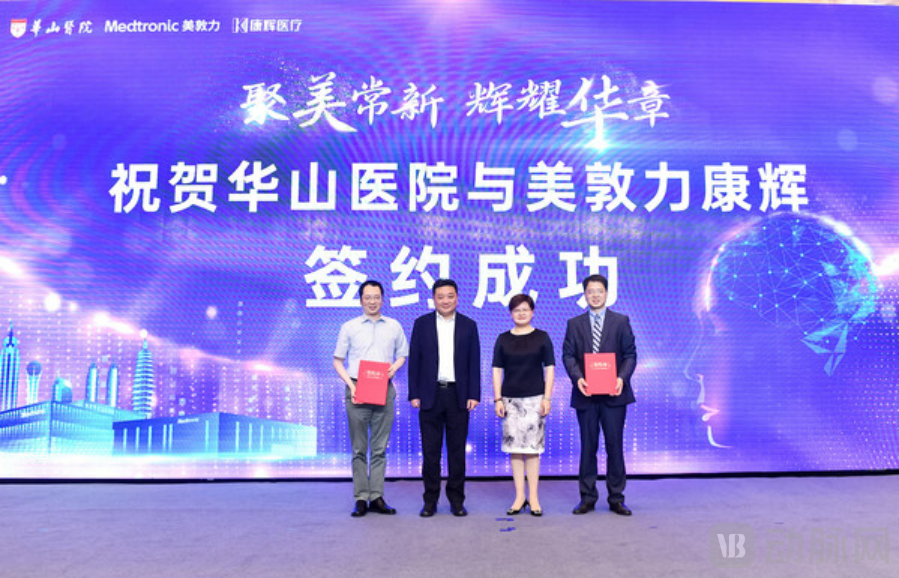 Medtronic Kanghui Signs Strategic Cooperation Agreement with Huashan Hospital Affiliated to Fudan University. Image source: Medtronic
This collaboration represents a complementary choice between “clinical” and “commercial” sectors.
In terms of clinical practice, the neurological diagnostic and therapeutic expertise of Huashan Hospital is self-evident. Its Department of Neurosurgery, established in 1952 with a history spanning over 70 years, has successively been designated as a WHO Collaborating Centre for Research and Training in Neuroscience (1982), a “Priority Discipline” at Fudan University (2001), and a “National Key Clinical Specialty” (2011).
In the commercial arena, Medtronic stands as a global innovation leader in the healthcare sector, boasting extensive professional expertise and a rich ecosystem of innovative resources. Medtronic China’s Orthopedics and Neurosurgery Business Group operates under two major brands in China—Medtronic and Kanghui—focusing on unmet local needs and frequently launching initiatives to empower the industry, thereby demonstrating a strong commitment to industrial enablement.
In addition, Huashan Hospital has jointly established the Center for Translational Research in Precision Medicine for Infectious Diseases with Weiyuan Genomics; co-founded the BNCT Research Institute with Sinopharm Science & Technology Services; and partnered with China Resources Jiuxin to establish the Institute for Pathogen Diagnosis of Drug-Resistant Bacterial Infections and Innovative Drug R&D...
In 2022, Huashan Hospital celebrated its 115th anniversary. At the celebration, leaders of the Shanghai Municipal People’s Government stated in their address that Huashan Hospital currently hosts three National Medical Centers, with certain specialty disciplines leading the nation. The hospital has formed a layout centered on its main campus, driven by its leading disciplines, to promote the expansion of high-quality medical resources and achieve balanced regional distribution, thereby establishing a multi-campus healthcare delivery model encompassing the entire city of Shanghai.
This distinctive hospital is also seizing opportunities to proactively translate its achievements for external application. Whether through advancing specialized clinical research or leveraging specialty-based external collaborations, Huashan Hospital’s innovative endeavors are highly anticipated.