

Insight Technologies Secures Tens of Millions in Angel Funding to Accelerate Commercialization of Solid-State Nanopore Technology for Real-Time Biomolecular Detection and Gene Sequencing

Porespect Technology
Manufacturers of Equipment, Reagents, and Consumables

Forcefield Ventures
Early-Stage Investment Firms
VCBeat has learned that, recently,Guangzhou Insight Technology Co., Ltd. (hereinafter referred to as “Insight Technology”)Announced the completion of a tens-of-millions-yuan angel round of financing. This financing was led byForcefield Ventures (IMO Ventures)Lead Investor,Tiantu CapitalandYayi Capitalco-investment by institutions,Multi-Dimensional CapitalServed as the exclusive financial advisor for this round of financing.

Insight Tech was established in January 2022. Leveraging solid-state nanopore single-molecule detection technology, the company independently develops accurate, rapid, low-cost, and miniaturized equipment for biomacromolecule detection and gene sequencing, along with supporting reagents and consumables. Over the two years since its inception, the company has experienced rapid growth, completed the formation of its core team, built engineering prototypes, and conducted validation tests on a diverse range of samples in substantial quantities. The funds from this financing round will be allocated to the research and development of solid-state nanopore detection devices and the expansion of application scenarios. The company expects to launch a solid-state nanopore sequencer targeting the scientific research market this September.
Nanopore single-molecule detection technology originated from the invention of the Coulter counter and single-channel current recording techniques. Its fundamental working principle involves the translocation of target molecules through a nanoscale pore under an applied voltage in an electrolyte solution, which induces changes in ionic current. Target molecules are identified by recording and analyzing these characteristic current signals. Compared to previous-generation technologies such as Next-Generation Sequencing (NGS), nanopore single-molecule sequencing requires neither labeling nor amplification. It offers long read lengths, high speed, and operational flexibility, thereby addressing the limitations of NGS. This technology significantly improves the detection rate of large or complex structural variants and repetitive sequence variations in genomes, meeting the demands of applications requiring visualization and rapid turnaround. Furthermore, nanopore technology can be extended to RNA sequencing and enables the direct identification of various nucleic acid modifications. Currently, this field is divided into two technical approaches: protein nanopores and solid-state nanopores.
With the proposal of using α-hemolysin for DNA sequencing, protein nanopores have rapidly advanced in the field of sequencing, giving rise to companies such as Oxford Nanopore Technologies (ONT). Biotech giants like Roche and Illumina have also begun to establish their presence in the single-molecule sequencing sector. However, protein nanopores require insertion into phospholipid bilayers and specific polymer substrates to function, posing significant challenges for the integration of protein nanopore chips. Due to the inherent physicochemical properties and fragility of pore-forming proteins, protein nanopores have stringent requirements for solution pH and applied electric fields. They suffer from high current noise, inability to achieve high sequencing accuracy, poor stability of protein nanopore arrays, and high production and storage costs, which keep sequencing costs elevated and, to some extent, hinder their development.
Solid-state nanopores are primarily fabricated from silicon and its derivatives. Compared with protein nanopores, solid-state nanopores offer significant advantages in stability, current noise, and process integration, and are widely recognized within the industry as the future direction of sequencing technology. Furthermore, mass-produced silicon substrates and silicon nitride thin films are low-cost and reusable, holding promise for substantially reducing the per-sequencing cost of nanopore-based methods.
Conventional methods for fabricating solid-state nanopores typically involve using focused ion beams (FIB) or electron beams to bombard silicon-based thin films (such as silicon nitride) to create nanoscale pores. However, FIB/electron beam processing requires skilled operators to manage expensive equipment in a vacuum environment, is time-consuming, and results in relatively large pore diameters. Subsequent appropriate pore-shrinking techniques are required to modify the pore size for sequencing applications. The low fabrication efficiency and high costs have confined solid-state nanopores primarily to research settings, hindering their commercialization.
Solid-state nanopores can also be fabricated using dielectric breakdown, a technique that is simple in principle, rapid in pore formation, and cost-effective. Dielectric breakdown involves applying an electric field to a silicon nitride membrane immersed in an electrolyte solution. When the electric field strength reaches the dielectric strength of the membrane, the material undergoes breakdown, causing a sharp increase in tunneling current. At this point, a nanopore gradually forms, and its diameter can be precisely enlarged by subsequently applying a dynamic voltage.
Notably, this technology has also garnered favor from Oxford Nanopore Technologies (ONT), the leading company in the nanopore sequencing field. In November 2023, ONT made its inaugural acquisition by announcing the purchase of Northern Nanopore Instruments (NNi), a Canadian startup focused on fabricating solid-state nanopores via dielectric breakdown and commercializing related tools. This move marks ONT’s formal entry into the solid-state nanopore sector. ONT’s involvement is sure to ignite industry-wide interest in solid-state nanopores. However, large-scale commercialization of solid-state nanopores still faces several unresolved challenges, such as ensuring the consistency and stability of nanopore diameters, controlling the speed and orientation of DNA translocation through the pores, and training algorithms to improve sequencing accuracy.
Insight Tech was co-founded by multiple PhDs from prestigious institutions such as Stanford University in the United States and Imperial College London in the United Kingdom. Its founding team comprises pioneering scholars in the field of solid-state nanopore fabrication and detection. Recognizing the bottlenecks associated with ion beam/electron beam processing techniques in large-scale mass production, the team chose from the outset toHole-Drilling Process via Dielectric Breakdown. After years of exploration,Successfully overcame technical barriers such as reducing the aperture of dielectric breakdown pores, precise pore enlargement, and pore stabilization. Using a self-developed drilling program, solid-state nanopores ranging from 1.2 nm to 100 nm can be stably produced with a precision of 0.1 nm., and has already established small-scale mass production capabilities ranging from chip design and fabrication to nanopore drilling. Building on precise control of solid-state nanopore diameters, Insight Technology combines physical velocity-control methods,Single-base signal differences have been successfully identified, and algorithm models are currently being trained to improve sequencing accuracy.
Furthermore, the customizable pore size of solid-state nanopores and the technical advantages that confer ultra-high sensitivity enable this technology to achieve rapid and precise detection of various samples, including antigens or antibodies, neurotransmitters, and viral particles in different matrices. We anticipate that Insight Technology’s solid-state nanopore system will evolve into a highly scalable detection platform, offering next-generation direct-reading solutions for genes, proteins, and viruses, thereby making lower-cost, faster, and more accurate diagnostic products accessible to a broader range of end users.
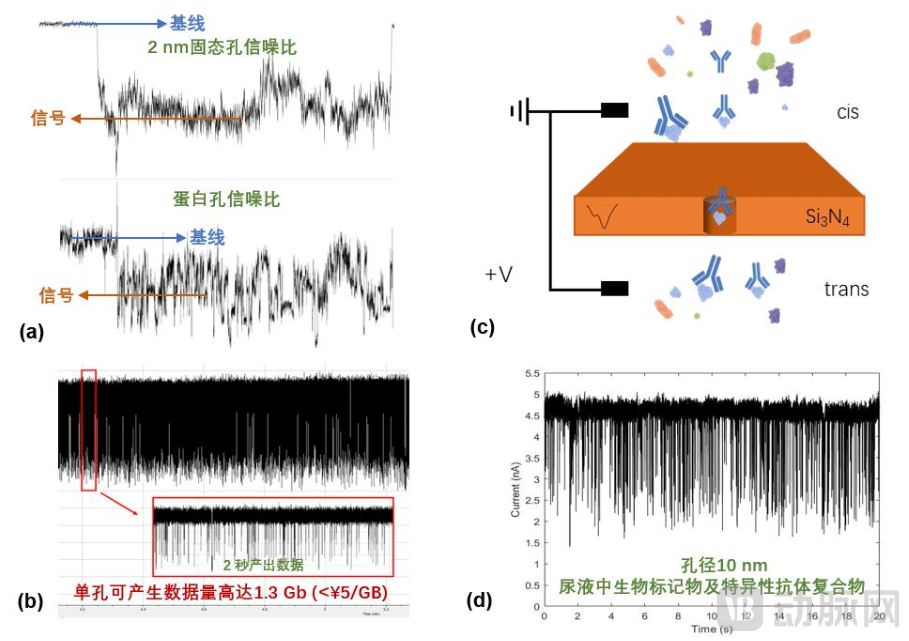
Solid-State Nanopore Detection of Single-Stranded DNA (a, b) and Antigen-Antibody Complexes (c, d)
Mr. Feng Xiaowen, Partner at Forcefield Ventures (IMO Ventures)Statement: We firmly believe that the greatest opportunity of this century will inevitably arise from the mutual advancement of AI and biology, with biomacromolecular information—including nucleic acids and proteins—serving as the foundational data driving the transformation of life sciences into life engineering. As a platform technology, solid-state nanopores hold immense transformative potential, whether applied in gene sequencing, protein sequencing, direct detection, or even as readers for future DNA hard drives. As an angel investor focused on insightful technologies, IMO Ventures is highly optimistic about the team’s long-term research accumulation and continuous innovation capabilities in solid-state nanopores. We look forward to rapid, accurate, and low-cost solid-state nanopore technology becoming the most reliable and efficient “shovel” for mining biological information in the near future.
Mr. Wei Guoxing, Partner at Tiantu CapitalIt is our belief that the efficiency of reading and writing biological information is a fundamental challenge in the biotechnology era. Insight Technology’s solid-state nanopore sequencing technology offers a concise, elegant, convenient, and cost-effective solution, holding immense commercial potential in fields such as DNA sequencing and protein detection. TIANTU CAPITAL is delighted to have partnered with Insight Technology at the angel investment stage, and we look forward to the company steadily emerging as a representative of new quality productive forces in the life sciences tools sector.
Project Lead, Yayi CapitalWe believe that the widespread adoption and decentralization of sequencing technologies necessitate the emergence of accurate, rapid, low-cost, and miniaturized sequencing platforms. Nanopore sequencing represents the latest generation of sequencing technology, and its market share continues to grow as the technology advances. The founding team of Insight Technology has achieved international leadership in multiple aspects of solid-state nanopore sequencing. We are confident in the team’s ability to sustain innovation and rapidly advance this technology. We eagerly anticipate the early large-scale commercial deployment of the company’s solid-state nanopore products in both research and clinical settings.
About IMO Ventures
IMO Ventures is an early-stage investment firm dedicated to technological innovation, with a portfolio spanning emerging sectors such as artificial intelligence, biopharmaceuticals, fintech, and new consumption. Its investment footprint covers China, the United States, Southeast Asia, Latin America, Africa, and other regions. The IMO investment team combines entrepreneurial spirit with extensive experience, possessing a deep understanding of the challenges and rewards of startup ventures, and firmly believes that computing power will transform the world. The firm currently manages four U.S. dollar funds, one RMB fund, and several specialized funds. Notable early-stage investments include disruptive innovators in their respective fields, such as Guazi Used Cars, XtalPi, Deephi Technology, Paytm, Conflux, and Lime.
About TIANTU CAPITAL
Founded in 2002, Tiantu Capital is one of the earliest professional equity investment firms in China. Adhering to a path of in-depth research and specialization, it boasts a professional investment and research team of dozens. To date, its assets under management exceed RMB 25 billion, with investments in over 200 companies, including more than 20 in the life sciences sector. Its investment portfolio includes Zhuozheng Medical, Phoenix Healthcare, Xbiome, ZuoDian, Boya Biopharma, Higo Bio, Limang Biotech, China Feihe, Nayuki’s Tea, Pagoda, Xiaohongshu (Little Red Book), and AiHuiShou.
About Yiyi Capital
Yayi Capital was established in 2018, with key investment areas including artificial intelligence, life sciences, and synthetic biology. Its investment targets primarily originate from universities and research institutions in major scientific hubs such as Boston and Shenzhen, including the Massachusetts Institute of Technology (MIT), Harvard Medical School, the Broad Institute, the Dalian Institute of Chemical Physics, and the Shenzhen Institutes of Advanced Technology of the Chinese Academy of Sciences. The fund’s investment strategy focuses on early-stage incubation, leveraging its accumulated industry resources and years of practical experience in legal, financial, and other aspects gained from facilitating the implementation of early-stage projects in both China and the United States. This approach accelerates the growth of startups and helps them navigate the “valley of death” during their initial phases.
About Multi-Dimensional Capital
Multi-Dimensional Capital was established in 2016 with the vision of “empowering global entrepreneurs to grow from zero to infinity.” As an industrial investment bank with a global perspective, it has successfully executed numerous cross-border M&A transactions. Its current business scope covers private equity financing advisory, M&A restructuring and incubation, investment and asset management, as well as industrial development and implementation. Since its inception, Multi-Dimensional Capital has assisted over 150 new economy and industrial group companies in completing more than 200 private financing transactions, with a cumulative transaction value exceeding USD 50 billion, and has managed seven industrial investment funds.