

Alzheimer's Disease Market at a Crossroads: New Lipid-Based Pathogenesis Theory Challenges Established Paradigms
Recently,Stanford University School of Medicine’s Tony Wyss-Coray TeamResearch has found that the root cause of Alzheimer's disease may beLipid Accumulation in Brain Cells. The team stated that genes involved in lipid processing and transport—APOE, particularly APOE4—are closely associated with the abnormal accumulation of lipid droplets in microglia in Alzheimer’s disease, a finding that may open up new avenues for the prevention and treatment of Alzheimer’s disease.
As of March 13, 2024, this study has beenAPOE4/4 is linked to damaging lipid droplets in Alzheimer’s disease microgliapublished in the journal Nature.
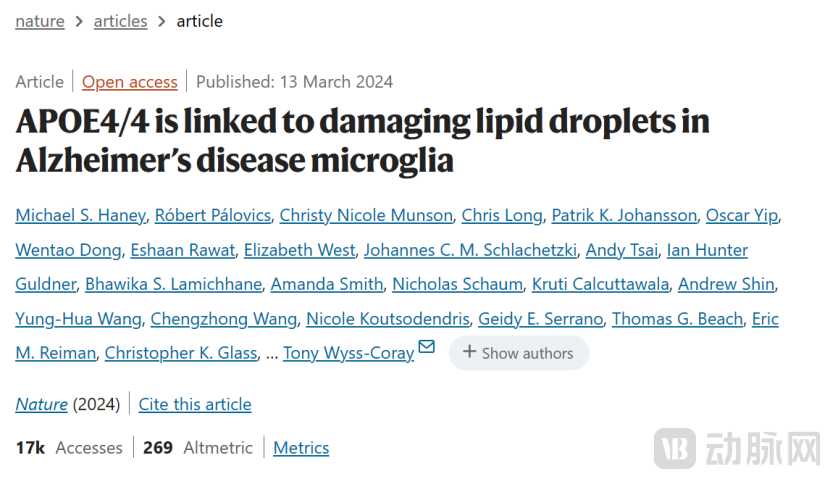 Paper screenshot (Image source: Nature)
I. Continuation of LDAM Research
In fact, there were early indications of this groundbreaking discovery by Tony Wyss-Coray’s team.
In 2020, the team discovered in the brains of mice and humans that lipid droplets accumulate significantly in microglia as the brain ages. They named these cellsMicroglia with Lipid Droplet Accumulation(lipid-droplet-accumulating microglia, hereinafter referred to as LDAM). These LDAMs exhibit impaired phagocytic function, produce high levels of reactive oxygen species, and secrete pro-inflammatory cytokines. Furthermore, RNA sequencing analysis of LDAMs revealed a transcriptional profile driven by innate inflammation, distinct from previously reported microglial states.
At that time, Professor Tony Wyss-Coray proposed that LDAM might contribute to age-related and genetic forms of neurodegeneration. The research findings published in 2024 represent a continuation of this work.
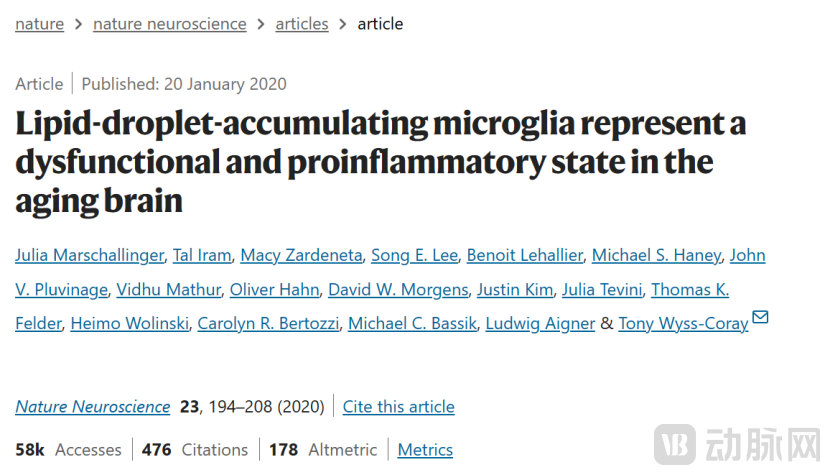 Screenshot of the paper (Image source: Nature)
Furthermore, a study by Dylan Williams’ team at University College London also provides indirect validation of the findings from Tony Wyss-Coray’s team.
The team led by Dylan Williams previously studied and documented the APOE variants carried by individuals and tracked their health records. They found thatIndividuals carrying one or two copies of other genetic variants are nearlyFour copies of the APOE2 gene variant。
II. AD Drugs Approved Based on Three Mainstream Hypotheses
The pathogenesis of Alzheimer's disease remains a subject of considerable debate, with three prevailing hypotheses currently dominating the discourse:Amyloid-β Cascade Hypothesis, Abnormal Tau Phosphorylation Hypothesis, Cholinergic Hypothesis。
1The Amyloid Cascade Hypothesis
The amyloid-beta (Aβ) cascade hypothesis is currently the most widely accepted theory. In 1991, John Hardy and David Allsop proposed that extracellular Aβ (beta-amyloid) in the cerebral cortex constitutes the core component of senile plaques in the brains of patients with Alzheimer’s disease, and that its deposition represents the central mechanism underlying disease pathogenesis.
In 2023,FDA Approves First New Drug for Alzheimer’s Disease (AD)Leqembi (generic name: Lecanemab) Market Launch. It is reported that the drug exerts its therapeutic effect by reducing the accumulation of amyloid-beta (Aβ) in the brain. As the world’s first breakthrough targeted therapy addressing the underlying cause of Alzheimer’s disease (AD), Lecanemab sets a precedent for the development of similar Aβ-targeting disease-modifying therapies for AD.
In January 2024, the drug was approved by the National Medical Products Administration (NMPA) for official launch in China, indicated for the treatment of mild cognitive impairment due to Alzheimer’s disease and mild dementia due to Alzheimer’s disease.
2Tau Protein Abnormal Phosphorylation Hypothesis
In 1993, a team of neuroscientists at Duke University in the United States, led by Warren Strittmatter, proposed the hypothesis of abnormal Tau protein modification. The team posited that the abnormal formation of neurofibrillary tangles by Tau protein triggers Alzheimer’s disease (AD). Given the correlation between amyloid-beta (Aβ) and Tau protein, the scientific community believes that these two molecular mechanisms jointly mediate the pathogenesis of AD.
No Tau protein-targeted drugs for Alzheimer’s disease have been approved to date, yet many companies are still charging toward this target.
In April 2023, Takeda and Treventis entered into an exclusive licensing agreement, under which Treventis will receiveUp to $372.5 millionresearch funding to further investigate, develop, and commercialize small-molecule drugs targeting tau protein for Alzheimer’s disease (AD). Furthermore, as of April 2023, more than 20 tau-targeting therapeutics were undergoing clinical trials.
3Cholinergic Hypothesis
The cholinergic hypothesis was the earliest theory attempting to explain the pathogenesis of Alzheimer’s disease (AD). In 1971, Deutsch demonstrated through animal experiments that the cholinergic system is involved in the formation and storage of memory. Subsequently refined by other researchers, this hypothesis posits that cholinergic impairment leads to deficits in memory and cognitive function in patients, which constitute the behavioral manifestations of AD.
Based on this theory, the largest number of AD drugs have been approved. In 1994, Academician Tang Xican’s team developed huperzine A, a reversible cholinesterase inhibitor, for the treatment and delay of AD progression.
In addition, as of 2022, the FDA had approved six Alzheimer’s disease (AD) drugs that work by inhibiting acetylcholinesterase, including donepezil, rivastigmine, and galantamine.However, clinical outcomes indicate that these drugs merely delay disease onset and have limited therapeutic efficacy in the treatment of Alzheimer's disease.
III. Repeated Failures in AD Drug Development, Yet Big Pharma Continues to Invest
In addition to Eisai and Biogen, major pharmaceutical companies such as Eli Lilly and Roche have not relaxed their R&D efforts on Alzheimer’s disease (AD) drugs.
In 2023,Eli Lilly’s Alzheimer’s disease treatment drug donanemab has entered Phase III clinical trials.From a mechanistic perspective, both Donanemab and Leqembi exert their therapeutic effects by clearing amyloid-beta (Aβ) plaques. In July and October 2023, Eli Lilly submitted marketing applications for Donanemab to the U.S. Food and Drug Administration (FDA) and China’s National Medical Products Administration (NMPA), respectively. The drug is poised to become the next-generation approved therapy following Lecanemab.
In addition,Eli Lilly is also developing the next-generation Aβ monoclonal antibody LY3372993, targeting the pyroglutamate modification at the third amino acid of amyloid-β peptide found exclusively in cerebral amyloid plaques, has now entered clinical development.
Compared with Eli Lilly, Roche’s path to developing Alzheimer’s disease (AD) drugs has been less smooth. In 2024, Roche, which had suffered repeated setbacks in clinical trials,Announced the discontinuation of the development of crenezumab, an anti-amyloid-beta monoclonal antibody, and semorinemab, a monoclonal antibody targeting Tau protein.
However, Roche has retained its Aβ-targeted trontinemab pipeline. According to Roche’s report, trontinemab reduces amyloid levels more rapidly than Biogen’s therapy.
Furthermore, domestic pharmaceutical companies are also making strategic moves in the research and development of Alzheimer’s disease (AD) therapeutics. In March 2023,Hengrui MedicineIt was announced that the first patient has been enrolled and dosed with SHR-1707, an anti-Aβ monoclonal antibody, at the First Affiliated Hospital of University of Science and Technology of China. Reportedly, this is the first fully independently developed anti-amyloid antibody in China.
In addition to these three mainstream hypotheses regarding the pathogenesis of Alzheimer’s disease (AD), researchers are actively exploring other potential mechanisms, including neuroinflammation, excitotoxicity due to glutamatergic system dysfunction, and mitochondrial impairment. Only by achieving a more comprehensive understanding of the pathogenesis of AD can effective prevention and treatment strategies be developed.