

Philips Wins China Medical Equipment 'Golden Figure Award' for the 11th Time: Driving High-Quality Healthcare Through Innovation, Quality Control, and Service Excellence

Philips
Healthcare Service Provider
From March 15 to 17, the 14th China Medical Equipment Industry Data Release Conference and China Medical Industry Development Forum 2024, hosted by China Medical Equipment Magazine, was held in Beijing. The highly anticipated “China Medical Equipment Industry Data Survey Report” was released concurrently.
Global Health Technology Leader Royal Philips Wins the 2023 “Golden Man Award for Excellence” in China’s Medical Device Industry
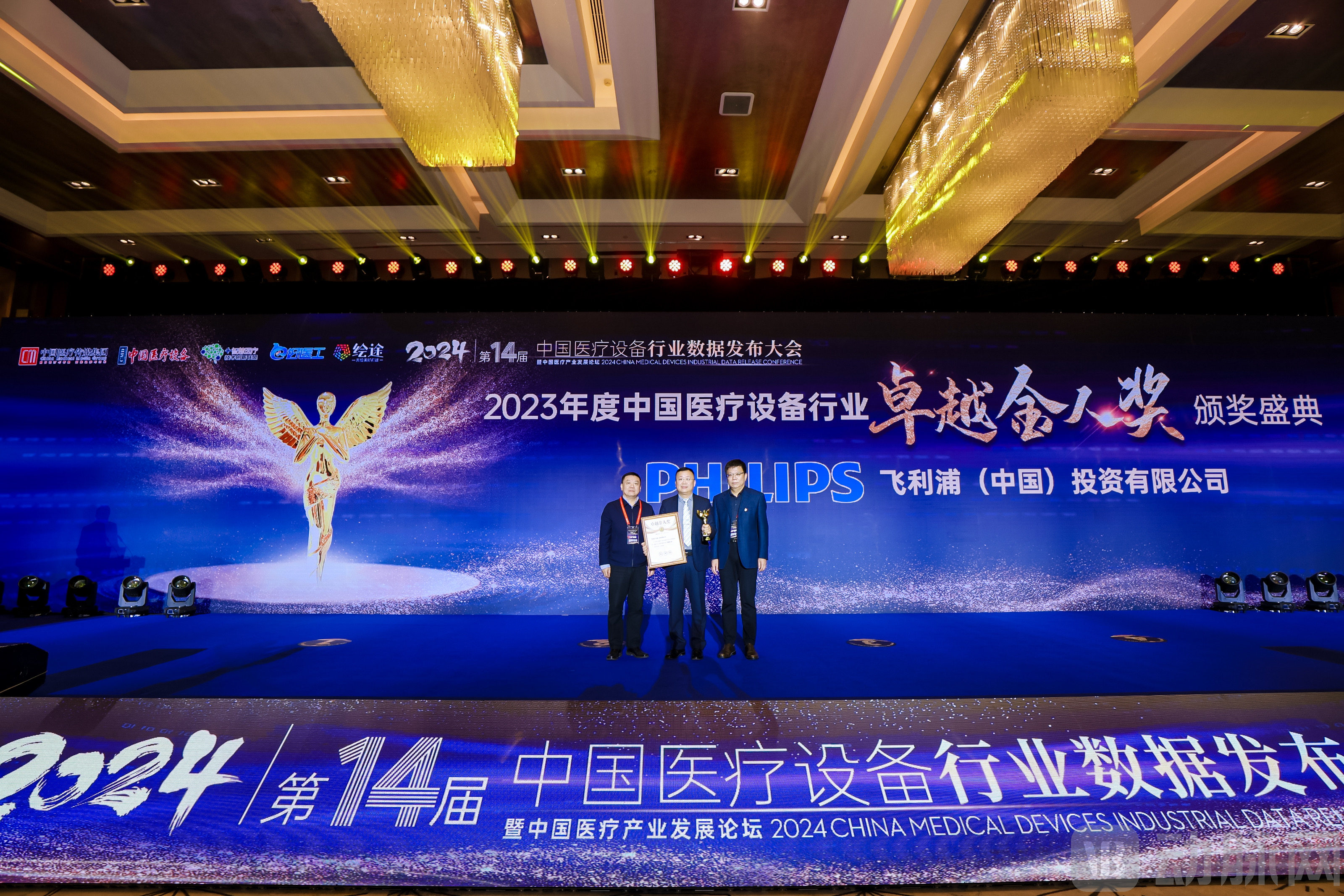
It is worth noting that since China Medical Devices established this award in 2010, Philips has won the “Excellent Golden Man Award” for the 11th time, demonstrating its comprehensive brand service strength and market recognition.
What Has Philips Done Right Behind Its Frequent Award Wins? As 2024 Unfolds, What New Pathways and Trends Will Philips Explore for Patients and Customers? To Delve into the Reasons for Philips’ Strong Market Recognition, VCBeat Conducted an Exclusive Interview withLin Jianping, General Manager of Philips Healthcare Services DivisionMr.
At this conference, Philips achieved significant success, not only winning the “Golden Man Award for Excellence” in China’s medical equipment industry for the 11th time, but also receiving corporate awards such as the 2023 “Social Responsibility Award,” “Outstanding Imported Brand Award,” and multiple “No. 1 Product Line” honors, as well as individual accolades including the “Excellent Manager Award” and “Outstanding Manager Award.”
This achievement represents the culmination of Philips’ long-standing expertise in the medical equipment sector, as well as a strong endorsement from the Chinese market of the professionalism and service capabilities of the Philips team. Since entering the Chinese market in 1923, Philips has leveraged its innovative and cutting-edge technological advancements to witness the continuous progress of healthcare in China while leading the wave of technological innovation within the domestic medical industry. Lin Jianping stated, “Philips remains committed to being ‘patient-centric,’ aiming to provide Chinese patients with more high-quality products and services.”
Regarding how to achieve high-quality medical services, Lin Jianping emphasized three aspects, namely:Sustained technological innovation capabilities, a rigorous product standardization and quality control system, and an after-sales service team with rapid response capabilities。
As a technology-led company, Philips envisions a healthier and more sustainable world through meaningful innovation. “The emergence of AI has unlocked greater possibilities for our services,” said Lin Jianping. He highlighted that Philips places significant emphasis on the innovative integration of AI technologies with medical devices, achieving disruptive breakthroughs and widespread application across multiple product lines.
In February 2024, Philips announced a remarkable breakthrough in medical technology, officially launchingLumiGuide Radiation-Free Imaging SolutionThis solution leverages AI-based recognition technology, eschewing traditional X-rays in favor of optical principles to provide vascular navigation for physicians. It enables real-time 3D visualization of interventional devices within the body, earning it the vivid moniker “light-driven 3D human GPS.” This technology represents the culmination of Philips’ decades of expertise and technological innovation in optics, medical devices, and image guidance, holding the promise of ushering in a new wave of transformation for the medical imaging industry.
If we sayWhile technological innovation enables Philips to move fast, its rigorous quality control system is the core reason why Philips performs well.. The medical industry is critical to life safety, imposing extremely high requirements on the safety and stability of medical devices, thereby challenging manufacturers' product quality control capabilities.
Upholding the “people-centric” service philosophy, Philips has established dedicated departments and standardized processes to ensure the stability of product development and quality control. This management authority extends beyond Philips’ own products to third-party products within the Philips medical technology ecosystem, treating them with equal rigor. Every third-party system in the ecosystem must pass Philips’ review standards before it can be integrated and delivered.
Finally,A Post-Sales Professional Service Team with Rapid Response Capabilities: The Foundation of Philips’ Long-Term Success. To provide efficient and accurate after-sales service, Philips has assembled a team of nearly 1,000 engineers and, leveraging 5G technology, pioneered the establishment of an industry-first remote service engineer team to deliver timely maintenance, upkeep, and repair services to customers.
In 2023, Philips launchedFeiyilian 5G Remote Service SolutionBy leveraging remote monitoring and AI-driven analytics, we establish predictive maintenance models for medical equipment. Integrated with operational data, this approach enables comprehensive equipment support—including fault early warning, preventive maintenance, and functional upgrades—thereby safeguarding customer interests and patient safety.
Lin Jianping stated that with the iterative updates of information and communication technologies, remote service models will become a major trend in the maintenance of medical devices. Taking Feiyilian as an example, it demonstrates significant advantages in the timeliness of technical support and troubleshooting, as well as in cost reduction and efficiency enhancement for routine maintenance and upkeep. Furthermore, this solution enables the accumulation of remote service data, providing data support for the balanced allocation of medical resources.
“As equipment manufacturers, Philips service engineers have a natural advantage, with solid equipment knowledge and extensive maintenance experience, providing customers with the quality assurance of original factory services.” Lin Jianping revealed that in 2024, Philips will further enrich the product services of Feiyilian (Philips Healthcare Connect), continue to practice remote mobile technology, and constantly launch differentiated products to benefit the industry.
In addition to quantifiable metrics such as stock price, market capitalization, and revenue, as well as key elements like core technologies and R&D capabilities, a crucial indicator for assessing a company’s value is its organizational strength aligned with strategic growth. From this perspective, Philips, leveraging its “diverse and inclusive” corporate environment,Certified as a “Top Employer China” by a globally recognized authoritative professional organization for three consecutive yearsTitle, reflecting the industry's high recognition of Philips in organizational capability building.
Philips adheres to its “people-first” philosophy. Over decades of accumulation, it has established a comprehensive service quality management system, encompassing a robust personnel training and management model and a mature engineer talent pipeline development framework. This system provides employees with diverse growth pathways and career plans with significant development potential.
Among these initiatives, the cross-product-line engineer role represents an innovative approach by Philips to talent development. Once engineers have fully mastered the skills required for one product line, they can proceed to acquire knowledge and engage in practical service delivery across other product lines. This model not only enhances engineers’ comprehensive professional capabilities but also benefits business operations by enabling effective allocation of engineering resources across Philips’ various product lines. Consequently, it improves customer experience, ultimately delivering better care to patients and achieving a win-win outcome that encompasses patient benefit, customer success, business growth, and individual professional development.
“Only by stimulating employees’ enthusiasm for growth and cultivating their proactive service mindset can we deliver more professional and higher-quality products and services,” said Lin Jianping. He stated that Philips will continue to iterate and upgrade its training system in the future, expanding engineers’ skills across multiple product lines, enhancing interaction among employees through the establishment of sharing platforms, and strengthening team cohesion. Guided by a physician- and patient-centric philosophy, Philips is also continuously creating comprehensive upgrades in medical equipment and services for its customers.The recently launched “Heart Renewal” initiative is a comprehensive empowerment solution integrating medical equipment and services.
Lin Jianping noted that in 2023, China’s healthcare market witnessed significant trends, including major breakthroughs in AI technology and increasingly diverse customer demands. As the medical device market continues to expand, more innovative enterprises will emerge, bringing new products to market. For Philips, this presents both challenges and opportunities.
“Localization” has become Philips’ breakthrough strategy. On one hand, Philips has launched its “Smart Manufacturing in China” initiative by establishing production bases in Suzhou and Shenzhen to achieve localized product manufacturing. On the other hand, positioning China as a global source of innovation, Philips embraces “Innovation in China” by deploying three major innovation centers in Suzhou, Shanghai, and Shenzhen to conduct independent research and development and upgrades for its four core business segments.
From traditional transactional relationships to a focus on local innovation, local manufacturing, and local services in China, and further to collaborative innovation with the local ecosystem, Philips has become an integral part of China’s healthcare industry after a century of presence in the country.
Amid the fertile ground of China’s medical device industry, what moves Philips will make next is worth anticipating.