

WuXi Biologics Commits $1.4 Billion to Integrated CRDMO Hub in Singapore Amid Global Expansion Push
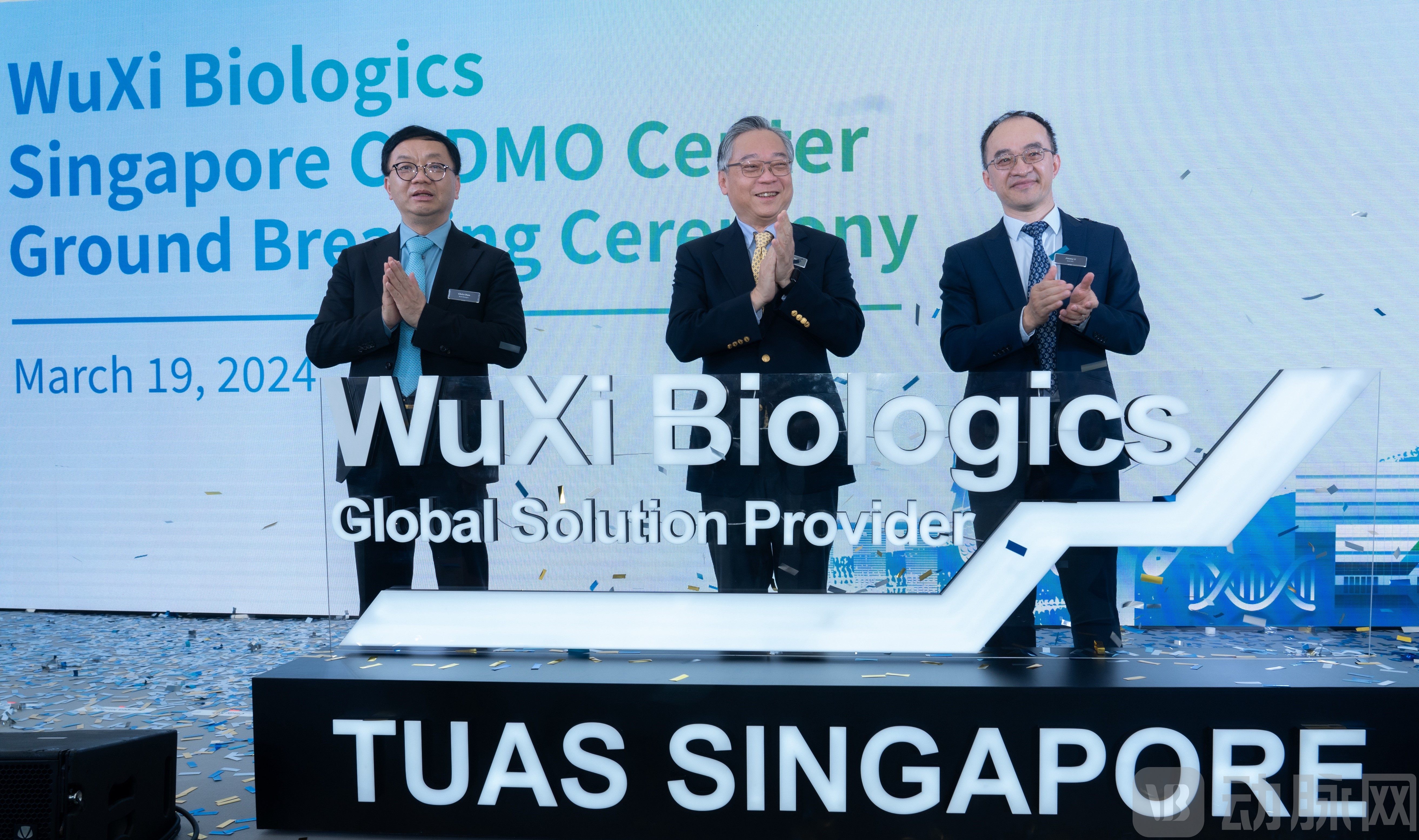
On March 19, WuXi Biologics announced the groundbreaking of its integrated CRDMO center at the Tuas Biomedical Park in Singapore, marking the official commencement of construction.
In 2022, WuXi Biologics announced plans to invest $1.4 billion (approximately RMB 10.1 billion) in building an integrated CRDMO center in Singapore.Upon completion, the center will provide integrated research, development, and manufacturing services for biological drugs. The facility covers an area of 13.5 hectares, with a planned design capacity of 120,000 liters, and will create 1,500 jobs.
This also marks WuXi Biologics’ first move to establish its first large-scale overseas CRDMO facility in Asia.In 2018, WuXi Biologics invested S$80 million (approximately RMB 380 million) to establish a modern biopharmaceutical production base in Singapore as an initial venture. The facility includes bioprocess development laboratories and has the capacity for clinical sample production and small-scale commercial manufacturing.
Since 2024, WuXi Biologics has officially announced its overseas production base construction and capacity expansion plans for the second time.
In January, WuXi Biologics announced an expansion of its production capacity at its Massachusetts facility in the United States, adding 12,000 liters of commercial bulk drug substance capacity to the originally planned 24,000 liters. The Worcester site covers an area of 189,500 square feet, is scheduled to officially commence operations in 2025, and will begin GMP manufacturing in 2026.
Public information indicates that WuXi Biologics had a planned production capacity of 430,000 liters in 2024 and expects its capacity to double from the end of 2023 to reach 588,000 liters by 2026. Under its capacity expansion plan, nearly all new capacity is located overseas: 120,000 liters in Singapore, 30,000 liters in the United States, 30,000 liters in Ireland, and 15,000 liters in Germany.
In retrospect, WuXi Biologics’ extensive overseas production capacity layout enables compliance with local regulations and helps balance geopolitical impacts. To some extent, this may serve as a “fallback option.”However, the expansion of the global R&D and production network is a strategic long-term endeavor. As early as the 2018 earnings conference, WuXi Biologics officially announced its “Global Dual-Plant” strategy. It can be inferred that internal implementation of this plan began even earlier, given that WuXi Biologics had already established 11 production facilities worldwide at that time.
According to public reports, the so-called "Global Dual-Source Manufacturing" strategy refers to an arrangement whereby partners contracting with WuXi Biologics can choose any two of its commercial manufacturing sites in China, Europe, and the United States. This approach ensures global product supply while eliminating the risks associated with technology transfer between different suppliers.
This is determined by the commercial manufacturing model adopted by multinational biopharmaceutical companies. Due to the significant complexities associated with biologics manufacturing, multinationals typically engage two manufacturers for commercial production partnerships. This is because any supply disruption at a biologics manufacturing facility could take 8–9 months or even up to a year to resolve, severely impacting drug availability. For large pharmaceutical companies, it is common practice to establish internal manufacturing facilities as the primary supply chain, thereby retaining control over key markets, while external CDMOs serve as supplementary partners to support production.
WuXi Biologics CEO Chen Zhisheng explained that the company has shifted its strategy to provide partners with both primary and secondary supply chains, known as the “Global Dual-Source Manufacturing” strategy. As both manufacturing sites are operated by WuXi Biologics, the difficulty and risks associated with internal technology transfer are significantly reduced.
Guided by this business model strategy, WuXi Biologics has continuously expanded its overseas production capacity in recent years. In Europe, the Dundalk facility in Ireland commenced operations in 2021; its subsidiary, WuXi Heiden, established an integrated vaccine manufacturing facility in Ireland. In 2020 and 2021, WuXi Biologics acquired Bayer’s biologics manufacturing plant in Leverkusen, Germany, and its drug substance facility in Wuppertal, respectively. The two German sites are only a 30-minute drive apart, perfectly exemplifying the synergies under its “Global Dual-Plant Production” strategy.
In the United States, WuXi Biologics has established production facilities in the biopharmaceutical hubs of Massachusetts, New Jersey, and Pennsylvania, which commenced operations in 2020 and 2021, with the third facility expected to become operational in 2026. In 2023, its Boston Research and Development Center also officially began operations.
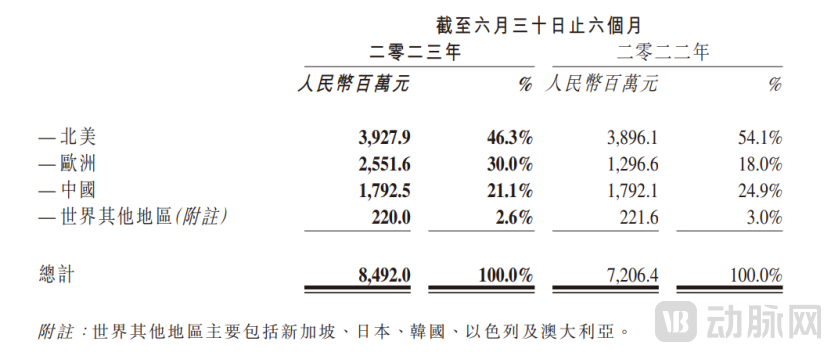
Amid the combined impact of its “Global Dual-Plant Production” strategic layout and the dividend period for CXOs, WuXi Biologics has entered a phase of rapid growth. In terms of sales revenue, WuXi Biologics’ global market share increased from 2.4% in 2017 to 12.8% in 2022. According to WuXi Biologics, its market share in Europe is expected to rise gradually. The company’s interim performance report for the first half of 2023 shows a significant increase in the proportion of revenue from Europe, which grew from 18.0% in the first half of 2022 to 30%, indirectly validating the feasibility of the “Global Dual-Plant Production” strategy.
In the first half of 2023, WuXi Biologics experienced a significant slowdown in growth, with a year-on-year increase of only 17.84%. Additionally, net profit declined by 10.81% year-on-year due to the revenue gap resulting from the end of the pandemic. Whether compared to its own 48.4% year-on-year revenue growth in 2022 or to Samsung Biologics’ approximately 36.5% year-on-year revenue growth, these figures suggest that WuXi Biologics has entered a period of slower growth.
Taking the integrated CRDMO center in Singapore and the Worcester site as examples, the Singapore center will provide 1,500 jobs, while the full operation of the Worcester site will increase WuXi Biologics’ U.S. workforce from 400 to approximately 600 employees. Global expansion and the establishment of overseas facilities inevitably lead to higher operational and personnel costs. The era of benefiting from a surplus of CDMO engineers has passed.
In the early stages, a large number of CDMO companies, represented by WuXi Biologics, rose to prominence by leveraging competitive advantages such as cost efficiency, the engineer dividend, flexibility, high operational efficiency, and customized customer solutions. These companies adopted a business model characterized by “attracting clients through the engineer dividend and securing orders via high returns on fixed asset investments.”
As a leading CDMO in China, WuXi Biologics has long undergone transformation and business upgrading. When entering the industry, WuXi Biologics adopted single-use bioreactor technology to establish differentiated advantages, offering greater flexibility and safety, and introduced large-scale commercial production.
From “Follow-the-Molecule” to “Follow and Win the Molecule,” biopharmaceutical startups have become a significant source of clients for WuXi Biologics. By focusing on end-to-end service demands and building an open, integrated biologics capability and technology-enabling platform, the company is better positioned to meet the increasingly stringent cost-control requirements of today’s startups.
An examination of WuXi Biologics’ construction of two major overseas facilities in 2024 further demonstrates the continuity of its CRDMO and end-to-end service strategy. Upon completion, the integrated CRDMO center will become Singapore’s first comprehensive CRDMO base dedicated to end-to-end biologics services, offering integrated research, development, and manufacturing capabilities. Meanwhile, the Worcester facility is primarily adding commercial-scale production capacity. Together with the company’s first Research Center (Boston), which officially opened last year, the clinical manufacturing site in New Jersey, and the process development and characterization laboratory in Pennsylvania, these assets form a comprehensive system covering biologics discovery, development, clinical production, and commercial manufacturing.
On the business front, WuXi Biologics’ unique model has fostered a pronounced long-tail customer profile. While the compound annual growth rate (CAGR) of revenue from its top ten customers reached 52.3% between 2014 and 2022, their share of total revenue declined from 65.1% in 2014 to 40.8% in 2022. The customer base has become more diversified, with average revenue per long-tail customer rising year over year. This trend reflects deepening customer trust and the progression of early-stage clients into later-stage and commercial phases, gradually evolving into more substantial revenue sources.
In the 2024 Annual Healthcare Conference Briefing recently released by WuXi Biologics, it was pointed out thatIn 2023, the company added 132 comprehensive projects, including 41 new projects in December, with the monthly increase exceeding expectations.Furthermore, the company disclosed that the number of new projects saw a strong recovery in the second half of 2023, with non-COVID-related new projects reaching a historic high. By region, North America contributed approximately 55% of the new projects, while the proportion of new projects from China rebounded significantly to 25%. The most active areas of collaboration were in hot sectors such as antibody-drug conjugates (ADCs) and bispecific/multispecific antibodies.
In 2022, WuXi Biologics added 136 comprehensive projects, exceeding its original target of 120 new projects.
References:
China-South Korea CDMO: An Inevitable Showdown or Separate Spheres? - VCBeat (vbdata.cn)
[Dialogue with the CEO] Net Profit Surges 149.6%; WuXi Biologics Reveals Its Exclusive Market Strategy for the First Time
Behind the Addition of 41 New Projects in a Single Month, Why Has WuXi Biologics Become the First Beneficiary of the Biotech Recovery?