

Don't Miss the Window: Why Medical Innovation Companies Must Enter the Middle East Now
A sense of urgency is emerging among a growing number of medical innovation enterprises.
“"In recent years, the industry has become increasingly competitive, and our pressure has also grown significantly."“Fan Lingxin, Marketing Director at a pharmaceutical company with 15 years of experience in the industry, told VCBeat, ‘On one hand, there is severe homogenization of drug pipelines among domestic pharmaceutical companies, leading to intense competition; on the other hand, prices have dropped significantly after pharmaceutical and medical device products were included in the national centralized volume-based procurement for medical insurance coverage, putting pressure on corporate profits.’”
Faced with challenges, numerous medical innovation companies have begunPin hopes for performance growth on overseas expansion.
How Attractive Are Overseas Markets? Taking PD-1 as an Example, a Domestic Manufacturer’s Annual Sales of Its PD-1 Drug Reached Approximately $600 Million, Representing the Peak Performance for This Product Pipeline; However, Merck’s Keytruda Achieved Annual Sales of $14 Billion.The gap between the two is more than 20-fold.
The massive incremental market opportunity has allowed medical innovation enterprises to see the outline of a compelling business narrative. As Cai Daqing, Founding Managing Partner of Sherpa Capital, stated at a conference, going global is a strategic imperative that both biopharmaceutical and medical device companies must prioritize.
However, it is important to recognize that"Going global" is not as simple as selling products from China to overseas markets; it requires careful selection of opportunities, locations, and timing.“In the past few years, expanding into Southeast Asia was all the rage; while”The Past Two Years Have Been an Opportune Time for Expanding into the Middle East.” Sun Yingxue, an industry investor, stated, “I often tell the companies we have invested in,It’s Already Too Late to Expand into the Middle East。”
Why Has the Middle East Become the Latest Hotspot for Medical Innovation Companies Expanding Overseas?
Selecting target markets has always been a challenge for medical innovation companies expanding overseas.
Whether in developed markets such as Europe and the United States, or in emerging markets like Southeast Asia and the Middle East, the difficulty of international expansion varies due to differences in local policies, cultural contexts, and economic development levels. For instance, as a hub for countries along the Belt and Road Initiative, Southeast Asia boasts advantages such as geographical proximity, convenient transportation, and cultural similarities; however, its pharmaceutical industry chain remains incomplete.
“Selecting the wrong destination can have a significant impact on a company. This not only results in wasted expenditure but may also undermine the company’s overall strategy.“The aforementioned pharmaceutical company’s Marketing Director, Fan Lingxin, stated.”
Therefore, inFor a considerable period in the past, the Middle East market received little attention from Chinese enterprises.“The Middle East has long been stereotypically associated with traditional energy, religious influences, and conflict. In the past, Chinese companies operating in the region were predominantly state-owned enterprises engaged in conventional sectors such as infrastructure development and real estate,” added Fan Lingxin.
How Did the Middle East Suddenly Become a Hotspot, Attracting Medical Innovation Startups in Droves?
“Based on my observations,Chinese medical and health enterprises began expanding into the Middle East in 2020 and 2021.“One prominent example is BGI Genomics. At that time, under the impact of the pandemic and led by government authorities, BGI Genomics helped establish numerous nucleic acid testing facilities and related laboratories in the region, assisting the Middle East in navigating through difficult times,” Shawn Choi, Executive Director of Meddcom, told VCBeat.
Subsequently, in early 2023,Middle Eastern sovereign wealth funds have been successively establishing offices in China, providing new channels for engagement with the Middle East.Meanwhile,Chinese Capital Begins Fundraising in the Middle East, deepening exchanges between the industries in the two regions. In this regard, VCBeat, in its “Middle Eastern Capital “Pours Into” China’s Healthcare Sector: Aggressive Buying in Secondary Markets, Betting on the Future in Primary Markets》provides a detailed analysis.
In addition to the collaboration during the aforementioned pandemic period and the deepening interactions between industry and capital in recent years, a more critical signal is that the Middle East has begun to vigorously develop its medical innovation industry and frequently release related policies. This has allowed a host of medical innovation companies to sense opportunity.
Taking Saudi Arabia in the region as an example, starting from 2017, the healthcare sector in Saudi Arabia lifted shareholding restrictions for foreign investors; in 2020, the Saudi government allocated a budget of approximately $44.5 billion to privatize 295 hospitals by 2030, improve medical education, and promote the digitization of patient medical records...
Meanwhile, several countries in the Middle East have implemented measures such as expedited approval and registration processes, along with preferential pricing for locally manufactured pharmaceuticals, to encourage the localization of the pharmaceutical industry. Furthermore, these countries are offering substantial incentives to foster joint ventures between multinational pharmaceutical companies and local manufacturers.
Following the policy liberalization, substantial pent-up demand was unleashed. According to IQVIA reports, the global pharmaceutical market is projected to reach approximately $1.9 trillion by 2027, with a compound annual growth rate (CAGR) of 3%–6%. Among this,Spending growth in the Middle East and North Africa is projected to range from 35% to 55% over the next five years, significantly exceeding the global average.
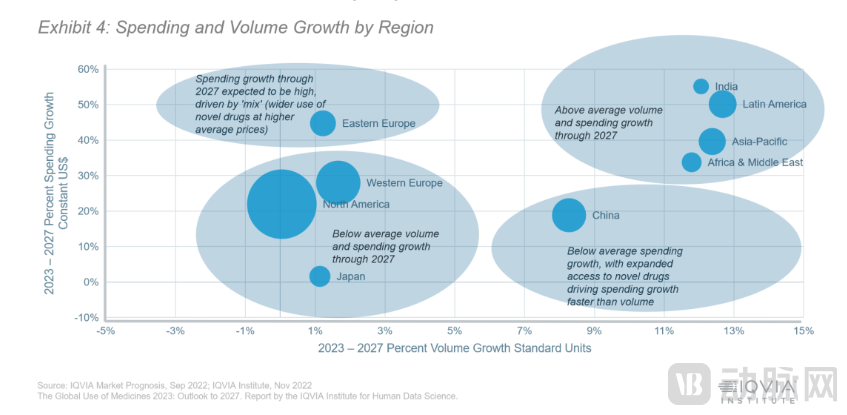 (IQVIA Report: Healthcare Spending Growth in the Middle East to Outpace Global Average Over the Next Five Years)
Robust policy support and a high-growth market landscape make business opportunities in the Middle East full of promise.
“However, the choice of an overseas destination requires a company to have sufficient understanding of the local market. This demands extensive research and in-depth communication,” said Fan Lingxin. “ThereforeSeize opportunities in the Middle East promptly; once everyone has entered the market, such opportunities will diminish.”
From an industry perspective,Numerous companies have been racing to explore the Middle East market.Last May, KPMG China led a 24-member delegation comprising 14 Chinese biotech innovators to the Middle East for exchanges; in September of the same year, a delegation of Chinese healthcare enterprises, jointly supported by AstraZeneca and Legend Capital (including CanSino Biologics, Luye Pharma Group, Amoy Diagnostics, Changchun High-Tech Industry Group, Innovent Biologics, Boan Biotech, New Horizon Health, Innomind, Kanglianda, Etana, Berger Medical, Yidu Tech, and others), conducted visits to the Middle East region...
"Undoubtedly, a brand-new opportunity for global expansion is gradually unfolding for medical innovation enterprises."
Despite the Middle East’s rising popularity, it is not a suitable overseas expansion destination for every enterprise.
“There is currently a misconception in the industry that draws an analogy between the Middle East and Southeast Asia, or China in the early 2000s; in fact,”The local area is very affluent.; Additionally,Many people have received an international education., with a global perspective; in terms of cost investment,The infrastructure costs for building a local factory are extremely high..” Sun Yingxue, an industry investor, stated, “Therefore, healthcare innovation enterprises seeking to expand into the Middle East must take all these factors into account.”
Shawn Choi, Executive Director of Meddcom (Jianshang Chuhai), also holds a similar view, he told VCBeatA comparison of the basic market conditions in current mainstream overseas expansion destinations, along with the types of enterprises suited to each region.
First isMiddle East, influenced by geopolitical factors, the region seeks to decouple from Western countries such as the United States, aiming to establish a complete domestic pharmaceutical industry chain and localize its biotechnology supply chain. Therefore, the Middle East not only has upstream demand for products,We are more inclined to introduce technology to upgrade the local industrial chain and establish an end-to-end industrial structure spanning from upstream to downstream.In addition, the Middle East market also carries market risks; it is advisable for enterprises to have prior operational experience in other overseas markets.It is not advisable for early-stage innovative enterprises to enter the Middle East market prematurely.
“Whether in terms of the timing of entry into the Middle East or local market share, Chinese pharmaceutical and medical device companies do not really possess a first-mover advantage. This is a challenge currently faced by many Chinese enterprises,” Shawn Choi added. “ButThe advantage of domestic enterprises lies in their ability to collaborate with certain government initiatives to achieve partnerships., which in itself signifies equal opportunity. Taking Saudi Arabia as an example, private-sector business activities must align with the government’s development strategy. We hold greater advantages in international relations and have facilitated ecosystem collaborations through partnerships with pharmaceutical industry giants. In Q4 of this year, we will also partner with a multinational corporation (MNC) that has made numerous forward-looking arrangements for overseas expansion over the past year, helping more Chinese healthcare enterprises expand into the Middle East. Additionally,The Middle East region shows a stronger preference for established brands; therefore, companies seeking market entry are advised to partner with multinational pharmaceutical enterprises or engage in initiatives led by government bodies and chambers of commerce.”
Then, looking at Europe, this region boasts a well-established market system and high drug pricing, but faces intense competition. Nearly all global pharmaceutical and medical device companies regard launching their products in the European and American markets as a significant milestone, making it a “paradise for top-tier players.”
Next is Southeast Asia, a region with a population of 600 million and numerous pharmaceutical companies. Each country has hundreds of pharmaceutical firms, but they are primarily focused on generic drugs, creating an urgent need for industrial upgrading. “The domestic pharmaceutical industries in these countries are generally underdeveloped. Although their regulatory policies and payment systems are flexible, their drug regulatory frameworks remain relatively weak. Whether it involves GCP or GMP inspections, or marketing authorization approvals, they tend to reference or rely on the regulatory decisions of other countries,” said Shawn Choi.
It is not difficult to see that, given the varying conditions across different regions, healthcare innovation enterprises must exercise greater prudence:Do not blindly choose to expand into the Middle East simply because it is currently a hot market.
Additionally, due toThe Middle East covers a broad area, and the selection of specific countries and regions should vary accordingly.
As one of the hottest destinations in the Middle East,Saudi ArabiaThe healthcare market is a high-end market, but due to the underdeveloped local pharmaceutical and medical device industries, it relies more on imported drugs and medical devices, involving leading companies from the United States, Germany, Japan, etc.This presents an opportunity for high-end medical equipment manufacturers and innovative pharmaceutical companies.
However, given that brand recognition for Chinese enterprises remains immature in local markets, it is advisable for Chinese medical innovation companies to collaborate with local channels and distributors. Furthermore, providing comprehensive clinical solutions upon market entry will significantly enhance the probability of success.
United Arab EmiratesAs another popular destination for overseas expansion, this region has also becomeA venue for domestic medical innovation enterprises to make their “debut in the Middle East” or “flex their muscles.”
For instance, on January 29 this year, Mindray Medical, Hisense Medical, United Imaging Healthcare, BMC Medical, Yuwell Medical, Arite Medical, Silicon-Based Bionics, Anbao Medical, Edan Ultrasound, Wanmai Medical, Perlove Medical, Kangyuan Medical, David Medical, Weiqing Big Health, and Zhenhai Medical made their appearances at the 49th Arab International Medical Equipment Exhibition (Arab Health 2024). It is reported that Arab Health is the largest and most comprehensive professional medical exhibition in the Middle East and North Africa region, enjoying a high reputation there.
Another Middle East DestinationTurkey, with relatively mature markets in cardiovascular diseases, organ transplantation, ophthalmology, dentistry, medical aesthetics and plastic surgery, cancer treatment (oncology), and medical tourism, presenting significant opportunities for market substitution; furthermore, the local market is highly sensitive to prices under government centralized procurement.High-cost-performance medical products will find it easier to enter local markets.
Beyond geographic regions, certain niche sectors also present significant opportunities.“Currently, China’s innovative drugs and medical devices are transitioning from ‘Fast Follow’ to ‘First-in-Class,’ with products demonstrating inherent strength. In terms of corporate input and output, although the payback period for many product pipelines is lengthy, domestic production costs in China remain lower compared to those in the Middle East. Islamic countries face more stringent ethical and regulatory challenges, resulting in higher costs for local multi-center clinical trials,” said Shawn Choi, Executive Director of Meddcom.Generic Drugs and Blood Products May Present Significant Opportunities in the Middle East“The completeness of the upstream and downstream industrial chains, fostered by intense domestic competition, enables products to effectively meet local demands when entering the Middle Eastern market.”
Moreover, due to dietary habits and other factors, local residents in the Middle East frequently suffer from obesity, diabetes, male pattern hair loss, and other conditions, compounded by the region’s unique disease spectrum.IVD and diabetes-related companies have a greater advantage in expanding into the Middle East.
Of course, during the process of expanding overseas, factors such as safety compliance, risk assessment, and local customs and culture will inevitably become challenges for enterprises, especially when entering the Middle Eastern market. Therefore, medical innovation companies should conduct thorough market research, select appropriate partners and investors, adapt to local laws, regulations, and consumer habits, and build their own advantages through differentiation.
As Going Global Becomes the Choice for Many Medical Innovation Companies, Industry Experts Offer Some “Cool-headed Reflections.”
“To go global, be prepared to incur losses for two to three years..” Sun Yingxue, an industry investor, told VCBeat, “Based on our observations, it is actually difficult to achieve significant results in overseas expansion in the short term. One innovative medical device company has been expanding into the Middle East for nearly two years, but so far, there is no sign of profitability. Therefore, this requires long-term investment, and one must have realistic expectations.”
Beyond the extended payback period for profitability, the underlying motivations for going global also warrant further reflection.At the 10th International Biopharmaceutical Conference and Exhibition, Wu Zhenhua, Chairman of Hangzhou Jiayin Biotechnology Co., Ltd., pointed out: “It is important to distinguish between passive and proactive global expansion. Much of the overseas expansion has been passive, driven by the need to ensure corporate survival. China’s biopharmaceutical industry entered a ‘winter’ in 2022, a downturn colder than anyone had anticipated. WeAddress the sharp contraction in the capacity of China’s pharmaceutical market before considering overseas expansion.”
At the aforementioned conference, Zhang Xiaokui, Chief Scientific Officer (CSO) of U.S. biotechnology company Hopewell Therapeutics, also stated that “going global” appears to be a pseudo-proposition. “Many believe that domestic measures such as centralized procurement have dampened enterprises’ enthusiasm for innovation, leaving them with no choice but to seek foreign markets, making international expansion the only way out. However, this seems to put the cart before the horse. The core question companies must answer is: What problems can their products solve? What is the initial foundation of a pharmaceutical project? Is it innovation in indications, or technological improvement upon existing foundations? These issues must be adequately addressed before pursuing global expansion.”
Behind this,At its core, medical innovation companies should not treat global expansion as a last resort following business contraction; rather, it is an essential step in their journey to scale up and strengthen their market position., and products going global must meet the actual needs of local populations.
In other words, products that are truly innovative and meet clinical needs are the most important chips on the table for going global.
(At the request of the interviewees, Fan Lingxin and Sun Yingxue are pseudonyms.)
References:
"Outlook 2027: Global Pharmaceutical Market Trends and Prospects for the Next Five Years" – IQVIA
“Pharmaceutical Companies’ ‘Global Expansion’: Must It Be the U.S.? Why Not First Establish a Solid Foothold in China?” — The Paper