

Nanjing University Chemistry Department Quietly Builds a $50 Billion Market Cap Powerhouse with 6 IPOs in 4 Years
Sepax Technologies
Developer of Chromatography Technologies for Biopharmaceutical Separation and Purification
The Shanghai Stock Exchange Granted the First IPO Approval of 2024 to Sepax Technologies. On January 11, Sepax Technologies Successfully Passed the Review for Its STAR Market Listing.
In 1990, Huang Xueying, the founder of Sepax Technologies, graduated from the Department of Chemistry at Nanjing University and went to the United States to pursue a Ph.D., specializing in ion chromatography. In 2002, Huang Xueying and his wife established Sepax Technologies in the United States. In 2009, Huang Xueying returned to China and founded Sepax Technologies.
In a similar vein, not long ago, Ni Jinsong, also an alumnus of the Department of Chemistry at Nanjing University, filed a prospectus with the Hong Kong Stock Exchange for Bokang Shiyun, the company he founded. Ni graduated from the Department of Chemistry at Nanjing University in 1989 and has nearly two decades of experience in pharmaceutical R&D. He established Bokang Shiyun in 2015, focusing on the research and development of innovative ophthalmic drugs.
In addition to those awaiting IPOs, there are also many listed companies originating from the Department of Chemistry at Nanjing University. According to incomplete statistics by VCBeat, since 2020, the Department of Chemistry at Nanjing University has produced six listed companies with a combined market capitalization exceeding RMB 150 billion, includingAide Pharmaceutical, Legend Biotech, Trina Solar, Abbisko Therapeutics, Huahai Chengke, and Tengya Precision.
Alumni of the Department of Chemistry at Nanjing University have also demonstrated outstanding performance in the primary market. According to incomplete statistics from VCBeat, nine biopharmaceutical technology companies directly founded by alumni of the Department of Chemistry at Nanjing University secured financing in 2023 alone, with total funding exceeding RMB 2.5 billion; half of these companies have advanced to Series B or later stages.
Unbeknownst to many, the understated Department of Chemistry at Nanjing University has nurtured a powerhouse cohort of companies with a combined market capitalization exceeding RMB 100 billion.
Compared to the “Tsinghua-Peking-Fudan-Shanghai Jiao Tong” entrepreneurial factions among China’s top universities, Nanjing University appears much more low-key. In fact, this university located in Nanjiang boasts a strong culture of technology-driven entrepreneurship. Taking the School of Chemistry and Chemical Engineering, where the founders of Sepax Technologies and Bokang Shiyun are based, as an example, numerous enterprises have already gone public on secondary markets.
Among them is Hengrui Medicine, founded by Sun Piaoyang, an alumnus of Nanjing University’s organic chemistry program and known as the “King of A-Share Pharmaceuticals.” In 2000, Hengrui Medicine listed on the Shanghai Stock Exchange, becoming China’s first publicly traded company primarily focused on innovative drugs, as well as the first IPO from Nanjing University’s Department of Chemistry in the innovative drug sector. Notably, under Sun Piaoyang’s leadership, Hengrui Medicine and Hansoh Pharmaceutical, founded by his wife and fellow Nanjing University alumna Zhong Huijuan, long held the top positions in market capitalization among pharmaceutical companies listed on the A-share and H-share markets, respectively.
Another example is Zhang Fangliang, an alumnus of the Class of 1984 from the Department of Chemistry, who has already achieved two IPOs as a provider of R&D and manufacturing services for the life sciences industry.GenScriptSuccessfully listed on the Hong Kong Stock Exchange in 2015, the spun-offLegend BiotechIt also successfully listed on the NASDAQ in 2020, becoming the “first Chinese CAR-T stock.”
Since then, companies founded by alumni of the Department of Chemistry at Nanjing University have periodically filed for IPOs or gone public on the secondary market. According to incomplete statistics from VCBeat, a total of 12 enterprises directly founded by alumni of the Department of Chemistry at Nanjing University have successfully gone public, among whichBiopharmaceutical Sector Accounts for 8 SpotsWhat insights do these listed companies reveal about the Department of Chemistry at Nanjing University?
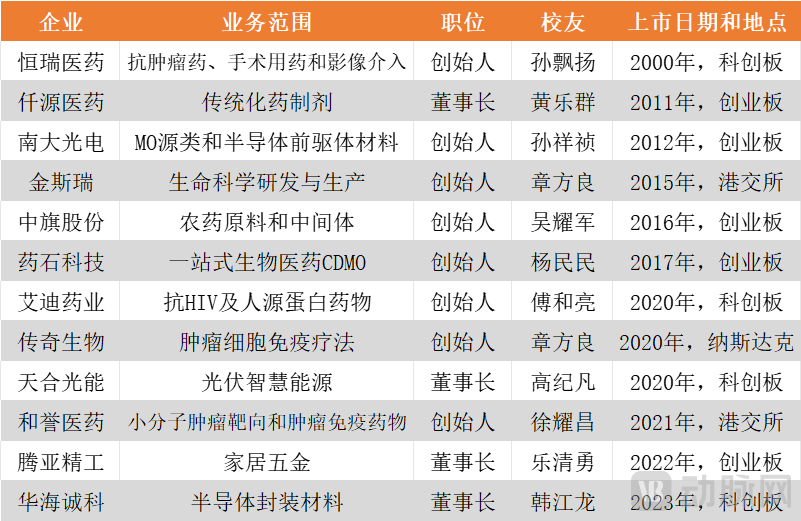
VCBeat’s analysis of the 2023 financial reports already released by these eight listed companies in the biopharmaceutical sector revealed that,1. Some companies still achieved growth against the trend, while many companies experienced declining revenues or incurred losses amid the harsh market winter, others maintained steady performance growth or achieved a turnaround from loss to profit;Second, we will continue to increase R&D investment to strengthen our competitive moat., for instance, in the first three quarters of 2023, Hengrui Medicine incurred R&D expenses of RMB 3.725 billion, while Genscript and Legend Biotech reported annual R&D investments of USD 410 million and USD 382.2 million, respectively, in 2023.
The founders mostly have work experience in pharmaceutical companies.Sun Piaoyang of Hengrui Medicine was once assigned to the Lianyungang Pharmaceutical Factory; Yang Minmin of Pharmablock led multiple new drug R&D projects at Roche Pharma; and Xu Yaochang of Akeso received professional systematic training and guidance at Eli Lilly for over 10 years. Having experienced both major and minor cycles in the biopharmaceutical industry while working at large pharmaceutical companies, they have accumulated extensive innovation and R&D experience, which has helped them drive their enterprises forward more smoothly.
Among them are also several serial entrepreneurs with an indomitable spirit.Huang Lequn, Chairman of Qianyuan Pharmaceutical, left Bayer Healthcare in 2005 to return to China and found Dongying Pharmaceutical; after its acquisition by Shanghai Pharmaceuticals Group, he established Jiayi Pharmaceutical. Fan Xiaohu, an alumnus of the Department of Chemistry at Nanjing University and co-founder of Legend Biotech, left the company to found Wandao Cell Therapy, a next-generation cell therapy company. Wu Yaojun, founder of Zhongqi Co., Ltd., established Yien Biopharma in 2021, focusing on pharmaceutical research and the development of new material technologies.
Despite the “capital winter” macroeconomic environment, entrepreneurs from the Department of Chemistry at Nanjing University have frequently attracted investment in the primary market, securing over RMB 2.5 billion in cumulative financing in 2023 alone.
In early 2023, GenScript ProBio, with Zhang Fangliang serving as Executive Director and Founder, completed a $224 million (nearly RMB 1.5 billion) Series C financing round, setting the record for the largest CDMO industry financing in China over the preceding six months. Since its establishment in 2019, GenScript ProBio has completed three rounds of financing, raising a total of $411 million. According to the financial data from GenScript Biotech’s 2023 annual report,GenScript ProBio’s external revenue in 2023 was approximately $107 million, with cash reserves of about $260 million., ample cash reserves provide strong support for business development.
Small-molecule drug R&D company founded by Wu Yongqian, a 1981 alumnus of the Department of ChemistryPharmAbcureThe company also completed a RMB 260 million Series D+ financing round. In February 2024, Allist Pharmaceuticals announced the initiation of pre-clinical development for its clinical candidate compound TT-02332, an inflammasome inhibitor, to accelerate its entry into clinical trials and benefit patients.
A Biopharmaceutical Company Specializing in Innovative Biomacromolecule Drug R&D, Founded by Tu Chao, Ph.D. in Chemical Biology from Nanjing UniversityBio-MingSai, it possesses multiple internationally leading fully human rapid antibody discovery and optimization platforms. The company completed two rounds of financing amounting to hundreds of millions of yuan in 2020 and 2023, respectively, with cumulative financing nearing RMB 400 million. Within three years of its establishment, two lead products have entered Phase I and II clinical trials, and a third product has submitted an Investigational New Drug (IND) application.
Moreover, a leader in the field of electrochemistryQin YuAs a former Associate Professor and Doctoral Supervisor at the School of Chemistry and Chemical Engineering, Nanjing University, he founded Jingjie Bio, which has completed an RMB 150 million Series A financing round. The company is an in vitro diagnostics (IVD) enterprise dedicated to the research, production, and sales of medical point-of-care testing (POCT) devices, home health management products, and health management solutions.
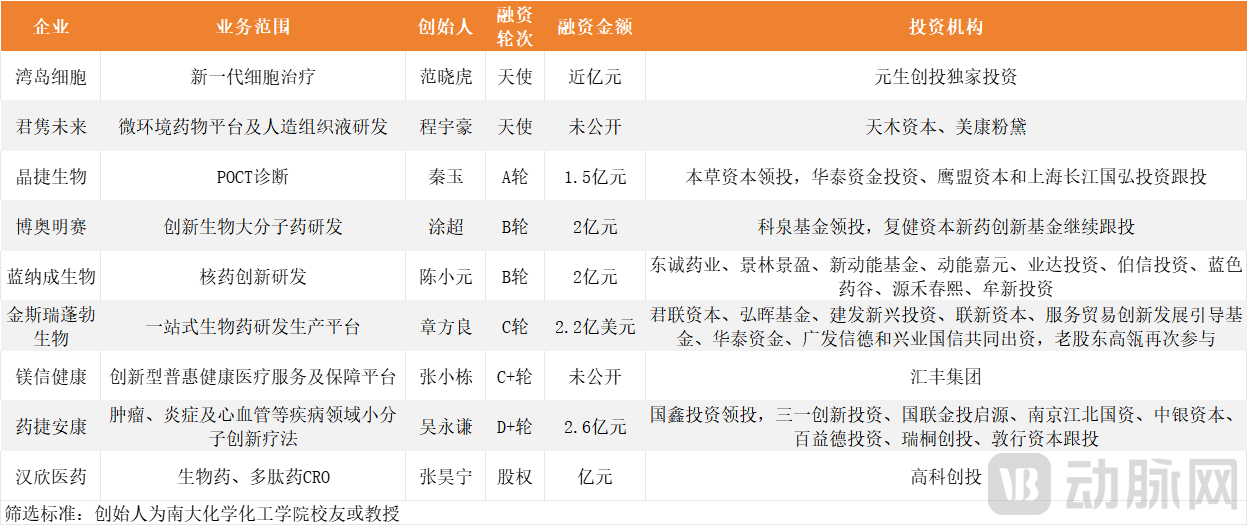
Selected Medical Enterprises from the Department of Chemistry at Nanjing University That Completed Financing in 2023
In addition to launching their own startups, many graduates from the School of Chemistry and Chemical Engineering at Nanjing University hold key positions in innovative biopharmaceutical companies. Dr. Guo Xiaoning, an alumnus of the Department of Chemistry, joined Nacura Ophthalmic, a leader in ocular gene therapy, as Chief Medical Officer. In 2023, Nacura Ophthalmic completed a Series C+ financing round of nearly RMB 700 million.
This achievement was no easy feat. On one hand, the R&D cycle in the biopharmaceutical sector is lengthy, requiring long-term commitment from investors; on the other, market conditions have made it increasingly difficult for pharmaceutical companies to break through in recent years. So how did students from the Department of Chemistry at Nanjing University succeed in attracting investors?
First, the project itself must possess robust strength.Entrepreneurs from the Department of Chemistry at Nanjing University have deeply cultivated the biomedical sector, demonstrating significant advantages in technological leadership, team professionalism, and product innovation.
Taking Lanacheng Biopharma as an example, the company has grown into a leading domestic radiopharmaceutical enterprise in just three years since its establishment. A key factor behind this success is its reliance on Professor Chen Xiaoyuan, a world-renowned expert in molecular imaging and nanomedicine. After completing his bachelor’s and master’s degrees in the Department of Chemistry at Nanjing University, Professor Chen pursued advanced studies in the United States. He currently holds the tenured Nasrat Muzayyin Chair Professorship at the Yong Loo Lin School of Medicine and the College of Engineering of the National University of Singapore. In February 2024, Lanacheng Biopharma had another investigational new drug (IND) application accepted for review, marking the third radioactive therapeutic drug it has submitted for clinical trials in China within three years of its founding.
Secondly, entrepreneurs have access to efficient channels for resource matching.Entrepreneurs from the Department of Chemistry at Nanjing University not only have access to innovation platform services provided by local governments and the university, but also receive resource support from various Nanjing University alumni associations in the biomedical field, such as the Biomedical Professional Committee of the Nanjing University Sci-Tech Innovation Investment Alumni Association and the Nanjing University Biomedical Industry Alumni Association.
Taking the Nanjing University Biomedical Industry Alumni Association, established in 2017, as an example, it has gathered more than 2,600 members, including nine academicians, over ten founders of listed companies, hundreds of entrepreneurial founders, renowned investors, and experts and scholars. The association has established a startup innovation center and a dedicated operating company in Nanjing, providing pro bono industry-finance integration services to Nanjing University alumni, such as venture capital financing, forum exchanges, investment promotion for industrial parks, technical training, resource matchmaking, and talent recruitment.
Furthermore,Students from the Department of Chemistry at Nanjing University Are Also Actively Engaging in Healthcare InvestmentChen Penghui, Founding Partner of Boyuan Capital, is actively investing in the medical and biotechnology sectors, with a focus on identifying true “innovators in biopharmaceuticals.” Li Jia, Partner at Longsheng Investment, oversees the firm’s venture capital activities in the healthcare and wellness sector. Yida Capital, where Zhou Chunfang serves as Founding Partner, also prioritizes healthcare and life sciences as a key investment focus.
Nanjing University’s traditionally low-profile Department of Chemistry is quietly nurturing a powerhouse team for biopharmaceutical IPOs. This achievement is inseparable from Nanjing University’s pioneering “basic research–technology creation–achievement commercialization” trinity model of originality-driven scientific research.
In 2015, Nanjing University established a Leading Group for Innovation and Entrepreneurship to deepen the reform of innovation and entrepreneurship education. In 2016, within its “13th Five-Year Development Plan” and the “Double First-Class Initiative,” Nanjing University designated innovation and entrepreneurship as key components of its future development, thereby laying a solid foundation for innovation and entrepreneurship at the university.
Strengthening Internal Capabilities Across Three Dimensions: Disciplinary Layout, Talent Development, and Technology Transfer System
First, regarding internal development, Nanjing University is advancing the role of higher education in serving economic and social development through disciplinary layout, talent cultivation, and the translation of research outcomes.
First, robust disciplinary strength serves as the foundation for innovation.The School of Chemistry and Chemical Engineering at Nanjing University, established in 1920, is one of the earliest chemistry departments founded in China. It was later formed by the merger of the Department of Chemistry at the former National Central University and the Department of Chemistry at Jinling University into the Department of Chemistry at Nanjing University. In 1993, the School of Chemistry and Chemical Engineering was officially established. Fifty-two academicians from the Chinese Academy of Sciences and the Chinese Academy of Engineering have studied or taught here.
In terms of specialized disciplines, the College’s Chemistry and Chemical Engineering and Technology programs are both designated as national “Double First-Class” disciplines. According to the 2022 Essential Science Indicators (ESI) database, Nanjing University’s Chemistry discipline ranked 21st globally in total number of publications and 25th in total citations among research institutions worldwide, maintaining its position within the top 0.02% globally. Global university subject rankings placed Nanjing University’s Chemistry discipline at 20th worldwide. The ShanghaiRanking Consultancy reported that Nanjing University’s Chemistry discipline ranked 25th globally, while its Chemical Engineering discipline ranked 37th worldwide. The Nature Index indicated that Nanjing University’s Chemistry discipline ranked 5th among research institutions and 2nd among universities globally.
Second, establish a “five-in-one” innovative education system to cultivate innovative talent at the source.To cultivate students' innovative and entrepreneurial mindsets, Nanjing University initiated the reform of its "Three-Three" talent development model in 2006, proposing a tiered approach to student cultivation. Under this model, students progress through broad-based education, specialized training, and finally into a diversified development phase, where they independently choose their career paths.
One of the pathways in the “Three-Three System” focuses on employment and entrepreneurship. For students pursuing this pathway, Nanjing University has established a five-in-one innovation and entrepreneurship education system comprising “courses, lectures, training, competitions, and outcome incubation.” This system integrates general education to introduce innovation and entrepreneurship, fosters relevant competencies through project-based experiences, and facilitates market entry via outcome incubation.
Third, establish and improve policies for the commercialization of research achievements to encourage researchers to engage in innovation and entrepreneurship.In 2023, Nanjing University revised five policies, including the Administrative Measures for the Transformation of Scientific and Technological Achievements of Nanjing University, to promote the transfer and transformation of more original achievements in Jiangsu Province through differentiated benefit distribution ratios. By granting researchers ownership and long-term usage rights to job-related scientific and technological achievements, the university aimed to enhance researchers’ voluntary participation in technology transfer, reduce conversion costs, and stimulate vitality in commercialization efforts. In 2022, the total value of contracts for the transformation of scientific and technological achievements at Nanjing University exceeded RMB 120 million for the first time, representing a 120% year-on-year increase. In 2023, the contract value for such transformations increased by 262% compared to the previous year.
Nata Opto-electronic Material Co., Ltd., a publicly listed company, stands as an exemplary case of technology transfer from the School of Chemistry and Chemical Engineering at Nanjing University. Sun Xiangzhen, a professor at the school and alumnus of the class of 1959, dedicated over two decades to successfully developing metal-organic (MO) sources, thereby breaking through technological blockades imposed by other countries. He subsequently industrialized these research achievements in the Suzhou Industrial Park, leading to Nata Opto-electronic’s listing on the Shenzhen ChiNext market in 2012.
Establish External Collaboration Platforms with Universities, Enterprises, and Local Governments
Regarding external collaborations, Nanjing University leverages the resource advantages of schools, local governments, and affiliated enterprises to jointly establish government-industry-academia-research platforms, develop innovative carriers such as local industrial parks, and establish long-term cooperation mechanisms with enterprises.
First, establish an incubation platform for the commercialization of achievements based on the “Four Innovations Integration” model to facilitate the industrialization of original research outcomes.Specifically, Nanjing University has partnered with national and local governments as well as enterprises to jointly establish a technology transfer and incubation platform centered on “innovation, creativity, creation, and entrepreneurship,” with many laboratories located directly within science parks or corporate facilities.
In 2023, Nanjing University established a total of 41 joint laboratories with enterprises, with total cooperative funding exceeding RMB 480 million. The amount received in 2023 surpassed RMB 100 million. Among these, the agreement value for the Nanjing University–China Mobile Joint Research Institute reached RMB 150 million, marking the largest university-enterprise collaboration project in the history of Nanjing University.
Secondly, establish a “three-way collaborative” service system to provide high-quality resource support.The "Three-Way Collaboration" refers to collaboration among universities, between universities and enterprises, and between universities and local governments. For instance, Nanjing University jointly established an International College of Innovation and Entrepreneurship with universities in the UK and the US, co-built research centers with companies such as Tencent and Baidu, and entered into comprehensive strategic cooperation agreements with local governments. These initiatives closely link Nanjing University’s strengths in talent, scientific research, and education with local policy and spatial advantages, thereby transforming them into industrial competitive advantages.
For example, the “Nanjing University Yangzhou Institute of Chemical and Chemical Engineering,” jointly established by Nanjing University and the Yangzhou Chemical Industry Park, leverages Nanjing University’s talent and technological strengths in chemistry and chemical engineering while integrating the park’s industrial characteristics to build a sci-tech innovation platform that closely combines industry, academia, and research.
After more than a decade of exploration, and building upon its “5-4-3” innovation and entrepreneurship framework, Nanjing University has prioritized the development of four mutually supportive, specialized, and resource-concentrated operational platforms: the Industry–Education Integration “Campus Mass Innovation and Practical Training Platform,” the University–Local Government Co-constructed “Technology Transfer and Commercialization Platform,” the University–Enterprise Collaborative “Cultural and Creative Industries Platform,” and the International Cooperation “Innovation and Entrepreneurship Support Platform.”
In summary, the Nanjing University alumni entrepreneurs from the School of Chemistry and Chemical Engineering mentioned above represent only the tip of the iceberg among Nanjing University’s entrepreneurial community. In China’s biomedical sector, many other founders and leaders hail from other schools at Nanjing University, including those behind listed companies such as GemPharmatech, Rendu Biology, and Vazyme, as well as Angkuo Medicine, which secured over RMB 700 million in Series A financing at the beginning of 2024. Emerging from a research-intensive university, they carry forward Nanjing University’s spirit of innovation and entrepreneurship, stepping out of campus to become pillars of their respective fields.