

BlossomHill Therapeutics Files for IPO Following $4.1B Exit of Founder’s Prior Venture, Focused on Next-Gen Small Molecule Oncology Drugs
BlossomHill Therapeutics
Small Molecule Drug Discovery and Development
In February 2024, BlossomHill Therapeutics ((hereinafter referred to as “BlossomHill”) announced the completion of its $100 million Series B financing round, led by Colt Ventures,Existing and new investors, including Cormorant Asset Management, OrbiMed, Vivo Capital, Hercules BioVentures Partners LLC, Plaisance Capital Management LLC, and H&D Asset Management, participated in the follow-on investment.
BlossomHill is located in San Diego, California, a hub for startup pharmaceutical companies in the United States. It was co-founded in June 2020 by Chinese-American scientists Cui Jingrong and Li Yishan.According to Crunchbase data, BlossomHill has completed three rounds of financing since its inception. Including$71 million Series A financing completed in March 2021, and the $2 million seed funding round completed in 2020,The company's total financing amount hasAchieve$173 million.
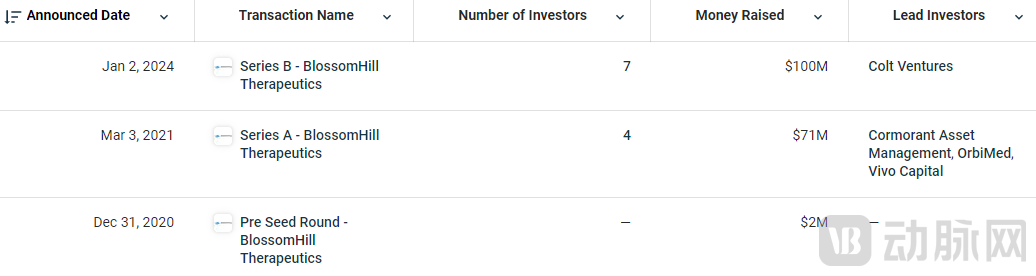 BlossomHill Financing Status (Image Source: Crunchbase)
In February 2024, Cui Jingrong, founder of BlossomHill Therapeutics, Inc., was elected as a member of the U.S. National Academy of Engineering (NAE).
Cui Jingrong earned his bachelor’s and master’s degrees from the University of Science and Technology of China, and his Ph.D. from The Ohio State University, after whichConducted postdoctoral research at Lawrence Berkeley National Laboratory and the University of California, Berkeley. 1999Over the following four years, Cui Jingrong was at Pharmaciaits subsidiary SUGENHe embarked on his career, serving as a project and team leader. In the decade following 2003, Cui Jingrong joined Pfizer, where he successively held the positions of Senior Principal Scientist and Associate Research Fellow.
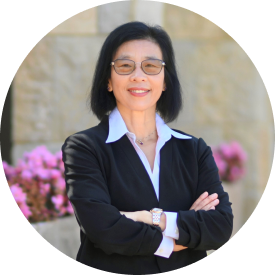
Cui Jingrong (J. Jean Cui,Image source: BlossomHill official website)
The journey of a new drug from research and development to market launch involves multiple stages, including candidate drug discovery, preclinical studies, Investigational New Drug (IND) application, clinical trials, and New Drug Application (NDA) for marketing approval. Successfully bringing a pharmaceutical product to market is already a formidable challenge. Cui Jingrong, a serial entrepreneur with a scientific background, has achieved remarkable success in the design of oncology drugs.She has developed multiple clinical small-molecule drugs, including three FDA-approved agents: crizotinib (brand name Xalkori), repotrectinib (brand name Augtyro), and lorlatinib (brand name Lobrena).。
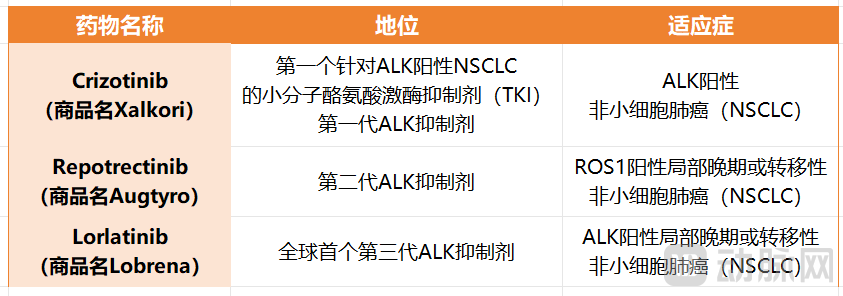
Three FDA-Approved Drugs (Compiled by VCBeat Based on Public Data)
In August 2011, crizotinib was approved by the U.S. Food and Drug Administration (FDA) for the treatment of ALK-positive non-small cell lung cancer (NSCLC), becoming the first targeted therapy against ALK.
As the first-generation ALK inhibitor, crizotinib created a sensation upon its launch, as it marked a shift in the treatment of NSCLC from the empirical use of cytotoxic drugs to better-tolerated and more effective regimens that target specific molecular subtypes of the disease. For this achievement, Cui Jingrong was awarded the 38th National Inventor of the Year Award (the National Inventor of the Year Award, established by the Intellectual Property Owners Association, honors only one patent annually across all U.S. industries). In addition, Cui Jingrong has received more than ten other honors.
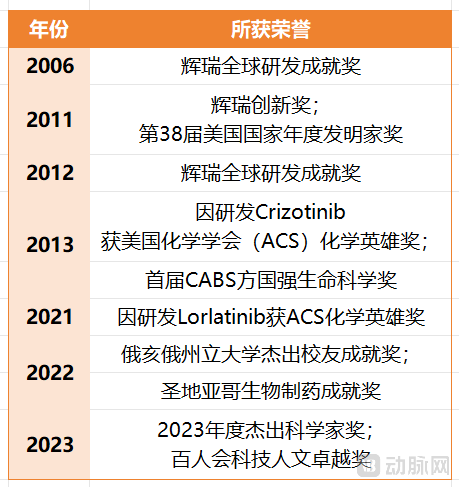
Honors Received by Cui Jingrong (Compiled by VCBeat Based on Public Data)
Cui Jingrong and Mr. Li YishanHe is an alumnus of the University of Science and Technology of China and also earned his Ph.D. at The Ohio State University. Subsequently, Li Yishan conducted postdoctoral research in the Department of Molecular and Cell Biology at the University of California, Berkeley, and was awarded the 2023 Committee of 100 Excellence Award in Science and Humanities. The period during which their career paths diverged the most mayis atCui Jingrong Joins Biotechnology Company SUGENAt work, Li Yishan, however,Took a career break to pursue an MBA at the Haas School of Business, University of California, Berkeley, and this experience also played a role in enabling the two to successfully establish their company and accelerate the pace of commercialization.

Li Yishan (Y. Peter Li, image source: BlossomHill official website)
The two are not only co-founders of BlossomHill Therapeutics, but also previously co-founded Turning Point Therapeutics (hereinafter referred to as “Turning Point”).Turning Point was founded in 2013, listed on NASDAQ in April 2019, and announced to be acquired by pharmaceutical giant Bristol Myers Squibb for $4.1 billion in June 2022, marking another major acquisition following Bristol Myers Squibb’s $74 billion purchase of Celgene in 2019.
At Turning Point, Cui Jingrong and his team have developed a solution to address the issue of drug resistance emerging in targeted therapy.Proprietary Macrocyclic Platform,Leveraging this platform, the company has established a pipeline of multiple drug candidates focused on the development of small-molecule oncology therapeutics, including the macrocyclic molecule TPX-0005 (Repotrectinib).
One of the primary mechanisms of resistance to ALK inhibitors is the emergence of secondary resistance mutations in the ALK kinase domain. Common resistance mutations observed after treatment with first-generation ALK inhibitors include G1269A, F1174X, and L1196M. TPX-0005, with its lower molecular weight and compact small-molecule structure, enables effective binding to the central site within the ATP-binding pocket while avoiding steric hindrance caused by mutations outside the ATP-binding site, thereby circumventing interference from clinical resistance mutations.
BlossomHillNot yet publicly announced on the official website.ofCandidatepipeline,However, according to VBInsight data,CurrentlyBlossomHill holds a total of 40 patents, 36 of which are currently in force., and most patents are also related toKinases and Macrocyclic MoleculesRelevant.
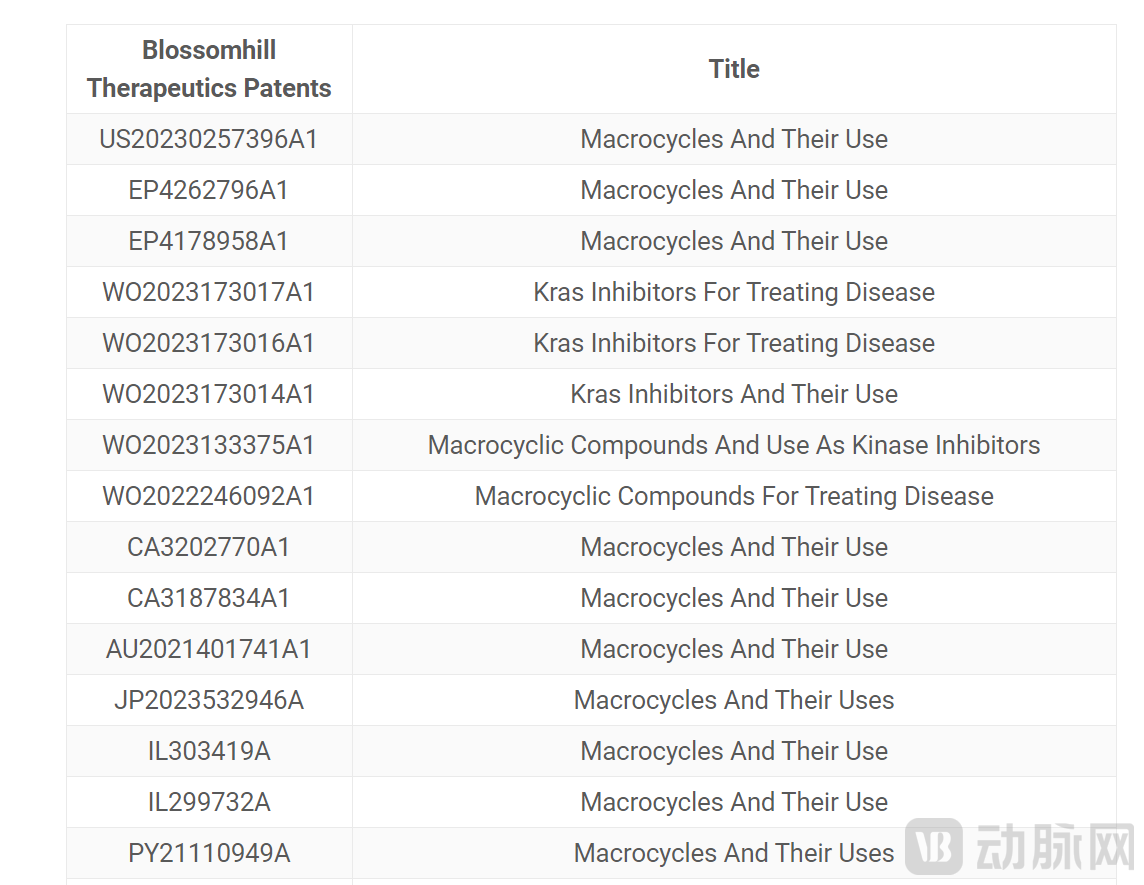
Excerpt from BlossomHill Patent Diagram (Source: VBInsight Official Website)
Currently, small-molecule targeted drugs used in clinical practice are predominantly antineoplastic or anti-inflammatory agents. As signal transduction inhibitors, they can specifically block signaling pathways essential for tumor growth and proliferation, or inhibit signaling pathways associated with inflammatory cytokines. The "Healthy China 2030" Planning Outline sets forth the strategic goal of "increasing the overall five-year cancer survival rate by 15% by 2030," with lung cancer being one of the most common malignancies.
Based on target types and mechanisms of action, small-molecule targeted drugs can also be classified into kinase inhibitors, epigenetic inhibitors, and proteasome inhibitors. Kinase inhibitors are the primary agents used in the treatment of non-small cell lung cancer (NSCLC), with key therapeutic targets including EGFR, ALK, HER2, ROS1, BRAF, MET, RET, and NTRK. Additionally, targets such as DDR2, FGFR1, and KRAS are closely associated with the onset and progression of NSCLC; however, drug development targeting these molecules remains in its early stages.
Based on multidimensional statistics covering drug targets, R&D progress, and innovative technologies, VCBeat has found that indications for innovative small-molecule drugs are concentrated in the oncology field, with solid tumors, lung cancer, and hematologic malignancies ranking as the top three. There are 36 major innovative targets, with KRAS, FGFR4, and SHP2 being the top three hottest targets; however, key therapeutic targets for non-small cell lung cancer (NSCLC) do not fall within this popular range. While the R&D progress of domestic small-molecule drugs on most targets still lags behind the global level, the gap is gradually narrowing.
The following are the small-molecule drugs targeting ALK that have been launched/approved in China:
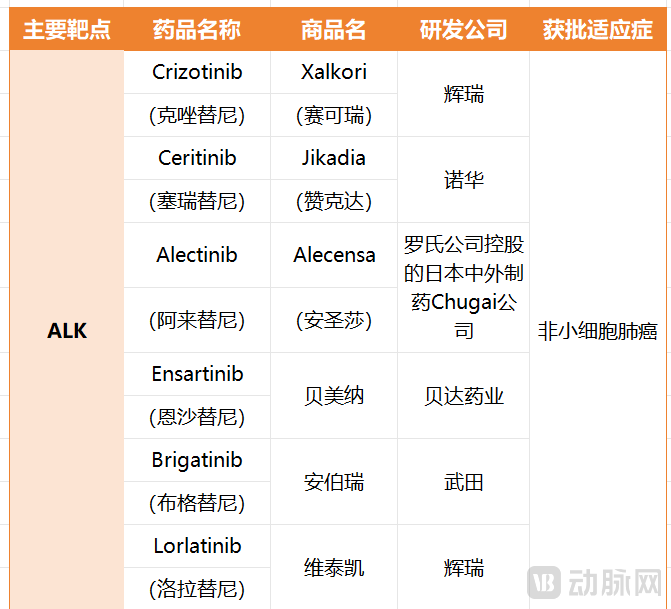
ALK Inhibitors Listed/Approved in China (Incomplete Compilation; Graphic by VCBeat)
According to Sullivan's analysis, from 2016 to 2020, the global market size of small-molecule drugs grew from $932.8 billion to over $1 trillion, while the Chinese market size increased from RMB 722.6 billion to RMB 708.5 billion.The global small-molecule drug market is projected to grow to $1.18 trillion by 2025, with China’s small-molecule drug market reaching RMB 975.2 billion at that time.
In recent years, with gene therapy, cell therapy, andWith the emergence of numerous innovative biologics such as antibody-drug conjugates (ADCs), the number of small-molecule drug development projects has shown a gradual decline. In addition to being influenced by other types of drugs and therapies in the pharmaceutical market, small-molecule drug development is also constrained by its own limitations. The slowing annual growth rates in new target discovery and small-molecule library diversity have resulted in relatively low R&D success rates.
But as Cui Jingrong once said, “If I could live my life over again, I would still choose chemistry and remain a medicinal chemist, because I feel that drug research and development is a mission and a responsibility—and I also find great joy in it.”Researchers in the field of small molecules are also continuously forging new paths, giving rise to numerous novel R&D concepts for future small-molecule drugs.Possibly inPROTAC technology, molecular glues, and allosteric modulation have “broken through the siege” to return to the “hot track.”