

After Achieving No.1 Growth in Chemiluminescence Instrument Sales, Where Is PHOENIXBIOMED Headed?
“IVD seems less cutthroat now.” This was the observation shared by an industry practitioner after the conclusion of the intensive season of trade shows and forums at the beginning of the year. Over the past two years, domestic IVD manufacturers have scrambled to capture share in the clinical diagnostics market, whose growth rate has been continuously slowing, by offering higher performance at lower prices. Unsurprisingly, such zero-sum competition for incremental gains has yielded no true winners.
"The End of Involution Is Innovation."
Last week, FAPON BIOTECH, a leading domestic supplier of core IVD raw materials, unveiled two new chemiluminescence instruments at the CACLP exhibition: the Shine i3000 and Shine i6000 fully automated chemiluminescence immunoassay systems, with single-unit throughput rates of 300 tests/hour and 600 tests/hour, respectively. Compared with its 900-tests/hour chemiluminescence platform launched last year, FAPON BIOTECH clearly did not pursue higher throughput this time.
However, VCBeat has noted that after the launch of Shine i3000 and Shine i6000,FAPON BIOTECH possesses a chemiluminescence platform with nearly the most comprehensive throughput in the industry.Corresponding to this differentiated portfolio of open instrument products is the diagnostic ecosystem that FAPON BIOTECH has been continuously cultivating in recent years.
Many people’s perception of FAPON BIOTECH may still be limited to its role as a leading supplier of diagnostic raw materials and reagent solutions.. However, as a co-builder of the global diagnostic ecosystem, FAPON BIOTECH has deployed over 5,000 chemiluminescence instruments worldwide, achieving rapid growth exceeding 200% for three consecutive years, with its growth rate ranking first in China.In the somewhat sluggish domestic IVD market, this is undoubtedly a remarkable achievement.
The Stage Builders
In 2021, FAPON BIOTECH launched its diagnostic ecosystem strategy to provide customers with more comprehensive customized services. Three years later, under this diagnostic ecosystem, FAPON BIOTECH has integrated additional resources and services to form a multidimensional technical solution, helping users improve quality, reduce costs, and accelerate product commercialization.
Starting with the core raw materials for the upstream IVD industry, FAPON BIOTECH has successively expanded its business modules to include reagent solutions and open instrument platforms. The ecosystem strategy based on open instrument platforms marks another upgrade in FAPON BIOTECH’s operational strategy. “As an upstream enterprise, FAPON BIOTECH possesses a natural attribute of openness, enabling closer collaboration with downstream customers. We aim to maximize downstream value through empowerment,” pointed out Zhu Jielun, Chief Financial Officer and Chief Investment Officer of FAPON Group. “For an upstream company, the prosperity of the downstream sector is the fundamental guarantee for sustaining commercial benefits. This is the underlying logic of our business.”
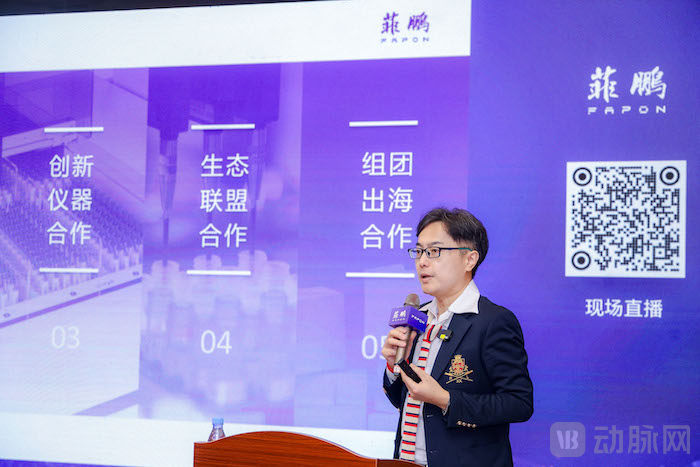
Jie Lun Zhu, Chief Financial Officer and Chief Investment Officer of FAPON Group
Nowadays, “industrial ecosystem” is undoubtedly a buzzword in the business world. A thriving industrial ecosystem fulfills people’s imagination regarding the various possibilities that facilitate economic transactions. For FAPON BIOTECH, the formation of its ecosystem strategy stems not only from its inherent technical advantages as a B2B enterprise specializing in customization, but is driven more significantly by the upgrading of user demands.
FAPON BIOTECH is one of the earliest enterprises in China to provide independently developed diagnostic raw materials, boasting an extensive library of such materials. After rapidly establishing a solid foothold in the domestic market, FAPON BIOTECH quickly expanded into overseas markets. Through extensive engagement with downstream users, FAPON BIOTECH observed that clinical diagnostic settings demand a high degree of diversity in IVD products; however, many companies have limited reagent development capabilities, which constrains the scaling of their business operations.
This point is particularly evident among IVD companies in emerging market countries. “The clinical diagnostic demand in these markets is substantial, but the IVD development ecosystem lags behind; many enterprises are unable to develop assays even when they have access to core raw materials,” pointed out Hu Jiangwei, Vice President of FAPON BIOTECH. Consequently, FAPON BIOTECH incorporated reagent solutions into its business portfolio. Later, the company expanded into instrument platform services to help customers address their R&D shortcomings.

Hu Jiangwei, Vice President of FAPON BIOTECH
The current diagnostic ecosystem strategy builds on this foundation by incorporating greater innovation and industrial resources. “What FAPON BIOTECH does is provide the stage, while users enjoy considerable flexibility in deciding what products and technologies to develop on its platform, and even in determining which business model to adopt to achieve a closed-loop commercial operation.” In Zhu Jielun’s view, no type of enterprise is entirely excluded from FAPON BIOTECH’s open platform.
Reconstructing the IVD Industry Chain
Now, the diagnostic ecosystem strategy has entered its fourth year,FAPONFAPON BIOTECH has continuously deconstructed needs and reconstructed services, establishing a differentiated systematic approach.
Focusing on the upstream IVD sector, FAPON BIOTECH believes that the industry’s most significant pain point is the lack of an explosive growth in available biomarkers. “If there are only a few hundred types of reagents, the market will fall into competition over existing offerings. This zero-sum game makes it difficult to build a robust ecosystem,” stated Hu Jiangwei. Objectively, current biomarkers are far from meeting the needs for early disease diagnosis. Compared with engaging in fierce internal competition over a handful of popular reagents and raw materials, IVD developers still have substantial innovative work to be accomplished.
Recently, FAPON BIOTECH has upgraded its diagnostic ecosystem and launched an innovative diagnostic model, aiming to establish a closed-loop commercial cycle spanning “research—Independent Clinical Laboratory (ICL)—clinical practice” to accelerate the translation of scientific achievements. “The journey of a biomarker—from discovery and validation to development, clinical application, market launch, and hospital adoption—is exceptionally lengthy. We hope that partners across the industry chain will leverage their respective strengths to ultimately realize the value of innovative biomarkers, share the benefits, and enable earlier detection and intervention for diseases among the general population,” pointed out Hu Jiangwei. He emphasized that accelerating the development and application of innovative biomarkers is not a task that can be accomplished by a single company operating in isolation; rather, it requires collaborative efforts grounded in a robust industrial ecosystem.
Xia Liangyu, Vice President of FAPON BIOTECH, stated that the company is strategically positioning itself in early-stage disease areas such as neurodegenerative diseases, infections, preterm birth, and ophthalmology. It is actively introducing globally innovative biomarkers and technologies, and leveraging its big data- and AI-driven multi-omics biomarker discovery platform to integrate clinical, data, and principal investigator (PI) resources. This approach aims to build comprehensive solutions covering the entire lifecycle of innovative applications for specific diseases. Notably, a blood-based biomarker for risk warning of mild cognitive impairment (MCI) in Alzheimer’s disease has entered clinical trials. In the field of infectious diseases, a biomarker capable of predicting sepsis three days in advance is nearing commercialization. Regarding innovative detection technologies, a single-molecule immunoassay platform is currently under application development and will be launched in the future alongside diagnostic reagents for Alzheimer’s disease.
In the midstream of the industry, FAPON BIOTECH offers an open, universal platform as its solution. Historically, IVD instrument platforms have largely adopted closed business models, requiring end-users to purchase new instruments to access corresponding reagents whenever they wished to expand their diagnostic test menus. This approach has fragmented the market to some extent and hindered improvements in industry efficiency. From the outset of its instrument platform strategy, FAPON BIOTECH committed to building an open instrument platform, providing users with interfaces, methods, and processes. “The cost of developing a complex instrument can exceed hundreds of millions of yuan. We believe that reagent developers should invest these funds in their core areas of expertise,” pointed out Hu Jiangwei.
Moving downstream, FAPON BIOTECH believes that companies can leverage the industrial ecosystem to reuse channel resources, thereby avoiding redundant investments and trial-and-error costs. According to Zhu Jielun, FAPON BIOTECH is currently establishing a global downstream network for the IVD industry. In China, the company has rapidly built an extensive distribution system by collaborating with national and regional pharmaceutical distributors, facilitating the swift market entry of customers’ innovative products. Overseas, FAPON BIOTECH has implemented more refined, differentiated strategies tailored to local industrial foundations and market characteristics.
It is understood that at present, FAPON BIOTECH’s overseas presence mainly covers countries along the Belt and Road Initiative, with plans to expand into developed markets in Europe and the United States in the future. “Overseas, each market has its own unique characteristics, which is the most significant objective reality of operating in international markets,” said Zhu Jielun. “However, there is one consistent principle: products must be competitive.”
The Diagnostic Ecosystem Begins to Flourish
From Stock Competition to Incremental Innovation, FAPON BIOTECH Chose a Less-Traveled Path, Yet Accurately Addressed the Industry’s Pain Points.
It is understood that FAPON BIOTECH’s diagnostic ecosystem has connected a large number of partners across various segments of the industry chain. On one hand, targeting reagent manufacturers, FAPON BIOTECH leverages its core raw materials business, combined with upstream core technologies and technical platforms in in vitro diagnostics (IVD), to provide products and services that help these partners reduce costs and increase efficiency, accelerate R&D and market deployment, enhance service support, and share resources. Previously, FAPON BIOTECH assisted numerous domestic IVD companies in expanding their product menus in fields such as chemiluminescence.
On the other hand, targeting channel resource providers, FAPON BIOTECH coordinates industry chain resources and collaborates with industry partners to provide standardized industrial-grade IVD products and personalized customization services. This helps partners transform from downstream distributors into manufacturers, build core competitiveness, and offers necessary support in brand building and product registration. VCBeat has learned that FAPON BIOTECH has established a deep cooperation with China Resources Pharmaceutical Commercial Group to jointly expand the domestic IVD application market.
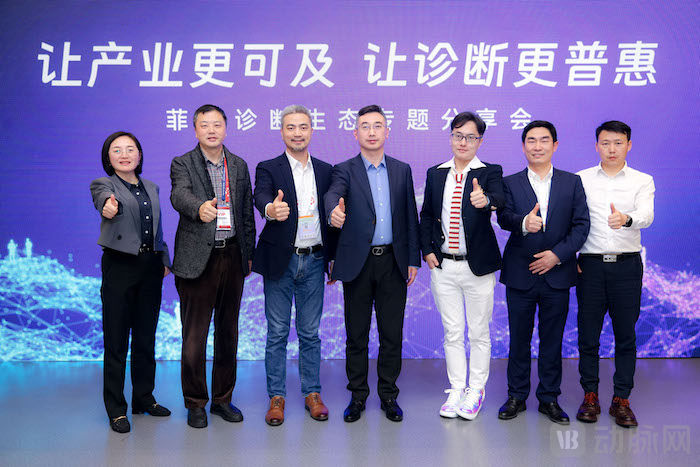
More importantly, the diagnostic ecosystem built by FAPON BIOTECH is no longer purely a vertical collaboration between the upstream and downstream segments of the IVD industry chain. VCBeat has learned thatIn the diagnostics ecosystem, horizontal collaboration among FAPON BIOTECH’s customers is gradually flourishing.For example, FAPON BIOTECH’s clients, Shenzhen Hailaiheng and Beifang Biology (Beifang Institute), have established complementary cooperation in their diagnostic menus based on FAPON’s instrument platform. “The gradual formation of such sub-ecosystems signifies that our diagnostic ecosystem model has gained industry recognition,” pointed out Hu Jiangwei.
In fact, from a longer-term perspective, the global IVD industry is still in its early growth stage, and existing diagnostic products struggle to meet the ever-expanding clinical demands. For IVD practitioners, this represents not only a significant opportunity but also a challenge. We look forward to witnessing a more prosperous diagnostic ecosystem.