

Lenmeldy Becomes World's Most Expensive Drug at $4.25 Million as Orchard Therapeutics Files IPO
Orchard Therapeutics
Gene Therapy Developer
The World’s Most Expensive Drug Has a New Owner.
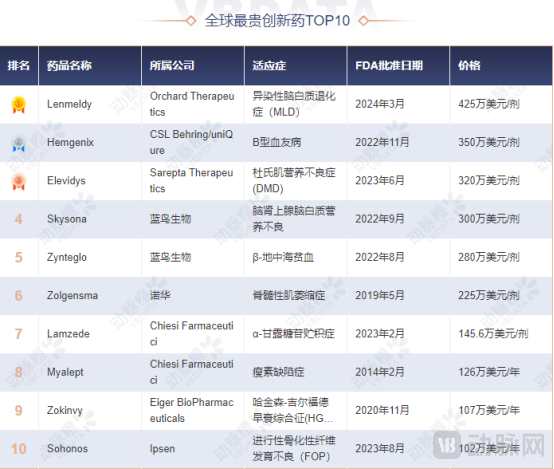
On March 18, 2024, the FDA approved Lenmeldy, a gene therapy developed by Orchard Therapeutics, for the treatment of pediatric patients with metachromatic leukodystrophy (MLD). On March 20, Orchard Therapeutics announced that the wholesale acquisition cost (WAC) for Lenmeldy, its ultra-rare disease drug, was $4.25 million (approximately RMB 30 million) for a one-time treatment in the United States, making it the most expensive drug in history.
Furthermore, as MLD encompasses pediatric patients with presymptomatic late-infantile (PSLI), presymptomatic early-juvenile (PSEJ), or early-symptomatic early-juvenile (ESEJ) forms, it has become the first and only therapy in the United States for the treatment of early-onset disease.
Libmeldy is a gene therapy based on autologous CD34+ cells genetically modified ex vivo with a lentiviral vector. It utilizes a lentiviral vector containing the human ARSA gene to transduce autologous hematopoietic stem and progenitor cells (CD34+), enabling them to express arylsulfatase A (ARSA) for the treatment of metachromatic leukodystrophy (MLD). Libmeldy is administered via intravenous infusion and can correct the underlying genetic cause of MLD with a single infusion.
Prior to the pricing of Lenmeldy, CSL Behring’s Hemgenix was the world’s most expensive drug, priced at $3.5 million per single dose for the treatment of hemophilia B. Next was Elevidys, priced at $3.2 million for the treatment of muscular dystrophy; in fourth place was Skysona, priced at $3 million for the treatment of adrenoleukodystrophy.
In the past two years, with the market launch of gene therapies, drug pricing records have been repeatedly broken. The high price tags assigned by pharmaceutical companies to gene therapies are not only due to the substantial R&D and manufacturing costs driven by the dual challenges of “R&D and production barriers” and “safety,” but also because gene therapy aims to address diseases at their root cause. By regulating genetic information in upstream DNA to “correct” disease-causing genes and thereby altering downstream protein expression, gene therapy holds the potential for a one-time curative treatment.
Furthermore, rare diseases are also a field where sky-high-priced drugs frequently emerge. Due to the small number of patients, limited market size, and high development costs, pharmaceutical companies generally lack enthusiasm for R&D in this area and are unwilling to invest significant resources. Consequently, to achieve returns comparable to those of commonly used drugs, companies must inevitably raise unit prices.
1Lenmeldy
Lenmeldy is indicated for metachromatic leukodystrophy (MLD), a genetic disorder in which patients are born lacking the enzyme arylsulfatase A, which breaks down sulfatides. This deficiency leads to the accumulation of sulfatides, causing neurotoxicity and progressive loss of motor and cognitive functions. Children diagnosed with this condition typically have a life expectancy of no more than five years after diagnosis, with most not surviving beyond age seven. Approximately 40 newborns in the United States are affected by this disease each year.
Orchard justified its pricing by citing an assessment from the Institute for Clinical and Economic Review (ICER), which set the health benefit price benchmark for Lenmeldy at up to $3.94 million. This pricing also reflects the potential value the therapy may deliver to eligible patients and their families, as well as its potential long-term impact on overall healthcare utilization, minimization of caregiver productivity losses, and patients’ life opportunities.
Orchard Therapeutics stated that the first patients treated with Lenmeldy have been followed for more than 12 years, and researchers continue to find that the genetically modified cells produce the enzyme lacking in patients’ bodies.
2Hemgenix
Hemgenix is an adeno-associated virus 5 (AAV5)-based gene therapy developed by CSL Behring and uniQure. It received FDA approval in November 2022 for the treatment of patients with hemophilia B who require prophylactic therapy with coagulation factor IX or who experience severe or spontaneous bleeding episodes.
This is the world’s first gene therapy for the treatment of adult patients with hemophilia B. Hemgenix is an adeno-associated virus serotype 5 (AAV5) vector-based gene therapy that carries a variant of the coagulation factor IX (FIX) gene (FIX-Padua). Administered intravenously, the therapy enables hepatic expression of FIX following delivery; the expressed protein is secreted into the bloodstream to exert its coagulant effect, thereby achieving therapeutic benefit. In theory, a single dose provides long-term efficacy.
At a price of $3.5 million per dose, the product once topped the list after approval until Lenmeldy. Despite the high cost, CSL Behring believes that the drug will “save significant costs for the entire healthcare system” and “substantially reduce the economic burden on patients with hemophilia B by lowering the annualized bleeding rate, reducing or eliminating prophylactic treatment, and maintaining elevated factor IX levels over many years.”
3Elevidys
On June 22, 2023, Elevidys, a gene therapy drug co-developed by Sarepta and Roche, received accelerated approval from the U.S. Food and Drug Administration (FDA) for the treatment of patients with Duchenne muscular dystrophy (DMD). With this approval, it became the first DMD gene therapy to be marketed globally.
Subsequently, this new drug, priced at $3.2 million per course of treatment, quickly rose to rank among the top three most expensive medications globally. However, the launch of Elevidys did not garner the enthusiastic welcome anticipated; authoritative medical media outlets such as Nature and medical experts have adopted a wait-and-see stance regarding the drug’s prospects, while the stock price of the developing pharmaceutical company fell rather than rose.
The issue lies with the efficacy of Elevidys. At the FDA’s advisory committee meeting on the drug’s approval, experts narrowly voted 8-6 in favor of accelerated approval, making it the first gene therapy ever to reach the market via the accelerated review pathway without robust evidence of clinical efficacy. Furthermore, market expectations regarding Elevidys’ commercial viability remain pessimistic.
4Skysona
Skysona was approved for marketing in the European Union in July 2021 and received approval from the U.S. FDA in September 2022 for the treatment of early cerebral adrenoleukodystrophy (CALD).
Cerebral Adrenoleukodystrophy is an X-linked recessive neurodegenerative disorder and a more severe phenotype of adrenoleukodystrophy, caused by mutations in the pathogenic gene ABCD1. The onset of CALD typically occurs in childhood, with an incidence rate between 1/100,000 and 1/200,000, and over 95% of patients are male. Without timely treatment and control, the condition will progress to severe loss of neurological function, leading to communication disorders, blindness, and even complete loss of voluntary motor function.
Skysona is the second gene therapy launched by bluebird bio, priced at $3 million per dose. bluebird bio stated that, in addition to R&D costs, the manufacturing of Skysona requires substantial human resources, materials, and time. For instance, it takes 55–60 days to produce one dose of Skysona after collecting cells from the patient.
Less than three months after its launch in Europe, the drug was withdrawn from the European market due to commercial strategic reasons. Furthermore, CALD is extremely rare, with approximately 50 new cases reported annually in the United States. The company expects to treat around 10 patients per year, indicating that the drug is unlikely to generate substantial sales revenue.
5Zynteglo
Zynteglo is the first gene therapy for β-thalassemia developed by bluebird bio. It received marketing approval from the European Union in 2019 and from the U.S. FDA in 2022.
Similar to Bluebird Bio’s other costly gene therapy, Skysona, it faces the same revenue challenges. Priced at $2.8 million, the drug offers up to an 80% refund if patients require transfusions due to waning efficacy within two years. However, it has also been withdrawn from the European market due to pricing concerns.
6Zolgensma
Gene therapy has often been stereotyped in the industry as unprofitable, but Novartis’s gene therapy drug Zolgensma for spinal muscular atrophy has shattered this perception.
A single course of Zolgensma is priced at $2.25 million. The drug’s sales reached $160 million in the first quarter after its market launch, soared to $1.351 billion in 2021, and further increased to $1.37 billion in 2022, surpassing even risdiplam, an oral medication for the treatment of spinal muscular atrophy, which recorded sales of $1.173 billion in 2022.
Zolgensma’s strong sales performance is driven by two main factors: on the one hand, spinal muscular atrophy (SMA) is a relatively common rare disease with a substantial patient population; on the other hand, Zolgensma offers a simpler treatment regimen with fewer adverse reactions.
7Lamzede
In February 2023, Chiesi Global Rare Diseases, a business unit of Chiesi Farmaceutici under the Chiesi Group, announced that the U.S. Food and Drug Administration (FDA) had approved Lamzede (velmanase alfa-tycv) for the treatment of non-central nervous system manifestations in adult and pediatric patients with alpha-mannosidosis (AM). Meanwhile, Lamzede is the first enzyme replacement therapy for this disease.
However, Lamzede has limitations—hypersensitivity reactions, which are the most common adverse reactions, including anaphylaxis, nasopharyngitis, fever, headache, and arthralgia. Therefore, the prescribing information for Lamzede includes a boxed warning about the potential for serious hypersensitivity reactions.
8Myalept
Prior to the advent of gene therapy, Myalept once ranked among the top drugs on the annual list of the world’s most expensive medications. Developed by Amryt, Myalept is a recombinant human leptin analog that received FDA approval in 2014 for the treatment of leptin deficiency in patients with congenital or acquired generalized lipodystrophy.
Lipodystrophy is a rare disease characterized by widespread loss of subcutaneous adipose tissue, leading to leptin hormone deficiency and metabolic complications.
Currently, as Amryt has been acquired by Chiesi, Myalept is owned by Chiesi Farmaceutici. Notably, Myalept is the only drug approved for the treatment of leptin deficiency, and its price has shown a year-on-year upward trend. In early 2021, the list price of Myalept increased from $5,093 to $5,297 per vial, with sales reaching $141 million that year. Prior to this, the drug’s price had risen multiple times. According to Chiesi, the unit price is $5,867.52 per vial, and patients use an average of 18 vials per month, resulting in a monthly cost of $105,615. However, the specific number of vials used may vary among patients.
9Zokinvy
Zokinvy is an oral farnesyltransferase inhibitor that reduces the accumulation of progerin in the cell nucleus by inhibiting its prenylation.
The drug was originally developed by Merck & Co., and Eiger BioPharmaceuticals obtained the license in 2018. In 2020, Zokinvy received FDA approval for marketing to treat Hutchinson-Gilford Progeria Syndrome (HGPS) and progeroid laminopathies (PL), becoming the first drug approved in the United States for the treatment of progeria.
In terms of pricing, although the dosage of Zokinvy is determined by body surface area, patients typically take approximately 200 mg daily. Based on a price of $746 per 50-mg capsule, the monthly cost amounts to $89,500. Consequently, the annual cost of Zokinvy reaches as high as $1.07 million.
10Sohonos
Sohonos, an approved drug under Ipsen, experienced two clinical trial holds, a Complete Response Letter (CRL), rejection by the European Commission, cancellation of a trial for another indication, as well as multiple safety issues, resubmissions, and delays over four years, before finally receiving FDA approval in August 2023 for the treatment of fibrodysplasia ossificans progressiva (FOP).
It is just that after the seemingly endless trials and tribulations, there was no true turnaround or bright prospect.
The clinical data for Sohonos are somewhat ambiguous. Moreover, in addition to concerns regarding the selection of clinical endpoints and analytical methods, the drug carries a boxed warning due to the risk of premature closure of the growth plates (also known as epiphyseal plates), which may lead to skeletal deformities and impaired growth and development; it also carries a warning for embryo-fetal toxicity.
However, Sohonos’s indication—fibrodysplasia ossificans progressiva (FOP)—affects approximately 400 individuals in the United States and 900 worldwide. Under the U.S. definition, it is classified as an ultra-rare disease, referring to conditions that affect no more than 1 in 50,000 people. The FDA’s approach and standards in the drug approval process for such diseases, which impact extremely small populations yet lack effective treatments, are among the key reasons why Sohonos has attracted widespread attention. Compared with the European Union, the FDA has maintained a more inclusive stance.
Currently, Ipsen’s oral small-molecule drug Sohonos is the first and only approved treatment for fibrodysplasia ossificans progressiva (FOP). The annual cost is approximately $1,022,894 for patients older than 14 years and about $622,373 for those younger than 14 years.
Gene therapy has also introduced another challenge: drug prices are continually shattering the ceiling for exorbitant costs, rising from $1 million to $2 million, and now to $3.5 million per dose. No healthcare system in any country worldwide can afford these astronomical prices, which are far beyond the means of ordinary households. It is therefore imperative to prioritize the development of innovative payment solutions.
Currently, the U.S. Centers for Medicare & Medicaid Services (CMS) announced on January 30, 2024, a new exploration of payment models for cell and gene therapies. The plan involves implementing a Cell and Gene Therapy Access Model: if gene therapies fail to achieve expected success rates in improving long-term health outcomes, drug manufacturers will refund a portion of the treatment costs to healthcare payers. The agreements will also include other price concessions, such as volume-based rebates or guaranteed rebates.
Subsequently, CMS will negotiate with manufacturers on behalf of the states, in the hope that this payment model will also have certain applicability in other countries and regions.Implications for Reference.