

Next Big Money-Making Target Emerges: Could the Best-in-Class TYK2 Inhibitor Come from China?

Alumis
Autoimmune Disease Therapy Developer
Sudo
Biopharmaceutical Manufacturer

Myrobalan Therapeutics
Developer of Oral Neurorepair Therapy
The next lucrative therapeutic target has emerged.
In early March, Alumis, a biotech company centered on its TYK2 pipeline, announced a $259 million Series C financing round. According to Fierce Biotech, this represents the largest funding amount raised by a startup biotech company to date in 2024.
Prior to this, Alumis rapidly completed a $70 million Series A financing in May 2021 and a $200 million Series B financing in January 2022, bringing its total cumulative funding to over $520 million to date. Alumis’s core product is ESK-001, a highly selective TYK2 inhibitor with best-in-class potential, which is about to initiate a Phase 3 trial for the treatment of moderate-to-severe plaque psoriasis and supports two ongoing Phase 2 clinical trials for systemic lupus erythematosus and non-infectious uveitis. The company is also developing A-005, a second-generation TYK2 inhibitor, as a first-in-class preclinical program targeting neuroinflammatory diseases such as multiple sclerosis.
Meanwhile, as ESK-001 was initially licensed from FT Group, a subsidiary of Haisco Pharmaceutical, Haisco expects to receive approximately $12.8 million in milestone payments following the initiation of Phase III clinical trials for ESK-001 in the second half of this year.
Alumis is not the only TYK2-focused company to secure substantial funding this year.Sudo Biosciences announced that it completed its second Series B financing round in January 2024 and raised an additional $30 million in February, bringing the company’s total Series B funding to $147 million. Another TYK2-focused company, Myrobalan Therapeutics, also secured $24 million in Series A financing in January.
TYK2 is a member of the JAK kinase family; however, due to its early discovery, it was not named according to the standard JAK kinase nomenclature. Therefore, TYK2 inhibitors are also considered a type of JAK inhibitor in the broad sense.
Currently, there is only one TYK2 inhibitor on the market: Sotyktu (deucravacitinib) from Bristol Myers Squibb (BMS), which was approved by the FDA in September 2022 for the treatment of moderate-to-severe psoriasis. Sotyktu is the only JAK inhibitor available for treating chronic inflammatory diseases that does not carry a black box warning. This distinction is attributed to the specificity of its action on the TYK2 target and the drug’s high selectivity for TYK2 itself (achieved through allosteric inhibition), resulting in minimal off-target toxicity.Sotyktu generated $170 million in revenue in 2023, and BMS expects its sales to exceed $4 billion by 2030.
The most notable transaction in the TYK2 field is the collaboration between Takeda and Nimbus Therapeutics announced in late 2022 regarding TAK-279 (formerly known as NDI-034858), with a total deal value of $6 billion, including a $4 billion upfront payment. The development of TAK-279 was informed by BMS’s deucravacitinib and demonstrates higher in vitro selectivity.
In a dramatic turn of events, a poster showcasing the Phase 2b clinical data for TAK-279 was stolen from Takeda’s booth at last year’s American College of Rheumatology (ACR) annual meeting, underscoring the intense interest in TAK-279 and TYK2.
As the autoimmune landscape shifts, the blue ocean for TYK2 has emerged.
TYK2: The Crown’s Heavy Burden
The JAK-STAT pathway plays a pivotal role in inflammation, metabolism, and oncology. To date, 11 JAK inhibitors have been approved globally; excluding the JAK2 inhibitor indicated for myelofibrosis, the majority are utilized in the field of autoimmune diseases. As Humira, the former blockbuster king, gradually loses its dominance, JAK inhibitors are poised to assume the mantle as the next leading therapeutic agents in autoimmunity.
Compared with biologics, small-molecule inhibitors are more convenient to manufacture, transport, and store; the regulatory framework is relatively mature, and they offer a significant price advantage. Their oral administration route leads to high patient adherence. Newly launched JAK inhibitor small molecules have demonstrated superior clinical efficacy and faster onset of action compared with biologics.
However, since members of the JAK family can mediate signaling pathways for multiple cytokines, currently approved JAK inhibitors inevitably cause certain side effects, which largely limit their clinical application. This is also why abrocitinib and upadacitinib, despite demonstrating superior efficacy to Dupixent (dupilumab), cannot replace Dupixent in clinical practice.
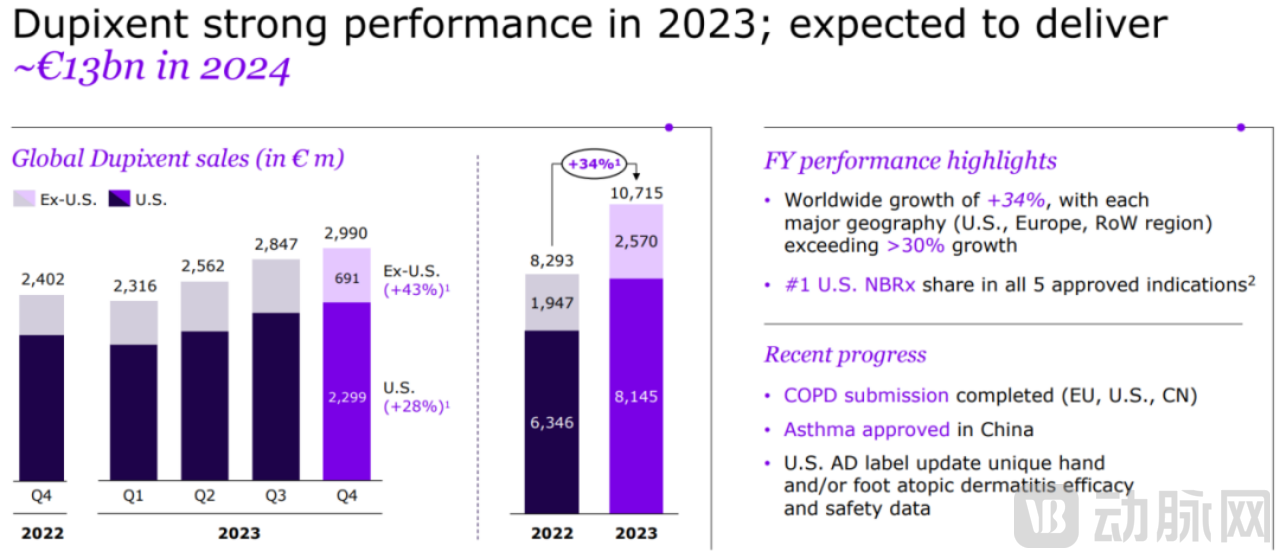
Dupixent’s sales reached $11.57 billion in 2023, a year-on-year increase of 34%
In contrast, TYK2 inhibitors primarily exert their effects by inhibiting the JH2 pseudokinase domain, whereas JAK inhibitors target the JH1 kinase domain. By binding to the JH2 domain of TYK2, these agents maintain high selectivity for TYK2 over other members of the JAK family and the broader kinase family. Through selective blockade of a limited number of TYK2-mediated inflammatory signaling pathways—including those involving IL-23, IL-12, and type I interferons (IFNs)—TYK2 inhibitors deliver therapeutic benefits while minimizing impacts on other JAK family members and cytokine pathways. This high degree of selectivity helps achieve a better balance between efficacy and safety, thereby reducing the risk of adverse effects.
Therefore, TYK2 inhibitors are considered the most promising candidates within the JAK family. Data on Sotyktu, the first TYK2 inhibitor, demonstrate that it exhibits relatively superior efficacy in the treatment of plaque psoriasis compared with other JAK inhibitors, with potentially lower risks of infections and cardiovascular events. No serious adverse effects have been reported; adverse events were predominantly mild to moderate, with upper respiratory tract infections and nasopharyngitis being the most common. The median time to relapse is comparable to that of second-generation biologics.
TAK-279, acquired by Takeda at a significant cost, is predicted by GlobalData to be the second TYK2 inhibitor to gain approval. Last year, the Phase 2b study of TAK-279 for active psoriatic arthritis met its primary endpoint. Clinical data demonstrated favorable efficacy, with a dose-dependent increase in therapeutic effect and significant improvement in pruritus. Furthermore, there was no significant increase in the incidence of adverse events across all dose groups compared with placebo.
BMS, having secured the first-in-class advantage, is aggressively expanding the indication portfolio for Sotyktu. According to the BMS official website, in addition to psoriasis, indications for Sjögren's syndrome, psoriatic arthritis, systemic lupus erythematosus, alopecia areata, and discoid lupus erythematosus have all reached late-stage clinical development. BMS is also exploring the potential of Sotyktu for Crohn’s disease and other conditions in clinical trials. Although these strategic moves remain subject to uncertainty, any breakthroughs would significantly broaden Sotyktu’s market potential.
The World of TYK2 Is Just Beginning to Unfold. The global psoriasis drug market is projected to expand further to approximately $40 billion by 2028. If TYK2 can continue to demonstrate efficacy, long-term safety, and sustained clinical benefits through large-scale clinical trials, the existing psoriasis indication alone would be sufficient to position TYK2 as a potential gold-standard therapeutic target.
Best-in-Class TYK2: Will It Come from China?
Notably, Chinese companies hold a significant position in the current pipeline of TYK2 inhibitors under development.Although Chinese companies entered the JAK inhibitor market relatively late, with first-generation JAK inhibitors only launching in 2017, domestic pharmaceutical companies are by no means inferior in the research and development of TYK2 inhibitors.
For example, Alumis’s core asset, ESK-001, was a project initiated by Haisco in 2018. While Bristol Myers Squibb’s (BMS) TYK2 inhibitor (BMS-986165) was still in Phase III clinical trials, Haisco published an article describing the discovery of a new Phase I clinical candidate based on BMS-986165, presenting a successful case of Me-too drug development. In March 2021, FT Group, a subsidiary of Haisco, transferred the patents and rights to its investigational TYK2 inhibitor to the predecessor company of Alumis, receiving an upfront payment of $60 million and potential milestone payments totaling $120 million.
At the time of the transfer, its global R&D progress ranked third, trailing only BMS and Takeda.
After three years of clinical research, ESK-001 has demonstrated the potential to compete for Best-in-Class status. At the recent American Academy of Dermatology (AAD) conference, Alumis announced positive Phase 2 results, with all five tested doses meeting the primary endpoint for PASI 75. In the highest dose group (40 mg twice daily), 64.1% of patients achieved this level of improvement, compared with 0% in the placebo group, and the treatment showed good overall tolerability.
Among the first tier of domestic companies, InnoCare Pharma is making the fastest progress. Although InnoCare Pharma, which started with oncology, is still incurring losses, its cash and cash equivalents amount to a substantial RMB 8.58 billion. This relatively strong financial position is a significant advantage for developing autoimmune disease drugs.
Among the two TYK2 inhibitors, ICP-332 is one of the most promising agents for moderate-to-severe atopic dermatitis based on current clinical data, and it is also one of the JAK inhibitors with the most favorable safety profile. This is primarily attributed to its potent inhibitory activity against TYK2 and its approximately 400-fold selectivity over JAK2.
ICP-488, a TYK2 allosteric inhibitor, directly competes with BMS’s Sotyktu by selectively binding to the JH2 pseudokinase domain and exhibiting no inhibitory activity against JAK1–3. It is being developed for the treatment of psoriasis, psoriatic arthritis, systemic lupus erythematosus, and other conditions. In Phase I clinical trials involving healthy subjects, ICP-488 has completed both single-ascending-dose and multiple-ascending-dose studies, demonstrating favorable safety and tolerability profiles, and has now rapidly advanced to Phase II clinical development.
However, the therapeutic landscape for TYK2 inhibitors in autoimmune diseases has become increasingly crowded. Another avenue of exploration for TYK2 lies in its role in the potential inflammatory processes underlying neurodegenerative diseases, including Alzheimer’s disease (AD) and multiple sclerosis (MS). Although MS and AD differ in etiology and clinical presentation, the TYK2 signaling pathway may represent a common therapeutic target. Inhibition of TYK2 can block IL-12/IL-23-mediated inflammatory responses in MS and reduce Aβ-induced neuronal death in AD.
Currently, few companies have established a presence in multiple sclerosis (MS) and Alzheimer’s disease (AD), yet domestic biotech firms are once again taking the lead. Gaoguang Pharmaceutical’s TLL-041 is the first highly selective TYK2/JAK1 inhibitor with blood–brain barrier penetration capability. Its potential indications include Parkinson’s disease, Alzheimer’s disease, and multiple sclerosis, among others. The asset was out-licensed to Biohaven last March.Gaoguang Pharma Secures $20 Million Upfront Payment, Potential $950 Million in Milestone Payments and Sales Royalties, with Global Collaboration on Clinical Development
TLL-041 is expected to enter Phase II clinical trials this year. The ability to identify a CNS-penetrant TYK2/JAK1 inhibitor amidst the competitive TYK2 landscape underscores GaoGuang Pharma’s strength.
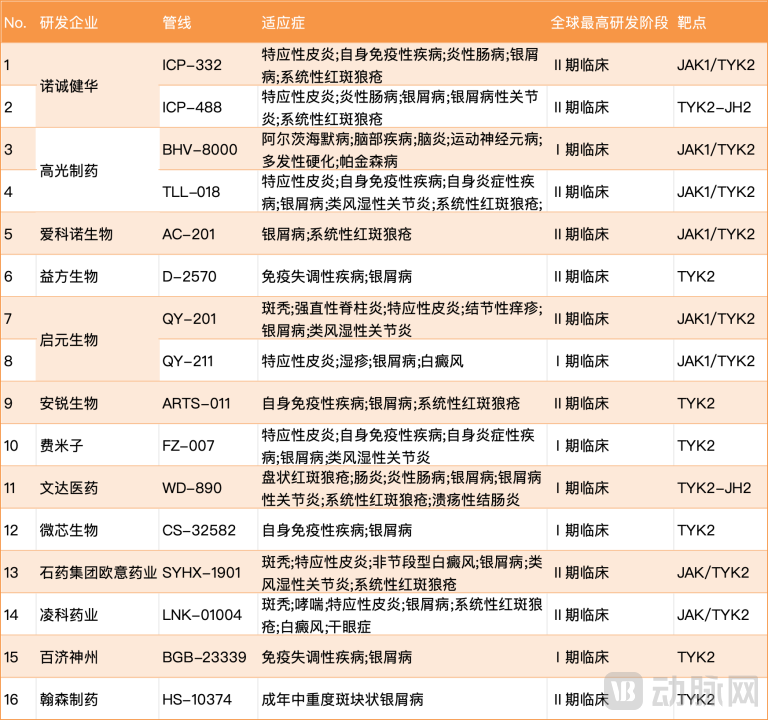
TYK2 Pipeline Under Development in China, Compiled from Public Data
Overall, Chinese pharmaceutical companies are rapidly advancing in TYK2 development, with first-tier candidates progressing quickly through clinical trials. However, domestic TYK2-targeted drug research and development remains in its early stages. Innovative structural optimization and differentiated molecular design to achieve superior TYK2 inhibitors may provide domestic players with the opportunity to compete for best-in-class status.
The initial commercial success of BMS’s Sotyktu and Takeda’s significant investment have both endowed TYK2 with strong “financial prospects.” However, it is also necessary to pay attention toTYK2 inhibitors face competition not only from within their own class but also from established, commercially mature drugs such as Dupixent, as well as potent candidate drugs targeting other mechanisms, including Johnson & Johnson’s IL-23R antagonist peptide JNJ-2113 and Eli Lilly’s IL-17 inhibitor DC-806.