

Calico Life Sciences Files IPO Prospectus: Google-Backed Biotech Advances Aging Reversal Pipeline with AbbVie Partnership

Calico Life Sciences
Compound Developer
In 2012, Google announced the shutdown of Google Health, its first healthcare initiative launched in 2008, marking a failure for the tech giant in the healthcare sector.
However, the shutdown of Google Health did not halt Google’s forward momentum in healthcare exploration. A year later, Google returned to the healthcare arena with even greater ambition.
September 18, 2013,Google Announces the Establishment of Calico Life Sciences (hereinafter referred to as “Calico”), a Biopharmaceutical Company Focused on Aging and Related Diseases, with an Eye Toward Research on Aging and Death. In 2015, Calico and another life sciences company, Verily, were folded into Alphabet, Google’s parent company, as two divisions focused on healthcare that continued operations after the closure of Google Health.
For over a decade, Google has never stopped pursuing its healthcare ambitions, with Calico becoming part of its team striving to enter biopharmaceuticals and achieve the “reversal of aging.”
The original intention behind the establishment of Calico stemmed from an idea by Bill Maris, a partner at Google Ventures.
At the time, Bill Maris had not identified any companies in the biomedical sector that were focused on research into human aging. Therefore, he approached Google co-founders Sergey Brin and Larry Page to discuss establishing a company dedicated to identifying the causes of human aging and developing interventions to extend human lifespan.
However, when the news of Calico’s founding broke, it caused a public uproar. U.S. Time magazine questioned on its cover: “Can Google Defeat Death?”
In response to skepticism, Larry Page stated in an interview with Time magazine, “In certain industries, it takes 10 or 20 years to go from an idea to implementation, and healthcare is one of them. We should strive to work on what truly matters, so that these things will be accomplished in 10 or 20 years.”1”
Therefore, to realize the vision of “defeating death” in 10 or 20 years, Calico rapidly recruited industry experts and assembled a team that quickly got the company up and running.
First,Calico Appoints Apple’s Current Chairman Arthur Levinson as CEOPrior to joining Calico, Arthur Levinson served as the former Chairman and CEO of Genentech. In addition to his role as Chairman of Apple Inc., Arthur Levinson is a Director at Google, Chairman of the Board of Genentech, and serves as a member of the Board of Directors of the Broad Institute, as well as a member of the Scientific Advisory Boards of research centers including the Memorial Sloan Kettering Cancer Center and the California Institute for Quantitative Biosciences (QB3).
Notably, Arthur Levinson’s joining has attracted numerous experts in the fields of biological sciences and computer science to Calico.Among them is David Botstein, former Vice President of Science at Genentech and a founding father of genomics.。
David Botstein, the current Chief Scientific Officer at Calico, is a genetics expert with over 30 years of research experience. He graduated from Harvard University in 1963 and worked under the supervision of Maurice Sanford Fox, then Chair of the Department of Biology at the Massachusetts Institute of Technology (MIT). After earning his Ph.D., he joined the faculty at MIT, where he became a Professor of Genetics. In 1987, he joined Genentech as Vice President of Science. Notably, in 1980, he and his colleagues proposed a method for constructing genetic linkage maps, which has been used to identify genes associated with various human diseases.
Meanwhile, to accelerate the discovery of the “longevity genes” in naked mole rats—given the phenomenon that they can live up to 30 years while ordinary mice only live for 1–3 years—and to advance the development of life-extending drugs,Calico also recruited Cynthia Kenyon, who ignited the anti-aging wave, as Vice President of Aging Research.。
Cynthia Kenyon is currently one of the most prominent authorities in the fields of molecular biology and genetics of aging. She graduated from the Massachusetts Institute of Technology and completed her postdoctoral research under the supervision of Nobel laureate Sydney Brenner. She subsequently became an American Cancer Society Professor and is currently a member of the National Academy of Sciences and the National Cancer Institute.
Notably, in 1993, Cynthia Kenyon discovered in her laboratory that a mutation in the single gene daf-2 could double the lifespan of Caenorhabditis elegans. This study demonstrated that aging does not occur “naturally” in a random manner; rather, the rate of aging is genetically controlled. Her laboratory thus became the first to identify that genes can influence animal lifespan. At Calico, Cynthia Kenyon’s research has received nearly unlimited funding support. Building on this foundation, years of research have led her to identify multiple genes and pathways associated with aging.
In addition to its distinguished founders and two experienced researchers, Calico’s Scientific Advisory Board boasts an impressive lineup of experts, including Dr. Shirley M. Tilghman, President of Princeton University and a molecular geneticist; Dr. Anne Brunet, Head of the Brunet Lab at Stanford University, which focuses on the molecular basis of aging and age-related diseases; Dr. Jonathan Pritchard, Co-Director of the Center for Computational, Evolutionary, and Human Genomics (CEHG) at Stanford University; and Dr. Gary Ruvkun, Professor of Genetics at Harvard Medical School and Head of the Ruvkun Lab.
In addition, to further accelerate research on aging and related diseases for the development of innovative drugs, Calico has recruited star experts from various research fields, forming a senior R&D team of 35 members to drive research and development in aging.
Upon announcing the establishment of Calico, Larry Page stated that the company’s mission was to “build the Bell Labs of aging research” and to achieve a breakthrough as significant and beneficial to humanity as the transistor, thereby extending human lifespan.
To realize this grand vision, Google has poured ample funding, top-tier talent, and cutting-edge technology into Calico. However, Calico’s “ambition” extends beyond merely conducting basic research on aging and age-related diseases; it aims to uncover the true secrets of reversing aging by probing deeper into the fundamental mechanisms of the aging process.
With full support from Google, Calico has established partnerships with multiple enterprises and research institutions, including four biotechnology companies—AbbVie, C4 Therapeutics, the Broad Institute, and Ancestry.com—as well as several research institutes such as the Buck Institute for Research on Aging, The Jackson Laboratory, and the MIT-Harvard Broad Institute, to collaborate on the discovery, development, and commercialization of therapies for age-related diseases.
Among them, the most notable isCalico and AbbVie’s Collaboration, Worth Up to $2.5 Billion
In 2014, Calico announced a long-term collaboration agreement with AbbVie, under which the two parties would jointly develop innovative therapies for age-related diseases such as neurodegenerative disorders and cancer. Additionally, Calico and AbbVie would each invest $250 million to help Calico establish research facilities in the San Francisco Bay Area.
Following this collaboration, Calico and AbbVie announced in 2018 and 2021, respectively, two extensions of their partnership through 2025, with each extension involving an additional investment of $1 billion.
Under the terms of the collaboration agreement, Calico will continue to be responsible for the research and early-stage development of the collaborative projects through Phase 2a until the next decade. AbbVie will continue to support the former’s R&D efforts and, upon completion of mid-stage testing, may opt into late-stage development and commercialization. Should drug development prove successful, both parties will share costs and profits equally.
Three collaborations have accumulated a total of $2.5 billion in R&D funding in Calico's capital pool,The two parties have currently collaborated to generate more than 20 early-stage projects targeting immuno-oncology and neurodegenerative diseases, and have advanced three targets into clinical trials.。
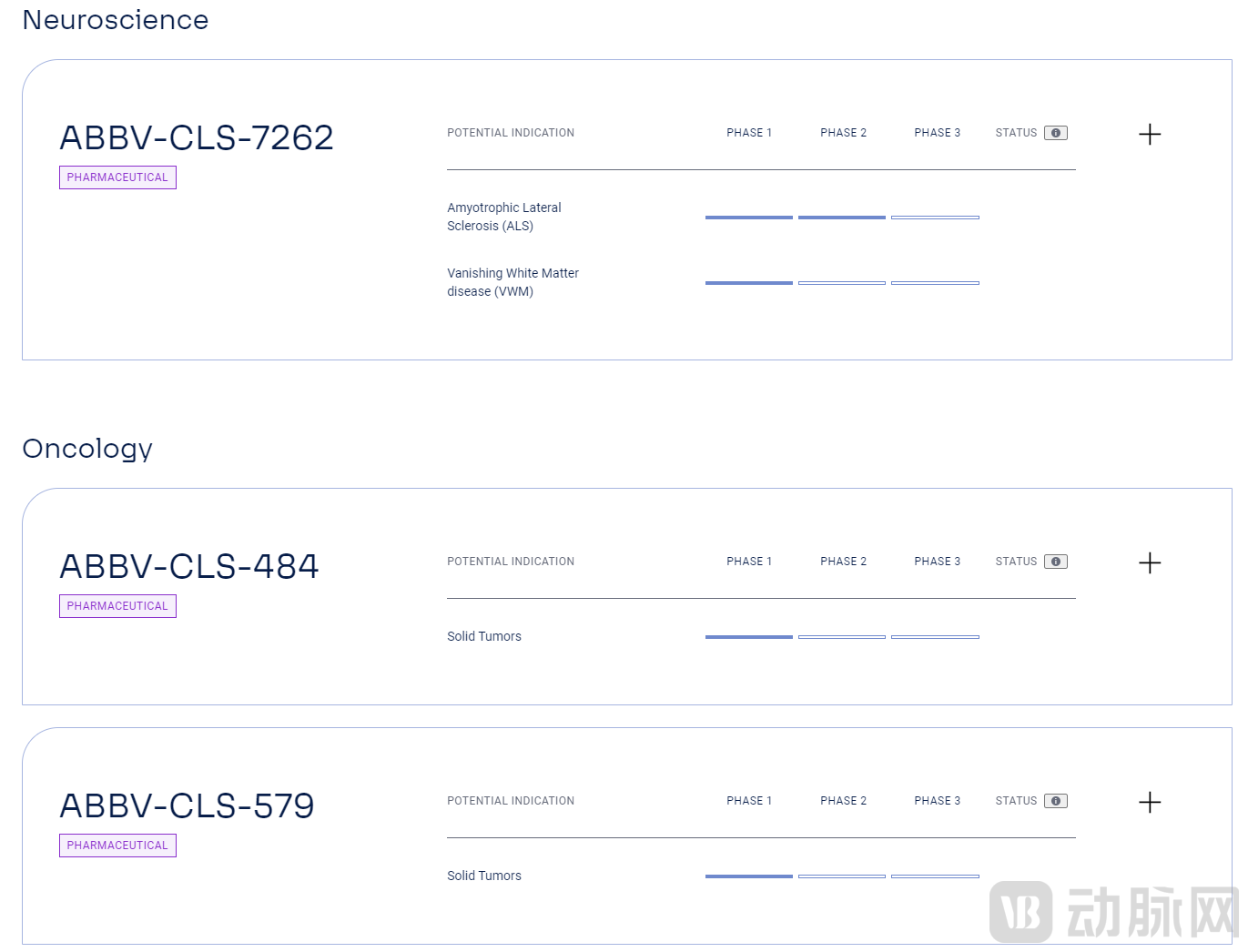
Calico and AbbVie Collaborate to Advance Clinical Pipeline. Image source: AbbVie official website
Among them,ABBV-CLS-7262 is an oral eIF2B activator currently being developed for the treatment of vanishing white matter disease (VWM) and amyotrophic lateral sclerosis (ALS), with research and development involvement by scientist Peter Walter.。
eIF2B is an intracellular protein complex that regulates protein synthesis and maintains neuronal health and function. Upon neuronal stress, activation of the integrated stress response (ISR) pathway inhibits eIF2B activity, leading to impaired protein synthesis and the formation of stress granules, thereby affecting proteostasis and cellular resilience. Vanishing White Matter (VWM) disease is caused by mutations in eIF2B. These mutations result in chronic ISR activation, which, when sustained in the brain over the long term, ultimately leads to white matter degeneration.
Therefore, ABBV-CLS-7262 is considered effective in inhibiting ISR and may restart cellular protein production and restore bodily functions. Research data show that in animal trials, treatment of aged mice with ABBV-CLS-7262 significantly improved cognitive decline after 3 days.
Currently, ABBV-CLS-7262 is being evaluated in a Phase 1b clinical trial for its safety, tolerability, and pharmacokinetics in patients with vanishing white matter (VWM). Meanwhile, Calico will collaborate with the Healey ALS Platform to conduct a Phase 2/3 clinical trial assessing ABBV-CLS-7262 for the treatment of patients with amyotrophic lateral sclerosis (ALS).
Calico stated that if ABBV-CLS-7262 progresses smoothly, it could achieve commercialization within 5–10 years, entering the anti-aging market currently dominated by Rejuvator, and accelerating the realization of “reversing aging.”2。
In addition, ABBV-CLS-484 is another blockbuster drug from Calico. It is the first potent active-site inhibitor of the protein tyrosine phosphatases PTPN2/N1 to enter clinical evaluation as a cancer therapy and is currently being assessed in patients with advanced solid tumors. If trial data are positive, ABBV-CLS-484 may potentially address PD-1 resistance in immunotherapy, emerging as a potential therapy to enhance anti-tumor immunity.
Since 2013, Calico has been “sprinting” along the path of anti-aging for a decade. Over these ten years, some of Calico’s practices have also sparked controversy.
First,Calico Has Long Kept Its Research Under Wraps. After Calico made a high-profile announcement of its entry into the anti-aging field, attracting widespread attention, it subsequently disappeared from public view for more than three years. During this period, Calico never published or discussed its research externally, refused to grant interviews, and required scientists to sign non-disclosure agreements.
Compared with other anti-aging companies in the same field, such as Altos Labs, Unity Biotechnology, and Oisin Biotechnologies, Calico appears somewhat too “silent.” For other scientists and researchers, its research on aging remains a mystery. In this regard, Felipe Sierra, Director of the Division of Aging Biology at the National Institute on Aging, also stated, “We want to know what he is doing so that we can collaborate with him or conduct other related studies.”
Secondly,Calico is obsessed with exploring the fundamental mechanisms of aging, yet it has not translated its existing research into practical applications.Since its inception, Calico has long focused on researching the biological mechanisms of aging. Although current studies have demonstrated that certain mechanisms have a definitive impact on aging and age-related diseases—a fact widely recognized—Calico has not developed aging intervention strategies based on these existing conclusions. Instead, it seeks to verify whether these conclusions are accurate.
Some industry insiders consider Calico’s approach to be “putting the cart before the horse.” Aubrey de Grey, Chief Science Officer of the SENS Research Foundation, has expressed disappointment with Calico, noting that despite its abundance of distinguished scientists and top-tier resources, the company has long remained bogged down in theoretical aging research. Unlike firms such as Unity Biotechnology, Calico has not rapidly developed related therapies and advanced them into clinical trials within a short timeframe.
As the ten-year mark arrives, Calico has failed to deliver a product as transformative as the transistor for extending human lifespan, despite having invested substantial research resources. Its “prolonged silence and lack of tangible progress” have long placed Calico at the center of controversy.
In addition to the controversy, Calico has also faced executive turnover. Dr. Hal Barron, President of Research and Development, chose to resign from his position in 2017 and joined Altos Labs in 2022. Leaving alongside Hal Barron was Daphne Koller, Chief Computing Officer. Subsequently, David Botstein, Chief Scientific Officer, announced his retirement in 2022, and Calico has not yet announced a successor for the role of Chief Scientific Officer.
Nevertheless, none of this has halted Calico’s continued exploration of aging. The company has preliminarily addressed external skepticism and controversy by demonstrating favorable clinical outcomes and progress in its pipeline. Meanwhile, Calico is collaborating with The Jackson Laboratory in the United States on a large-scale trial aimed at identifying a biomarker of aging in blood. If an ideal aging biomarker is successfully identified, it would enable more rapid assessment of individuals’ physiological age and facilitate the evaluation of how interventions, such as pharmaceuticals, affect lifespan.
Although our understanding of how cells, organs, and organisms age remains incomplete, and no drugs specifically approved for anti-aging are currently on the market, numerous companies have entered this high-potential sector. According to statistics from VCBeat, there are currently 14 anti-aging drug candidates in development worldwide: one in Phase II clinical trials, one in Phase I clinical trials, seven in preclinical stages, and five in drug discovery.
Furthermore, tech giants and ultra-wealthy individuals such as Mark Zuckerberg and Jeff Bezos, the former world’s richest person, have also entered the fray. The involvement of these tech behemoths has further facilitated the application of emerging technologies like AI in the research and development of anti-aging drugs, accelerating product launches and industry advancement. This also means that Calico is facing a more fiercely competitive market.
However, as research advances and technology continues to evolve, Calico may well succeed in establishing a closed-loop commercialization model for its pipeline in the future. Yet market competition remains fierce, with new players continually entering the race for the anti-aging market. Will Calico be able to secure a foothold in this space? Only time will tell.
References:
1.https://time.com/574/google-vs-death/
2. “At 25, Google Aims to Become a Pharmaceutical Giant”