

China's Aesthetic Device Sector Faces Major Shake-up as New RF Beauty Device Regulations Take Effect
Another Major Regulatory Policy Lands in the Medical Aesthetics Industry!
Today, the new regulations classifying radiofrequency-based beauty devices as Class III medical devices officially came into effect. This means that,Radiofrequency therapy devices and radiofrequency skin therapy devices shall not be manufactured, imported, or sold without legally obtaining a medical device registration certificate.The Beauty Device Market, Which Has Been Soaring for Years, Is Undergoing Major Changes.
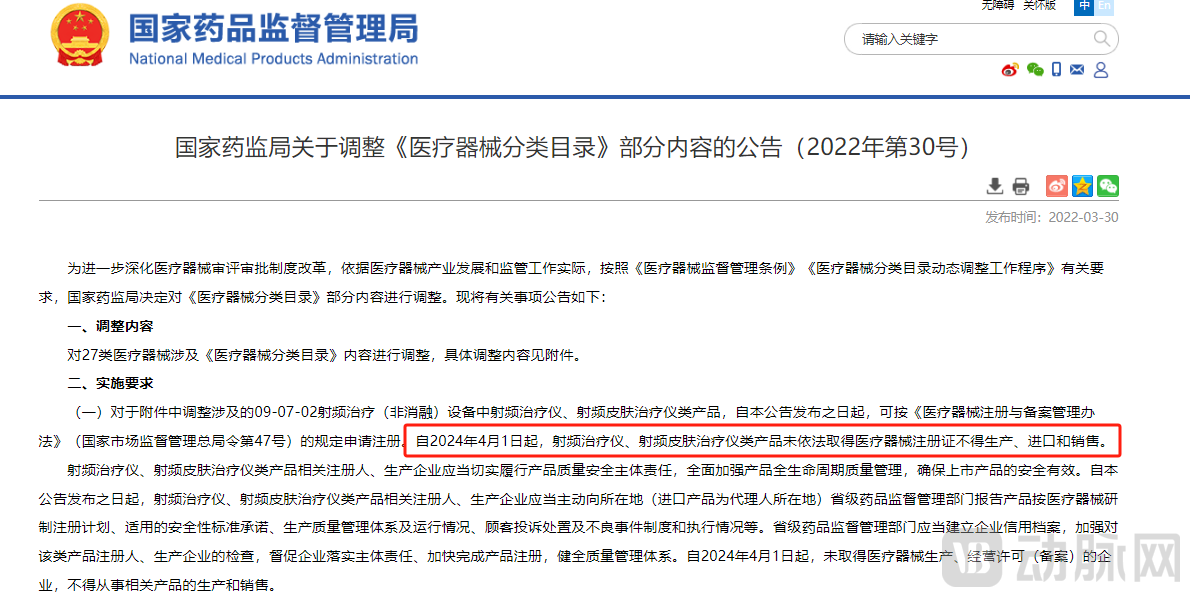 (Image source: Official website of the National Medical Products Administration)
“Beyond products that have not obtained certification, radiofrequency beauty devices that had previously secured Class II medical device certifications will also become unusable following the implementation of the new regulations today (April 1), and will be uniformly regulated as Class III devices,” senior investor Song Qingyuan told VCBeat.
It is important to note that,In the overall beauty device market, radiofrequency (RF) beauty devices account for the vast majority of market share.According to statistics from Guoji, during the 2022 Double 11 shopping festival, radiofrequency (RF) beauty devices accounted for 85% of the total sales share of beauty devices on Douyin.
Therefore, under stringent regulatory oversight, major beauty device brands will be temporarily unable to sell radiofrequency (RF) beauty devices from today until they obtain the necessary certifications, thereby losing a significant source of revenue.
In the face of challenges, market entrants currently have only three paths to choose from.First, exit the beauty device market; second, discontinue radiofrequency (RF) beauty devices, ceasing investment in R&D (primarily redesigning according to medical standards) and clinical trials, and redirecting funds toward new products leveraging technologies such as ultrasound and light-based therapies; third, continue investing to secure regulatory approval, but optimize resource allocation prior to certification by prioritizing the development of other hit home-use devices to alleviate corporate cash flow pressure.
According to VCBeat’s interviews with multiple industry insiders, the vast majority of beauty device manufacturers opted for the first and second options following the announcement issued in March 2022, and began aggressively clearing inventory during last year’s Double 11 shopping festival. Currently, only a few brands continue to invest in obtaining regulatory certification, aiming to be among the first to operate with proper credentials and thereby seize a competitive edge in the market.
Undoubtedly, a major industry reshuffle is already underway.
“The market logic of radiofrequency beauty devices has almost changed.”
In an interview with VCBeat, senior investor Song Qingyuan stated that home-use radiofrequency beauty devices had previously been regulated under the standards for “small household appliances,” but starting today (April 1),Such devices have officially completed their transition from “small home appliances” to “Class III medical devices.”
How significant is the impact of this identity change on the industry?
On one hand, after being included in the management of Class III medical devices, the requirements for the research and development, production, and sales of home-use radiofrequency beauty devices have become more stringent, raising the industry entry threshold.
In the past, when radiofrequency beauty devices were regulated under the category of household appliances, market entry was straightforward, allowing manufacturers to rapidly scale up production. According to the standard "Skin Beauty Devices for Household and Similar Purposes," home-use beauty devices in China were previously classified primarily as skin and hair care appliances within the broader household appliance category. They were subject to corresponding mandatory national standards, which mainly assessed safety, noise levels, and electromagnetic compatibility, but did not specifically evaluate the efficacy claims made by these beauty devices.
Now that radiofrequency beauty devices have been classified as Class III medical devices, they must undergo clinical trials, with specific efficacy and safety becoming the key focus of evaluation. This has increased companies’ R&D costs and significantly prolonged the market launch process, resulting in no related sales revenue for several years and inevitably posing challenges to their financial health.
Cost of Capital Side, according to data disclosed by Shen Xun, Chief Product Officer of the beauty device brand Huazhi, during his appearance on a program hosted by a key opinion leader (KOL) on Weibo, the brand has invested over RMB 10 million in redesigning its products in accordance with medical-grade standards—particularly in areas such as creepage distance and EMC (electromagnetic compatibility)—to obtain Class III medical device certification following the implementation of the new regulations.
Time Cost Aspect, VCBeat has learned that since 2023, only a few brands, including Flower Knows, Ya-Man, OGP, and Amiro, have submitted clinical trial applications to evaluate the safety and efficacy of radiofrequency skin treatment devices. As of today, when the new regulations have officially come into effect, no brand’s product has yet received approval.
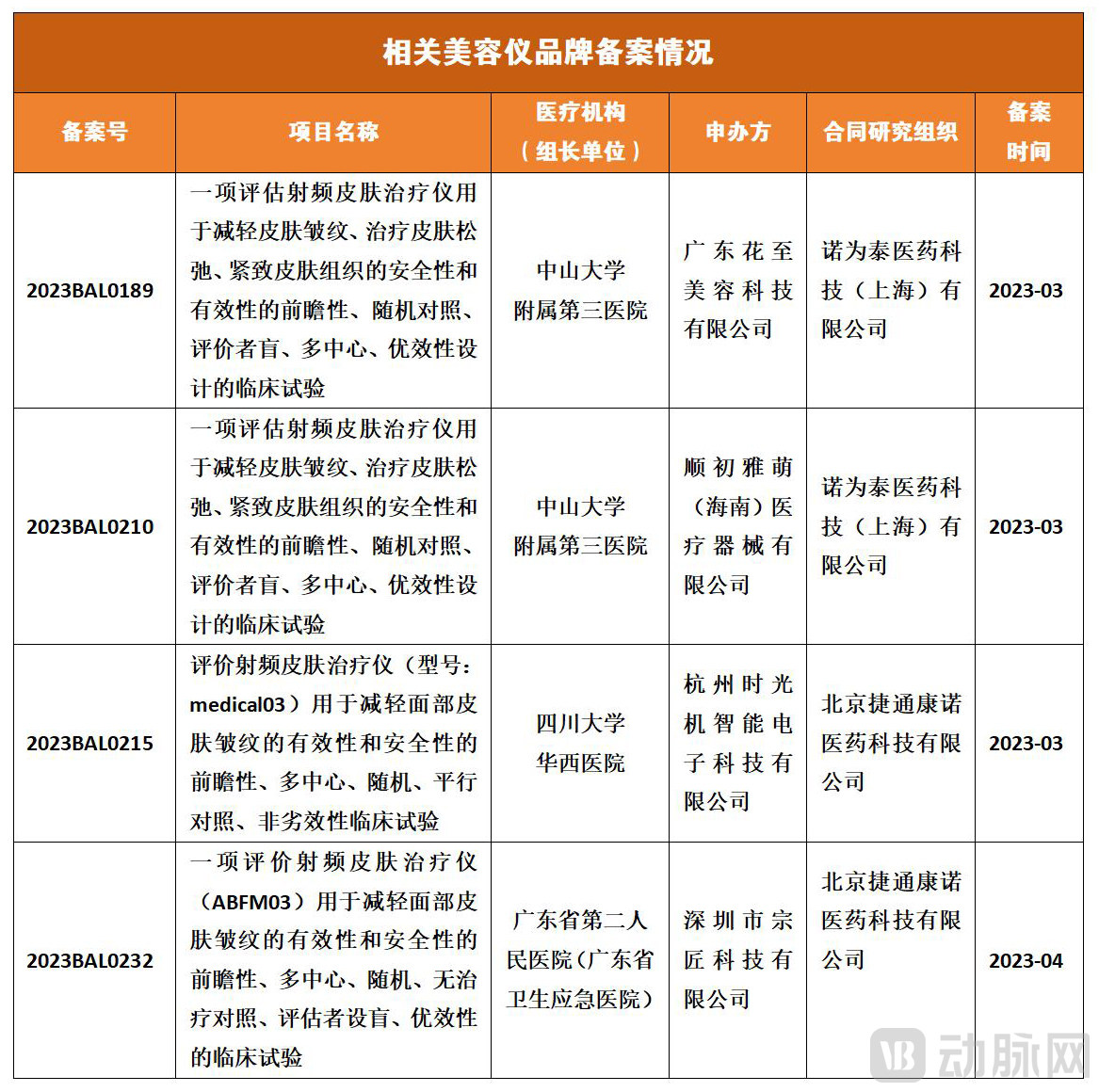
(Graphic by VCBeat; Source: Official Website of the Government Service Platform of the Ministry of Science and Technology)
Why Does Certification Take So Long? First, once a company decides to “obtain certification before market entry,” it must prepare application materials, including securing clinical trial registration. After registration is completed, the product can proceed to the subject enrollment phase of clinical trials, which generally takes 1–2 years. This is followed by medical device registration testing and reporting, which typically requires about six months. Moreover, after submitting the registration application, companies may be requested to provide additional research materials or supporting data, thereby extending the timeline.
However, it is important to note that in the classification of radiofrequency-based aesthetic devices,Not all radiofrequency products are classified as medical devices.On March 27, the National Medical Products Administration (NMPA) issued the “Interpretation on the Classification and Definition of Radiofrequency Therapeutic Devices and Radiofrequency Skin Therapeutic Devices,” which states that radiofrequency products not meeting the definition of medical devices are not regulated as such. For instance, radiofrequency products whose intended use does not fall under the scenarios specified in the NMPA’s “Announcement on Adjusting Certain Contents of the ‘Medical Device Classification Catalog’” but is limited to “non-invasive transdermal enhancement of serums (not for enhancing penetration of drugs or medical devices), promoting serum absorption, superficial skin cleansing, thermal massage, physical massage, skin relaxation, exfoliation,” or similar purposes, do not conform to the definition of medical devices and are therefore not regulated as medical devices.
On the other hand, the beauty device sector is beginning to diverge. First, industry consolidation is accelerating, with radiofrequency (RF) beauty device brands that secure regulatory approvals first poised to capture greater market opportunities. Second, demand is rising for other types of beauty devices and large-scale RF optoelectronic equipment.
Currently, industry changes have already begun. In addition to the aforementioned brands filing for clinical trials, many brand owners have ceased operations related to radiofrequency (RF) beauty devices. For instance, in 2023, Procter & Gamble announced the closure of both online and offline operations for its beauty device brand OPTE, while L'Oréal has shut down the flagship store of Clarisonic, its facial cleansing brush brand.
In addition, prices for related radiofrequency-based beauty devices have plummeted over the past few months. Data from a survey by Hongxing Capital Bureau shows that price discrepancies for the same brand’s products across different channels can reach as high as 74%.
“‘Rock-bottom’ sales are indeed occurring, predominantly among smaller-scale enterprises. Since these companies have largely not conducted clinical trials, it is certain that they cannot obtain Class III medical device certification. Consequently, such companies are opting for significant price reductions on online platforms to clear inventory. These data can be observed on platforms such as JD.com and Taobao,” stated Song Qingyuan, a senior investor.
“In fact, besides radiofrequency-based,”Common at-home beauty devices also include a range of products such as ultrasound-based, light spectrum-based, and microcurrent-based devices.“...but RF-based devices sell the best because they are marketed as having the most effective results,” Lei Li, founder of a leading Chinese manufacturer of high-end medical aesthetic devices, told VCBeat. He explained that RF beauty devices work by stimulating fibroblasts in the dermis to promote collagen regeneration, ultimately tightening the skin and reducing wrinkles. “This is the outcome most sought by consumers and the reason brands prioritize RF beauty devices; consumer demand is highly inelastic.”
In contrast, other types of beauty devices serve different purposes: ultrasonic devices primarily provide facial cleansing and nourishment; microcurrent devices enhance muscle fiber tension to achieve a lifting effect; and light therapy devices help smooth fine lines and maintain skin vitality.
“With the temporary market vacuum left by radiofrequency-based beauty devices, ultrasound- and microcurrent-based beauty devices are expected to see robust growth., because users' desire for beauty remains unchanged; theyHome Care SettingThis approach enables a cost-effective alternative to radiofrequency beauty devices; furthermore,From the perspective of radiofrequency efficacy, large-scale medical aesthetic energy-based devices meet this user demand.“...which includes treatments such as Thermage and DiamondTone. Aesthetic seekers with lower price sensitivity tend to choose medical aesthetic institutions for these services,” said Li Lei, founder of a leading Chinese manufacturer of high-end medical aesthetic devices.
In addition, another change deserves attention. According to the announcement requirements of the National Medical Products Administration (NMPA), for imported radiofrequency (RF) beauty devices, if they are not regulated as medical devices in their country of origin, corresponding regulatory basis and documentation proving that the product is approved for market sale in the country of origin must be provided. This presents a significant opportunity for the development of domestic brands.
It is not difficult to see that the implementation of these regulations has had a profound impact on the industry.
As a star category, home-use beauty devices have sparked several whirlwinds.
The first time was in 2015, when beauty devices began to gain widespread recognition among the general public in the Chinese market, driven by the reach of mobile internet.At that time, an increasing number of young people began to pay attention to and recognize light medical aesthetic-related products. Compact and portable home beauty devices, equipped with professional skincare functionalities, quickly gained popularity among young users.
However, as the industry is still in its nascent stage, user awareness and industry standards remain underdeveloped,Market Chaos and Endless Marketing Wars, which has led most beauty device manufacturers to neglect product quality, resulting in a collapse of the industry’s reputation.
Taking Fan Bingbing’s beauty brand “FANBEAUTY” as an example, its beauty device product sold thousands of units rapidly after its launch in March 2018, driven by marketing efforts and generating substantial revenue. However, issues such as unstable performance and overheating soon became frequent, ultimately leading to consumer rights disputes and significantly stalling subsequent growth. Consequently, the market quickly entered a cooling-off period.
The second instance occurred in 2021, when the venture capital market was at a fever pitch, and well-funded investment firms turned their attention to the beauty device market, which held significant potential for high-speed growth.According to the VCBeat database, around 2021, investment firms and corporations including IDG Capital, Shunwei Capital, Honghui Capital, Fortune Capital (Dachen Caizhi), Tiantu Investment, Aoniu Capital, Xinpao Capital, Sanqi Tiansheng, and Tencent all made strategic investments in the beauty device sector.
According to interview information from VCBeat at the time, there are two significant reasons why capital is betting on the beauty device sector: after the industry entered a cooling-off period, manufacturers of inferior products were continuously weeded out, allowing high-quality brands to emerge.There are promising investment targets in the market., andCapital’s Continued Optimism Toward the Entire Consumer Sector。
Furthermore, the growth potential of the beauty device market has revealed additional opportunities for investors. According to the “Research Report on Market Size and Development Trends of China’s Beauty Device Industry (2020–2026)” by Zhiyan Consulting, the market size of home-use beauty devices in China approached RMB 10 billion in 2023 and is expanding at a compound annual growth rate (CAGR) of over 30%, with projections indicating it will surpass RMB 20 billion by 2026.
How Hot Is the Market? According to big data from the Shangzhizhen Online Retail Platform, within the first four hours of the 2023 Tmall Double 11 pre-sale, all ten of the fastest-growing brands in the home appliances category were beauty device brands, including Flower Knows, Jimo, and JOVS. Rankings released by Douyin also showed that during the period from October 20 to October 31, the fourth through seventh places among the top ten brands by cumulative GMV in Douyin’s beauty industry were all occupied by beauty device brands.
But, like two sides of the same coin, hidden risks continue to emerge in the beauty device industry amid its rapid development.In addition to the marketing battles and safety hazards mentioned above, beauty devices also face controversies among consumers, such as being labeled a “IQ tax.” Furthermore, since radiofrequency (RF) beauty devices are energy-based products, some have caused adverse reactions in users, including skin redness, swelling, and tissue burns.
“It is quite difficult for consumers to evaluate the quality of products, as this involves specialized knowledge and entails a high learning cost. Therefore, raising the entry barriers for beauty devices and having regulatory authorities oversee compliance will significantly enhance user trust,” said an industry practitioner in a 2021 interview with VCBeat.Only regulatory intervention can truly guide the industry toward standardized development.
Therefore, in March 2022, after extensively soliciting industry feedback, the National Medical Products Administration (NMPA) decided to include radiofrequency-based aesthetic devices under the regulatory framework for Class III medical devices. As the most stringent regulatory category, Class III medical device regulations require that relevant products demonstrate their safety and efficacy and obtain a registration certificate before they can be manufactured or sold.
“This is a positive development.” In the view of Lei Li, founder of a domestic high-end medical aesthetics device company, after radiofrequency beauty devices were classified as Class III medical devices for regulatory purposes,Certified products do not need to expend additional effort and cost to address concerns about whether they are a scam or pose safety risks, thereby simplifying the user decision-making process and steering the industry toward healthier development.
Wang Zhen, a partner at Mingfeng Capital, similarly stated that the new regulations will have a profound impact on the industry, essentially driving a supply-side clearance—products without Class III medical device certification will be barred from the market, further highlighting the advantages of leading enterprises. Meanwhile, the sales models of products from these leading companies will also undergo changes.Overall, it is a process of industry consolidation, optimization, and compliance.”
After the implementation of mandatory certification for market entry, the beauty device sector has entered an era of regulatory compliance. How will the industry’s future development logic change?
From the perspective of Lei Li, founder of a domestic high-end medical aesthetics device company,The medical aesthetics industry is entering an era where product strength is the key competitive factor.The beauty device sector is no exception.In other words, while the first batch of radiofrequency-based aesthetic devices to obtain certification will gain a first-mover advantage, technical R&D capabilities and user experience will become the key determinants of product success as more products secure approval.
Therefore, at present, companies determined to cultivate the beauty device sector over the long term must continuously build up their technological reserves, particularly by achieving breakthroughs in optical components, electronic chips, and proprietary patented technologies and invention patents. They should also strengthen collaboration with relevant research institutes and universities, engage in exchanges with industry professionals, and explore greater possibilities for future business models.
In this regard, Lei Li cited as an example the logic underlying the development of optoelectronic devices,Beauty devices should also focus on exploring niche consumer segments.“As far as I know, mothers and individuals with prior experience in medical aesthetics constitute the primary consumer base for at-home beauty devices, and brands primarily consider their needs when positioning products. To achieve differentiation, greater attention should be paid to niche segments. For instance, the market for male medical aesthetic procedures is currently booming; could there be RF-based beauty devices specifically designed for men in the future?”
Senior investor Song Qingyuan mentioned,The beauty device industry will shift from a marketing-driven model to a product-driven one, requiring companies to adjust their strategies.“In the past, reaching users relied primarily on celebrity endorsements and social media virality; in the future, users may place greater emphasis on endorsements from leading experts and top-tier research institutions.”
Of course, navigating this process is by no means easy. Multiple industry experts interviewed believe that beauty device brands must not only continuously refine their technologies and improve their products, but also endure a prolonged period of solitude, bearing significant cost outlays and revenue fluctuations, which will be exceedingly challenging.
However, once this period is weathered, those innovators who dare to break through are bound to reap substantial rewards.
(Note: Song Qingyuan and Lei Li are pseudonyms, as requested by the interviewees.)
References:
1. Announcement of the National Medical Products Administration on Adjusting Certain Contents of the "Medical Device Classification Catalog" (No. 30 of 2022) https://www.nmpa.gov.cn/xxgk/ggtg/ylqxggtg/ylqxqtggtg/20220330144627167.html
2. Links to the registration websites of various beauty device brands
Huazhi: Public Notice on the Filing Status of International Cooperative Clinical Trials Involving Chinese Human Genetic Resources (March 3 to March 9, 2023)
https://fuwu.most.gov.cn/html/tztg/xzxkzx/20230321/123124648.html
YA-MAN, OGP: Public Notice on the Filing of International Cooperative Clinical Trials Involving Chinese Human Genetic Resources (March 10–16, 2023)
https://fuwu.most.gov.cn/html/tztg/xzxkzx/20230328/123124651.html
Mi Guang: Public Notice on the Filing of International Cooperative Clinical Trials Involving Chinese Human Genetic Resources (March 17 to March 23, 2023)
https://fuwu.most.gov.cn/html/tztg/xzxkzx/20230403/123124658.html
3. NMPA Clarifies Classification of Radiofrequency Beauty Devices: Not All RF Products Are Classified as Medical Devices
https://mp.weixin.qq.com/s/NvDeqOVSf7KBxjhJfsjTkA