

InferVision Achieves 'Three Certificates in One Month,' Expanding the Boundaries of Imaging AI

Infervision
Artificial Intelligence Product Developer
Recently, Infervision, a leading enterprise in medical artificial intelligence, obtained the Class III medical device registration certificate for its auxiliary diagnostic software for head and neck CTA. In less than half a month, the company replicated its regulatory approval success in head and neck CTA and intracranial aneurysms, following its earlier achievement with liver and kidney surgical planning software.
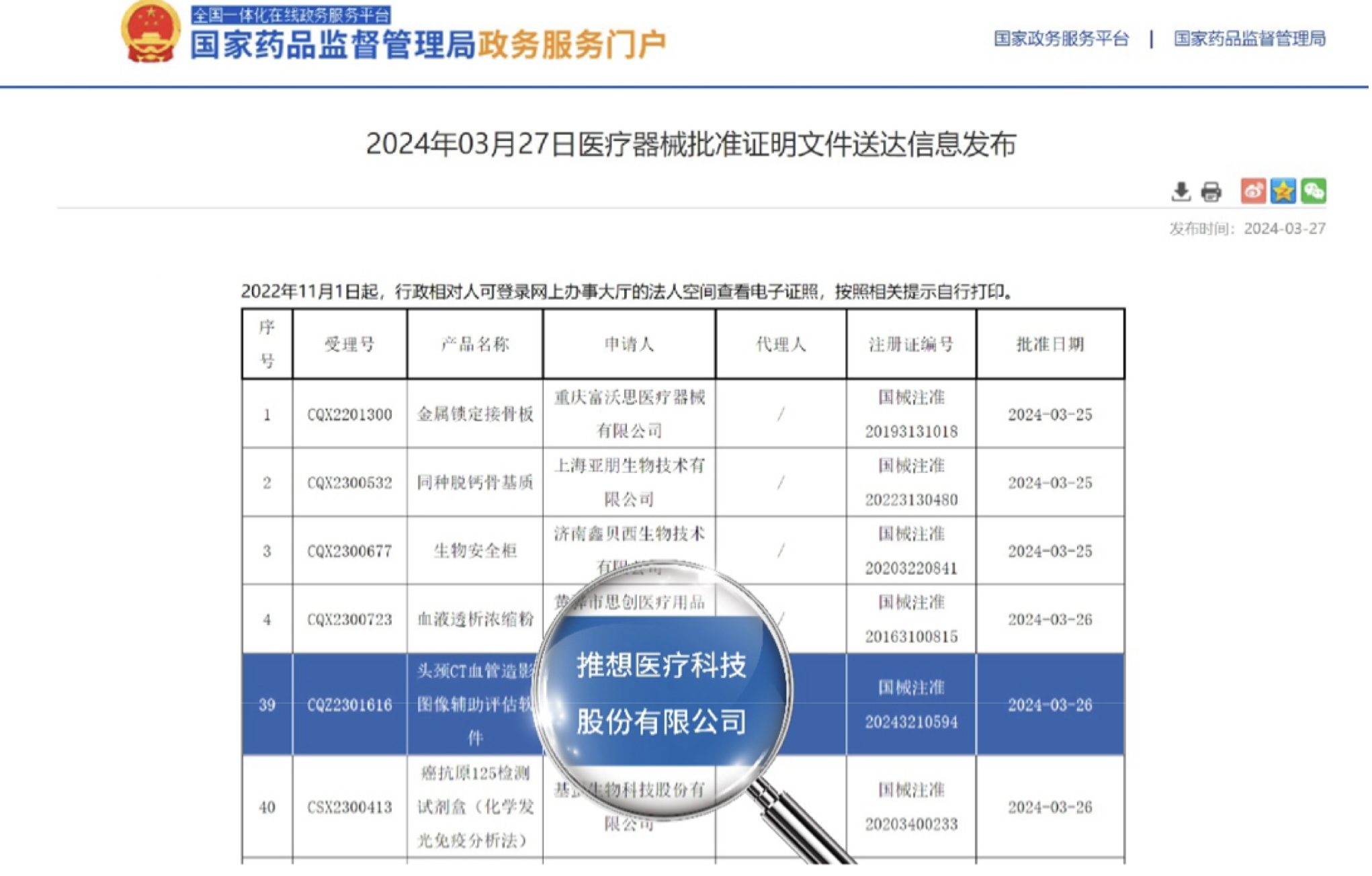
For Infervision, the approval of head and neck CTA has created a new model for the commercial implementation of AI. Previously, imaging AI was deployed in healthcare in isolated instances, with approved products sold independently and rarely integrated. Now, Infervision can integrate two new AI solutions with its previously approved Class III certification for intracranial hemorrhage to form a comprehensive one-stop intelligent solution for stroke care, thereby multiplying the clinical value of medical AI.
Infervision’s liver and kidney surgical planning system, the second Class III medical device certificate for tumor surgical planning obtained by the company, underscores its strengthened footprint in the field of surgical interventions. Together with its lung surgical planning product launched late last year, Infervision is now positioned to deliver a more comprehensive suite of intelligent solutions within the multi-billion-dollar minimally invasive surgery market.
With Three Certificates in One Month, Infervision Successfully Transitions from Focusing on Assisted Diagnosis to Parallel Diagnosis and Treatment. While Most AI Companies Are Still Immersed in Empowering Radiology with AI, Infervision Has Officially Entered the New Frontier of the Surgical Market.
Infervision has chosen head and neck CTA as the new focal point for its AI-assisted diagnosis and treatment, with its core driving force stemming from the severe situation in the prevention and control of cerebrovascular diseases.
Population data released by the National Bureau of Statistics show that as of the end of 2022, China’s population aged 60 years and above reached 280.04 million, accounting for 19.8% of the total population; those aged 65 years and above numbered 209.78 million, representing 14.9% of the total population. With the further intensification of population aging, nearly 300 million people in China will enter the peak incidence period for head and neck arterial diseases.
Head and neck CTA, as one of the important imaging examinations for head and neck arterial diseases, can provide a comprehensive observation of intracranial vessels in a rapid, non-invasive manner with relatively few complications, thereby enabling early screening and treatment of head and neck arterial diseases.
Based on the configuration of imaging equipment, some primary healthcare institutions in China already possess 16-slice or higher multi-detector spiral CT scanners. Therefore, using head and neck CTA as the core diagnostic modality can theoretically meet the needs for cerebrovascular and cardiovascular disease screening in populations of this scale.
However, due to the shortage of radiologists at the primary care level, limited diagnostic experience, and imperfect post-processing workstations, the number of primary medical institutions capable of performing head and neck CTA examinations is quite limited. As a result, a large amount of equipment has not fulfilled its expected value in the screening and prevention of cerebrovascular diseases.
Even experienced physicians are constrained by the efficiency of diagnostic workflows. Generating a complete head and neck CTA report requires complex reconstruction procedures, including image post-processing, bone subtraction, vessel extraction, curved planar reformation (CPR) of each individual artery, straightening, and measurement. Even for seasoned clinicians, this process typically takes 15 to 30 minutes to complete.
Infervision’s newly approved AI for head and neck CTA can alleviate the aforementioned issues to a certain extent. According to Chen Kuan, CEO of Infervision, the one-stop intelligent solution for stroke enables automated “vascular reconstruction + lesion analysis + film layout + structured report generation” from a single CT scan, with the final results submitted for physician review. The entire process takes approximately five minutes.
For physicians at tertiary hospitals, the value of AI-powered head and neck CTA lies not only in improving reporting efficiency—enabling them to serve more patients—but also in “liberating” them from repetitive and time-consuming reconstruction tasks, allowing them to devote their time to higher-value activities.
Primary care physicians also benefit from this. Chen Kuan told VCBeat, “Infervision’s AI-powered head and neck CTA product, like its other AI solutions, essentially replicates the diagnostic capabilities of specialist physicians, thereby extending the expertise of tertiary hospital specialists to primary care settings. Nowadays, primary care physicians only need to ensure the validity of CT scans; the AI automatically performs rapid and accurate post-processing of the images and generates structured reports and films with a single click. In this process, AI lowers the diagnostic threshold for primary care physicians, improves diagnostic accuracy, and ultimately achieves a scalable enhancement of cerebrovascular disease diagnosis and treatment capabilities at the primary care level.”
It should be noted that the Infervision medical technology product, the Head and Neck CT Angiography Image-Assisted Evaluation Software, approved this time was led by Director Xu Haibo from Zhongnan Hospital of Wuhan University. The effectiveness and safety validation of the product were completed through a blinded, multicenter clinical trial.
By comparing the software results with those from the gold-standard expert panel, relevant clinical trials demonstrated the AI’s exceptionally high performance in terms of sensitivity and specificity for detecting and localizing head and neck vascular stenosis, validating that the product can achieve automatic vessel segmentation, localization, and stenosis assessment predictions within an extremely short timeframe.
It is important to note that head and neck CTA is not a standalone product. Combined with Infervision’s previously approved products, its one-stop stroke solution will support AI-assisted evaluation of multi-modal imaging, including NCCT, CTP, and CTA. Furthermore, Infervision has disclosed plans to launch MR-related products for stroke, aiming to thoroughly address AI-based diagnosis of cerebrovascular diseases. At that point, Infervision’s capabilities will span the entire multi-modal, end-to-end workflow of stroke diagnosis and treatment. The integrated solution will not only enable precise early screening for populations at high risk of stroke but also facilitate rapid triage for patients in the hyperacute and acute phases of stroke, providing fast and accurate diagnostic decision support during emergency care. Additionally, it will offer intelligent follow-up comparisons for post-treatment patients and quantitative assessment of therapeutic efficacy, thereby covering the vast majority of diagnostic needs for cerebrovascular diseases.
In the field of medical imaging AI, there is a prevailing tendency to expand horizontally by targeting specific diseases, with few companies willing to take the risk of pursuing vertical integration. However, for Infervision, “a company that has always been innovating,” the progression from assisted diagnosis to assisted treatment may be an inevitable step.
Over the past few years, Infervision has established its presence in four key high-volume diagnostic and therapeutic areas—thoracic, abdominal, cerebral, and cardiac—and has achieved remarkable results. In this context, Infervision must not only develop multi-disease and multi-modal AI solutions around these four scenarios to enhance its existing ecosystem but also identify new, systematic, and vast “blue ocean” opportunities beyond auxiliary support to sustain rapid revenue growth. Driven by these dual imperatives, the “horizontal and vertical” strategy has become inevitable.
The results indicate that the risks undertaken by Infervision have yielded substantial returns. The lung surgery planning software, approved last December, works in synergy with the recently approved liver and kidney surgery planning software, enabling Infervision to successfully penetrate the surgical market, which is valued at tens of billions of yuan. Furthermore, Infervision has secured the world’s first and second Class III medical device certificates from the National Medical Products Administration (NMPA) for AI-assisted cancer surgery treatment. This achievement not only fulfills Infervision’s innovative commitment to China’s surgical healthcare sector but also signifies that AI healthcare has fully evolved from the 1.0 era of large-scale early screening and the 2.0 era of precise diagnosis into the 3.0 era of precision therapy.

The newly approved AI-4D Intelligent Surgical Planning System for Hepatobiliary Surgery is a distinctive product that organically integrates deep learning and image recognition technologies from artificial intelligence with medical imaging. It enables rapid and precise, fully automated segmentation and 3D reconstruction of images, extraction of anatomical structures, multi-phase image registration, and 4D fused imaging. The system provides stereoscopic visualization of the liver, vascular system, and surrounding organs—including the spleen, gallbladder, and bile ducts—while accurately simulating tumor margin ranges and calculating the future liver remnant ratio. This assists physicians in formulating surgical plans and effectively enhances the precision and success rate of hepatic surgeries.
To date, Infervision has achieved commercial deployment in the majority of high-volume scenarios across radiology, thoracic surgery, general surgery, hepatobiliary surgery, and urology, centered on medical imaging.
In the radiology department, Infervision’s deeply cultivated solutions for four major scenarios—chest, abdomen, brain, and heart—have all obtained Class III medical device certifications from the NMPA. The company has developed comprehensive, integrated solutions for each organ system, long moving beyond single-point AI-assisted diagnostic tools focused solely on conditions such as pulmonary nodules and pneumonia.
In the field of surgical surgery, Infervision has secured both the first approval for lung surgery planning and the first approval for abdominal surgery planning. Leveraging medical imaging, it has created a "golden duo" of thoracic and abdominal surgery planning solutions, ushering in a new era of surgical procedures and successfully penetrating the core of the multi-billion-dollar surgical planning market.
With this, Infervision’s success in both assisted diagnosis and assisted treatment has demonstrated a new possibility to the medical imaging AI industry: provided that clinical needs are accurately identified, imaging-related AI technologies can be extended to other scenarios where imaging is required.
Therefore, the leap achieved by Infervision is merely the beginning. Last July, Infervision unveiled its latest breakthrough in imaging AI technology transfer—the “Longdianjing® Puncture Surgical Robot,” an AI-powered surgical robot. With this innovation, it has made a strong entry into the departments of interventional radiology, oncology, and thoracic surgery, revealing its ambition for “hospital-wide AI.”
Following this trend, Infervision’s AI capabilities are expected to gradually encompass various interventional and ablation procedures. Its product pipeline for image fusion-based target guidance, surgical navigation, and surgical robots is also advancing steadily. In line with this trajectory, we may see imaging AI applications expand into more clinical departments in the future, ultimately enabling intelligent, AI-driven diagnosis and treatment across all medical imaging-related departments hospital-wide.