

Breaking Down Unreasonable Bidding Barriers: The 'Wolves' Are Coming to China's Trillion-Yuan Medical Market
Rules of the Bidding Market Are About to Change!
Recently, the General Office of the State Council issued the Action Plan for Solidly Advancing High-Level Opening-Up and Making Greater Efforts to Attract and Utilize Foreign Investment, proposing 24 measures across five areas. Among them, the Action Plan states:Accelerate the revision of the Bidding and Tendering Law to eliminate unreasonable restrictions that hinder enterprises of all ownership types from participating equally in bidding and tendering activities.。
Meanwhile, according to the Government Work Report, one of the government’s tasks for 2024 is to effectively implement national treatment for foreign-invested enterprises and safeguardParticipate equally in government procurement, bidding and tendering, in accordance with the law;Standard setting to promote the resolution of issues such as cross-border data flows.
Currently, local governments have responded promptly. On March 28, Beijing deliberated the “Beijing Municipal Regulations on Foreign Investment (Second Draft for Deliberation).” The regulations stipulate that when formulating policy measures closely related to the production and business operations of market entities—such as market access, bidding and tendering, and government procurement—the municipal and district people’s governments and their relevant departments shall conduct fair competition reviews.No discriminatory policies or measures shall be formulated, implemented, or implemented in disguised forms against foreign-invested enterprises.。
Zhejiang Province has also issued the "Measures for Fair Competition Review in Zhejiang Province." The Measures include a dedicated articleConduct focused reviews of typical illegal practices, such as the imposition of unreasonable conditions in tendering, bidding, and government procurement.. Among these, “restrictions on the bidder’s location and ownership structure” are key areas of review.
With the implementation of these policies, domestic tendering and procurement entities are expected to remove identity-based restrictions on bidders, making China’s bidding rules more equitable and transparent.
In the healthcare industry, tendering and bidding is a key method for hospital procurement.According to data from the Caizhao.com Data Center: September 2021–September 2022,The total value of public tenders in the healthcare industry amounted to approximately RMB 381.04 billion. With changes in the rules governing bidding and tendering processes, the landscape of this trillion-yuan market is expected to undergo significant transformation.。
Undoubtedly, the changes in bidding rules will inevitably benefit foreign companies and imported products. However, whether they can capture the domestic market will depend on specific market competition. How the domestic market evolves will also hinge on the strategic moves of overseas giants and Chinese enterprises.
Over the past decade, import substitution with domestically produced alternatives has been the central theme of the healthcare industry, with policy makers, investors, and innovative enterprises all striving toward this goal.
In 2016, the General Office of the State Council issued the "Guiding Opinions on Promoting the Healthy Development of the Pharmaceutical Industry," requiring that for government procurement projects, domestically produced drugs and medical devices shall be prioritized if they meet the specified requirements.In principle, domestically produced products must be procured., and gradually improve the configuration level of domestically produced equipment in public medical institutions.
Since then, governments and departments at all levels have continuously introduced policies to support the development of the domestically produced medical device industry and have employed various measures to facilitate the commercialization of domestically produced medical devices.
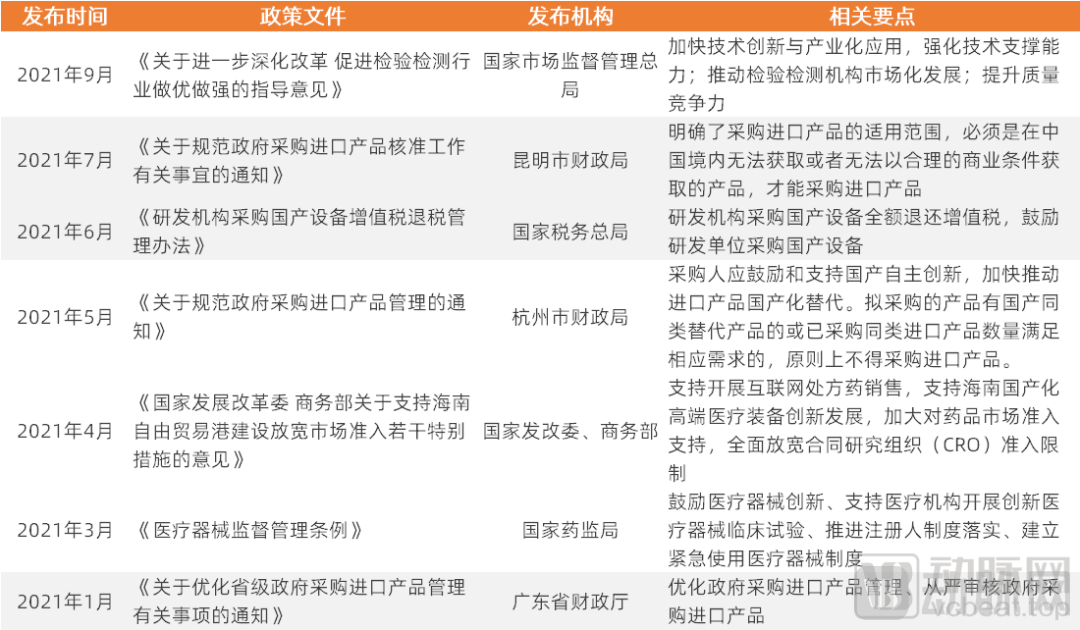
(Documents Partially Supporting Domestically Produced Medical Devices)
First, policies support domestically produced medical devices from the hospital procurement side.Multiple local governments, including those in Shenzhen and Jiangsu, have issued policies supporting domestically produced goods: government procurement shall prioritize the purchase of domestic goods, works, and services;For the procurement of imported products that is strictly necessary, the review procedures shall be strictly followed.. Some local governments have also successively issued notices,RequirementsAll public medical institutions are prohibited from procuring imported products without approval.. For imported products that are genuinely required, an audit-based management system shall be implemented. Meanwhile, local governments alsoEncourage Medical HospitalsPrioritize the procurement of domestically produced medical devices, gradually improve the configuration level of domestically produced medical equipment and reduce healthcare costs.
Second, policies restrict the categories of imported products eligible for procurement.Local governments are gradually reducing the variety and volume of imported medical devices by issuing documents such as the “Procurement List for Imported Medical Equipment” and the “Catalog of Imported Medical Device Products.” For instance, the Zhejiang Provincial Department of Finance issued a document that reduced the number of imported medical equipment items eligible for procurement from 215 in the previous version to 195. The Guangdong Provincial Health Commission released a catalog of imported products, cutting the number of imported medical devices available for procurement from 132 to 46 compared with the previous two years. Meanwhile, a public notice on the Sichuan Provincial Government Procurement Network specified that only 59 types of medical equipment are permitted to be sourced as imported products.
Finally, national departments stipulate the procurement ratio for domestically produced medical devices to support domestic products.. Previously, the Ministry of Finance, the Ministry of Industry and Information Technology, and other departments issued documents stipulating the requirements for the proportion of domestically produced medical devices and instruments to be procured by government agencies (public institutions). Among these, 137 types of medical devices are required to be 100% sourced from domestic manufacturers, 12 types require 75% domestic procurement, 24 types require 50% domestic procurement, and 5 types require 25% domestic procurement.
Supported by a multitude of policies, China’s medical device industry ushers in a 10-year golden period of developmentDuring this period, domestic products in fields such as coronary stents, drug-coated balloons, orthopedic implants, surgical staplers, medical imaging equipment, and biochemical reagents achieved import substitution, with the localization rate of related products exceeding 50%.
For instance, coronary stents, previously monopolized by Johnson & Johnson, Boston Scientific, and Medtronic, achieved a domestic production rate of over 70% in 2020; the trauma orthopedics market, formerly dominated by multinational giants such as Stryker and Zimmer Biomet, reached a domestic production rate of 69.56% in 2020; in the traditional surgical stapler sector, Chinese manufacturers have not only secured a dominant position in the Chinese market but also exported their products globally...
Meanwhile, domestic companies have begun to encircle multinational brands in multiple high-end medical device sectors. For instance, medical imaging equipment from Chinese brands such as Neusoft, United Imaging, Kuangteng, and Minfound is starting to capture market share from GE HealthCare, Philips Healthcare, and Siemens Healthineers; Chinese enterprises like MicroPort MedBot, Jingfeng Medical, and Sizhe Rui have initiated price wars with the da Vinci Surgical System...
In the face of the wave of domestic substitution in the Chinese market and the rapid rise of Chinese manufacturers,Some foreign-funded companies choose to exit the Chinese market, such as orthopedic giant ZimVie announcing in March 2023 that it would completely withdraw its spine business from the Chinese market;Others have chosen to implement localization strategies., as the "Big Three" medical imaging manufacturers—often referred to as "GPS"—have raised the banner of localization, competing in the market under their domestic identities.
According to the "Administrative Measures for Government Procurement of Imported Products," imported products refer to those produced outside the customs territory of China that have entered the Chinese territory through customs declaration and inspection by China Customs. Medical equipment manufactured domestically in China by foreign-invested medical device companies is also considered domestically produced and is entitled to the same treatment as domestic products.
Based on this, world-class medical device companies such as Medtronic, Johnson & Johnson, Boston Scientific, Olympus, and the “GPS” group have already established or plan to build production bases in China to obtain Chinese medical device registration certificates and compete in the market as domestically produced products.
If the overseas giants of the past decade were “bosses” on normal difficulty, today’s medical device titans will be bosses on epic difficulty. After nearly a decade of smooth sailing, China’s medical device industry has finally reached a higher-difficulty level.
The recently released “Action Plan” proposes several specific measures to promote fairness, including: advancing the opening-up of sectors such as telecommunications and healthcare; eliminating discriminatory practices against foreign-invested enterprises in government procurement, bidding, and tendering activities; and promoting amendments to the Bidding and Tendering Law.Eliminate unreasonable restrictions that hinder enterprises of all ownership types from participating equally in bidding and tendering.。
Previously, the state had already taken actions to optimize a fair competitive environment and expand market access. According to the "2024 Government Work Report," in 2023, the state cleared out a batch of policy provisions that hindered fair competition and separately introduced development policies supporting state-owned enterprises, private enterprises, and foreign-invested enterprises.
The Work Report also pointed out that the government’s tasks for 2024 include creating a favorable environment for fair competition and dynamic development among enterprises of all ownership types; strengthening regulation and management of the bidding and tendering market; and effectively implementing national treatment for foreign-funded enterprises to safeguard their lawful rights and interests.Equal participation in government procurement, tendering and bidding,Standard Setting...
Based on the “Action Plan” and the “Work Report,” foreign investors, perhaps recognizing the nation’s resolve to foster a fair business environment, are accelerating their investments in China.. According to the Ministry of Commerce, in January 2024, foreign investors established 4,588 new foreign-funded enterprises in China, representing a year-on-year increase of 74.4%. Foreign capital inflow into the high-tech manufacturing sector grew by 40.6%, among whichManufacturing of Medical Instruments and Equipment, as well as Measuring and Testing Instruments, Grew by 558.8%。
To date, numerous leading global medical device and pharmaceutical companies have announced increased investments in China. In January 2024, full-scale construction commenced on AstraZeneca’s $700 million project to establish a manufacturing and supply base for metered-dose inhalers. In March 2024, AstraZeneca announced a $475 million investment to build a new small-molecule innovative drug manufacturing facility in the Wuxi High-Tech Zone. That same month, Novo Nordisk announced an additional investment of approximately RMB 4 billion in Tianjin to expand its sterile formulation production capacity.
Furthermore, Eli Lilly CEO David Ricks recently stated that the company is “willing to increase investment in China and strengthen R&D collaboration to better serve the Chinese market.”
Medtronic’s Global Chairman and CEO, Geoff Martha, also stated, “Medtronic plans to establish a new innovation center in China to bring more high-quality products to Chinese consumers.”
For domestic healthcare enterprises, the Action Plan requires foreign-invested enterprises to participate fairly in bidding processes, meaning that an increasing number of imported medical products will enter market competition. In addition to domestic competition, Chinese-made products will also face competition from imported products. In the healthcare sector,This regulation primarily affects medical equipment procured through bidding and tendering, while consumable products, which are less frequently sourced via this method, are impacted to a lesser extent.Among them, domestic enterprises with significant product advantages will achieve greater success in a fairer market environment.
The Action Plan allows qualified foreign-invested enterprises to invest in areas such as the development and application of gene diagnosis and treatment technologies in free trade zones including Beijing and Shanghai, meaning that foreign-funded enterprises will be able to enterPreviously restricted high-end markets that were only open to domestic enterprise investment. On the one hand, domestic enterprises in related fields will face challenges from overseas competitors. On the other hand, companies operating in these high-end, specialized sectors—now open to foreign investment—will be able to diversify their financing channels, enhance their fundraising capabilities, and secure investment opportunities from foreign firms.
The Action Plan supports foreign-invested enterprises in participating, under the same conditions, in standardization technical committees or relevant standardization organizations for advanced manufacturing and other fields, and in engaging equally in the formulation and revision of standards. This means that foreign-funded enterprises are no longer merely rule followers, but alsoThe Opportunity to Become a Rule-MakerParticipating in the development of standards allows relevant enterprises to set their own parameters as industry benchmarks, gain early access to standard-related information, and seize a competitive advantage in the market.
Overall,A fairer healthcare market will select for companies with technological innovation and distinct product advantages, while eliminating those that rely on relationship-based sales, lag in technology, or offer products with low cost-performance ratios.。
From the perspective of measures to eliminate unreasonable rules in bidding and tendering, the “Action Plan” is expected to directly affect those products, services, and sectors where procurement is primarily conducted through bidding and tendering.
In the healthcare industry, niche markets such as X-ray machines (CT, DSA, etc.), magnetic resonance imaging (MRI) equipment, ultrasound diagnostic imaging devices, endoscopic equipment, and surgical robots will be significantly impacted.
According to statistics from Medidata Cloud, the total winning bid amount for X-ray machines in 2022 was approximately RMB 53.678 billion, of which CT equipment accounted for about RMB 28.954 billion and DSA equipment for about RMB 13.512 billion. In addition, the total winning bid amount for magnetic resonance imaging (MRI) equipment in 2022 was approximately RMB 23.620 billion, that for ultrasound diagnostic imaging equipment was RMB 22.262 billion, and that for endoscopy-related products was RMB 19.831 billion.
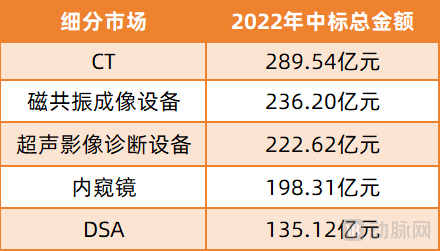
(Total Bid Winning Amounts in Selected Market Segments in 2022)
According to Medical Device Data Cloud, there were approximately 527 winning bids for surgical robots in 2023, with the total bid amount increasing by 62.5% year-on-year and the total number of bids rising by 26.7% compared to the same period last year.
In the medical imaging market for equipment such as CT and MRI scanners, domestic companies including United Imaging Healthcare, Mindray Medical, Neusoft Medical, and SonoScape have experienced rapid growth in recent years, with several ranking among the top 10 enterprises by annual bid-winning value in their respective fields in 2022. Their competitors are multinational giants such as GE, Philips, Siemens, Olympus, and Fujifilm.
Among them, the “GPS” trio initiated their localization strategies early on and established production centers in China. In April 2023, Olympus held a signing ceremony for its medical device production and R&D base in the Suzhou Industrial Park, marking the first time its core products were manufactured outside Japan. Pentax Medical and Karl Storz also announced in 2023 that they would establish production factories and manufacturing bases in Shanghai.
In the surgical robot market, domestic brands such as Tinavi, Huake Jingzhun, Edge Medical, Baihui Weikang, MicroPort MedBot, and Sizherui all achieved commercialization in 2023 and are accelerating their growth. In the same year, the da Vinci Surgical System obtained “National Medical Device Registration Approval,” thereby being reclassified as a domestically produced product.
Before the campaign to “eliminate unreasonable restrictions in bidding and tendering” gained momentum, these companies had already taken the lead in achieving localization, began participating in bids as “domestically produced” entities, and successfully won the contracts.
Everything appears unchanged, yet in reality, everything is evolving. With the removal of unreasonable restrictions on bidding processes, the bidding market will become more equitable and transparent.Commercial competition in the medical market, such as medical imaging, will increasingly rely on product advantages and cost-effectiveness., rather than other unspoken factors. Meanwhile, allowing devices with “National Medical Device Registration (Import)” status to participate fairly in tenders means that multinational giants with extensive product portfolios will enjoy greater advantages as they compete against devices with “National Medical Device Registration (Domestic)” status.
According to industry feedback, the Action Plan will soon be implemented at the execution level. For instance, in March 2024, the Fujian Provincial Development and Reform Commission introduced five measures to address issues in the bidding and tendering sector, such as difficulties in winning bids, as well as “glass doors,” “revolving doors,” and “spring doors.” It is expected that once these policies are fully implemented, China’s healthcare market will become more equitable and transparent.