

Basking Biosciences Files for IPO Following $55M Series A Led by ARCH Venture Partners

Basking Biosciences
Developer of Acute Ischemic Stroke Therapy

ARCH Venture Partners
Venture Capital Firms

Insight Partners
Venture Capital and Private Equity Firms

Solas BioVentures
Venture Capital Firm

Platanus
Software Product Developer

RTW Investments
Biopharmaceutical Investment Institutions

Longview Ventures
Venture Capital Firms

Rev1 Ventures
Venture Capital Firms
In January this year, biopharmaceutical company Basking Biosciences (hereinafter referred to as “Basking”) successfully completed$55 millionof financing, with this round led by one of the largest venture capital firms in the U.S. life and health sectorARCH Venture Partners Leads the Round, other investors include Insight Partners, Platanus, Solas BioVentures, RTW Investments, Broadview Ventures, Rev1 Ventures, and The Ohio State University.
According to the VBInsight database, this financing round was in 2024ARCH's inaugural exclusive lead investment。Basking, founded in 2019, is currently developing a reversible thrombolytic therapy for acute ischemic stroke (AIS) and leveraging biochemical properties to develop aptamers with high affinity and specificity for proteins involved in coagulation and hemostasis.
What did ARCH, which has invested in RNA drug giant Alnylam Pharmaceuticals, gene therapy company Bluebird Bio, CAR-T cell therapy company Juno Therapeutics, and base editing company Beam, see in Basking?
Basking’s new drug program is based on research conducted in the Duke University laboratories of Dr. Bruce Sullenger and Dr. Shahid Nimjee. These two scientists are not only the founders of Basking but also renowned experts in the generation and application of RNA aptamers.

Image source: Basking official website
Shahid Nimjee earned his undergraduate degree from Yale University and subsequently obtained his M.D. from Duke University. After graduation, he served as a professor and practicing neurosurgeon at The Ohio State University Wexner Medical Center (OSUWMC), specializing in the treatment of stroke patients. During his medical school internship, Dr. Nimjee frequently encountered patients with ischemic stroke caused by cerebral hypoxia due to thrombotic occlusion or arterial stenosis; however, effective clinical protocols were lacking at that time.
In his quest to identify effective clinical treatment regimens, he joined the research laboratory of Dr. Bruce Sullenger at Duke University. The laboratory focuses on evaluating the potential of anti-von Willebrand factor (vWF) agents and their antidotes in the treatment of thromboembolic stroke. Notably, Dr. Bruce Sullenger is a globally renowned expert in RNA biology, as well as the Joseph W. and Dorothy W. Beard Distinguished Professor of Experimental Surgery and Director of the Center for Translational Research at Duke University. At that time, Dr. Sullenger had just begun exploring an emerging field within RNA biochemistry: aptamers.
The term “aptamer” is derived from the Latin words “aptus,” meaning “fit,” and “meros,” meaning “part.” Aptamers are short, single-stranded DNA or RNA molecules that can selectively bind to specific targets, including proteins, peptides, carbohydrates, small molecules, toxins, and even living cells. After joining Dr. Sullenger’s research laboratory, Nimjee began investigating the use of aptamers for stroke treatment.
Following in-depth analysis of thrombus tissue extracted from the brain tissue of patients with large-vessel occlusion stroke, Dr. Nimjee discovered that the thrombi contained not only fibrinogen (a protein that promotes clot formation) but also platelets and an important blood factor—von Willebrand factor(vWF). vWF is a key structural component of thrombi and plays a driving role in the coagulation process. It is distributed throughout the entire thrombus, responsible for thrombus formation, stabilization, and propagation.
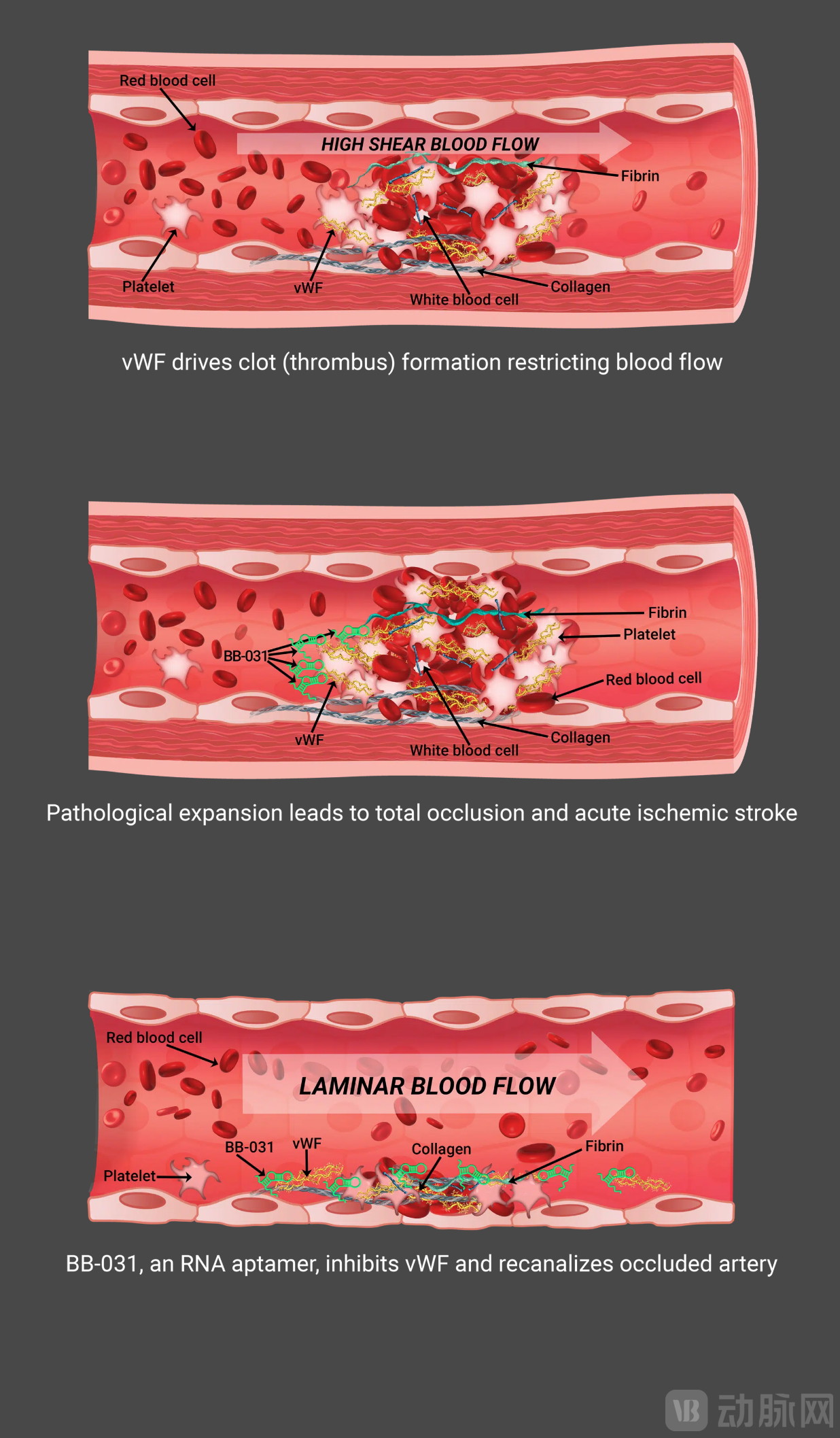
Image source: Basking official website
Dr. Nimjee’s team further confirmed that patients with stroke have higher levels of von Willebrand factor (vWF) than non-stroke patients. Furthermore, in preclinical models of large-vessel occlusion stroke, they successfully disrupted thrombi after formation by using aptamers to target vWF, thereby reducing the incidence of cerebral stroke. Based on this finding, they developed a drug namedBB-031RNA aptamer that binds to vWF and inhibits its activity.
BB-031 can exert thrombolytic effects immediately after injection and rapidly restore normal coagulation function after discontinuation of administration. Compared with existing recombinant tissue plasminogen activator (rtPA),BB-031 features a wider therapeutic window and higher specificity, binding exclusively to von Willebrand factor (vWF) to selectively dissolve vWF-mediated thrombi without affecting other types of thrombi or normal vascular function.Studies conducted in both small and large animal non-clinical models of ischemic stroke have demonstrated that BB-031 can reopen occluded cerebral arteries and restore cerebral blood flow within 6 hours after stroke onset.
In the Phase 1 clinical study, volunteers received BB-031 or placebo via intravenous bolus injection in a 6:2 ratio, with single ascending doses ranging from 0.1 mg/kg to 4.0 mg/kg. The study demonstrated that BB-031 exhibited a favorable safety and tolerability profile throughout the 28-day observation period, with no significant adverse events reported. Basking plans to initiate the RAISE study, a Phase 2 clinical trial of BB-031 for acute ischemic stroke (AIS), this year.
In addition, the Nimjee team also designed a product namedBB-025specific reversal agent. This is a fast-acting reversal oligonucleotide that complements BB-031, capable of rapidly neutralizing the pharmacological activity of BB-031 to promptly halt thrombolytic effects in the event of bleeding or other complications. According to Basking’s official website, BB-025 is about to enter Phase I clinical trials.
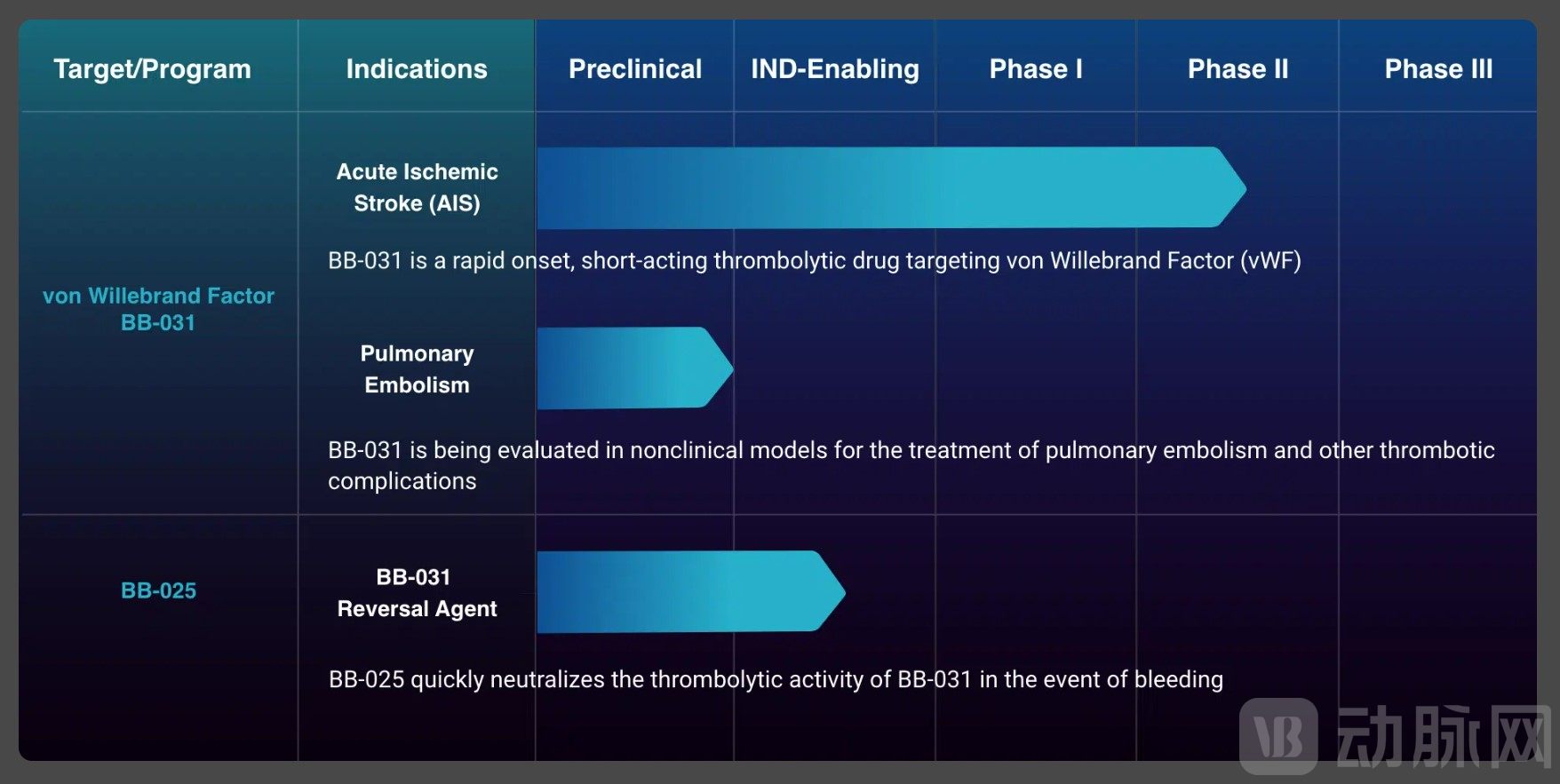
Image source: Basking official website
The key to treating acute ischemic stroke (AIS) lies in the early recanalization of occluded vessels to salvage the ischemic penumbra. Since the 1995 NINDS trial established the cornerstone role of recombinant tissue plasminogen activator (rt-PA) in intravenous thrombolysis for AIS, extensive clinical practice and experimental studies have confirmed that intravenous thrombolysis can effectively salvage the ischemic penumbra, significantly alleviate neurological deficits in AIS patients, and improve prognosis. Currently, intravenous thrombolysis is recommended by the Chinese Guidelines for the Diagnosis and Treatment of Acute Ischemic Stroke (2023) as one of the most effective therapeutic measures for improving outcomes in acute ischemic stroke.
Among intravenous thrombolytic agents, rt-PA is currently the recognized first-line choice. In addition, the novel thrombolytic drug tenecteplase (TNK) is garnering increasing attention. Compared with rt-PA, TNK has a longer half-life, offers more convenient administration, and achieves higher rates of vascular recanalization, demonstrating greater potential for clinical application.
In a series of clinical studies, researchers have found that TNK at a dose of 0.25 mg/kg is associated with better functional outcomes and a lower risk of hemorrhagic transformation compared with other doses. In 2022, the AcT trial presented at the European Stroke Organisation Conference (ESOC) further confirmed that, within the thrombolytic treatment window, TNK at 0.25 mg/kg was non-inferior to standard-dose alteplase at 0.9 mg/kg, providing robust evidence for the use of TNK within the 4.5-hour intravenous thrombolysis window.
However, it is worth noting that these studies were primarily conducted in Western countries with predominantly White populations; therefore, their results cannot be directly applied to Asian populations, particularly given that Asians are considered to have a higher risk of hemorrhagic transformation after thrombolysis. To address this issue, the research team at Beijing Tiantan Hospital, Capital Medical University, launched the TRACE (Tenecteplase Reperfusion therapy in Acute ischaemic Cerebrovascular Events) series of studies in 2018, aiming to explore China’s independently developedTNK——rhTNK-tPAIndications for Cerebral Infarction in the Asian Population. The first study of the TRACE series, TRACE-I, published its results in 2022. The study demonstrated that rhTNK-tPA at a dose of 0.25 mg/kg was well tolerated in Chinese patients with acute cerebral infarction within 3 hours of symptom onset. This finding is consistent with previous studies conducted in Caucasian populations, providing important reference evidence for the application of tenecteplase in Asian populations.
In February last year, Dr. Li Shuya from Beijing Tiantan Hospital, Capital Medical University, presented the results of the TRACE-II study at the ISC conference, and the research paper was simultaneously published in The Lancet.
TRACE-II, led by Professor Wang Yongjun from Beijing Tiantan Hospital, Capital Medical University, and involving 53 centers across China, is a prospective, open-label, endpoint-blinded, non-inferiority, randomized controlled Phase III clinical trial. The study aims to evaluate whether 0.25 mg/kg of rhTNK-tPA is non-inferior to 0.9 mg/kg of alteplase in patients with cerebral infarction who present within 4.5 hours of symptom onset, meet the indications for thrombolysis, and are not considered for endovascular therapy.
The study results indicate that, in the Chinese population, rhTNK-tPA is non-inferior to alteplase in terms of efficacy for treating patients with acute ischemic stroke within 4.5 hours of symptom onset, and both drugs demonstrate similar safety profiles. This suggests that substituting alteplase with rhTNK-tPA for intravenous thrombolysis within the therapeutic window may be reasonable.
In February this year,CSPC Pharmaceutical Group announced Mingfule, developed by its subsidiary CSPC Mingfule Pharmaceutical (Guangzhou) Co., Ltd.®(Recombinant Human TNK Tissue Plasminogen Activator for Injection) (rhTNK-tPA) (1.0×10⁷ IU/16 mg/vial): The new indication for thrombolytic therapy in patients with acute ischemic stroke (onset <4.5 hours) has been approved for marketing by the National Medical Products Administration of the People's Republic of China.. The launch of this drug fills the domestic gap for tenecteplase, enabling more patients to access the latest generation of thrombolytic agents. It holds promise for revising clinical diagnosis and treatment guidelines for intravenous thrombolysis in patients with acute ischemic stroke, thereby bringing benefit to a broader patient population.
References:
China Medical Tribune: “New Evidence Bolsters TNK from Within China, Chinese Research Speaks Loudly Again—The TRACE-II Study”