

Overjet Files for IPO Following Record $53.2M Funding Round, Marking a Turning Point for Dental AI

Overjet
Dental Health Service Provider
Major Financing Wave Hits the Dental Industry!
Recently, Overjet officially announced a $53.2 million financing round (approximately RMB 382 million), bringing the company’s post-money valuation to $550 million.Shattering the fundraising record in the dental AI sector.
Across the broader landscape of medical innovation, funding rounds exceeding $50 million are not uncommon. However, within the niche segment of dental innovation, such deals remain quite scarce.
“In the venture capital and private equity sector, the dental care track, particularly”Non-core dental services have long remained a “small and beautiful” niche, with large-scale financing rounds being rare.“Li Jing, a senior investor in the oral care industry, told VCBeat, ‘Angelalign’s last public financing round before its IPO amounted to $63.94 million, while Zhengya Dental’s previous round raised RMB 500 million. In a mature, trillion-yuan market like clear aligner orthodontics, late-stage financing for individual companies typically caps out at RMB 300–500 million. Therefore, Overjet’s raising of over $50 million in the nascent field of dental AI is quite noteworthy.’”
VCBeat’s analysis reveals that,Over the past few years, financing in the dental AI sector has remained active.: Numerous related companies, including Peerlogic, VideaHealth, Pearl, Diagnocat, DeepCare, Weiyun Artificial Intelligence, Beikangmei, Zhe’an Medical, Fussen Technology, and Yidedao Technology, have secured one or more rounds of financing.
Not only that, but dental giants are also entering the fray.Recently, Angelalign, the leader in clear aligner therapy, published three research papers on dental AI at NeurIPS (Conference on Neural Information Processing Systems), introducing the “Fed-GraB” algorithm. Reportedly, this algorithm enhances the intelligent diagnostic performance for complex, long-tail orthodontic cases while safeguarding patient privacy, thereby facilitating innovation in telemedicine services and promoting secure data sharing.
Undoubtedly, the frequent financing rounds and entry of industry giants reflect a new wave of transformation driven by AI in the dental sector.“Over the past few decades, many of the world’s advanced technologies were first applied in the field of dentistry, and AI is no exception. Currently, AI has been widely used in areas such as the detection and diagnosis of oral diseases, as well as the management and analysis of patient data,” said Yang Bo, an investor focused on the AI sector. “It is fair to say that AI is accelerating its penetration into the dental industry.”
How Will the Dental Industry Be Reshaped by the AI Storm?
Overjet’s Series C funding round broke the record for dental AI financing, sparking considerable industry discussion. In fact, beyond the buzz generated by the funding amount itself, the transformative impact of AI on the oral healthcare sector is even more noteworthy.
“Although the dental industry has not been established in China for a very long time, it has developed rapidly, which is related to the particular nature of oral health. As the saying goes, ‘Illness enters via the mouth,’ and the vast majority of Chinese people suffer from oral health problems,” Zou Yuan, co-founder of a dental institution in Chongqing, told VCBeat, “As the industry experiences rapid development, enterprises’ strong enthusiasm for new technologies has driven the application of AI in the field of dentistry.”
What Exactly Can AI Do in the Dental Industry?
“Nearly every process in the oral health industry will be transformed by AI.” In the view of investor Yang Bo, this applies to the prevention, screening, assisted diagnosis, treatment planning, and follow-up care of oral diseases.End-to-End Clinical Care Process, orManagement and Operations of Dental Institutions, andAI can play a significant role in enhancing the efficiency of both upstream and downstream segments of the industry chain.。
For example, in clinical practice, AI can assist dentists in rapidly and accurately identifying oral lesions. By leveraging machine learning to compare diagnostic findings with actual treatment outcomes, AI helps dentists devise more scientific and effective treatment plans. Currently, AI is already being applied to assist dentists in surgical procedures such as dental restoration and dental implantation.
As the protagonist of this financing event,Overjet also primarily applies AI to the clinical diagnosis and treatment side.—It analyzes dental patient data through its self-developed AI platform to determine the required treatments and provide more precise diagnostic insights.
According to investors in Overjet’s latest funding round, different experts often provide varying interpretations of the same dental X-ray. This discrepancy can lead to miscommunication among dentists, insurers, and patients, erode patient trust in dentists, create uncertainty for insurers regarding coverage decisions, and ultimately result in patients declining treatment.
Following the integration of Overjet, its AI platform—trained on millions of cases and supported by a large team of clinical experts—has significantly enhanced diagnostic precision. In multiple FDA studies, nearly every general dentist using Overjet demonstrated improved accuracy in detecting caries and calculus, achieving highly consistent results.The benefit is that, based on consistent diagnostic and treatment recommendations, patients have greater confidence in their dentists’ care, and insurers can ensure payment coverage.
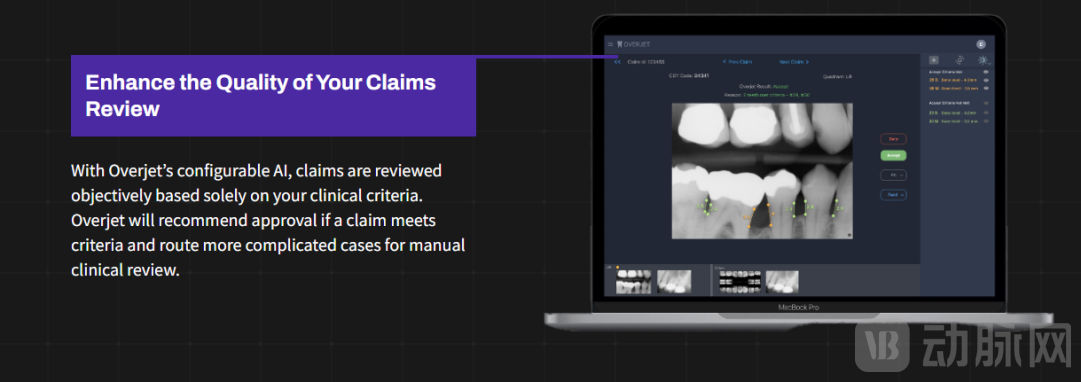
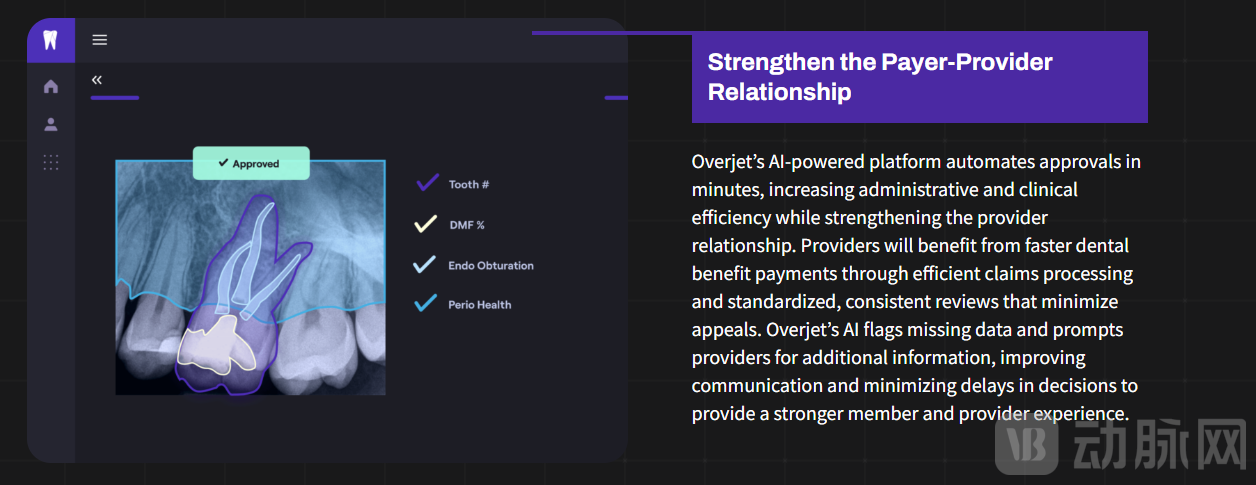
(Introduction to Overjet’s Related Business; Image Source: Corporate Website)
Li Jing, a seasoned investor in the dental industry, believes that Overjet possesses both advanced R&D capabilities in dental AI and helps patients overcome payment challenges. This provides a foundation for accelerating commercialization, thereby avoiding the difficulties other AI companies face in building viable business models.
Therefore, Overjet was selected for the “Forbes AI 50—Most Promising Artificial Intelligence Companies” list in 2022; in 2023, LinkedIn included Overjet among the top 50 startups in the United States.
Currently, Overjet is also ramping up its efforts in the pediatric dentistry market.On March 13 of this year, Overjet officially launched Overjet for Kids.This AI Platform Helps Pediatric Dentists Detect Early Signs of Tooth Decay in Children via X-rays, thereby enabling better recommendations to parents, helping children receive timely preventive care, and building lifelong trust with patients. In a clinical study conducted for the FDA, 100% of dentists demonstrated higher accuracy in detecting cavities when using Overjet for Kids compared to assessments performed without it. Furthermore, the AI is trained to analyze both primary and permanent teeth, highlighting its findings with color-coded outlines that are easily understood by both children and their parents.
According to the official website, Overjet for Kids has received two FDA Breakthrough Device designations. The first is primarily for detecting dental caries (commonly known as cavities) in patients aged four and older, covering both primary and permanent teeth. A key technical advantage of Overjet for Kids is its ability to precisely delineate and quantify carious lesions, enabling dentists to continuously monitor changes in teeth. The second designation involves AI-based detection of dental structures in patients aged five and older, expanding the scope of Overjet for Kids to include natural structures such as enamel and pulp, as well as artificial structures like crowns and fillings.
Following the completion of its latest round of financing, Overjet stated that it wouldContinue to make significant investments in AI with the aim of establishing a unified standard to connect all stakeholders in the U.S. dental care ecosystem., including dental institutions and upstream suppliers, patients, payers, and dental education institutions, to enhance the efficiency of the entire industry chain.
“AI’s impact on the dental industry may be unprecedented,” said investor Yang Bo. “This is because the dental sector closely resembles many traditional manufacturing industries in its heavy reliance on human labor, with dentists serving as the specialized professionals in this field. As AI matures, dental diagnosis and treatment are becoming increasingly standardized, which will significantly enhance the industry’s quality and efficiency.”
Yang Bo cited an example to VCBeat: ophthalmology, also a consumer healthcare sector, has been able to scale up rapidly primarily due to its higher degree of standardization.In ophthalmology, most tasks are delegated to devices and instruments, with physicians serving in supportive and oversight roles; whereas in dentistry, dentists still perform the majority of the work, relying on their clinical experience to determine the steps and methods for each treatment. AI is addressing this challenge., once the entire process is transformed, everything from the training pathway for dentists to the patient care experience, as well as the business models within the oral healthcare industry, will undergo profound changes.”
From an investment perspective, over the past decade, AI has achieved greater maturity and faster commercial deployment in sectors such as finance and automotive, as well as in niche areas like oncology diagnosis within healthcare. The recent rise of dental AI demonstrates that a major transformation in the oral health industry is already underway.
As dental AI continues to gain momentum,"Deploying AI has seemingly become a mandatory requirement, rather than an optional choice, for industry participants."
According to VCBeat, leading dental institutions—including Topcare Medical, Arrail Group, Meiya Dental, Happy Dental, Delun Dental, and Malo Clinic—have all entered the AI space by either building in-house teams or purchasing relevant services and equipment.
“It is a positive development that dental service providers are prioritizing AI, as this demonstrates the high enthusiasm of leading enterprises in embracing emerging technologies and sets an example for the industry.” Zou Yuan, co-founder of the aforementioned dental institution, believes that since the core business focus of dental service providers lies in diagnosis and treatment, their investment in AI will not be substantial. According to her observations, annual AI investments by service providers rarely reach millions of yuan, with most spending in the hundreds of thousands, primarily allocated to intelligent customer service systems or the procurement of AI-enabled equipment.
Therefore,Greater innovation must still come from the upstream sector of the industry.Taking Angelalign as an example, as a leading enterprise in clear aligner orthodontics, it has been consistently applying AI technology to the field of orthodontics. For instance, in the past, data analysis for CBCT and intraoral scans (both of which can present complex oral anatomical structures and precise crown-gingival information to dentists, respectively, and are key equipment in oral diagnosis and treatment) required doctors to manually complete based on their knowledge and experience.Angelalign's Intelligent Root-Bone System (IRS)This enables the use of precise algorithms to present 3D alveolar bone models in a “what-you-see-is-what-you-get” manner, reducing the time required for multimodal oral “crown–root–bone” reconstruction from the traditional 5–7 hours (of manual labor) to just 20–25 minutes.
Developed over 6 yearsWeiyun AI has built an intelligent factory based on artificial intelligence.—With its “fully digital, fully intelligent, and fully informatized” dental healthcare service model and proprietary core technologies, it can automatically manufacture a full range of dental products with nearly no manual intervention throughout the entire process, covering medical scenarios such as dental implants, cosmetic dentistry, orthodontics, and prosthodontics.
Founded in 2017,DeepCare Yuyi Ganlan Launches AI Dentist SystemReportedly, by rapidly identifying and analyzing oral imaging data, the system can detect more than 30 types of oral diseases and conditions within five seconds and generate a personalized “Oral Health Assessment Report” for each patient. This enables patients to better understand their oral health issues and significantly improves the efficiency of doctor–patient communication. Recently, the research paper “Towards clinically applicable automated mandibular canal segmentation on CBCT,” co-authored by Professor Fu Kaiyuan’s team from the Department of Medical Imaging at Peking University School of Stomatology and the Yuyi Ganlan AI team, was published online in the Journal of Dentistry, an internationally authoritative journal in the field of dentistry. Extensive experimental validation has demonstrated that Yuyi Ganlan’s AI system for automated mandibular canal segmentation has reached a level suitable for clinical application.
Abroad, those that secured seed funding this yearPeerlogic Is Ramping Up Its Conversational Analytics SystemAccording to Peerlogic’s official website, the company’s AI-powered conversation analytics system integrates with dental practices’ management or telephone systems. By analyzing conversations between patients and front-desk staff, it captures and interprets key information in real time, provides evidence-based communication scripts, enhances operational efficiency, and ultimately drives patient acquisition and revenue growth. Since its founding in 2020, Peerlogic has served more than 1,000 dental clinics across the United States.
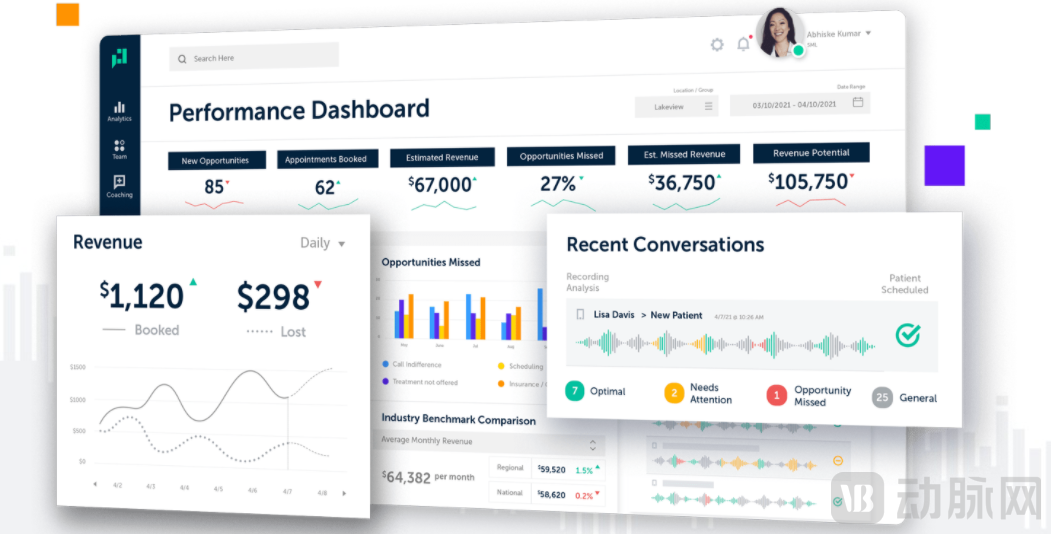 (PeerlogicAI Conversation Analysis System – Clinic Dashboard Panel. Image source: Corporate official website)
It is not difficult to see from the above that innovative companies have applied AI to their respective fields and have already achieved notable success. However, during interviews conducted by VCBeat, many industry professionals expressed a wait-and-see attitude toward the development of dental AI in the near future. They generally believe that,Current innovations in dental AI remain fundamentally isolated, making it difficult to support a closed-loop ecosystem across the entire oral care industry chain; thus, the commercial ceiling remains too low.
“Challenges certainly exist, but the process of overcoming them serves as a stepping stone for the industry’s rapid advancement,” said investor Yang Bo. He noted that the growth of dental AI requires concerted action from every participant across the entire industry chain to achieve greater success.
Amid the sweeping transformation of the dental industry driven by AI, a growing number of companies are aligning with this trend and joining the wave of innovation. In response, several interviewed investors cautioned that while opportunities presented by new technologies should be seized,Never forget the fundamental premise of being “patient-centered.”
“The core is to ensure a good consumer experience; AI should not be implemented for its own sake.“, making the process more cumbersome than before and ultimately counterproductive, as users abandon your (product) due to poor user experience.” In the view of investor Yang Bo, AI primarily serves a supportive role.
Taking clear aligner orthodontics as an example, the aligners themselves are the most critical component throughout the entire treatment process. The core value of AI integration lies in streamlining workflows and enhancing treatment efficiency. Therefore, R&D-focused companies must concentrate on continuously improving multiple aspects of aligner performance, including elasticity, tear resistance, and stain resistance. Otherwise, even with advanced AI devices and models, subpar aligners will lead to poor patient experiences, thereby negatively impacting user reviews.
Furthermore, the development of dental AI requires not only the accumulation of specialized medical expertise and clinical diagnostic and treatment experience, but also demands advancements in AI technology and equipment, materials, and distribution channels.Competition Among Dental AI Companies Is Multidimensional and Comprehensive. We generally believe that,"Only when scaled delivery is achieved does commercialization truly begin."“It’s not just about how advanced the technology is, nor is it as simple as delivering a few products,” said Li Jing, a seasoned investor in the dental industry.
Certainly, as technologies such as AI continue to advance, the dental market will undergo continuous transformation and upgrading. AI not only enhances the quality and efficiency of the industry but also contributes to social welfare by helping to balance medical resources, enabling the general public to access high-quality dental care and treatment technologies, thereby safeguarding oral health for all.
Throughout this process, the upward trajectory of China’s dental industry will remain unchanged, with promising market growth. According to the “2023 Insights Report on Dental Medical Services” released by VCBeat Research Institute, the market size of China’s dental medical services reached RMB 145 billion in 2021, maintaining an average annual growth rate of 20%, and is projected to reach RMB 300 billion by 2025.
Faced with tremendous opportunities, the story of innovation and exploration in the dental industry will undoubtedly continue.
References:
1:《Overjet Raises $53 Million: The Largest Investment in the History of Dental AI》——https://www.overjet.ai/news/overjet-raises-53-million-series-c/
2:《Introducing Overjet for Kids: Dental AI that Parents Need》——https://www.overjet.ai/news/introducing-overjet-for-kids-dental-ai-that-parents-need/
3:《Fast Model Debias with Machine Unlearning 》——https://arxiv.org/pdf/2310.12560.pdf
4: “Empowering Smart Healthcare: Angelalign Presents Three Papers at the Top AI Conference NeurIPS 2023”——https://i.ifeng.com/c/8VSKd6y99VC