

Listed Companies Seize Bargain Opportunities as Healthcare Innovators Hit Rock-Bottom Valuations
Listed Companies Begin Splashing Cash to Snap Up Bargains!
Over the past six months, more than 20 healthcare innovation projects have been acquired or invested in by listed companies. This signals that, after a prolonged slowdown in the capital market, a cohort of listed firms is ramping up mergers and acquisitions to acquire innovative technologies and forge new growth curves. Meanwhile, healthcare innovation ventures are poised to welcome a new wave of investors.
“The pressure is immense, and anxiety is high; we have already cut some non-core product lines. Although there are still funds in the account, we need new capital to keep our business going. Previously, our head of fundraising would play Guandan with market-oriented investors and study on the ‘Xuexi Qiangguo’ app with state-owned investors. Now, he probably needs to engage with investors from listed companies,” medical entrepreneur Hu Lan told VCBeat.
In the capital markets, following the phased tightening of initial public offerings (IPOs), investment institutions are facing challenges across all stages of fundraising, investing, managing, and exiting, leading to increasingly cautious investment decisions. According to the “2023 Global Healthcare Investment and Financing Analysis Report,” the total investment and financing in China’s healthcare industry amounted to $10.9 billion in 2023, marking a significant decline from $34 billion in 2021. Meanwhile, healthcare innovation projects are encountering growing difficulties due to the prevailing environment.
Therefore, as listed companies allocate substantial funds for investments and mergers and acquisitions, innovative projects are ushering in a new round of financing opportunities, while investment institutions also stand to help their portfolio companies secure funding or achieve exits. The entry of listed companies will bolster confidence in the capital markets.
Faced with opportunities, entrepreneurs, investors, and financial advisors are all seeking ways to secure funding from publicly listed companies. However, this is no easy task.
Recently, the capital market, which had been quiet for a long time, finally showed some signs of warmth.
On March 24, following rumors that Andon Health, a low-profile investor, had invested in the Kimi large language model—sending its shares up 23%—the company disclosed in an announcement on abnormal stock price movements that its investment vehicles had invested in the AI unicorn “Moonshot AI” in August 2023 and March 2024, respectively. This case offers a glimpse into listed companies’ investments in the primary market.
In addition to Andon Health,Other funds established or participated in by listed companies are also aggressively snapping up assets.For example,Huadong Medicine, Betta Pharmaceuticals, Tigermed“Hangzhou Guoshun Jianheng Venture Capital Partnership (Limited Partnership),” jointly established by the listed company and other investors, invested in CEC WuXi in February 2024. CEC WuXi is a national health and medical big data industry development group company jointly founded by China Electronics Corporation, SDIC Group, China Structural Reform Fund, Tencent, and other institutions.
For example,Tasly“Shaoxing Tasly Biomedical Equity Investment Partnership (Limited Partnership),” which subscribed to a 39% stake for RMB 390 million, invested in Shenyan Biology in February 2024.Porton Pharma SolutionsThe “Suzhou Daotong Tenghui Venture Capital Partnership (Limited Partnership)” invested in Kangyuan Huisheng Medical and Ruiyiwei Medical in January 2024 and December 2023, respectively."The Pharma Leader" Hengrui MedicineThe “Shanghai Shengdi Biopharmaceutical Private Equity Investment Fund Partnership (Limited Partnership),” which was initiated and established, invested in Luoqi Bio in December 2023……
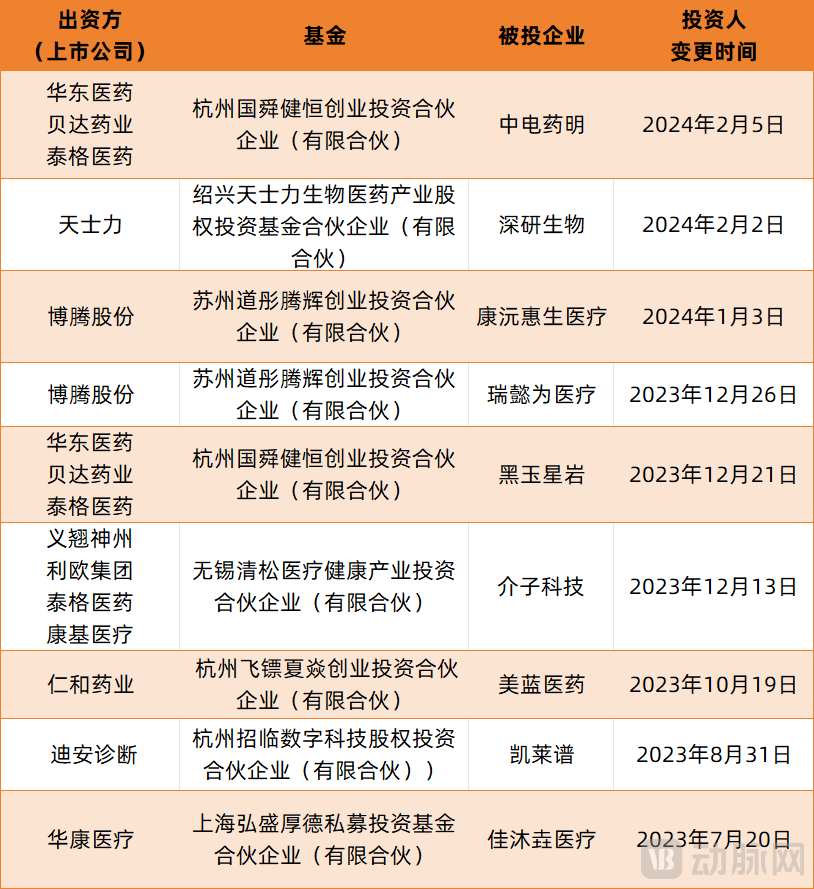
(Fund investment participation by selected listed companies; data source: Qichacha)
However, most of these investment deals have not been publicly disclosed, and the portfolio companies have maintained a very low profile. This has resulted in relatively few financing announcements in the market, creating an appearance of significant sluggishness. The reality is that listed companies are quietly accumulating assets.
In fact, it is not only the capital contributed by listed companiesFundInvesting in Innovative Medical Projects,Listed companies are also making direct investments in innovative startups.. In March 2024, Titan Science & Technology Group, a listed company, announced investments in Rundu Biotechnology and Maigao Instruments; in late January 2024, Borui Biopharmaceuticals invested in Aoli Biologics, a company focused on oral delivery technologies for macromolecular drugs; in September 2023, Hotgen Biotech invested in Aorui Biologics, a platform for early screening of gastrointestinal cancers...
Moreover, in addition to the investment and financing market, listed companies are also highly active in the M&A market, accelerating their acquisition of high-quality enterprises.. Taking Xintian Pharmaceutical’s acquisition as an example, in March 2024, Xintian Pharmaceutical announced its plan to acquire an 85.12% equity stake in Huilun Pharmaceutical. Previously, Huilun Pharmaceutical had initiated IPO tutoring in August 2022, but unfortunately encountered a phased tightening of IPO approvals, which ultimately terminated its path to going public. Nevertheless, Huilun Pharmaceutical’s strength should not be underestimated; its flagship product, “Sivelestat Sodium for Injection,” has achieved annual sales exceeding RMB 100 million, with sales of this product growing by 214.05% year-on-year in the first half of 2023.
More notably, Mindray Medical, the “leading player in medical devices,” announced in late January 2024 its plan to use RMB 6.652 billion of its own funds to acquire a 21.12% equity stake in Huitai Medical. If the plan is successfully implemented, Mindray Medical will hold a 24.61% share in Huitai Medical, becoming its largest shareholder and controlling shareholder.
It is reported that Huitai Medical is a leading enterprise in China’s electrophysiology and vascular interventional consumables sector. The company not only boasts a comprehensive product portfolio and leading scale but also possesses the capability to compete with foreign products. According to Huitai Medical’s 2023 annual report, its revenue for 2023 reached RMB 1.65 billion, representing a year-on-year increase of 35.71%; net profit amounted to RMB 534 million, up 49.13% year on year. Additionally, its international business grew by 72.62% year on year, with sales in the Middle East, Africa, and the Commonwealth of Independent States (CIS) regions increasing by over 100%.
Previously, in November 2023, Mindray Medical acquired a 75% stake in Germany’s DiaSys for €115 million. DiaSys is a globally renowned brand in in vitro diagnostics (IVD), with production facilities in Europe, the Asia-Pacific region, and Latin America. The acquisition will enable Mindray to localize production and delivery of its IVD products in key overseas markets, thereby enhancing delivery responsiveness and overall product competitiveness.
In addition to the aforementioned cases, listed companies including Grand Pharma, Shanghai RAAS, Situo Biotechnology, Nanomicro Technology, Conba Group, Chaoju Eye Care, and Enwei Pharmaceutical have all announced acquisitions of new enterprises within the past six months. For instance, Grand Pharma acquired a 90% equity stake in Duoputai Pharmaceutical Technology for a total consideration of RMB 632 million; Shanghai RAAS acquired a 95% equity stake in Guangxi Guanfeng for RMB 481 million; and Situo Biotechnology acquired a 60% shareholding in Yingu Pharmaceutical for RMB 458 million.
As the market entered its winter phase, many market-oriented investment institutions became increasingly cautious in their investments, while listed companies quietly accumulated assets. With substantial financial backing from these listed firms, the capital market is experiencing a subtle recovery.
Historically, listed companies have typically allocated large amounts of idle funds to wealth management products. For instance, Andon Health previously announced a plan to entrust RMB 17 billion for wealth management and allocate RMB 3 billion to securities investments; BGI Genomics planned to use RMB 5 billion to purchase principal-guaranteed wealth management products or deposit-type products.
But now, why have some listed companies begun to aggressively invest in and acquire healthcare innovation projects?
First, having weathered the harsh winter, innovative projects are now sufficiently affordable.In the recent past, many healthcare innovation projects that failed to secure “new money” began raising capital at discounted valuations. Although they have yet to complete their financing rounds, these companies have managed to eke out a precarious existence—with few filing for bankruptcy—thanks to support from industrial parks, existing shareholders, and government entities. Now, however, firms that have been backed into a corner and remain unable to secure funding are being forced to consider “rock-bottom” offers in order to survive.
Veteran investor Bai Bing told VCBeat, “The investment and financing market has been cooling for nearly two years, and the funds that innovative companies once raised are almost exhausted. Without new capital inflows, they will have no choice but to shut down. Against this backdrop, there is no shortage of innovative companies willing to accept ‘rock-bottom valuations.’”
Therefore, for listed companies with substantial cash reserves, now is an opportune time to make strategic investments. The closer to the market bottom, the lower the project valuations. However,Other investors also stated, “Valuations in the primary market remain high, and further deflation of the bubble is still needed.”
Second, as returns on financial wealth management products decline, the state is guiding and encouraging capital to flow into the real economy.. In 2023, the wealth management returns of listed companies declined. According to Wind data, among the investment products held by listed companies in 2023, the average projected minimum yield dropped from 2.11% to 1.66%, while the average projected maximum yield fell from 2.36% to 2.11%. This year, wealth management interest rates continue to decline, and overall returns on such products are expected to remain low.
Based on this, a number of listed companies have reduced the scale of using idle funds to purchase wealth management products in 2024, such as Yunnan Energy Investment, ENN Natural Gas, Blue Sail Medical, and Chuangxin Xincai.
On the other hand, the state is guiding capital toward the real economy. In late October 2023, the Central Financial Work Conference held in Beijing emphasized that serving the real economy must remain the fundamental purpose of financial services. It called for smoothing channels for capital inflows into the real economy, strengthening market rules, and building a unified and collaboratively regulated financial market to foster the formation of long-term capital.
Meanwhile, innovation projects at the current stage are sufficiently affordable, enabling listed companies to achieve returns that surpass those from traditional financial wealth management products through either direct investment or mergers and acquisitions (M&A). Consequently, an increasing number of listed companies are adjusting their capital allocation strategies by directing a portion of their funds into the primary market. It is worth noting that listed companies currently investing in the primary market or engaging in M&A still have significant room for stock price appreciation.
Third, by investing in and acquiring companies along the upstream and downstream of the industrial chain, listed companies can capture innovative technologies within the industry and secure a competitive advantage ahead of time.Compared with private companies, listed companies generally possess advantages such as larger scale and ample capital. For listed companies holding substantial cash flows,Profitability is important, and making money work for you is equally important.. Strategic investments and strategic mergers and acquisitions not only enable companies to deepen their integration across the industry chain and identify new growth curves, but also generate additional profit streams through financial investments, thereby achieving capital appreciation.
In terms of internal development, listed companies can acquire emerging technologies and projects across the upstream and downstream segments of the industrial chain through investments and acquisitions. By leveraging these emerging technologies and supply chain assets, they can strengthen their capabilities, expand their business scope, and enhance overall competitiveness. For instance, Mindray Medical previously acquired HyTest, a core supplier of raw materials for in vitro diagnostics (IVD), for €532 million, thereby resolving the bottleneck issue related to upstream material supply.
In addition, listed companies can rapidly enter new markets through investments and mergers and acquisitions. For example, in November 2023, Aier Eye Hospital acquired seven hospitals in regions such as Tangshan and Hengdong, thereby optimizing its regional market layout and achieving economies of scale; in February 2024, Jianzhijia acquired 69 pharmacies from Sichuan Derentang, further strengthening its dense network presence in Chengdu and expanding into new regions.
In terms of financial returns, the capital market has remained subdued for nearly two years, with bubbles largely cleared and valuations of innovative companies approaching bottom levels. Investing in innovative projects now is poised to deliver substantial returns to investors in listed companies once the market recovers.
Overall, driven by factors such as strategic development and financial returns, an increasing number of listed companies are beginning to allocate capital to the primary market and the mergers and acquisitions (M&A) market.
Nowadays,An Increasing Number of Listed Companies Are Investing to Become Limited Partners. For example, within four months, Intco Medical newly invested in five private equity funds, with investment directions covering aerospace, pan-semiconductor, new energy, digitalization, and general healthcare. To date, the number of funds invested in by Intco Medical and its subsidiaries has reached 23, with a total investment amount exceeding RMB 1 billion.
Intco Medical stated, “Participating in private equity funds enables the Company to allocate idle funds, diversify investment channels, mitigate investment risks, and achieve long-term investment returns. The Company will also monitor potential business collaboration opportunities with portfolio companies in the aforementioned sectors, striving to maximize synergies.”
In addition to Intco Medical, listed companies including Fosun Pharma, Sirio Pharma, Wanbangde, Porton Pharma, Noxeg, Ganfeng Lithium, Garden Bio, and Joinn Laboratories have all established industrial funds or subscribed to investment funds within the past six months, with their investment focus primarily on healthcare (biopharmaceuticals and medical devices).
In addition, Mindray Medical, Winner Medical, and Huadong Medicine all stated in their recently released “Announcement on the Action Plan for Dual Improvement of Quality and Investment Returns” that,Actively promote enterprise development through investment, mergers and acquisitions, and other means.。
Among them, Mindray Medical will continue to accelerate its M&A pace around its strategic development direction, mainly focusing on strengthening its core business, exploring new businesses, and supporting overseas development; Winner Medical will actively seek external M&A opportunities to strive for the strategic goal of "one-stop medical consumables solutions"; Huadong Medicine plans to carry out in-depth strategic cooperation with advanced pharmaceutical companies at home and abroad through product co-development and equity investment, among other methods, to build Huadong Medicine's global R&D ecosystem...
We hope that the influx of these funds will restore confidence in the tight and declining capital market, ushering the industry back into an era of high growth.
M&A Is Just the Beginning. Achieving a Win-Win Outcome Between the Target Company and the Investors Is the Key Focus for the Future.
Taking Mindray’s acquisition of Huitai Medical as an example, the merger enables Mindray Medical to rapidly enter cardiovascular segments such as electrophysiology and to build out and enrich its consumables-based business portfolio. For Huitai Medical, leveraging Mindray Medical’s domestic and international marketing capabilities and R&D technical support will help expand the commercialization of its electrophysiology products and enhance the technological competitiveness of its medical devices.
Mindray Medical stated: “Mindray’s robust capabilities in product engineering and system integration are expected to further enhance the performance of Huitai Medical’s products. Leveraging Mindray Medical’s overseas sales and service network and its multi-tiered customer resources, Huitai Medical’s cutting-edge innovative products can also be marketed to a broader international market.”
Additionally, following the completion of the acquisition, Cheng Zhenghui, founder of Huitai Medical, will continue to serve as Vice Chairman and General Manager, retaining a 10% equity stake (non-voting).
For the acquiree, some shareholders achieved premium cash-outs, while the founders retained their equity stakes and continued to serve as General Manager. With the support of the acquirer’s resources, the enterprise has ushered in new development opportunities. In this regard, Mindray Medical, Huitai Medical, and Huitai’s shareholders and founders have all had their needs met, achieving a win-win outcome for all three parties.
Similar to Mindray’s acquisition of Huitai, in other M&A cases, the acquirers and target companies have clarified their respective needs through multiple rounds of negotiations. Post-merger, the interests of all parties will be satisfied, while the two companies will leverage complementary advantages to accelerate development.
(At the interviewees’ request, Hu Lan and Bai Bing are pseudonyms.)