

NVIDIA Bets Big on Healthcare: 1000x AI Performance Leap in 8 Years Powers Generative AI-Driven Medical Transformation
NVIDIA
Artificial Intelligence Computing Service Provider
Even without the surge in popularity of generative AI over the past year or so, AI plus healthcare has been playing an increasingly significant role across the entire process and continues to steadily attract attention from the capital market. According to statistics from VCBeat’s “2023 Annual Innovation White Paper on Digital Healthcare,” despite encountering a capital “winter” in the past year, the enthusiasm for AI plus healthcare has not waned. It far outpaces other sub-sectors of digital healthcare in both the number of financing events and the total amount of funding raised.
An increasing number of people are recognizing that AI computing power is becoming infrastructure akin to traditional utilities such as water, electricity, and gas. Against this backdrop, every move by NVIDIA, a leading supplier of AI computing power, has drawn significant attention. At the recent GTC (GPU Technology Conference), healthcare emerged as the spotlighted focus for the first time, sparking widespread interest.
According to statistics, there were more than 90 sessions related to life sciences and healthcare at this year’s GTC, surpassing technology sectors such as hardware, semiconductors, and automotive for the first time to rank first across all industries. NVIDIA founder and CEO Jensen Huang explicitly stated at the conference that the healthcare sector will become NVIDIA’s next “multi-billion-dollar business.”
Of course, this does not mean that NVIDIA will directly transform into a healthcare company; rather, it is more about empowering the healthcare sector from an AI perspective. To support medical AI, NVIDIA provides assistance in two aspects: hardware that forms the computational foundation and software solutions that enable application deployment.
Generative AI represents the most significant breakthrough in the field of artificial intelligence in recent years, yet its demand for computing power has reached unprecedented levels. Taking the well-known GPT-3.5 large language model as an example, the total computational consumption for its training amounted to 3,640 petaflop-days, meaning that at a computing speed of one quadrillion operations per second, it would require 3,640 days of continuous calculation. Supporting this operation would necessitate seven to eight data centers, each with an investment scale of $3 billion and a computing capacity of 500 petaflops.
Less well known is that the stringent demands for power and heat dissipation triggered by this are even more staggering. Data shows that in January 2023, ChatGPT’s monthly electricity consumption may have equated to the annual power usage of 175,000 Danish households. Furthermore, Google’s large language models consume up to 2.3 terawatt-hours (TWh) of electricity annually, equivalent to the yearly power consumption of all households in Atlanta, USA!
Rumors suggest that such enormous power consumption has forced U.S. cloud service providers to adopt distributed deployment strategies, scattering generative AI server clusters across different regions to avoid overloading the power supply, despite being fully aware of the significant challenges posed by cross-regional data transmission. More strikingly, modeling forecasts by consulting firm Tirias Research indicate that by 2028, data center power consumption will approach 4,250 megawatts—a 212-fold increase from 2023—with the combined total of data center infrastructure and operational costs potentially exceeding $76 billion.
It is no wonder that some have jokingly remarked that, if this trend continues, the ultimate destination for generative AI may well be building its own nuclear power plants.
Continuously improving performance and energy efficiency per unit is the fundamental solution to the problem. The B100 (codenamed Blackwell) GPU released by NVIDIA at this year’s GTC delivers a 30-fold increase in AI inference performance compared to the previous-generation H100, while reducing energy consumption to just 1/25 of the original level, marking a significant breakthrough for the AI and computing sectors.
If this is not intuitive enough, the following comparison may be easier to understand: Training a 1.8-trillion-parameter GPT model requires 8,000 top-tier Hopper-architecture accelerators from the previous generation, consuming 15 megawatts of power over 90 days. However, under the same 90-day timeframe, only 2,000 Blackwell-architecture accelerators are needed, with power consumption reduced to one-quarter of the former.
From 2016 to the present, NVIDIA has launched five generations of AI-focused GPUs over an eight-year period, achieving a 1,000-fold increase in AI computing power. This performance has long surpassed the semiconductor industry’s well-known Moore’s Law and laid the foundation for the surge in generative AI.
Beyond hardware enhancements, NVIDIA continues to iterate and optimize its software solutions. It is worth noting that NVIDIA is not the sole provider of AI computing hardware; its long-time rival in graphics acceleration, AMD, also offers highly competitive hardware products. However, when it comes to the corresponding AI software ecosystem, NVIDIA’s CUDA, meticulously developed over many years, has become the de facto standard.
In fact, compared to hardware, the AI software ecosystem is more akin to NVIDIA’s insurmountable moat.
Starting with AI imaging, NVIDIA has been continuously refining its software solutions in the medical AI sector. At this year’s GTC, NVIDIA launched more than 20 new NIM microservices, covering areas such as medical imaging, health tech, drug discovery, and digital health. These microservices package essential AI development components—including industry-standard APIs, domain-specific code, and optimized inference engines—thereby simplifying generative AI development and drastically reducing AI deployment time from weeks to just minutes.
In simple terms, this microservice is quite similar to the low-code approach popular in software development. Absent any specific requirements, users need not write code from scratch; development teams can leverage existing NIM microservices for fine-tuning, training, and deployment to build personalized generative AI solutions.
With these integrated hardware-software solutions, NVIDIA has prepared for the upcoming era of generative AI from two perspectives: continuous hardware iterations to deliver higher performance and more optimized energy efficiency, and multiple software optimizations to facilitate user deployment of generative AI applications.
The era of widespread generative AI adoption is rapidly approaching.
NVIDIA’s emphasis on generative AI extends beyond hardware and software optimization; through partnerships and investments with third parties, it is actively accelerating the practical deployment of generative AI, with new drug development being a key focus. At this year’s GTC conference, NVIDIA partnered with Novo Nordisk to build the Gefion supercomputer, which will be available to researchers in Denmark’s public and private sectors for the discovery of new drugs and therapies.
In many contexts, AI-driven drug discovery is regarded as the ultimate solution for enhancing the efficiency of new drug development. It is particularly highly anticipated in the extremely tedious yet critical tasks of identifying novel targets and screening compounds.
In the realm of novel therapeutic targets, pharmaceutical companies are leveraging the powerful computational and analytical capabilities of AI-driven drug discovery to identify and fully exploit the potential of "undruggable" targets, thereby circumventing homogeneous competition in saturated markets. Statistical data indicate that undruggable targets account for more than 75% of the human proteome, and over half of all human diseases currently lack effective pharmacological treatments.
Target validation is a critical step in drug development and one of the most complex. At present, the majority of targets utilized in new drug research and development are proteins. In AI-driven target discovery, researchers first extract raw features from protein sequences, structures, and functions. They then employ machine learning methods to construct accurate and stable protein models, which are ultimately used to infer, predict, and classify target functions. This approach has become a key methodology in AI-based target research.
In compound screening, in addition to structural data, AI can extract multi-omics data—including genomics, proteomics, and metabolomics—from patient samples, i.e., vast amounts of biomedical information. By leveraging deep learning to analyze differences between non-disease and disease states, it can also be used to identify proteins that influence disease.
Furthermore, AI technology can streamline drug screening and synthesis, thereby reducing costs. Compounds identified through screening typically require evaluation across multiple dimensions, including solubility, activity/selectivity, toxicity, metabolism, pharmacokinetics/pharmacodynamics (PK/PD), and synthesizability. This entails iterative experimental processes that are time-consuming and labor-intensive, driving up the costs of preclinical research. Such highly repetitive tasks involving extensive computations are precisely where computer programs excel.
In this process, AI technology is employed to achieve molecular generation, i.e., using machine learning methods to produce novel small molecules. Specifically, AI can learn the patterns underlying compound molecular structures and drug-likeness by analyzing vast datasets of compounds or drug molecules. Based on these learned patterns, it can generate numerous compounds that have never existed in nature as candidate drug molecules, thereby effectively constructing a molecular library of substantial scale and high quality.
Furthermore, AI technologies are employed for chemical reaction design and compound screening. Currently, one of the areas where AI is making significant strides in chemistry is the modeling and prediction of chemical reactions and synthetic routes. Leveraging AI technologies, molecular structures are mapped into formats processable by machine learning algorithms; based on the structures of known compounds, multiple synthetic routes are generated, and the optimal route is recommended. Conversely, given specific reactants, deep learning and transfer learning can predict the outcomes of chemical reactions. AI technologies can even be utilized to explore novel chemical reactions. In compound screening, AI technologies are used to model the relationship between the chemical structure of compounds and their biological activity, thereby predicting the mechanisms of action of these compounds.
As exploration deepens, the industry has gradually recognized that generative AI can play a role not only in “AI prediction” but also by integrating AI into experimental processes. Constructing a methodology of “AI prediction + experimental validation” to accelerate new drug development may represent a more efficient direction. This approach shifts from relatively siloed, independent development based on pharmaceutical companies’ laboratory data, clinical data, and idealized biological models, toward an upstream, reverse-engineering strategy. It employs mathematical methods to deconstruct disease mechanisms from a biological perspective, adopting an end-to-start approach to drug discovery.
This process involves data analysis and computation on a scale far larger than ever before, which is precisely why companies like NVIDIA, with their command of computing power, are deeply involved.
Furthermore, NVIDIA is attempting to address the challenges of experimental validation through generative AI. To this end, it has launched BioNeMo, which offers innovative computational methods that can reduce the need for experiments, and in some cases, completely replace them. At this year’s GTC, NVIDIA continued to upgrade BioNeMo, enhancing its foundational models for accelerating protein structure prediction, generative chemistry, and molecular docking predictions. Leveraging these capabilities, pharmaceutical companies can better understand and design drug molecules while reducing reliance on time- and resource-intensive physical experiments.
In addition to partnerships, NVIDIA has also directly entered the generative AI industry through investments in recent times.
For the most part, NVIDIA has primarily relied on its “NVIDIA Inception” program for investment-related initiatives. This program provides GPUs and AI development platform support to lower the barriers to AI R&D and accelerate growth for entrepreneurs in the AI sector, while also deeply integrating NVIDIA’s hardware and software solutions with startups to continuously expand its ecosystem foundation.
However, in 2023, NVIDIA shifted away from its previously conservative and steady approach. Its venture capital arm, NVentures, was exceptionally active in the primary market, making a total of 35 investments—approximately six times the number recorded in 2022. More than half of these deals were led by NVentures, signaling a strategic shift aimed at accelerating industry growth by assuming greater risk.
Notably, among the 13 projects involving medical AI, aside from two in medical imaging and two in internet healthcare, the remaining nine were all focused on new drug development.
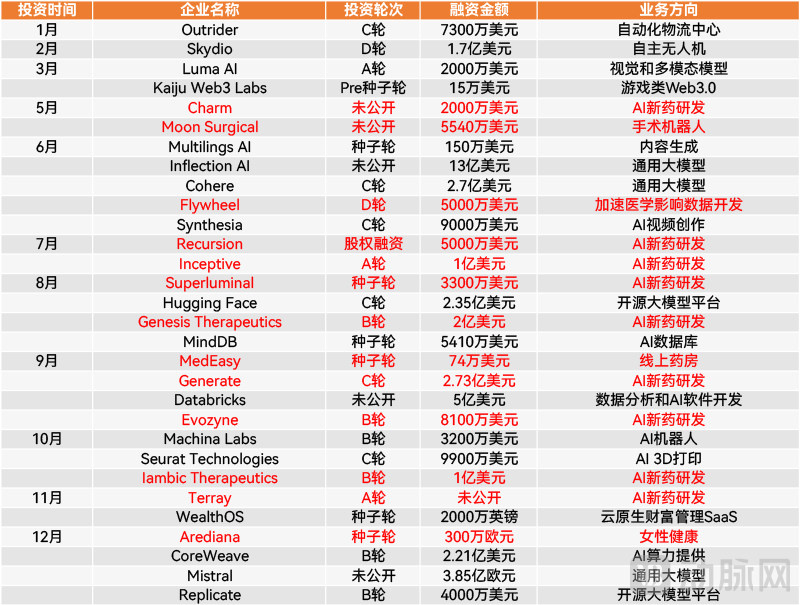
Incomplete Statistics of NVIDIA’s Investments in AI Companies in 2023 (Healthcare Companies Are Highlighted in Red)
This also reflects NVIDIA’s strong confidence in generative AI. After all, new drug development is one of the most promising fields for generative AI, where disruptive breakthroughs are most likely to occur. Although no new drugs discovered by generative AI have yet reached the market, once such success is achieved, it is easy to imagine the prominent position NVIDIA will secure, given its early and deep involvement in this area.
It is no surprise, then, that healthcare made its debut at the center stage of this year’s GTC.
Beyond new drug development, NVIDIA has not overlooked the potential of generative AI in other healthcare subsectors. For instance, medical device giants Johnson & Johnson MedTech and GE HealthCare have partnered with NVIDIA. The former will leverage NVIDIA’s IGX edge computing platform and Holoscan edge AI platform to accelerate and expand AI applications in surgical procedures, while the latter will utilize NVIDIA AI technology to develop SonoSAMTrack, a research model for segmenting ultrasound images.
Furthermore, NVIDIA has engaged in deep collaboration with Hippocratic AI, a company specializing in large medical models. Whether in Jensen Huang’s keynote address or in the presentation by Kimberly Powell, NVIDIA’s Vice President of Global Healthcare Business, Hippocratic AI’s generative AI-powered health assistant featured prominently. This health assistant can provide patients with real-time medical advice through conversational interactions, at an hourly cost that is only one-tenth that of a human assistant.
Over time, generative AI will become a critical foundational capability across an increasingly broad range of healthcare scenarios, much like water, electricity, and gas are today.
Through internal upgrades combining software and hardware enhancements, as well as external collaborative investments, NVIDIA is continuously expanding new application scenarios for generative AI and accelerating the industry’s maturation. Particularly in the field of drug discovery, generative AI is expected to significantly improve R&D efficiency.
As Kimberly Powell emphasized in her speech, “The healthcare industry is adopting generative AI, becoming one of the largest technology sectors.” From traditional pharmaceutical giants to startups, a growing number of global healthcare companies are choosing NVIDIA’s accelerated computing platform to enhance AI productivity and reduce R&D costs. Thanks to the continuous efforts of NVIDIA and its partners, the day when AI computing power truly becomes the “water, electricity, and gas” of the digital age will eventually arrive.
References:
Jia Ming Ge, Wall Street News: “Server Energy Consumption Surges Threefold! Is the Final Battle in AI Not About Computing Power, But Electricity?”