

Unity Biotechnology Files for IPO: A Leader in Senolytic Therapies Backed by $300M Funding and WuXi AppTec
UNITY Biotechnology
Developer of Anti-Aging Drugs
Aging is an inevitable process for humans.
As time passes, people’s chronological age gradually increases, accompanied by morphological changes—such as graying hair, the appearance of wrinkles, and loosening or loss of teeth. Alongside these changes, there is a decline in physiological functions and major sensory capabilities, leading to increased susceptibility to various diseases, including cancer, cardiovascular and cerebrovascular disorders, and metabolic conditions, ultimately progressing toward death. “Birth, aging, sickness, and death; all things have an end” is an ironclad law that has been proven by countless biologists and scientists and is unavoidable.
Nevertheless, how to delay aging remains an enduring topic of discussion. As human life expectancy increases and population aging intensifies, anti-aging has become a key area of focus for industry and capital.
Previously, numerous elites from the scientific research and industrial sectors have deeply explored the secrets of “immortality.” They have discovered that although aging is inevitable, it is a process that can be delayed. With in-depth research, researchers have currently summarized twelve hallmarks of aging, including cellular senescence, telomere attrition, and stem cell exhaustion.1, which has also become an entry point for exploring the aging process and developing anti-aging therapies.
Moreover, a growing body of research has shown thatClearing Senescent Cells in the Body Can Mitigate the Effects of Aging on Organisms and Extend Healthspan2. Based on this theory, scientists have developed senolytic therapies, which aim to improve health and extend healthspan by eliminating senescent cells.Senolytic therapies have attracted numerous aging-focused startups since their inception, including Unity Biotechnology (“Unity”).。
Unity is a star anti-aging company focused on developing senolytic therapies.. Since its establishment in 2009, it has been dedicated to developing drugs that can selectively eliminate or modulate senescent cells, thereby preventing and treating age-related diseases, with the goal of extending healthspan.
To date, UNITY Biotechnology has established a diverse clinical pipeline targeting indications such as diabetic macular edema (DME), cognitive impairment, and other age-related ophthalmic and neurological diseases. Among these,The company’s lead investigational drug for DME, UBX1325, is the most advanced in its pipeline and is currently in Phase 2b clinical trials.。
Since its establishment in 2009, UNITY Biotechnology has attracted significant attention. The company completed six rounds of financing over nine years and successfully went public in 2018, raising a total of $294.9 million. Among its investors,Jeff Bezos, the former world’s richest person and founder of Amazon, is prominently included. Meanwhile, 26 renowned investment institutions and enterprises, including WuXi AppTec, Mayo Clinic Venture Capital, and Tonghe Yucheng, have also heavily invested in supporting UNITY Biotechnology’s development of senolytic therapies.。
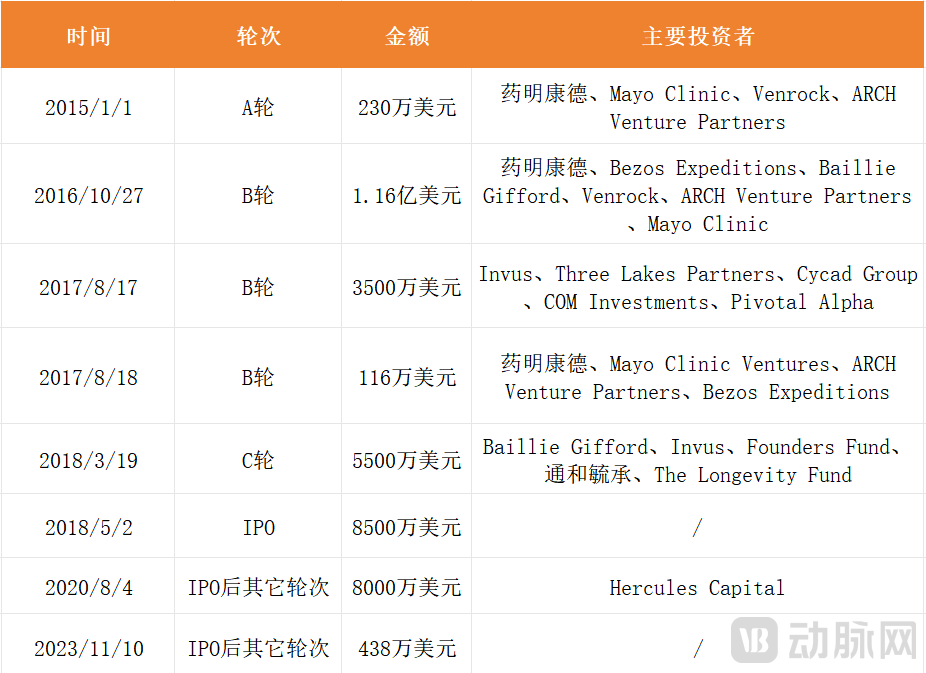
UNITY’s Financing Process Data Source: Compiled from public information; graphic by VCBeat
In addition, in 2016, UNITY Biotechnology entered into a strategic licensing collaboration with Ascentage Pharma (6855.HK). Under the terms of the agreement,Ascentage Pharma Grants UNITY Biotechnology Rights to Develop UBX1325 for Age-Related Diseases, and holds the rights to the compound in Greater China, with plans to establish a joint venture with UNITY Biotechnology to jointly develop and commercialize the compound in the Chinese market.
Backed by star investors and renowned companies, UNITY Biotechnology has enjoyed a stellar growth trajectory, with its market capitalization once reaching $972 million. Behind this success are four founders with years of experience and expertise, leading the company forward.
andThe formation of the star-studded team was inseparable from Dr. Nathaniel David, co-founder of UNITY Biotechnology.. Nathaniel David is a scientist and entrepreneur with many years of industry experience. Before embarking on his entrepreneurial journey in the biomedical sector, he earned a Bachelor’s degree in Biology from Harvard University and a Ph.D. in Molecular and Cell Biology from the University of California, Berkeley.
In the final year of his doctoral studies, Nathaniel David co-founded his first biopharmaceutical company, Syrrx. In 2005, Syrrx was acquired by Takeda for $270 million. Notably, Nesina, a diabetes medication approved by the FDA in 2013, was developed at Syrrx. During his tenure at Syrrx,Nathaniel David was also named one of the world’s top 35 innovators under the age of 35 by MIT Technology Review.。
Following this, Nathaniel David went on to found three biopharmaceutical companies: Achaogen (NASDAQ: AKAO), Kythera Biopharmaceuticals (acquired by Allergan for $2.1 billion), and Sapphire Energy. These ventures not only provided Nathaniel David with extensive industry experience but also brought several key partners into his orbit, including Keith Leonard, who served as CEO of both Kythera and UNITY Biotechnology. Prior to that, Keith Leonard spent 13 years at Amgen, where he held the position of Senior Vice President and General Manager of Amgen Europe, overseeing commercial operations across 28 countries and regions.
Nathaniel David’s idea to found a company dedicated to developing proprietary senolytic therapies stemmed from the laboratory research of Dr. Jan van Deursen. Dr. van Deursen is a molecular biologist and former Professor of Gerontology at the Mayo Clinic, with 20 years of research experience in transgenic and gene-knockout mouse models.
In a 2011 paper published in Nature, Jan van Deursen demonstrated that senescent cells can be simply eliminated. The study introduced a transgenic strategy that selectively clears stably replication-arrested cells in mice by targeting proteins associated with senescence, specifically the tumor suppressor p16INK4a, thereby improving their health status.3。
A few weeks after the paper was published, Nathaniel David reached out to Jan van Deursen and entered into a collaboration with him to develop drug compounds for clearing senescent cells in humans. Jan van Deursen also officially became a scientific co-founder of UNITY Biotechnology in 2014.
In addition, Nathaniel David attracted two experts in the fields of aging and cancer research to join the company’s founding team: Dr. Judith Campisi, Professor at the Buck Institute for Research on Aging, and Dr. Daohong Zhou, Deputy Director of Drug Development at the Winthrop P. Rockefeller Cancer Institute. With this, UNITY Biotechnology’s core team was essentially formed, and the company emerged from stealth mode in 2016.
After Unity came into the public eye, it published a series of research papers demonstrating that clearing senescent cells can improve health and even extend lifespan. Its research has attracted more industry experts, including Anirvan Ghosh, former Senior Vice President and Head of Research and Development at Biogen and a postdoctoral fellow at Harvard Medical School; Dr. Sharon Klier, who previously held clinical development and operations roles at Pfizer and ISTA Pharmaceuticals; and Dr. Mike (Przemyslaw) Sapieha, Canada Research Chair in Retinal Cell Biology. Their involvement has provided additional R&D momentum for Unity’s senolytic therapies.
Leveraging the strengths of its R&D team, UNITY Biotechnology has established four pipelines in ophthalmology and neurology to develop senolytic therapies for age-related diseases.
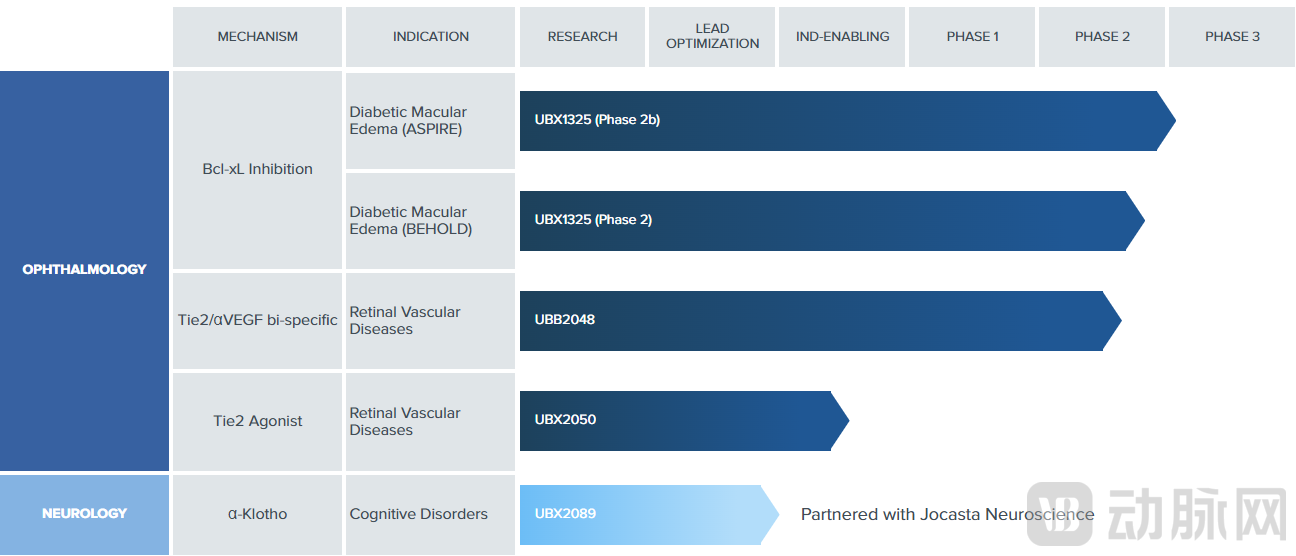
Unity’s Pipeline Under Development. Image source: Unity official website
Among them, UBX1325 is the core investigational product that Unity is currently prioritizing.UBX1325 is a small-molecule BCL-xL inhibitor developed for the treatment of age-related ocular diseases, including diabetic macular edema (DME) and wet age-related macular degeneration (AMD).. Among them, Bcl-xL is a member of the Bcl-2 family of apoptosis-regulating proteins and is highly expressed in retinal pathological blood vessels.
Diabetic macular edema (DME) is a major ocular complication of diabetes and the leading cause of blindness in adult patients with diabetes. The research team at UNITY Biotechnology has discovered that the progressive accumulation of senescent cells in the retina is a primary driver of DME. Their findings indicate that chronic hyperglycemia induces cellular senescence in specific subpopulations of vascular endothelial cells, leading to blood-retinal barrier dysfunction and low-grade inflammation, which ultimately results in capillary leakage and the development of DME.
Therefore, researchers believe that removing senescent cells from blood vessels can improve visual function in patients with diabetic macular edema (DME) and may help the eyes heal. On this basis,UNITY Biotechnology has launched UBX1325, which is designed to inhibit the function of proteins essential for the survival of senescent cells, selectively eliminate senescent cells accumulated in patients’ blood vessels, promote the reorganization and regeneration of functional, healthy vasculature, and restore the barrier function of the eye, thereby achieving therapeutic outcomes.。
The Phase 2 BEHOLD study results for UBX1325 demonstrated that, 48 weeks after a single 10-microgram injection of UBX1325, 65 patients with diabetic macular edema (DME) achieved a mean improvement in best-corrected visual acuity (BCVA) of +6.2 ETDRS letters from baseline, representing a statistically significant and clinically meaningful improvement.
Furthermore,53% of subjects required no additional anti-vascular endothelial growth factor (VEGF) therapy within 48 weeksThroughout the study period, retinal structure remained stable in patients treated with UBX1325, and no cases of intraocular inflammation, retinal artery occlusion, endophthalmitis, or vasculitis were reported, demonstrating that UBX1325 has a favorable safety and tolerability profile.
Based on the positive data from this study,UNITY Biotechnology is currently further evaluating UBX1325 in a Phase 2b clinical trial (ASPIRE).. ASPIRE is a multicenter, randomized, double-blind, active-controlled study designed to evaluate the safety and efficacy of UBX1325 versus Regeneron’s anti-VEGF drug Eylea (aflibercept) in patients with previously treated diabetic macular edema (DME). The study results are scheduled to be announced in the fourth quarter of 2024.
The development of UNITY Biotechnology has not been smooth, and it has encountered setbacks.
At the inception of UNITY, Jan van Deursen and Nathaniel David identified nutlin-3a, a promising senolytic compound, in the Campisi laboratory at the Buck Institute for Research on Aging. Based on this compound, they developed UBX0101, a small-molecule inhibitor of MDM2 (mouse double minute 2), intended for the treatment of knee osteoarthritis.
Following Unity’s announcement of the launch of UBX0101, its valuation once rose due to the drug. However, UBX0101 also proved to be a “double-edged sword.” On August 17, 2020, Unity announced that UBX0101 failed to outperform the placebo group in a Phase 2 clinical trial involving 183 patients with moderate-to-severe painful knee osteoarthritis. Upon this news, Unity’s stock price plummeted by 48%, and as of May 2022, the company’s market capitalization had shrunk to $58.58 million.
In addition, a Phase 2 ENVISION study of UBX1325 also failed. On March 27, 2023, Unity announced the results from Part A of the study. The data showed that patients in the control group received aflibercept every eight weeks; these patients unexpectedly gained 3.5 ETDRS letters at Week 2 and remained largely stable throughout the study period. The robust effect observed in the control group resulted in the study failing to meet the non-inferiority threshold at 24 weeks. Following this news, Unity’s stock price plummeted by 46.25% on the same day.
However, these two clinical trial failures have not halted UNITY Biotechnology’s continued exploration of senolytic therapies.
UNITY Biotechnology remains committed to the development of senolytic therapies, continuously advancing its investigational candidate UBX1325. In addition, the company is concurrently developing UBX2089, a senolytic drug designed to eliminate senescent cells in the central nervous system. Researchers are currently evaluating the therapeutic activity of UBX2089 in preclinical animal models, with clinical studies expected to commence in the near future.
Nowadays, thanks to the concerted efforts of numerous companies such as UNITY Biotechnology and researchers, senolytic therapies—including dasatinib and quercetin, as well as fisetin—have been proven to effectively reduce the burden of senescent cells and improve aging-related biomarkers.
However, just as numerous companies and scientists are eager to develop a Senolytics drug, some scientists have expressed doubts about the safety of senolytics therapy.Ensuring that senolytics selectively eliminate harmful senescent cells without damaging healthy ones, and determining the optimal safe dosage, have become urgent issues to address.。
Professor James L. Kirkland of the Mayo Clinic also indicated in his paper that although senolytics have shown beneficial results in preclinical models, holding promise for delaying multiple morbidities and extending healthspan, and while randomized controlled trials will further determine the safety and potential benefits of senolytic strategies, scientific and regulatory challenges must be addressed before senolytics can be used in clinical practice.4。
Nevertheless, numerous companies have entered this field with the aim of developing novel senolytic drugs, including Oisin Biotechnologies, Decidious Therapeutics, and StarkAge Therapeutics. Their ongoing research into cellular senescence is deepening the understanding of senolytics.
In the future, driven by researchers and industry professionals, Senolytics therapy may see further advancements.
References:
1. López-Otín C, Blasco MA, Partridge L, Serrano M, Kroemer G. Hallmarks of aging: An expanding universe. Cell. 2023 Jan 19;186(2):243-278. doi: 10.1016/j.cell.2022.11.001. Epub 2023 Jan 3. PMID: 36599349.
2. Gasek, N.S., Kuchel, G.A., Kirkland, J.L. et al. Strategies for targeting senescent cells in human disease. Nat Aging 1, 870–879 (2021).
3. Baker, D., Wijshake, T., Tchkonia, T. et al. Clearance of p16Ink4a-positive senescent cells delays ageing-associated disorders. Nature 479, 232–236 (2011).
4. Chaib, S., Tchkonia, T. & Kirkland, J.L. Cellular senescence and senolytics: the path to the clinic. Nat Med 28, 1556–1568 (2022).