

Otaitech Unveils Consumer-Grade AI-Powered CGM System with Multiple Industry Firsts at CMEF 2024
Ottai
Provider of Medical-Grade Smart Wearable Devices and Digital Chronic Disease Management Solutions
Amidst the current healthcare landscape, which is characterized by volatility and uncertainty, the field of diabetes management has demonstrated stable and sustained innovative vitality. Through relentless efforts, numerous pioneers have rapidly advanced relevant technologies, leading to the successive launch of world-first products such as Continuous Glucose Monitoring Systems (CGMS), GLP-1 receptor agonists, and artificial pancreas systems.
To date, the market has witnessed a range of medical devices that have achieved significant milestones in technological innovation, commercial application, and user experience. These products have not only enriched the tools available for chronic disease management and provided diversified development models, but the sector also continues to maintain strong growth momentum, demonstrating substantial market potential and broad prospects for future development.
As one of the most prominent products, CGMS has steadily increased its share in the global blood glucose monitoring market, rising from 9.8% in 2015 to 21.3% in 2020. Furthermore, in 2023, CGMS achieved total sales of nearly $10 billion, representing a year-over-year growth rate of over 20%.
It is worth noting that the CGMS market, despite its impressive performance, currently remains at a low penetration rate with substantial room for growth. According to forecasts by Frost & Sullivan, the domestic CGM market size in China is expected to grow from RMB 890 million in 2020 to RMB 16.6 billion in 2030, highlighting the sector’s significant growth potential.
It can be said that,The blood glucose monitoring market has truly entered the era of CGMS.
This trend can be glimpsed through the CMEF (China International Medical Equipment Fair).At the exhibition, several companies specializing in the CGMS field have achieved breakthrough innovations. These medical device companies have all adopted diverse product forms, technological approaches, and commercialization strategies to expand their market presence.
Notably, at this year’s exhibition, Ottai Technology Co., Ltd. (hereinafter referred to as “Ottai Technology”), as an emerging team, successfully attracted widespread attention within the industry with its newly developed M8 Continuous Glucose Monitoring System (CGMS).

2024 CMEF Ottai Booth
Not only has the company secured investment support from Xiaomi Group and AstraZeneca, but it has also innovatively adopted a dual strategy integrating consumer goods and medical products to drive its growth. This innovative initiative undoubtedly demonstrates Ottai’s capabilities in technological innovation and will further promote the sustained development of the diabetes management sector.
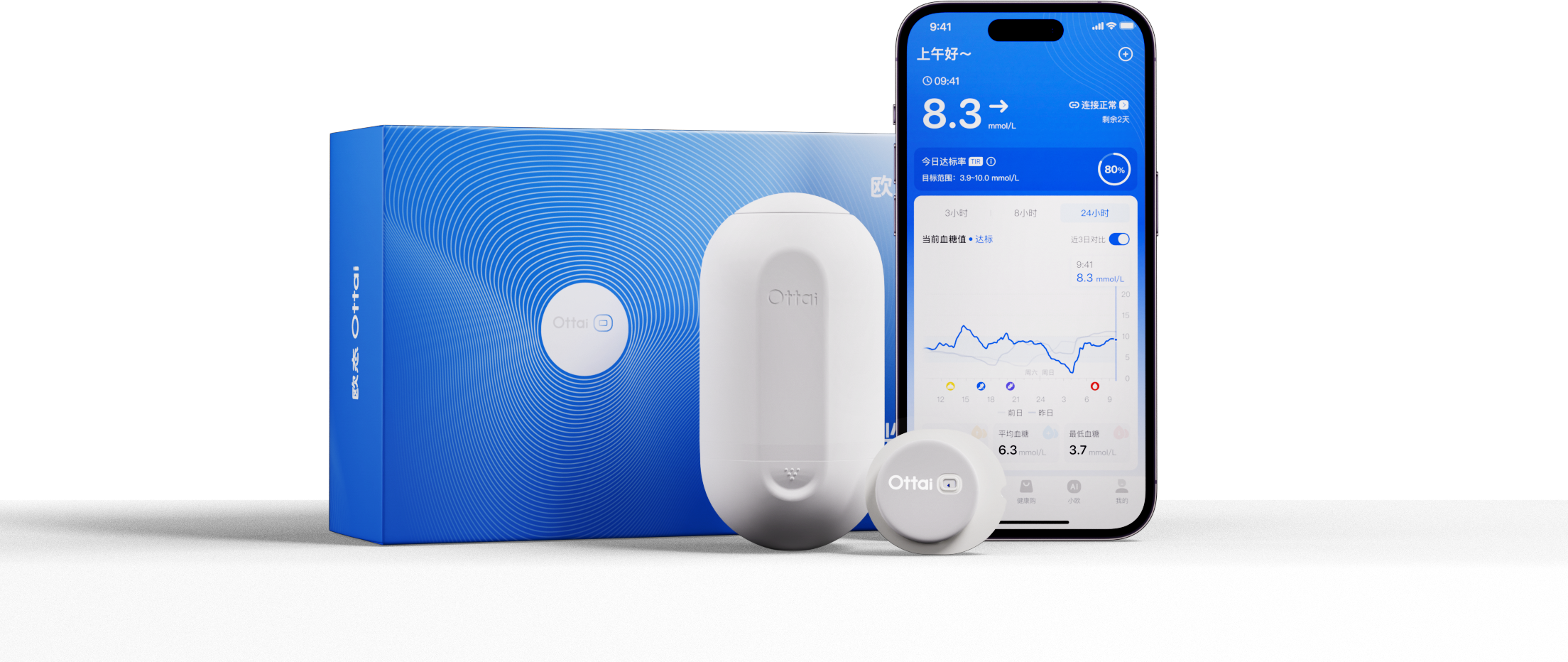
Product weight is only 1.6g, MARD value is 8.106%, with the proprietary Xiao Ou AI feature,
Building a “User-Centric” Consumer-Grade CGMS
In recent years, domestically produced CGMs have demonstrated strong growth momentum, with several products already approved for market launch.
However, due to high technical barriers and complex manufacturing processes associated with CGM products, the localization rate of CGMs in China remains below 10%. To capture a share of the domestic CGM market, Chinese manufacturers must overcome challenges related to manufacturing techniques, user wearing experience, and monitoring performance.
At the design level, Ottai has assembled a team from the University of Oxford to embed a “user-centric” design philosophy throughout its development process. By actively engaging individuals with diabetes, the company gains deep insights into the needs and expectations of patients with chronic diseases, ensuring that product designs truly align with user requirements. With an exceptional wearing experience and usability, highly stable measurement accuracy, and affordability, Ottai provides the most cost-effective blood glucose monitoring solution for people with diabetes and those focused on health management—one that closely resembles a consumer-grade product.

This product prioritizes user convenience and comfort, offering three key advantages: “lightweight,” “ease of use,” and “precision.”
Light: Pioneering flexible PCBA circuit board, weighing only 1.6g
• Leveraging its unique innovative design, Ottai’s product has become the thinnest and lightest CGMS device in the industry. Its distinctiveness lies in the company’s pioneering use of flexible PCBA circuit boards, which effectively reduces the product’s weight. Throughout the 14-day monitoring period, users can truly experience its lightweight, unobtrusive nature, enjoying a seamless and hassle-free usage experience.
• With a smaller, lighter, and thinner design, the product also ensures superior wearing stability.
Accuracy: MARD of 8.106%, industry-leading
• Ottai’s calibration-free CGMS achieved an excellent MARD of 8.106% in clinical trials, the best in the industry.
Easy: Pioneering all-in-one, assembly-free design for effortless operation
• Ottai’s design team has fully considered user convenience, introducing China’s first integrated, assembly-free design to deliver a seamless, one-step wearing experience, making blood glucose management effortless.
By visualizing mobile interactive scenarios, it helps patients more clearly and quickly identify blood glucose change patterns and risks, enabling users to monitor data anytime on their smartphones and wearable devices, and easily share it with family members and doctors.
Set reasonable blood glucose targets and alert ranges based on individual blood glucose levels, and support multiple reminder configurations for different lifestyle scenarios to minimize disruptions.
The clear and intuitive home screen interface allows users to instantly overview their blood glucose levels, ensuring easy data comprehension.
As the first product to integrate ChatGPT into daily user data management, Ottai’s proprietary Xiao Ou AI feature provides users with a 24/7 intelligent health assistant. By leveraging cutting-edge international artificial intelligence technologies, it responds in real time to user inquiries and questions regarding blood glucose management.
Ottai’s innovation and product R&D strategy undoubtedly accurately captures the three core attributes of CGM products: “medical use, innovation, and recurring consumption.” This further demonstrates the company’s market insight and innovative capabilities.
Intervening through blood glucose monitoring,
Gradually introduce CGMS into more health management scenarios, such as weight loss and prediabetes screening.
As an increasing number of clinical studies have validated the equivalent importance of CGMS-monitored metrics to HbA1c, the clinical value of combining GLP-1 receptor agonists with CGM for patient disease management, and the potential of lifestyle interventions coupled with glucose alerts to facilitate diabetes remission.
Therefore, Ottai’s understanding of CGMS extends beyond the single function of blood glucose monitoring.
Ottai’s algorithm team at the University of Oxford will leverage the company’s software development expertise and algorithmic capabilities to gradually expand into multiple scenarios, including weight management, prediabetes screening, and early reversal of diabetes, building on its existing CGMS products. The company is committed to developing a new product that covers a broader population, integrating CGMS into more aspects of health management. The target user group for this product extends beyond patients with diabetes to include the wider population concerned about metabolic health, thereby meeting the personalized needs of diverse users.
Currently, Ottai is conducting large-scale real-world studies in multiple cities, aiming to leverage extensive data accumulation to explore the glycemic control efficacy of CGMS and its impact on HbA1c improvement across populations with varying disease durations, complications, BMI, and other indicators. This paves the way for an even broader market opportunity.
Algorithm-driven construction of large-scale databases has become possible,
Diabetes Digital Ecosystem Fuels Expansion into New Markets
With the continuous advancement of technology, artificial intelligence (AI) has permeated various industries, profoundly impacting the healthcare sector. The integration of AI with healthcare has not only driven innovation in traditional medical models but also injected new momentum into the robust development of the broader health industry. This convergence will further help the healthcare sector enhance service quality, optimize resource allocation, and better meet people’s health needs.
In the fields of diabetes management and weight loss, artificial intelligence (AI) plays a pivotal role in achieving the dual goals of maintaining near-normal blood glucose levels and reducing patient burden. In daily life, patients are often required to make numerous decisions regarding blood glucose control, which can lead to confusion and may even cause them to abandon the most effective treatment modalities. Consequently, existing systems still necessitate that patients make multiple dosing decisions related to diet, exercise, and other activities.
Furthermore, the increasing volume of data provided by wearable devices—such as continuous glucose monitoring (CGM) sensors, insulin pumps, smart pens, and activity trackers—is making the decision-making process increasingly complex. Current diabetes research is dedicating significant efforts to developing algorithms and software applications that enhance diabetes care by leveraging the latest technologies and their interoperability. The integration of artificial intelligence with continuously updated “digital twins” can provide personalized management plans, effectively improving patients’ medication adherence and addressing the aforementioned pain points.
One of these applications is forDecision Support System (DSS) for Advanced Diabetes Management, which can be achieved throughTools that automatically analyze patient data and provide personalized treatment recommendations to assist patients and/or physicians in adjusting decisions during the decision-making process.From Ottai’s perspective, the vast amount of data collected from patients with diabetes makes artificial intelligence (AI) technology highly attractive for developing diabetes decision support systems (DSS).
While managing blood glucose levels, the availability of connected and interoperable sensors continues to improve,making it possible to build large-scale databases.This includes interstitial glucose concentration measurements and integrates with several other data sources. For instance, CGM data can be merged with information from other medical devices (SMBG, pumps, smart pens), mobile applications, clinical registries, electronic health records, and other wearable sensors (e.g., activity trackers). Data collected by activity trackers can be used to automatically detect exercise processes, predict exercise-induced hypoglycemia, and recommend carbohydrate intake when necessary to prevent hypoglycemia.
This type of data integration may help generateDigital Ecosystem for Diabetes Data, this ecosystem can be used to extract new medical knowledge that cannot be discovered by relying on a single information source. Large diabetes databases integrating multiple data sources increasingly require the use of artificial intelligence technologies toDevelop applications for personalized treatment and complication prevention.
In fact, artificial intelligence technology can process large datasets with diverse data types without requiring underlying physiological models. Among its potential applications, AI-driven decision support systems (DSS) are promising tools that can alleviate the burden of diabetes management for patients and improve glycemic control.
From BGM to CGM, continuous glucose monitoring (CGM) has ushered in a digital revolution in blood glucose management. Glucose monitoring continues to evolve toward non-invasive, portable, and precise solutions, with substantial room for optimization even within coin-sized CGM devices. Ottai recognizes that diabetes management is not an overnight achievement but rather a process requiring long-term monitoring, adjustment, and optimization.
Therefore, the company focuses not only on blood glucose data itself but also strives to help users better understand their physical condition, identify potential health risks, and provide scientifically effective management recommendations through data analysis and algorithm optimization. In addition to product design and breakthroughs in core technologies, the company leverages algorithms and artificial intelligence (AI) to deliver more precise and personalized health management solutions for individuals with diabetes and those concerned about metabolic health, while simultaneously committing to the development of AI-driven Clinical Decision Support Systems (CDSS).
In the future, as Ottai continues to deepen its research in the fields of diabetes and metabolic health, it will consistently optimize and innovate product features and services, building a true digital ecosystem for diabetes data to meet the needs of a broad user base.
About Ottai
Ottai Technology Co., Ltd., a technology-driven company. We specialize in the R&D and manufacturing of AI-enabled, medical-grade smart wearable devices and digital chronic disease management solutions. Upholding our mission and vision of “Technological Innovation for Smarter, More Precise, and Comprehensive Deep Health Management,” we leverage cutting-edge technologies—including advanced biosensing, flexible electronics, wireless transmission, data analytics, and deep learning algorithms—to break the traditional constraints of chronic disease management.
Ottai leverages its independently developed multi-hardware devices and deep learning algorithms to accurately collect and analyze biochemical indicators for chronic diseases, providing users with cost-effective, personalized disease management solutions. We are committed to deeply integrating technology with healthcare, making health management more intelligent and personalized, and safeguarding user health.
References:
Martina Vettoretti, Giacomo Cappon, Andrea Facchinetti, and Giovanni Sparacino. "Advanced Diabetes Management Using Artificial Intelligence and Continuous Glucose Monitoring Sensors". Sensors (Basel). 2020 Jul; 20(14): 3870.