

Orca Bio Files for IPO: Advancing Precision Cell Therapies with $300M Raised and Phase III Orca-T Program

OrcaBio
High-Precision Allogeneic Cell Therapy Developer
Last August, Fierce Biotech announced its Fierce 15 list, featuring 15 companies from China and abroad that possess cutting-edge technologies in the biopharmaceutical industry. The technologies represented by these companies reflect the shifting trends in the biopharmaceutical sector in recent years and offer a glimpse into future frontier opportunities. Most of the selected companies have ongoing R&D pipelines in their respective niche fields and are expected to announce related achievements soon. This article focuses on one of these selected companies—the regenerative medicine unicorn Orca Bio (hereinafter referred to as “Orca”).
This February, OrcaBio presented positive data on its core cell therapy, Orca-T, in two oral presentations at conferences hosted by the American Society for Transplantation and Cellular Therapy (ASTCT) and the Center for International Blood and Marrow Transplant Research (CIBMTR).
In the first oral presentation, Orca presented a retrospective analysis comparing Orca-T therapy with historical outcomes of conventional allogeneic hematopoietic stem cell transplantation (allo-HSCT) in patients with malignant hematologic tumors. In non-randomized cohorts across different treatment regimens and disease types, Orca-T demonstrated favorable clinical outcomes, including key parameters affecting overall patient survival such as relapse-free survival (RFS), non-relapse mortality (NRM), and overall survival (OS).
In the second oral presentation, Orca shared subgroup analysis results from a multicenter Phase Ib clinical trial evaluating Orca-T and biofeedback therapy (BFT) in patients with acute myeloid leukemia, myelodysplastic syndromes, and acute lymphoblastic leukemia. The findings demonstrated that Orca-T has the potential to treat various hematologic malignancies and offers advantages in reducing mortality, particularly among elderly patients.
Originating from the Irv Weissman Laboratory,
The latest round of financing was nearly $200 million.
Why has OrcaBio been able to frequently make its voice heard in the fiercely competitive field of cell therapy, demonstrating its therapeutic advantages in hematologic malignancies with detailed clinical data? What underpins this confidence?
First, companies engaged in clinical R&D are certainly well-funded.Orca was founded in 2016 and has completed three rounds of financing to date, raising a total of approximately $300 million.(approximately RMB 2.169 billion, with the amount sourced from Orca’s official website), including prominent overseas investment institutions such as Lightspeed, 8VC, DCVC Bio, ND Capital, Mubadala Investment Company, Kaiser Foundation Hospitals, Kaiser Permanente Group Trust, IMRF, Felicis, Dream Variation Ventures, and Blue Chip Venture Company.
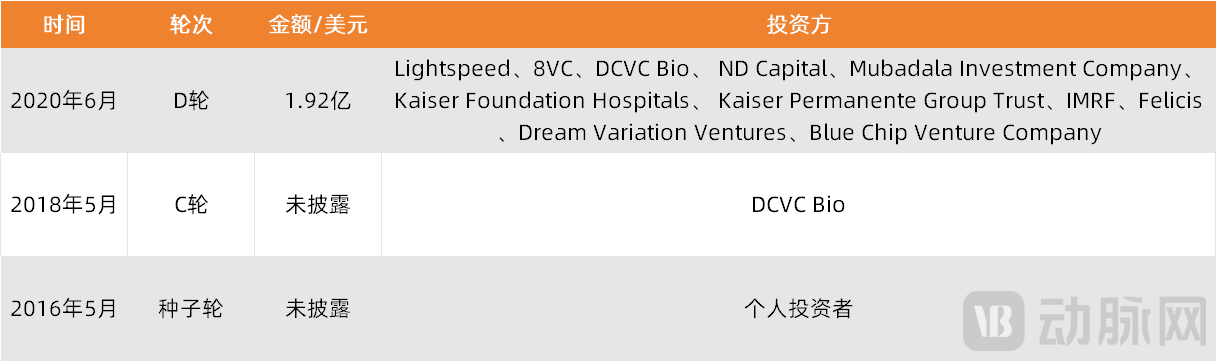
Financing History, Compiled from Public Sources
In addition to its robust financial backing, Orca’s core leadership team also boasts an impressive pedigree.The company’s origins can be traced back to the laboratory of Irv Weissman, Director of the Stanford Institute for Stem Cell Biology and Regenerative Medicine.
During their time at Stanford University, Orca’s three co-founders—Jeroen Bekaert, Ivan Dimov, and Nate Fernhoff—were drawn to the cell purification work conducted in Irving Weissman’s laboratory. The Weissman Lab’s research encompassed the phylogenetics and developmental biology of cells comprising the hematopoietic and immune systems. It was during this period that the three founders recognized the potential of immune cell therapy, laying the groundwork for their joint establishment of Orca years later.
Currently, Orca’s scientific advisors and board members include Dr. Irving Weissman himself, while co-founders Dr. Nate Fernhoff and Dr. Ivan Dimov were also members of the laboratory.
Prior to joining Orca, Dr. Ivan was a researcher and visiting lecturer in the Irving Weissman Laboratory, as well as a Senior Scientist at Stanford University. He also served as a Visiting Scholar in the BioPOETS Laboratory at the University of California, Berkeley, where he developed innovative microfluidic platforms for stem cell research and low-cost molecular diagnostics.
In addition to co-founding OrcaBio, Dr. Ivan is also a co-founder and former Chief Technology Officer of Lucira Health, a molecular diagnostics company that received the FDA’s first authorization for a COVID-19 at-home self-test kit. To date, Dr. Ivan has published more than 40 articles and holds over 40 patents or patent applications, achieving remarkable success in both industry and academia.
Another co-founder, Dr. Nate, is one of the inventors of Orca-Q, Orca’s core therapy—a high-precision cell therapy designed for patients with high-risk hematologic malignancies. Prior to joining Orca, Dr. Nate was a Ruth L. Kirschstein National Research Service Award (NRSA) postdoctoral fellow in the laboratory of Irving Weissman at Stanford University. He holds a Ph.D. in Molecular and Cell Biology from the University of California, Berkeley, as well as B.S. degrees in Biological Sciences and Mathematics from Stanford University, and has authored numerous publications, patents, and patent applications.
High-Precision Cell Therapy:
Breaking Through the Pain Points of Traditional Gene Therapy for Graft-versus-Host Disease
Leveraging its extensive research and development expertise, Orca has achieved rapid growth in the industrial sector. By employing precise cell selection, it develops high-precision cell therapies to establish new, healthy blood and immune systems for patients. Compared with traditional allogeneic transplantation, this emerging therapy significantly reduces the risk of patient relapse while also lowering the incidence of GvHD (graft-versus-host disease).
Graft-versus-host disease (GVHD), commonly referred to as rejection, is a frequent complication of allogeneic hematopoietic stem cell transplantation. It can be categorized into acute graft-versus-host disease (aGVHD) and chronic graft-versus-host disease (cGVHD). The incidence of aGVHD ranges from 30% to 60%, with moderate-to-severe cases accounting for 13% to 47%; the incidence of cGVHD ranges from 30% to 70%. Inappropriate diagnosis and management of GVHD can adversely affect patients’ quality of life in mild cases and compromise long-term survival in severe cases.
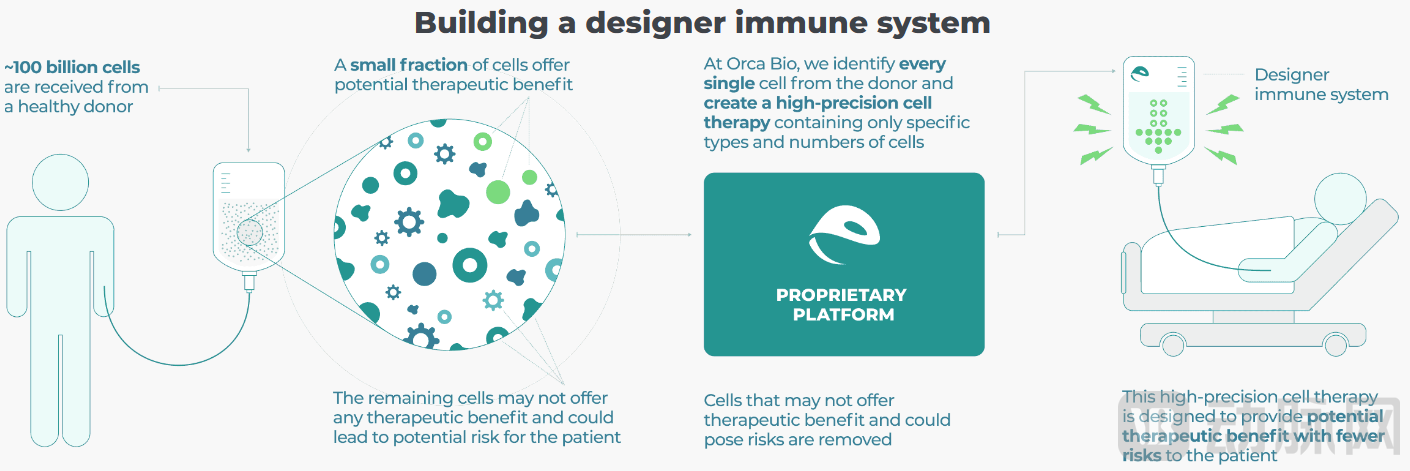
Orca’s Therapeutic Approach. Image source: Orca official website
To address these pain points, Orca has independently established its own manufacturing facilities and technologies, with the goal of reliably delivering purified, high-precision investigational cell therapies to each patient at scale, every time.
Currently, the company has established five pipelines under development, with indications covering various hematologic malignancies, including acute myeloid leukemia (AML), acute lymphoblastic leukemia (ALL), myelodysplastic syndromes (MDS), myelofibrosis (MF), and mixed-phenotype acute leukemia (MPAL). Its core therapies, Orca-T and Orca-Q, both demonstrated strong efficacy at the 2023 American Society of Hematology (ASH) Annual Meeting.
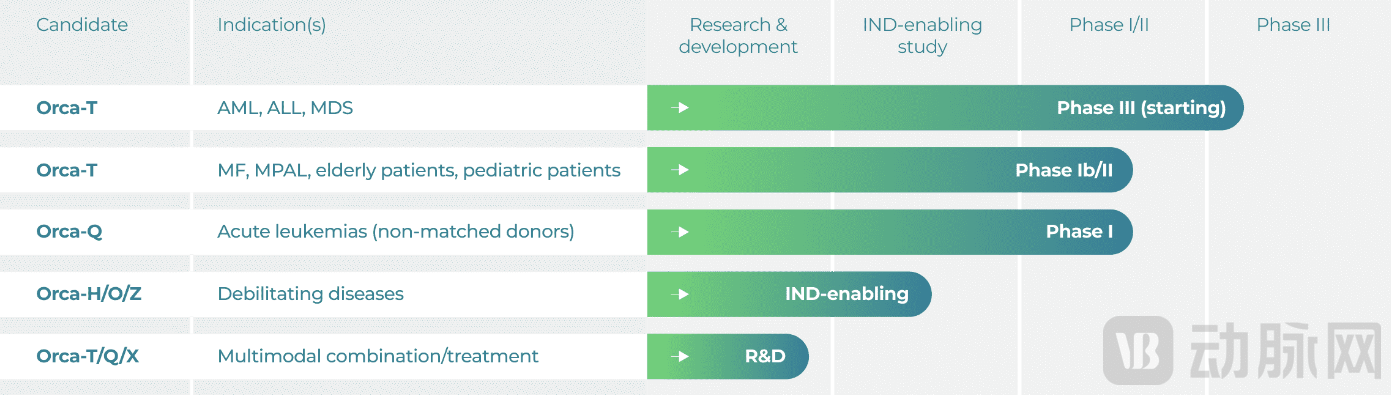
Pipeline in Development, Image Source: Orca Official Website
At the 2023 ASH Meeting, Orca announced that in the Phase Ib/In the Phase II study, Orca-T demonstrated the following advantages when compared with concurrent non-randomized single-center controls in allogeneic transplant patients:The use of the BFT myeloablative conditioning regimen and Orca-T therapy can improve the prognosis of elderly patients with hematologic malignancies, with a 1-year OS rate >95% and a 1-year TRM of 0%.These data indicate that Orca-T cell therapy is a lower-toxicity alternative to conventional transplantation. Its ongoing Phase III trial, designed to evaluate and compare Orca-T with standard of care, is currently enrolling patients. Furthermore, Orca-T has been granted Regenerative Medicine Advanced Therapy (RMAT) designation by the FDA.
Orca-QIt is Orca’s second high-precision allogeneic cell therapy to enter clinical development, designed for the treatment of hematologic malignancies. This cell therapy consists of enriched CD34+ stem cells and specific T-cell subsets purified from haploidentical donors using a high-precision platform.It can reduce rejection issues for most blood cancer patients who cannot find a fully matched donor.
At the 2023 Transplantation and Cellular Therapy Conference, Orca presented Phase I multicenter trial data for Orca-Q, which demonstrated that:Following allogeneic hematopoietic stem cell transplantation from haploidentical or half-matched donors, the incidence of moderate-to-severe chronic GvHD was 0%, and the GRFS rate was 75%.
These results collectively demonstrate that Orca-T and Orca-Q hold significant potential and advantages in the treatment of hematologic malignancies.
Over 1 Million Patients with Malignant Hematologic Disorders,
Cell Therapy Industrialization Enters an Acceleration Phase
In recent years, driven by multiple factors including an aging population, environmental pollution, and social stress, the number of new cancer patients has been rising year by year.
According to Hengrun Dasheng’s prospectus, the number of new cases of malignant hematologic diseases worldwide increased from 1.133 million in 2015 to 1.305 million in 2021, and is projected to reach 1.546 million by 2030. Among these, the number of new cases in China rose from 193,000 in 2015 to 237,000 in 2021, and is expected to grow to 300,000 by 2030.
The corresponding global oncology drug market grew from USD 117.7 billion in 2015 to USD 217.8 billion in 2021, while China’s oncology drug market increased from RMB 107.9 billion in 2015 to RMB 236.0 billion.
Compared with treatment modalities such as surgery, chemotherapy, and targeted therapy, cellular immunotherapy is also striving to catch up and is gradually being applied in clinical practice.According to available data, the global market size for CAR-T products was USD 1.9 billion in 2021 and is projected to reach USD 23.1 billion by 2030. As 2021 marked the inaugural year of CAR-T cell therapy in China, the domestic market is expected to reach approximately RMB 5 billion by 2025 and grow to RMB 32.5 billion by 2030.
Driven by China's vast patient population, the domestic cell therapy market is growing significantly faster than the global average., an increasing number of outstanding Chinese companies specializing in hematologic oncology cell therapies—such as BeiGene, Ascentage Pharma, Legend Biotech, and CARsgen Therapeutics—are expanding globally. This trend highlights the clinical and industrial strengths of domestic enterprises and has gradually gained recognition from major multinational corporations (MNCs).
In February this year, AstraZeneca officially completed the merger with Gracell Biotechnologies, positioning itself in the cell therapy sector for hematologic malignancies. According to available data, AstraZeneca acquired Gracell Biotechnologies for a total consideration of approximately $1.2 billion (over RMB 8.5 billion), representing an 86% premium over Gracell’s closing share price on December 22, 2023, thereby reigniting enthusiasm in the sluggish pharmaceutical market. This momentum is expected to persist within the cell therapy industry for some time.