

Who Is Driving Chinese MedTech Startups Global? Insights from the Booming CMEF
The Spring 2024 CMEF was as bustling as ever, with a notable increase in foreign faces amidst the surging crowds compared to previous years.
“Previously, most of our clients were from Europe and the United States. This year, we have not only seen an increase in visitors from Japan, South Korea, and Singapore, but even guests from Russia and the Middle East have proactively reached out to engage with us,” a sales director at a Chinese-made X-ray tube manufacturer told VCBeat.
“Some are distributors seeking new market collaboration opportunities, others are exploring the Chinese market for innovative products worth developing, and still others are overseas doctors and students who are simply interested in learning about our new technologies.”
Beyond X-ray tubes, leading domestic medical AI companies, imaging equipment manufacturers, and even foreign core component makers for imaging systems—mistaken by distributors for Chinese firms—have all described similar scenarios to us.
Global attitudes toward China’s high-end manufacturing have shifted significantly. Just two years ago, medical device startups were focused on domestic substitution; now, overseas markets are driving them to expand internationally.
Based on feedback from selected exhibitors, the needs of overseas visitors exhibit distinct regional variations. The products that interest them are not necessarily the most cutting-edge in terms of technology, but they must align closely with their respective countries’ healthcare demands.
Some attendees from Europe and the United States, who hold senior executive positions at multinational corporations such as GPS, Canon, and Fujifilm, were led by their China-based colleagues to visit the booths of startups, with the aim of identifying projects with potential for mergers and acquisitions or collaboration.
Take AI-assisted diagnostic tools related to CT as an example. Many imaging equipment manufacturers are independently developing intelligent algorithms for the chest, brain, heart, and other regions, yet they ultimately struggle to cover all clinical scenarios associated with these organs. Therefore, they sometimes seek out AI products that fill gaps in their product lines during exhibitions, completing their offerings through direct collaboration or acquisitions; at other times, they evaluate competitors who have developed their own AI solutions, as these AI startups may deliver superior performance compared to the manufacturers’ in-house developments.
Visitors from Japan, South Korea, and Singapore are predominantly distributors. These three countries are geographically close to China and have highly developed economies. Their healthcare markets have undergone extensive growth and development over a prolonged period, becoming highly mature and professional.
Unlike their counterparts in Europe and the United States, these visitors do not prioritize product innovation above all else. Instead, they compare Chinese medical devices with those already commercialized at scale in the domestic market, seeking products that meet these demands while offering superior quality and more competitive pricing than existing options. These products are then introduced into their home markets either as complete units or through original equipment manufacturer (OEM) arrangements.
The Middle East is also emerging as a new force. Influenced by geopolitical factors, the region seeks to decouple from Western countries such as the United States and build a complete local pharmaceutical and medical device industry chain, achieving localization of related technological supply chains. Therefore, the Middle East not only has upstream demand for raw materials and components but also aims to introduce advanced technologies to upgrade its local industrial chain, establishing an end-to-end industrial structure spanning from upstream to downstream.
In recent years, in addition to numerous distributors from the Middle East, several Middle Eastern investment institutions have followed suit. These entities have shown strong interest in technologically advanced innovations and companies with high investment potential, aiming to identify partners at CMEF to facilitate their market entry into the Middle East, thereby strengthening local supply chains and supporting the development of the medical device industry.
The number of exhibitors from Russia has also seen a significant increase. NanoVision, a domestic manufacturer of ultra-high-end static CT scanners, has recently hosted numerous visitors from this country. Relevant personnel stated that although Russia can still procure imaging equipment produced by GPS (GE Healthcare, Philips, and Siemens Healthineers), it continues to face the risk of supply disruptions for core components. This situation is similar to that in China, compelling them to reconsider and adjust their supply chain strategies.
Therefore, attendees at CMEF included not only Russian medical device distributors but also national-level representatives. They aim to identify suitable suppliers through cooperation with China, thereby further reducing reliance on European and American markets and mitigating potential risks.
Overseas distributors are enthusiastic, but domestic manufacturers remain cautious about expanding abroad. This attitude is largely related to the companies' own international expansion plans.
At the exhibition, VCBeat visited a total of 19 early-stage medical device startups, over 90% of which already have comprehensive global expansion strategies in place. Consequently, proposals from overseas distributors are unlikely to alter their existing trajectories, with only a very small number of companies potentially considering such requirements in the future.
Among these companies’ international expansion strategies, Europe and the United States are unequivocally the top choices. After all, these two regions not only boast advanced economies and mature healthcare industries, but also have widely recognized regulatory review and approval systems.
However, the objectives of Chinese companies seeking development in Europe and America are not entirely the same.
Xinhong Electronics is a high-tech enterprise specializing in "cold cathode" distributed X-ray source products. In the medical field, it has launched various distributed multi-focus X-ray sources for applications in dentistry, mammography, cranial imaging, and chest imaging. The intraoral 3D rapid imaging system showcased at this CMEF, as an upgraded product of traditional dental X-ray machines, features 3D imaging, low radiation dose, low artifacts, and fast imaging speed. Furthermore, through collaboration with North American partners, this product has obtained FDA certification and achieved large-scale sales in the North American market.
This company targeted the specific needs of the U.S. market before expanding overseas. In the U.S., hospital-based 2D dental X-ray machines are on the verge of being upgraded and replaced. The intraoral 3D imaging system developed by Xinhong Electronics improves image detail by 40% compared to traditional dental X-ray machines, while reducing radiation dose per scan and scanning time by 90% compared to 3D imaging with dental CBCT. This helps dentists achieve more precise, efficient, and safe dental diagnoses.
It is worth noting that XinHong Electronics positions its intraoral 3D imaging system as an upgrade to traditional dental X-ray machines, offering improved capabilities for the diagnosis and treatment of dental diseases. In Europe and the United States, widespread emphasis on oral health, driven by dietary habits, has led to a large-scale population proactively undergoing dental disease screening, creating a substantial market opportunity. Markets with similar demand include Japan and South Korea. In the future, XinHong Electronics plans to expand into European and Asian markets using the same strategy employed for its entry into North America.
In contrast, the vast majority of the population in China does not proactively undergo screening for dental diseases, indicating that market education will still require considerable time. Therefore, XinHong Electronics plans to first establish proven case studies in overseas markets, then leverage this mature experience to enter tertiary hospitals in China for initial implementation, and finally achieve large-scale promotion within China’s specialized dental market.
Startups such as Infervision, Shukun Technology, and Aibo Hechuang have chosen a path of simultaneously expanding into both European/American and domestic markets.
Among them, Infervision holds the world’s first and second Class III medical device certificates issued by China’s National Medical Products Administration (NMPA) for AI-assisted cancer surgical treatment; Shukun Technology’s “Digital Human 3.0” has redefined the workflow of certain imaging examinations; Aibotek has pioneered the global development of a pan-vascular interventional robot with fully independent intellectual property rights. All these companies possess globally leading and versatile innovative technologies, and their products are capable of meeting the implementation requirements in both the Chinese and U.S. markets.
Furthermore, some Chinese enterprises expanding into European and American markets do not prioritize commercialization. According to the head of a startup in the medical AI sector, “We have invested significant funds in recent years to collaborate with top-tier overseas hospitals, jointly conducting scientific research projects and exploring new solutions.” For these companies, the goal of global expansion is to acquire cutting-edge medical expertise; even in the absence of market demand or profitability, they aim to establish a presence in European and American markets.
Beyond Europe and the United States, Belt and Road Initiative (BRI) countries, bolstered by national policy support, have also become a key direction for many enterprises expanding overseas. However, corporate assessments of this destination remain mixed.
As the leading domestic medical imaging equipment manufacturer, Neusoft Medical has achieved considerable success in its commercialization efforts along the “Belt and Road” initiative, with its imaging systems deployed in 80% of the countries along the route. According to Wu Shaojie, CEO of Neusoft Medical, the company is conducting in-depth market research in regions where its products have already been partially implemented, aiming to identify suitable countries for establishing R&D centers and achieving a higher degree of localization—a strategy reminiscent of how GPS (GE, Philips, and Siemens) has deeply integrated into the Chinese market.
However, for most startups, these developing countries have demand but lack funding. An executive in the surgical robotics sector joked, “If the state could support their high-end manufacturing industries as it does with hospital construction projects, we would be more than happy to put down roots along the ‘Belt and Road.’”
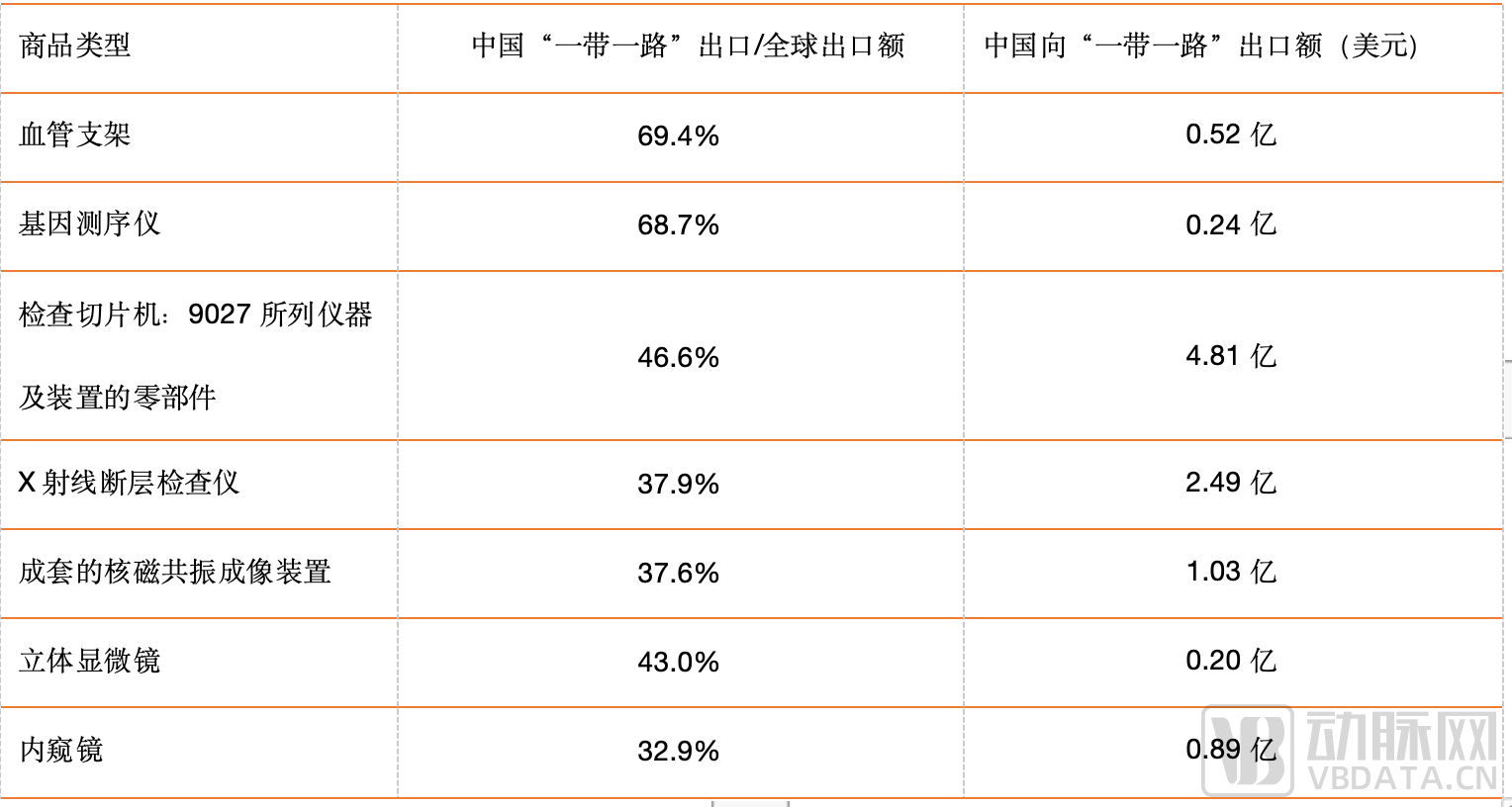
2022 “Belt and Road” High-Contribution Medical Device Export Results
Over the past two years, enthusiasm for overseas expansion from Japan has continued to rise, with a rapid increase in Chinese medical device manufacturers seeking certification from the Pharmaceuticals and Medical Devices Agency (PMDA). Among existing cases, Yizhun Smart, a leading Chinese AI medical imaging company, has partnered with Marubeni Corporation of Japan to jointly promote the application and commercialization of Yizhun Smart’s AI-assisted diagnostic products in Japan.
In response, a representative from Yizhun AI stated, “In the past, many medical tourism agencies designated Japan as a destination for oncology treatment. If China’s cutting-edge technologies continue to expand globally, patients who travel to Japan seeking high-end diagnosis and treatment may ultimately benefit from advanced diagnostic and therapeutic services available domestically.”
Although many domestic medical device companies are enthusiastically preparing for overseas expansion, and foreign enterprises and distributors are continuously extending olive branches to China’s high-end manufacturing sector, a significant number of companies remain committed to strengthening their position in the domestic market first and are reluctant to take the step toward going global.
“We previously had overseas operations, but we have largely shut them down to focus on the domestic market,” said the head of marketing at a medical AI company in an interview with VCBeat. “From initial team building and market research to product regulatory approval, commercial deployment, maintenance, and supply chain management, substantial investments are required. There is also the risk of inadvertently violating stringent laws, which could result in exorbitant penalties. Without enduring several years of losses, it is difficult for enterprises to establish a firm foothold in the market.”
“Given the economic instability over the past two years, many companies’ R&D departments have faced tight budget constraints. Therefore, we have opted for a more prudent approach by allocating funds to domestic operations with greater potential for rapid profitability, which better aligns with our company’s current strategic pace.”
Therefore, even if domestic competition is unavoidable, it is advisable for companies to build a team with certain overseas market operational experience before planning their overseas business. Especially for innovative enterprises in the very early stages, it may not be appropriate to enter emerging markets such as the Middle East and Russia at this stage.
Furthermore, companies must also consider the depth of their overseas expansion. Whether to merely establish a sales team or to build comprehensive maintenance and support teams along with R&D systems depends on the scale of investment a company can commit to and the duration of losses it can endure.
Nevertheless, Chinese medical device companies are ushering in an unprecedented opportunity for development. Transitioning from “replacement” to “leadership,” they are writing a new chapter in the global market.