

2024 China Healthcare Industry White Paper – Core Insights Edition by China Renaissance
CEC CAPITAL
Investment and Asset Management Institutions
Editor’s Note: This article is from CEC CAPITAL, authored by its healthcare investment banking team. VCBeat has been authorized to republish it.
“2024 CEC Capital China Healthcare Industry White Paper” is CEC Capital’s flagship annual industry research product,CEC Capital has systematically released this series of industry research reports for the sixth consecutive year since 2019.
The 2024 White Paper was jointly produced by the Pharmaceuticals & Biotechnology Group, Medical Technology & Devices Group, Healthcare & Health Services Group, Synthetic Biology Group, and Healthcare M&A Team of CEC CAPITAL’s Healthcare Investment Banking Division.Divided into the Core Perspectives Section and the Five Major Themes Sections.
Today's release is“2024 CEC Capital China Health Industry White Paper – Key Insights”Additional thematic articles will be published consecutively in the coming days. Stay tuned.

In our release last year,《2023 CEC Capital China Health Industry White Paper》Previously, we estimated that China’s health industry was a market worth RMB 12 trillion (approximately USD 1.7 trillion) in 2022. Of this, the market size related to pharmaceuticals (from the perspective of ex-factory prices for pharmaceutical companies) was approximately RMB 2.9 trillion; the market size related to medical devices and diagnostics (from the perspective of ex-factory prices for device manufacturers) was approximately RMB 1.1 trillion; and from the perspective of healthcare services, digital health, and broader health market participants directly serving end consumers, the total market size of healthcare services was approximately RMB 8.3 trillion (including pharmaceuticals and medical devices sold to end consumers through healthcare service institutions).After excluding double-counted components, the overall market size of China’s health industry in 2022 was approximately RMB 9–10 trillion (USD 1.3–1.4 trillion).
In 2023, as China fully emerged from the COVID-19 pandemic, and taking into account factors such as domestic centralized procurement policies and anti-corruption campaigns in the healthcare sector, we estimate that China’s health industry reached a market size of RMB 13.3 trillion (approximately USD 1.84 trillion). Within this total, the pharmaceutical-related market remained largely flat compared to 2022, at around RMB 3 trillion; the market for medical devices and diagnostics saw slight growth relative to 2022, reaching approximately RMB 1.2 trillion; and driven by the continuing intensification of population aging in China, the market size for healthcare services—including medical services, digital health, and broader wellness-oriented health services—increased to about RMB 9.1 trillion.After excluding double-counted components, we estimate that the total market size of China’s health industry in 2023 was approximately RMB 10.5–11 trillion (USD 1.4–1.5 trillion), representing a 7–8% increase compared with 2022.

In 2023, the market capitalization of healthcare companies listed on China’s A-share and Hong Kong stock markets generally exhibited a downward trend, with the decline being particularly pronounced among those listed in Hong Kong.According to Wind data, by the end of 2023, there were 512 listed healthcare companies in the A-share market, with their total market capitalization declining from RMB 7.6 trillion at the beginning of the year to RMB 7.1 trillion by year-end, representing an overall drop of 6.5%. Meanwhile, the CSI Healthcare Index fell by 23.8% by the end of 2023 compared to the start of the year. In the Hong Kong stock market, there were 232 listed healthcare companies, with their total market capitalization decreasing from RMB 2.8 trillion at the beginning of the year to RMB 2.2 trillion by year-end, marking an overall decline of 21.4%. During the same period, the Hang Seng Healthcare Index dropped by 26.3% by year-end compared to the beginning of the year.
In 2023, the valuation framework of the healthcare sector in China’s A-share and Hong Kong stock markets underwent significant adjustments,Represented by the CSI Healthcare Index, the PS TTM (trailing twelve-month price-to-sales ratio) decreased from 6.9x at the beginning of the year to 6.4x at year-end, a decline of 6.2%. During the same period, the PE TTM (trailing twelve-month price-to-earnings ratio) rose from 24.3x at the beginning of the year to 33.5x at year-end, an increase of 37.9%. In comparison,In 2023, the overall valuation system of the healthcare sector in the Hong Kong stock market continued to decline, with a more significant drop.Represented by the Hang Seng Healthcare Index, the P/S TTM (trailing twelve-month price-to-sales ratio) decreased from 1.6x at the beginning of the year to 1.2x at the end of the year, a decline of 29.1%. The P/E TTM (trailing twelve-month price-to-earnings ratio) dropped from 138.0x at the beginning of the year to 56.5x at the end of the year, a decline of 59.0%.
In 2023, affected by the decline in the secondary market and the tightening of IPO policies, the willingness to trade and the transaction amount in the primary market dropped significantly, with an overall decline greater than that of the secondary market.In 2023, the number of investment deals in the primary market dropped to 1,440, a 28.7% decrease from 2,019 deals in 2022. The total investment amount fell to RMB 93.23 billion, representing a nearly 50% decline compared to RMB 181.38 billion in 2022. Financing activities at Series D and later stages saw significant changes, with a substantial reduction in Pre-IPO investments and a notable decrease in the total value of merger and acquisition transactions.
Based on our market perception,In 2023, the valuations of healthcare companies in the primary market underwent significant changes.Moreover, this change is not consistent across different sub-sectors.Specifically, the biopharmaceutical and synthetic biology industries exhibit a pronounced trend of polarization:Leading companies in niche sectors continue to command high valuations and remain highly sought after by investors, while the valuations of other enterprises have declined sharply, with drops exceeding those seen in the secondary market. Meanwhile,Valuations of companies in the medical device and healthcare services sectors have generally declined.Among them, leading companies experienced a relatively smaller decline, which was lower than that of the secondary market, while other companies suffered more severe declines, exceeding the drop in the secondary market.
The market no longer regards IPOs as the most critical exit route, leading to downward adjustments in corporate valuations and asset prices.Investors are placing greater emphasis on a company’s technological leadership, profitability, and long-term returns, rather than focusing primarily on equity appreciation and exit through an initial public offering (IPO) as in the past, marking a significant shift in transaction logic. RMB-denominated funds, particularly those backed by state-owned enterprises and local governments, remain the dominant investors in the primary market.
Judging from the series of policies introduced in early 2024 to support industrial consolidation and promote innovation in the health industry, the state will continue to support technological innovation. This support is premised on ensuring that enterprises prioritize their own operations and profitability rather than merely pursuing high valuations, while deepening hard-core innovation, advancing domestic substitution, and resolving “chokehold” issues.Enterprises with core technologies and sufficient self-sustaining capabilities can still secure adequate financial support to weather the industry’s downturn.

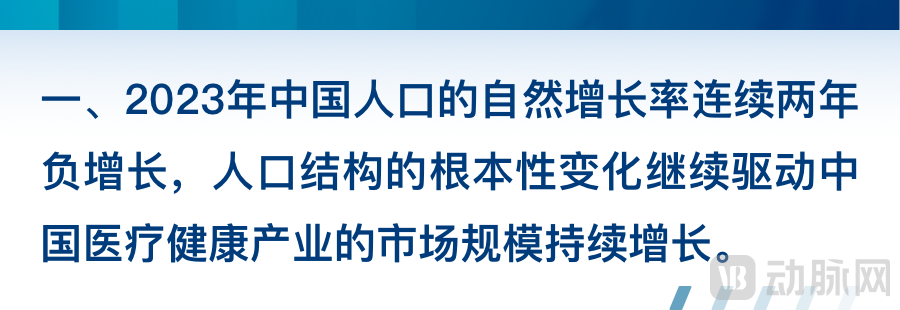
In 2023, China’s birth rate continued to decline, while population aging intensified.
According to the "Statistical Communiqué of the People's Republic of China on the 2023 National Economic and Social Development,"In 2023, the number of live births in China decreased to 9.02 million, a 5.65% decline from 2022, with a natural growth rate of -1.48‰, marking the second consecutive year of negative population growth.Meanwhile, the population aged 60 and above rose to 297 million, accounting for 21.1% of the total population, an increase of 1.3 percentage points from 2022; the population aged 65 and above reached 217 million, representing 15.4% of the national total, with an increase of 0.5 percentage points, further intensifying the aging of China's population.
According to the analysis in our white paper from last year, the proportion of China’s population aged 60 and above will increase from 21.1% today to 26.2% by 2030, reach 32.5% by 2040, climb to 38.8% by 2050, and ultimately peak at 48.3% in 2080. In other words,Barring the influence of new external factors on current trends, China will transition over the next 60 years from a society in which approximately one in five people is aged 60 or older to a highly aged society by 2080, where one in every two people will be aged 60 or older.
While the aging population poses significant challenges to social and economic development, it also gives rise to substantial market opportunities.Many human diseases are directly associated with aging and the senescence of bodily organs, such as tumors, cardiovascular and cerebrovascular diseases, chronic conditions like diabetes and hypertension, and age-related disorders such as Alzheimer’s disease.The “silver economy” industries—encompassing patient rehabilitation, daily care, and assistive smart devices for an aging society, as well as senior-friendly social platforms and elderly entertainment with broader extensions—will become one of the key pillars of China’s future economic development.Meanwhile,Fields such as assisted reproductive technology and eugenics, which are employed to counter the trend of population aging and boost birth rates, will also indirectly become important branches of the health industry in an aging society.
Therefore, against the backdrop of China’s increasingly aging population and declining fertility rate, we believe that the market boundaries of China’s healthcare industry will continue to expand, and the overall market size will sustain its growth.
The rapid growth of China’s health industry over the past decade has been driven by three key forces: technology, policy, and capital. In 2023, the policy dimension played a particularly prominent role, surpassing technology and capital in influence to become the core force driving industry transformation. The three policies with the greatest impact on the sector were the anti-corruption campaign in healthcare, centralized volume-based procurement, and the slowdown in initial public offerings (IPOs).
“Anti-corruption in Healthcare” was the most influential and highly watched healthcare policy event of 2023.In May 2023, a joint “anti-corruption campaign in the healthcare sector” was launched by 14 departments, including the National Health Commission. This initiative had far-reaching implications, involving an unprecedented number of departments and marking a historic depth of governance within China’s pharmaceutical and medical industries. The subsequent wave of actions—including self-inspections by medical institutions, physicians returning kickbacks, pharmaceutical companies strengthening compliance measures, salary adjustments, postponement of academic conferences, and widespread layoffs—further demonstrated the profound impact of this policy cycle.
Meanwhile,In an era where national medical insurance negotiations and centralized volume-based procurement have become routine, the 2023 medical insurance negotiations and centralized procurement still exhibited some new characteristics.In the 2023 adjustment of the National Reimbursement Drug List (NRDL), a total of 126 drugs were newly added, with an average price reduction of 61.7%, a decline largely comparable to that of 2022. However, during the 2023 NRDL negotiations, policy support was tilted toward orphan drugs and innovative medicines. A total of 25 innovative drugs participated in the negotiations, with 23 successfully included, achieving a high success rate of 92%. In negotiating the reimbursement prices for these innovative drugs, the approach was no longer characterized by "aggressive price slashing," resulting in relatively moderate price reductions.Regarding the pricing mechanisms for truly innovative drugs and medical devices, Chinese regulatory authorities successively introduced policies in 2023 and early 2024 to explore market-oriented autonomous pricing mechanisms, thereby protecting and incentivizing innovation.
On December 15, 2023, the National Healthcare Security Administration (NHSA) issued the "Letter in Response to Proposal No. 02870 (Social Management Category No. 217) of the First Session of the 14th National Committee of the Chinese People's Political Consultative Conference," which explicitly stated: Encourage the inclusion of new technologies, new drugs, and new medical devices into the coverage scope to stimulate pharmaceutical companies' motivation for innovative research and development. In the reform of healthcare payment methods such as DRG/DIP, full consideration shall be given to the application of new technologies, new drugs, and new medical devices. On March 4, 2024, the NHSA released the "Response to Suggestion No. 3298 of the Fifth Session of the 13th National People's Congress." In response to the deputies' proposal on further improving the NHSA's DRG payment system—specifically regarding new medical technologies—the NHSA provided a clear response, further supporting the exemption of innovative medical devices from DRG payment controls. On February 5, 2024, the NHSA published the "Notice on Establishing a Price Formation Mechanism for the Initial Launch of Newly Marketed Chemical Drugs to Encourage High-Quality Innovation (Draft for Comment)," which further clarified that high-quality innovative drugs may explore reasonable autonomous pricing in the future.
The prosperity of the capital market has a significant impact on the development of China’s healthcare industry. However, in 2023, as the pace of initial public offerings (IPOs) on the A-share market slowed substantially and the Hong Kong stock market remained sluggish, financing difficulties became a common challenge across the entire sector.In 2023, the number of initial public offerings (IPOs) on China’s A-share market (excluding the Beijing Stock Exchange) by companies in the healthcare and medical industry dropped to 15, with total funds raised amounting to approximately RMB 20.9 billion. Compared to 2022, which saw 46 IPOs and RMB 774.1 billion in funds raised, these figures represent declines of 67.39% and 71.70%, respectively. Notably, on the STAR Market, there were only four IPOs in 2023, with just one meeting the STAR Market’s five sets of listing criteria (designed for technology innovation enterprises without revenue or profits). In contrast, the STAR Market recorded 23 IPOs in 2022, eight of which complied with the five sets of listing criteria. For innovative biopharmaceutical and medical device companies seeking capital through IPOs, particularly under the STAR Market’s five sets of listing criteria, the A-share market environment in 2023 was unfavorable for technology innovation enterprises. We look forward to policy support and a turnaround in 2024.
We believe that in 2024, the influence of the “policy cycle” will continue to surpass that of the “technology cycle” and the “capital cycle,” exerting a decisive impact on the future direction and development pace of the healthcare industry.
Chinese medical enterprises are transcending simple partnerships with local distributors in their internationalization efforts, instead deeply embedding themselves in local markets to achieve co-development with local industries.The unique characteristics of the healthcare industry make market access a high-barrier threshold. Although obtaining approval from the U.S. FDA or European CE certification typically meets the entry requirements of most countries, this is merely the starting point for entering overseas markets. After-sales services for medical products—such as on-site technical support for medical devices during clinical procedures, and frequent academic promotion and interaction between manufacturers and local hospital physicians—must be rooted in the local market and pursued through localized development.
In July 2023, Mindray Medical announced the acquisition of a 75% equity stake in DiaSys Diagnostic Systems (“DiaSys”), a renowned German company, to establish an overseas localization platform. DiaSys maintains subsidiaries in North America, Europe, Latin America, and the Asia-Pacific region, with production facilities in Europe, the Asia-Pacific, and Latin America, serving end customers in over 140 countries worldwide. Upon completion of the transaction, Mindray will leverage its extensive experience in cross-border M&A integration and management to gradually introduce and enhance supply chain platforms for overseas IVD businesses, including chemiluminescence, through DiaSys. This strategy aims to strengthen capabilities in localized overseas production, warehousing, logistics, and services, laying a solid foundation for the comprehensive internationalization of its IVD business.Currently, Chinese medical enterprises are increasingly focusing on rapidly exporting their overall industrial capabilities to overseas markets, including the cultivation of upstream and downstream segments of the industry chain. This strategy closely resembles the approach adopted by multinational medical corporations from Europe and the United States in the Chinese market over the past two decades.
Furthermore, Chinese medical enterprises have undergone significant shifts in their selection of overseas target markets. Amidst major changes in global geopolitics and the promotion of China’s Belt and Road Initiative, domestic companies are uncovering new opportunities for international expansion, particularly in emerging markets represented by the Middle East.Although the European and American markets have long been the coveted destinations for Chinese companies’ global expansion, sales growth in these regions has consistently fallen short of expectations due to factors such as product positioning.
Since 2020, BGI Genomics has placed high priority on technological cooperation with Middle Eastern countries. During this period, BGI has established high-level public health laboratories in multiple countries, including Saudi Arabia, the United Arab Emirates, and Oman. In 2023, BGI’s wholly-owned subsidiary in Saudi Arabia formed a joint venture with the Faisaliah Group to jointly develop the third-party medical testing market in Saudi Arabia. As such cases multiply, Chinese healthcare enterprises are rapidly transitioning from traditional product exports to the comprehensive export of technological capabilities.As companies transfer technologies and patents to local markets, create more job opportunities locally, and cultivate more professional talent, growing together with local markets should become the long-term strategy for Chinese medical enterprises’ overseas development.

In Nature’s 2023 list of the Ten Most Important People in Science, ChatGPT was prominently featured, marking the first time a non-human entity was included on the list. Since the official emergence of AIGC (Artificial Intelligence Generated Content), represented by the new generation of large language models such as ChatGPT, in late November 2022, it has iterated to version 4.0 in less than four months. To date, Figure AI has recently launched Figure 01, a humanoid robot powered by GPT, whose capabilities in seeing, hearing, speaking, moving, and even thinking are all achieved through self-learning.Artificial intelligence is leading human technological development into a new era. We believe that over the next decade, the systematic opportunities in life sciences and healthcare will belong to AI, which will bring profound transformation to the entire health industry.
NO.1Next-generation generative large language model AI, represented by ChatGPT, will profoundly influence and transform the way people access health consultations and medical services, making healthcare resources more accessible and inclusive, and is poised to comprehensively empower fields such as scientific research, medical services, elderly health, and payment systems.
// In the realm of scientific research, breakthrough advancements brought by large language models and multimodal AI may usher in a new paradigm for scientific inquiry.
The recently released Claude 3 is capable of joint thinking and reasoning by integrating multimodal data, such as text and images, and can even conduct research at a doctoral level. With its assistance, generating research results based on big data, conducting interdisciplinary studies, and solving complex problems beyond the reach of human intelligence will no longer be difficult for researchers and will become part of their daily routine.
// In terms of patient services, AI is transforming traditional online and offline medical service and diagnosis/treatment models, addressing issues related to the accessibility of high-quality medical resources, such as the scarcity of specialists, inefficient interactions, and high costs.
The “expert avatars” powered by large language model (LLM) AI enable affordable, on-demand online consultations with renowned physicians anytime and anywhere. This approach leverages AI to increase the supply and efficiency of high-quality medical resources, covering patients’ needs across the entire care journey—pre-consultation, during consultation, and post-consultation.
// In the comprehensive and innovative effort to enhance the quality of life for the elderly, large language model (LLM)-based AI will integrate technologies such as big data, non-invasive vital sign sensing, communication and positioning, the Internet of Things (IoT), and smart wearables. It will automatically detect, record, and evaluate vital signs, behavioral patterns, and other medical indicators in real time, providing tiered management services to safeguard the safety and physical health of older adults.
Notably, companion robots for the elderly represent a significant direction for development. Empowered by generative large language models, these robots not only possess precise speech recognition capabilities but also understand human emotions. They can engage in conversations with older adults, participate in activities and games together, provide reminders to avoid safety risks, and offer specialized functions such as medication guidance. These systems can identify over 40,000 types of medication packaging, announcing details including drug names, indications, and expiration dates.
// In the direction of medical insurance payments, AI can provide precise solutions for the supervision of medical insurance funds based on big data from medical insurance.
By refining new rules and leveraging label propagation algorithms, intelligent data analysis can identify more insured individuals with consistent group behaviors, thereby pinpointing key populations with anomalous medical insurance activities. This approach proactively detects population-level risk factors and anomalies in healthcare expenditure settlements, providing regulatory authorities with a scientific basis for decision-making.
NO.2Machine learning and deep learning AI applications have been integrated throughout the drug R&D and production processes, as well as the diagnostic and therapeutic procedures of medical equipment and devices.
// Across all stages of pharmaceutical research, development, and manufacturing, the application of artificial intelligence is becoming increasingly mature. AI technologies are now actively involved in processes ranging from drug target discovery, virtual screening of compounds, and druggability prediction to clinical trials.
Insilico Medicine’s PandaOmics platform identifies novel targets by comparing multi-omics data; Atomwise leverages AI for structure-based drug design to rapidly screen promising drug candidates; ConcertAI has established the most extensive clinical network to provide evidence for new therapies; and the next-generation AlphaFold model can predict the structures of nearly any molecule in the Protein Data Bank (PDB). Furthermore, AI applications in drug manufacturing have optimized production processes. For instance, Greater Bay Biotech provides process optimization services and culture media to pharmaceutical companies, significantly reducing production costs and accelerating time-to-market for drugs.
The involvement of AI has shortened the average duration of preclinical drug development to 11–18 months, significantly reducing costs.According to MedMarket Insights, as of Q3 2023, approximately 40 AI-related drug pipelines had advanced to Phase II clinical trials, and nearly 10 had progressed to Phase III. It is projected that after 2027, AI-driven drugs currently in Phase II and III clinical trials will enter the marketing stage, ushering in a peak period for the AI drug discovery market. AI-enabled drug development and manufacturing are likely to become standardized, inevitably reshaping the paradigms and processes of the pharmaceutical industry and driving comprehensive sector-wide transformation. Furthermore, new low-cost drugs developed with AI support will disrupt the existing pharmaceutical market.
// In the diagnostic and therapeutic processes involving medical devices and equipment, continuous iterations of deep learning capabilities will enable AI to significantly enhance automation, precision, and intelligence, thereby improving patient outcomes and achieving greater cost-effectiveness.
Deep learning-based artificial intelligence in the medtech and diagnostics sectors encompasses AI-assisted imaging diagnosis, AI-assisted pathological diagnosis, AI analysis of high-throughput sequencing, hospital automation equipment, and AI monitoring. Healthcare professionals are utilizing AI-enabled surgical robots with intelligent navigation, heart failure detection devices based on sensors and algorithms, and motor rehabilitation and brain disease treatment devices based on brain-computer interfaces.Leveraging AI deep learning technology, the level of automation continues to rise.Leveraging deep learning and extensive historical data, the robot can autonomously plan surgical strategies and automate procedures, assisting physicians in precisely planning surgical pathways and providing decision support.
Enhanced precision represents another major breakthrough in the development of AI technology.AI technology enables faster lesion localization and reduced interpretation time in the analysis of ultrasound, CT, MRI, and endoscopic images. In the analysis of high-throughput sequencing results, AI enhances sequencing accuracy and lowers overall sequencing costs through advanced algorithms and optical signal processing.
AI is transforming the in vitro diagnostics (IVD) sector by enhancing the speed and precision of complex biomedical data analysis, leading to significant improvements in cost-effectiveness.Roche Diagnostics has partnered with PathAI to develop digital pathology algorithms for companion diagnostics, significantly reducing the time and cost of Roche’s reagent development. Siemens Healthineers leverages AI in digital pathology to automatically detect and quantify diagnostic markers in tissue samples, thereby accelerating and refining the diagnostic process.

We believe that artificial intelligence and synthetic biology will jointly lead humanity into the Fourth Industrial Revolution.Over the past five years, synthetic biology has been the only technological revolution globally that can be compared to large artificial intelligence (AI) models in terms of its potential to reshape human destiny. As multi-dimensional big data continues to accumulate and iterate, AI will become a key tool driving innovation and iteration across the entire biomanufacturing value chain. AI enables accurate predictions, thereby facilitating effective reverse design. AI holds distinct advantages in upstream applications—such as the rational design of nucleic acid and protein elements, high-throughput screening of chassis cells, construction of enzyme libraries, and precise prediction of enzyme activity—as well as in midstream processes including production fermentation and separation/purification. These areas represent the perfect convergence points where these two technology platforms synergize and mutually reinforce each other. Therefore, we believe that AI and synthetic biology are jointly propelling the biomanufacturing industry toward a new wave of growth.
Whether driven by the aim to reduce corporate production costs and boost profitability, or by the goals of environmental protection and energy conservation and emission reduction, the biomanufacturing industry has become a key sector of global attention this year and in the years to come.In 2023, synthetic biology innovations have permeated various industries, gradually establishing and refining the industrial ecosystem of biomanufacturing. This trend ranged from the explosive growth of semaglutide’s “weight-loss” application in the healthcare sector, to the approval of multiple biosynthetic food additives such as human milk oligosaccharides (HMOs) in the consumer market, and further to the production of fish feed protein from steel industry off-gases in the energy sector. Theoretically, 60% of global material production could be achieved through biomanufacturing in the future, with an expanding range of involved industries and an increasing number of products being “replaced.” More importantly, bio-innovative products and manufacturing processes that do not rely on petroleum resources can significantly improve energy efficiency and reduce carbon emissions.
Much like artificial intelligence, synthetic biology is not a single technology but rather a foundational technology platform capable of permeating every aspect of human life,Spanning sectors such as healthcare, energy, materials, medical aesthetics and daily chemicals, and agricultural food. Against this backdrop, synthetic biology can rapidly “evolve” from a platform technology to become the core of the biomanufacturing industry. Market focus has shifted from disruptive breakthroughs at the technical level—such as genetic engineering, enzyme engineering, and fermentation engineering—to whether synthetic biology technologies, through integrated innovation, can sustainably deliver “industrial-scale” commodities via “mass production.” Biomanufacturing has emerged as a new industry closely intertwined with industrialization.

We believe that industrial capital will play an increasingly critical role in the industry consolidation of China's healthcare sector in the future.
Across European and American capital markets, waves of industry consolidation and mergers and acquisitions have risen one after another. Although the driving factors vary each time, they are all closely related to industry policies, industrial competition, and technological iteration. The conclusion of each consolidation wave is accompanied by the emergence of a new industry landscape and leading companies.
During the decade of rapid IPO expansion in China’s A-share market, the primary drivers were sell-side securitization and buy-side market capitalization management.During this period, mergers and acquisitions were predominantly characterized by “cross-industry M&A” and “market-cap-management-driven M&A,” with industrial logic playing a less prominent role. However,In recent years, the drivers of mergers and acquisitions (M&A) and restructuring have shifted significantly, with an increasing number of transactions beginning to exhibit industry-led trends."Industry players are playing an increasingly important role in mergers and acquisitions."The M&A market in China’s health industry is shifting from being driven by market capitalization and securitization to being guided by industrial logic.
According to Wind statistics, industrial M&A accounted for over 80% of the merger and restructuring deals involving listed companies that passed regulatory review in 2023, reflecting a sustained and strong demand for industrial consolidation. Among the top ten minority equity financing deals in China’s healthcare industry by transaction value in 2023 were Haisheng Biologics ($300 million), WuXi XDC ($300 million), GenScript ProBio ($200 million), and Pharmaron ($100 million). These large-scale transactions were primarily driven by industry players, following logics such as incubation by leading companies, asset divestitures, or spin-offs. At the end of 2023, multinational pharmaceutical giant AstraZeneca announced its $1.2 billion acquisition of Gracell Biotechnologies, setting a precedent for multinational corporations acquiring Chinese biotech firms. This move further heightened global pharmaceutical giants’ interest in Chinese biotech companies, ushering in a wave of acquisitions by global pharmaceutical firms in China.
Therefore, at present, “heavyweight” industry players can not only empower and collaborate with innovative enterprises across multiple dimensions—including R&D, management, cost control, and sales channels—but also address the exit challenges faced by financial investors. Consequently, we believe that industrial capital will continue to play a critically important role in China’s health industry in the future.
Since 2022, initial public offerings (IPOs) have ceased to be the most sought-after exit route for investors. In the domestic market, policy-driven tightening led to consecutive months of “zero acceptances” in the second half of 2023. The number of IPO applications accepted for the Main Board and the ChiNext Board fell by 52% year-on-year in 2023, with the actual approval rate dropping below 50%. In overseas markets, geopolitical factors contributed to a 60% year-on-year decline in IPO fundraising volumes in Hong Kong and the United States in 2023 compared to the same period in 2022, while more than 50% of biopharmaceutical companies saw their stock prices fall below the IPO price on the first day of listing.China’s healthcare industry is experiencing the combined impact of an oversized primary market bubble and a sustained IPO chill. Exit returns from IPOs have shown persistent high volatility and low yields, marking the first time Chinese entrepreneurs and investors have witnessed the collapse of their faith in IPOs. With mergers and acquisitions (M&A) appearing to be the only theoretical exit route, M&A and restructuring have suddenly become a focal point for founders and investors alike.
Despite the widespread market discussion surrounding mergers and acquisitions (M&A), actual market data reveal a more sobering reality. According to Wind statistics, there were only 67 successfully completed and announced M&A transactions among China’s A-share listed companies in 2023, representing a nearly 60% decline from the 164 deals recorded in 2022. The average transaction value amounted to RMB 169 million, a 15% decrease from RMB 201 million in 2022.We have found that sellers in China’s current M&A market exhibit a strong willingness to transact, with financial investors’ “urgent exit” needs further fueling the surge in the seller’s market. However, this seller-side activity, driven by a single capital factor, will not lead to a significant increase in transaction volume in the short term.
Domestic acquirers are experiencing rapid growth, with listed companies beginning to establish large-scale M&A teams, while localized RMB-denominated M&A funds have also been set up and started engaging in exploratory transactions and negotiations. However,On one hand, there is still a significant gap between domestic M&A buyers and those in mature markets, both in terms of scale and number. The U.S. stock market has nearly 20 listed companies with market capitalizations exceeding $100 billion, whereas Mindray Medical, the largest company by market cap in China, is valued at only RMB 350 billion. The number of Chinese listed companies with a market capitalization exceeding RMB 100 billion is few and far between.On the other hand, during the economic downturn, the market capitalization of domestic listed companies has shrunk significantly, with limited funding availability and insufficient experience in mergers, acquisitions, and integration.Industrial buyers are exercising extreme caution, demanding both exceptionally low valuations and superior asset quality.Therefore, although M&A activity in China’s healthcare industry has not yet experienced a surge from a data perspective, we believe that as the mindsets of both buyers and sellers evolve and transaction capabilities mature, industry-driven M&A consolidation will inevitably explode in the future.

In 2023, among the top ten largest primary market financing deals in the global healthcare sector by transaction value, eight were from the healthcare services and digital health segments, while only two belonged to the life sciences/biopharmaceutical segment.Among them, U.S. dental service provider Smile Doctors led the pack with a single-round financing total of $550 million, becoming the startup with the largest primary market financing in the global health industry for the year.
In stark contrast to the global market, all of the top ten primary market financing deals in China’s healthcare sector in 2023 came from the life sciences/biopharmaceutical segment.Among them, Heisen Biopharmaceuticals topped the list with a $320 million financing round, as domestic investors appear to focus more on product manufacturers. In contrast, large-scale transactions in the healthcare services and digital health sectors were few and far between.The healthcare sector has long been valued by the market for its counter-cyclical nature. Particularly during economic downturns, healthcare service providers with healthy cash flows are more likely to attract investor favor compared to the high-risk biotechnology sector. However, the significant challenges associated with initial public offerings (IPOs) for domestic healthcare service companies have limited the number of high-quality firms capable of drawing substantial attention.In 2023, Boner Orthopedics alone secured over RMB 800 million in financing, highlighting the potential of the healthcare services industry. Meanwhile, China’s digital health sector witnessed only 16 financing deals in 2023, with a total amount of RMB 1.11 billion and an average deal size of less than RMB 100 million, further indicating insufficient attention to this field.
Domestic healthcare investments focus on product-driven companies, whereas overseas healthcare investments tend to favor service-driven or data-driven companies.This disparity may stem from the U.S. payment system dominated by commercial insurance and its non-public healthcare delivery system, coupled with the relatively sluggish performance of the U.S. biopharmaceutical sector in 2023, which has led investors to favor healthcare services and digital health.In the long run, we believe that both types of companies mentioned above have a broad market. Products provide treatment methods, services provide scenarios, and digital healthcare improves efficiency. We look forward to China’s medical services and digital healthcare industry becoming the focus of investors, promoting innovation and growth in these fields, and opening up a new round of industrial development opportunities.