

How Fangzhou Jianke Achieves Continuous Revenue Growth by Pioneering a Viable Internet-Based Chronic Disease Management Model

Fangzhou Pharmaceutical
Chronic Disease Service Platform
A vast patient population, persistently high healthcare expenditures, and diverse and complex health determinants... These numerous characteristics of chronic diseases have made chronic disease management a market that many companies are eager to explore.
Since the internet penetrated the healthcare sector, the concept of internet-based chronic disease management has emerged. There is no shortage of active participants in online chronic disease management, ranging from comprehensive internet healthcare platforms and vertical specialty platforms to pharmaceutical and medical device companies.
However, constrained by factors such as patient adherence, management effectiveness, and payer dynamics, few internet-based chronic disease management models have achieved true operational viability. Companies vary significantly in their core resources, strategic decisions, and execution capabilities, making it difficult to directly replicate any single model. Therefore, every model that withstands market scrutiny is of considerable value.
Recently, Fangzhou Cloud Health Holdings Limited updated its prospectus. The company owns the brand “Fangzhou Jianke” (hereinafter referred to as “Fangzhou Pharmaceutical”), which specializes in chronic disease management services. Data shows that its online chronic disease management model has driven steady performance growth in recent years. In 2021, 2022, and 2023, Fangzhou Pharmaceutical generated revenues of RMB 1.759 billion, RMB 2.204 billion, and RMB 2.434 billion, respectively.
More importantly, the company’s profitability has continued to improve: gross margin increased from 12.5% in 2021 to 20% in 2023, while the loss ratio narrowed year by year, declining from 17.3% in 2021 to 8.1% in 2023. Based on non-Hong Kong Financial Reporting Standards (non-HKFRS) adjusted profit, Fangzhou Pharmaceutical has reached break-even, with a net profit margin of 0.3% in 2023.
Performance results indicate that Fangzhou Pharmaceutical has established an online chronic disease management pathway suited to its own operations.
In the past, internet healthcare companies have extensively explored various business models, making frequent strategic and operational adjustments of varying scales. These enterprises have had to advance through a continuous interplay of trial and error, trade-offs, and gains.
A review of Fangzhou Pharmaceutical’s development trajectory in recent years reveals that the company has established a clear and stable business structure, with continued deep engagement in three core segments: comprehensive medical services, online retail pharmacy services, and customized content and marketing solutions.
In terms of comprehensive medical services, Fangzhou Pharmaceutical provides online chronic disease management services, covering a variety of chronic conditions such as chronic cardiovascular and respiratory diseases.Against the backdrop of uneven distribution of medical resources, patients with chronic diseases have relatively frequent needs for medical consultations, health monitoring, and long-term management, yet they must incur substantial costs in terms of transportation, time, and finances. To address this challenge, Fangzhou Pharmaceutical has established an H2H (Hospital-to-Home) service platform, leveraging carriers such as the “Fangzhou Doctor” and “Fangzhou Hospital” apps, the “Fangzhou Pharmaceutical Online Pharmacy” app, and WeChat mini-programs, to provide patients with a range of medical and healthcare services.
In addition, Fangzhou Pharmaceutical operates two physical medical institutions: Guangzhou Jingtai Hospital and Qishi Hospital, providing outpatient and health examination services to complement its online medical offerings.
In terms of online retail pharmacy services, Fangzhou Pharmaceutical has established an online retail pharmacy service platform that offers a wide range of pharmaceutical products, with a particular focus on prescription drugs.The platform’s product portfolio also covers home medical devices and accessories, health and nutritional supplements, and other wellness products. The company has also established a presence in offline retail, operating two pharmacies as of the end of 2023.
As of the end of 2023, Fangzhou Pharmaceutical offered 212,000 SKUs of pharmaceutical products, establishing a relatively comprehensive drug supply chain; approximately 61.6% of these were prescription drugs, fully meeting the medication needs of patients with chronic diseases.
In terms of customized content and marketing solutions, Fangzhou Pharmaceutical helps pharmaceutical companies enhance their digital marketing efforts,including facilitating online academic exchanges among physicians, assisting pharmaceutical companies in patient education, and improving medication adherence.
For physicians, Fangzhou Pharmaceutical provides educational content through its academic community services, disseminating cutting-edge knowledge and potential treatment regimens related to chronic diseases. For patients, it has launched the “Doctor Chat” feature on its app, enabling users to follow content from specific doctors or in particular disease areas.
A stable business structure and increasingly in-depth operations have driven continuous growth in revenue across all segments of Fangzhou Pharmaceutical. Notably, comprehensive medical service revenue increased from RMB 222 million in 2019 to RMB 1.297 billion in 2023, while online retail pharmacy service revenue grew from RMB 70 million in 2019 to RMB 984 million in 2023.
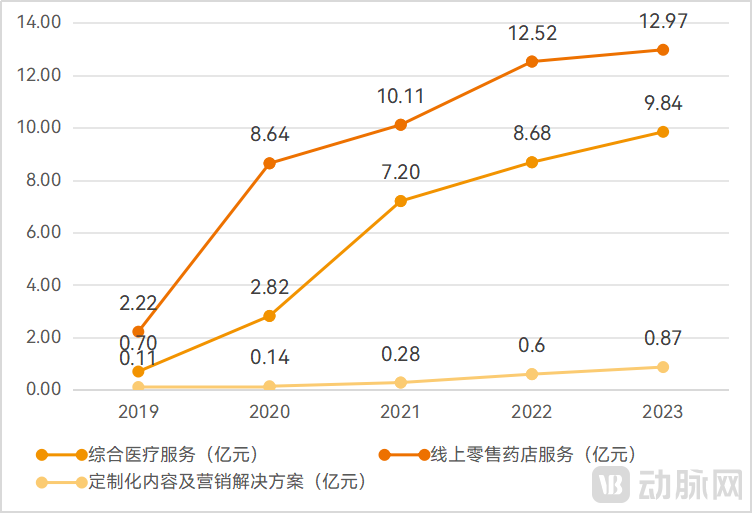
Revenue Growth by Business Segment of Fangzhou Pharmaceutical, Source: Prospectus
As all business lines demonstrated growth, synergies across business segments deepened: medical and pharmaceutical services accumulated physician and patient resources, enabling the provision of digital marketing services to pharmaceutical companies; academic knowledge and patient education content generated through collaborations with pharmaceutical companies further attracted physicians and patients, creating a virtuous cycle. This has been key to Fangzhou Pharmaceutical’s chronic disease management business realizing economies of scale and enhancing profitability.
Chronic disease management encompasses various aspects, including diagnosis and treatment, medication, health monitoring, and diet and exercise. Whether patients attend follow-up visits as scheduled, adhere to prescribed medication regimens in terms of timing and dosage, and consistently monitor health data with timely intervention for abnormalities can all impact disease stability. However, relying entirely on patients for self-management is virtually impossible.
When physicians intervene in chronic disease management, the number of patients they can manage is limited due to constrained resources. Moreover, since their core responsibilities lie in diagnosis and treatment, devoting excessive effort to other aspects of chronic disease management results in a waste of resources.
To optimize resource allocation and implement centralized management, Fangzhou Pharmaceutical has established a Chronic Disease Management Service Center, gradually expanding its scale and enriching its service offerings.
As of the end of 2023, the Chronic Disease Management Service Center had assembled a 169-member team led by internal medical professionals, enabling it to provide patients with more specialized solutions, including post-consultation follow-ups, medication reminders, prescription consultations, and patient education.
From the perspective of service delivery, Chronic Disease Management Centers can promptly provide patients with guidance on proper medication use and potential side effects, thereby reducing physicians’ workload in responding to routine inquiries and standardized questions. Furthermore, these centers can implement more proactive and continuous patient interventions, enhancing overall service efficiency and management outcomes.
From the perspective of patient benefits, patients can access more targeted diagnosis, treatment, and management plans, receive continuous follow-up services, achieve improved adherence, and maintain greater disease stability.
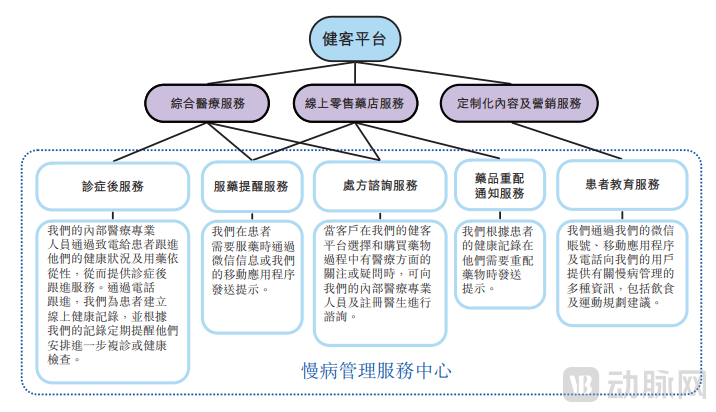
Fangzhou Pharmaceutical’s Chronic Disease Management Service Center: Service Offerings and Linkages to the Three Core Business Segments. Source: Prospectus
It is worth noting that the Chronic Disease Management Service Center was established to support and complement the H2H platform and online retail pharmacy services, thereby integrating certain service components across these business segments. Meanwhile, it also connects patient education services within customized content and marketing solutions, ensuring that patients’ medication adherence aligns with prescribed treatment plans and preventing medication discontinuation.
Overall, the Chronic Disease Management Service Center model breaks down barriers between business segments and integrates end-to-end services required by patients with chronic diseases, yielding positive benefits for the platform, healthcare professionals, users, and clients.
Doctors and patients are the two primary user groups in internet healthcare, with doctors serving as both users and service providers. Maintaining patient and physician retention, engagement, and conversion rates is crucial for the platform’s sustainable development.
Fangzhou Pharmaceutical attracts physicians to join its platform through offline expansion, online practice incentives, provision of academic exchange platforms, and enhancement of platform reputation. To attract more physicians, Fangzhou Pharmaceutical is continuously expanding the types of hospitals it engages with, extending from primarily public hospitals to include small-sized, private, and specialized hospitals, while also broadening its physician outreach and deepening its penetration in lower-tier cities.
As of the end of 2023, more than 212,000 doctors had registered on the Fangzhou Pharmaceutical H2H service platform.
In recent years, internet healthcare has developed rapidly, with platforms of various sizes emerging one after another. The competition for doctor resources has become more intense, and it is not uncommon for a single doctor to join multiple platforms. A survey conducted by VCBeat Research Institute shows that up to 71.5% of doctors have joined 1-3 platforms, while 11.1% of doctors practice on more than 4 platforms.
However, physicians have limited time. In addition to their offline clinical duties, they can dedicate only a finite amount of time to online consultation platforms, and the time allocated to each platform is also limited. In some cases, they may merely open a platform and let it run in the background, without actively focusing on online patient consultations during certain periods.
To better retain physicians, Fangzhou Pharmaceutical continuously optimizes its incentive measures and provides higher-quality physician tools.
For example, Fangzhou Pharmaceutical has established a reward policy based on multiple indicators, including physicians’ activity hours on the platform, the number of patients served during specific periods, and their contributions to online live broadcasts, academic communities, and patient community services.
In addition, Fangzhou Pharmaceutical provides physicians with a more comprehensive drug formulary, clearer and smoother video consultations, as well as patient data analytics dashboards and offline outpatient appointment scheduling, thereby enhancing the efficiency of medical practice.
In 2022, following the launch of the aforementioned measures and features, physician retention rates increased significantly, rising from 70.8% in 2021 to 81.8% in 2022, and remaining relatively stable at 81.3% in 2023.
At the user level, as of the end of 2023, the Jianke platform had accumulated 42.7 million registered users, with monthly active users reaching 8.4 million in 2023. A key factor driving user engagement is the refined chronic disease management service mentioned earlier.
Meanwhile, leveraging its high-quality physician resources and professional chronic disease management capabilities, Fangzhou Pharmaceutical has implemented various measures to enhance user payment conversion. These initiatives include launching a mini-program, optimizing service experience, improving recommendation algorithms and pricing structures, offering cost-effective products to new users, and recommending alternative products for out-of-stock items.
These measures have yielded tangible results. In 2021, 2022, and 2023, the conversion rate of active users to paying users on the H2H service platform was 32.6%, 42.9%, and 36.2%, respectively, while the conversion rate for the online retail pharmacy service platform increased from 14.7% to 14.8% and 17.7%, respectively.
Fully leveraging user resources on both the physician and patient sides has provided long-term momentum for Fangzhou Pharmaceutical’s chronic disease management model.
Similar to the early days of the internet industry, internet healthcare has also gone through a phase of frantic “cash burning,” investing heavily in physician acquisition and user growth, while driving engagement through free consultations and promotional campaigns. Even now, operations such as building regional teams and placing offline advertisements continue to incur high operational and marketing costs.
As enterprises reach a certain stage of development, with the steady growth in the number of doctors and patients, cost reduction becomes as important as revenue generation.
Fangzhou Pharmaceutical’s losses have narrowed and its profitability has strengthened. In addition to the major factors previously analyzed, cost control has also played a significant role. According to VCBeat, technology empowerment, word-of-mouth marketing, and prudent strategic trade-offs have become Fangzhou Pharmaceutical’s three key tools for reducing costs.
From a technological perspective, Fangzhou Pharmaceutical has extensively applied research and development technologies to its frontline operations. Currently, AI-powered physician assistants support approximately 65.7% of consultations.
Fangzhou Pharmaceutical launched its AI-powered doctor assistant in 2019. With the assistance of this tool, the average number of orders handled per customer service representative per day increased from 67.3 in 2019 to 366.2 in 2023, representing a compound annual growth rate (CAGR) of 52.7%.
Meanwhile, Fangzhou Pharmaceutical has integrated knowledge graph technology into its online platform and launched a prescription review system for its H2H services to assist professional physicians in reviewing prescriptions. By leveraging deep learning technology, Fangzhou Pharmaceutical has introduced an intelligent prescription image recognition system, significantly improving the efficiency of electronic prescription reviews.
To address drug supply, Fangzhou Pharmaceutical has developed an intelligent packaging optimization algorithm and established a mechanized assembly line to automate product packaging, labeling, and sealing processes, significantly improving warehouse operational efficiency.
In terms of marketing and promotion, Fangzhou Pharmaceutical is gradually reducing its reliance on large-scale marketing and advertising campaigns to improve promotional efficiency.
After the industry’s “cash-burning” phase, service quality and platform reputation are the key to sustaining customer acquisition and driving paid conversions.
In recent years, Fangzhou Pharmaceutical has reduced its promotional expenditures, attracting and retaining more users through word-of-mouth. From 2021 to 2022, the company’s advertising and platform service fees as a percentage of revenue decreased from 4.4% to 3.9%, further declining to 3.8% in 2023.
Although the proportion of the aforementioned expenses has declined, overall revenue continues to grow, validating the effectiveness of “word-of-mouth marketing.” In its prospectus, Fangzhou Pharmaceutical disclosed that while it will continue to regard marketing and promotional activities as a key channel for expanding its user base in the future, it will also further optimize its campaign delivery strategies to enhance promotional efficiency.
Fangzhou Pharmaceutical also made strategic trade-offs in its business operations, establishing a clearer positioning for its offline institutions.
In recent years, it has become increasingly common for internet healthcare providers to expand into offline services, sparking considerable debate. On one hand, offline services can address the limitations of online consultations—such as the inability to perform laboratory tests, diagnostic examinations, hospital admissions, and surgical procedures—thereby further earning patient trust. On the other hand, the construction and operation of physical medical institutions entail high costs and significant management challenges. The establishment of offline facilities by online platforms has always been a double-edged sword; how to wield this sword effectively remains a major test.
Fangzhou Pharmaceutical’s strategy is to operate offline hospitals and pharmacies with minimal overhead, primarily serving as a supplement and enabler for its online business. For instance, in addition to providing essential offline services, its physical hospitals offer facilities for offline medical nursing and on-site clinical practice training, while leveraging offline hospital operations to gain deeper insights into the needs of both patients and healthcare providers.
Over the past two years, the internet healthcare sector has undergone a significant shakeout, with barriers arising from regulatory policies and business models fostering a more sound exit mechanism for the industry.
“Survival of the Fittest” may not be an absolute rule, but companies that endure repeated trials and remain standing are certainly not to be underestimated, particularly those leveraging stable business models and consistently growing performance metrics to make a strong push into the secondary market.
The path is winding and circuitous, yet it always moves forward. The validation of the business model’s feasibility has already paved the way for a smoother journey.