

Tencent-Led National Next-Gen AI Open Innovation Platform for Medical Imaging Submits Prospectus Following Successful Completion and Evaluation

Tencent
Internet Comprehensive Service Provider
The “National Next-Generation Artificial Intelligence Open Innovation Platform for Medical Imaging,” constructed over a three-year period, has recently passed the comprehensive performance evaluation conducted by the High-Tech Research and Development Center of the Ministry of Science and Technology. This milestone marks the full-chain integration of medical imaging AI in China, transitioning from laboratory-based research to clinical application in hospitals.
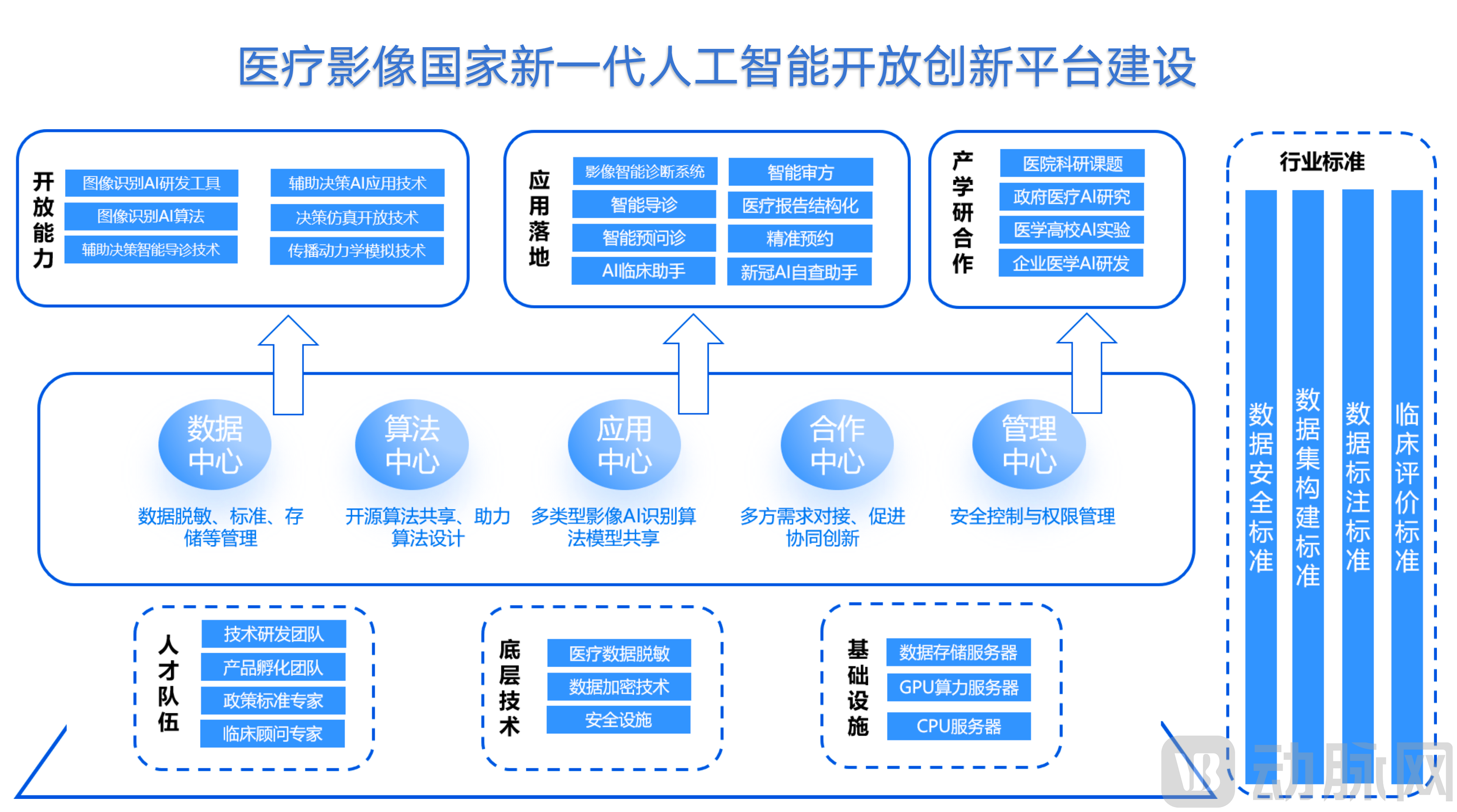 “National New-Generation Artificial Intelligence Open Innovation Platform for Medical Imaging” Architecture
The “National Science and Technology Major Project on New-Generation Artificial Intelligence,” launched in 2021 with Tencent as the lead institution, brings together ten partner organizations—including the China Academy of Information and Communications Technology, the Shenzhen Institutes of Advanced Technology of the Chinese Academy of Sciences, Mingfeng Medical Systems, Guangzhou Huyun, Yidu Cloud, the First Affiliated Hospital of Zhengzhou University, Nanfang Hospital of Southern Medical University, Shanghai Panacea Medical Imaging Diagnostic Center, and Haina Medical Information—to tackle critical bottlenecks constraining the development of medical imaging AI in China. The consortium focuses on five key areas: integration and open-source sharing of common technologies, construction of foundational medical data resource repositories, establishment of technical standards, translation of software and hardware innovations, and industry–academia–research collaboration models.
As early as 2017, the Ministry of Science and Technology issued the Implementation Plan for Major Science and Technology Projects on New-Generation Artificial Intelligence, relying on Tencent to build the “National New-Generation Artificial Intelligence Open Innovation Platform for Medical Imaging.” Currently, leveraging Tencent Cloud’s technologies, the “National New-Generation Artificial Intelligence Open Innovation Platform for Medical Imaging” has established a SaaS service platform supporting multi-modal data and multiple disease types. It provides full-process functionalities for medical AI research and development, including storage, statistical analysis, annotation, artificial intelligence model training, and validation of medical imaging data. The platform supports the annotation of medical images for ten types of diseases, including fundus photographs of retinal lesions, magnetic resonance (MR) brain images across all age groups, MR images of gliomas, PET-CT images of tumor metabolism, MR images of meningiomas, MR images of cervical cancer, MR images of prostate cancer, case images of thyroid cancer, pathological images of esophageal cancer, and colposcopic images of cervical cancer. By opening up common technologies for medical imaging AI via the cloud, the platform enables efficient “access-as-you-connect” usage. To date, it has served over 4,000 research institutions and users, with more than 70,000 cases of medical imaging data annotated.
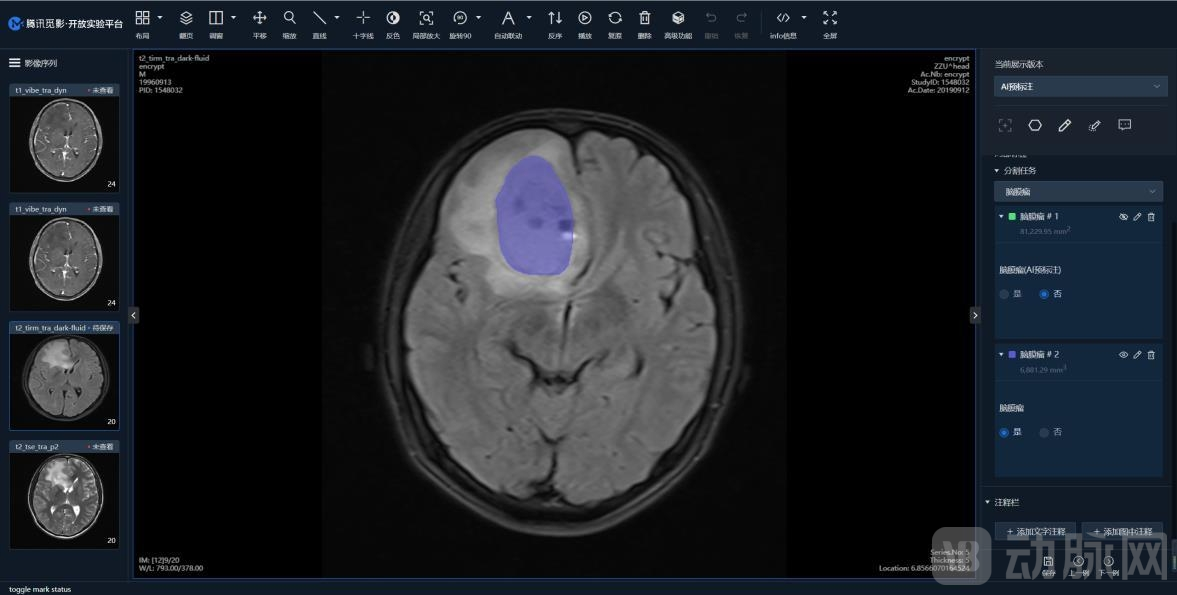 The platform enables annotation of medical images for 10 diseases, including meningioma MRI scans.
Tencent has also released six self-developed AI models for medical imaging to support the capacity building of the “National Next-Generation Artificial Intelligence Open Innovation Platform for Medical Imaging.” These include a model for identifying causes of intracranial hemorrhage, a pulmonary nodule detection model, a liver and hepatocellular carcinoma segmentation model, a glioma segmentation model, a multi-structure fundus segmentation model, and a glaucoma-like fundus manifestation analysis model. Covering diverse application scenarios such as clinical diagnosis and clinical research, these models have attracted more developers, healthcare institutions, and research organizations to join the platform. Currently, 41 algorithm model research projects on the platform have integrated and applied these open-source models.
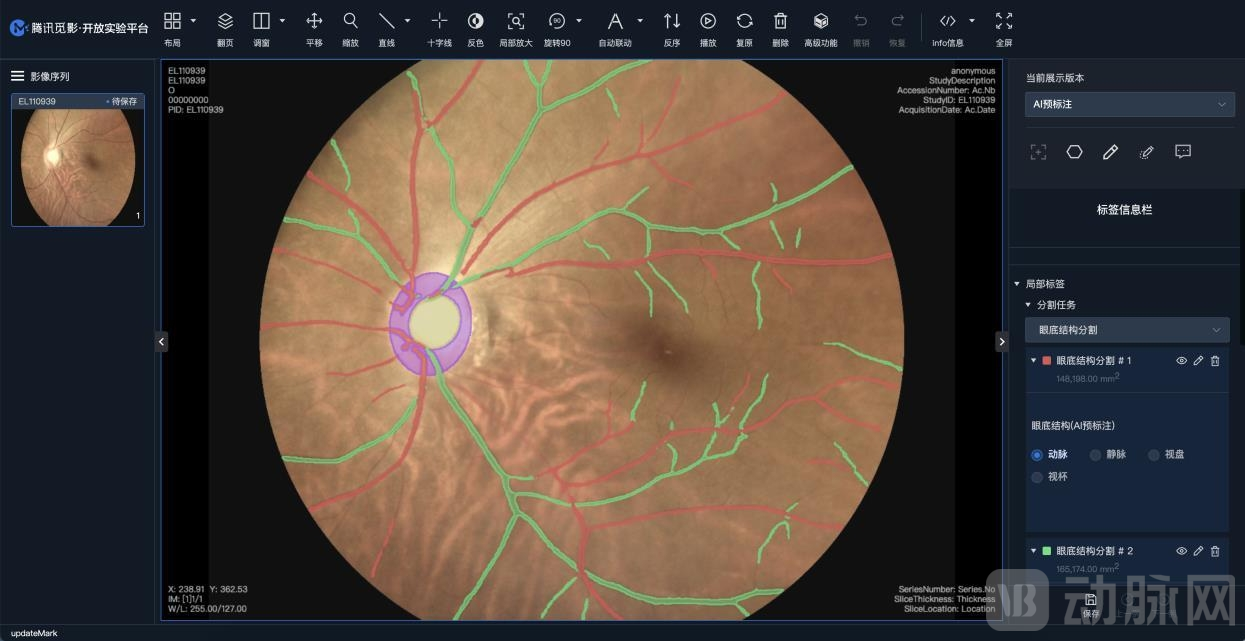 Tencent has made multiple AI models available on its platform.
Furthermore, in accordance with the requirements for multi-center, multi-modal, and multi-disease applications, the “National Next-Generation Artificial Intelligence Open Innovation Platform for Medical Imaging” has established a standardized, open, and shared medical imaging database. The dataset comprises more than 12,000 cases, covering 13 diseases including lymphoma, lung cancer, renal tumors, Crohn’s disease, meningioma, and cervical cancer. Through open access, this imaging database will further support researchers in training and validating AI algorithms.
In promoting the standardized development of AI in medical imaging, the project team jointly produced four draft industry standards. These standards cover performance metrics and testing methods for intelligent auxiliary decision-making algorithms applied to pathological images, electrocardiograms (ECGs), and gynecological microecology, as well as technical requirements and testing methods for cybersecurity capabilities of medical devices. These industry standards will support the maturation of the medical imaging AI sector and regulate the research, development, testing, and application of product technologies.
Over the past three years, institutions participating in the development of the “National New Generation Artificial Intelligence Open Innovation Platform for Medical Imaging” have been committed to transforming AI technologies in medical imaging into industrialized outcomes, thereby benefiting the public through widespread practical applications.
The platform has successively incubated a range of innovative products that have obtained medical device certifications, including Tencent Miying’s CT imaging software for auxiliary triage and assessment of pneumonia, fundus image analysis software for the auxiliary diagnosis of chronic glaucomatous optic neuropathy, electronic endoscopy image analysis software for the auxiliary detection of colonic polyps, as well as Pathology Cloud and Imaging Cloud. Other AI applications include LBP Medicine’s liquid-based cytology image analysis software for auxiliary cervical cancer diagnosis, Mindray’s AI-powered automated peripheral blood cell morphology analyzer, Mingfeng Medical’s PET/CT system (known as the “cancer-detection tool”), and Panorama Medical’s invocation model for precise radiological tumor staging.
Furthermore, Haina Yixin’s AI-powered tiered diagnosis and treatment cloud platform has been integrated with eight secondary and tertiary hospitals, as well as 28 community health service centers, and has expanded overseas; Yidu Cloud’s remote monitoring platform has been launched at more than 10 major clinical trial hospitals in China, cumulatively supporting thousands of projects.
In building a new model of industry-academia-research collaboration, the “National Next-Generation Artificial Intelligence Open Innovation Platform for Medical Imaging” has also established a sharing mechanism, further promoting exchanges and cooperation among universities, research institutes, and enterprises. For instance, in 2021, it hosted the “Miying” Medical Artificial Intelligence Algorithm Competition, focusing on multiple clinical challenges such as the classification of blinding diseases, early detection of Alzheimer’s disease, identification of gliomas, assistance in radiotherapy planning, and detection of hypermetabolic tumor lesions. The competition attracted 640 teams and was hailed as the most clinically valuable medical AI contest, paving a new path for collaborative research in medical imaging AI.
To further strengthen talent development, Tencent has partnered with multiple organizations to launch the “Public Health Talent Enhancement Program,” which has trained numerous core experts and young professional backbones for national and local disease control and prevention institutions. Additionally, Tencent Miying has established an electronic colposcopy training and learning platform through the “National New Generation Artificial Intelligence Open Innovation Platform for Medical Imaging.” This platform provides clinicians and medical students with extensive colposcopy case studies, enabling them to enhance their individual skills through an online “test–learn–retest” learning model.
The “National New-Generation Artificial Intelligence Open Innovation Platform for Medical Imaging,” upon completion, will integrate innovative elements such as infrastructure, cutting-edge research achievements, and talent. It will play a leading role in scientific and technological innovation, unleash new quality productive forces in the field of medical imaging, and promote the high-quality development of the healthcare industry.