

Peking University Shenzhen Hospital Unveils Novel Biomimetic Scaffold for Osteoporotic Bone Defect Repair
On April 16, 2024, Peking University Shenzhen Hospital had one additional patent published. This patent pertains to a novel bionic skeleton, consisting ofPorous Magnesium Alloy MaterialswithIcariincombined for use in filling osteoporotic bone defects.
The porous magnesium alloy material in this novel bionic scaffold provides structural support for osteoporotic bone defects, while its interconnected pores facilitate the attachment of new cells and the formation of new blood vessels. Furthermore, icariin loaded onto the material is released in a sustained manner as the scaffold degrades, enabling precise targeted delivery to specific cells. This stimulates surrounding newly formed osteoblasts or adjacent bone marrow mesenchymal stem cells (BMSCs), thereby promoting faster and more effective bone tissue formation for the treatment of osteoporotic bone defects.It helps address the issue of secondary injuries in patients with osteoporosis.
I. Broad Market Potential for Bone Repair Materials
Bone repair materials have a wide range of applications, involvingNeurosurgery, Stomatology, and Orthopedics, its indications are also extensive, including: severe skull base fractures, cranial vault injuries, dental defects, alveolar clefts and jawbone defects, as well as the repair of various spinal, traumatic, and joint sites.
To meet the demands of various indications, a diverse range of bone repair materials is currently available on the market. Many research institutions and universities have separated this field from traditional bioengineering to establish specialized research in osteogenic materials, including Sichuan University, South China University of Technology, and the University of Chinese Academy of Sciences.
From the perspective of the industrial chain, the upstream sector of bone repair materials mainly consists of raw material suppliers, such as those providing medical-grade metals, inorganic non-metallic materials, and polymer materials; the midstream comprises manufacturers of orthopedic bone defect repair materials; finally, these products reach healthcare institutions to benefit patients.
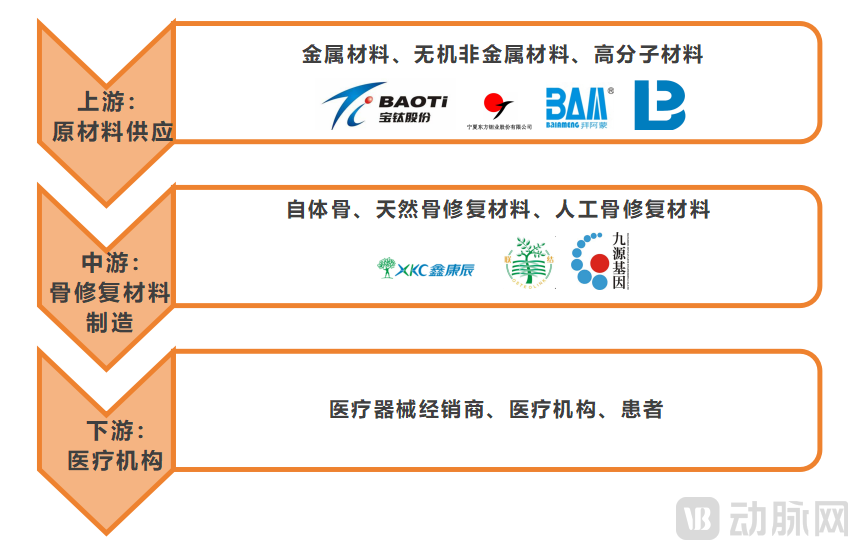
Upstream and Downstream Industry Chain of Orthopedic Repair Materials, Source: Qianzhan Industry Research Institute
II. The Monopoly Held by Foreign Capital Is Gradually Being Broken
From the perspective of material supply, the momentum of domestic substitution has gradually become apparent. Due to factors such as early market entry, mature manufacturing processes, and leading scale, overseas suppliers previously held a significant share in the Chinese market. As of now,Johnson & Johnson, Stryker, MedtronicForeign-funded enterprises still dominate the majority of China's bone repair materials market.
In recent years, with theZhenghai Biotechnology, Aojing Medical, Sanyou Medical, Shengboma Biology, Lixin ScienceAs domestic companies rapidly grow, Chinese-made bone repair materials are gaining a foothold in the market, and the monopoly previously held by foreign companies is gradually being broken.
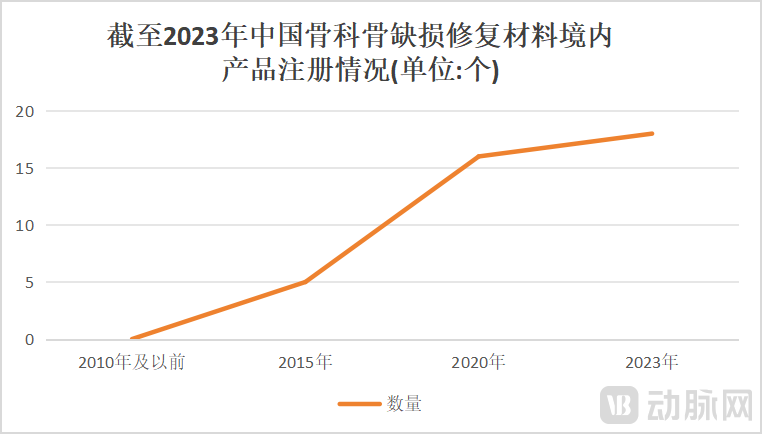 Data source: National Medical Products Administration
As of November 2023, 18 domestically produced bone repair materials have been approved in China., among which Aojing Medical had the highest number of approved products, with three all focused on artificial bone repair materials. In terms of product type, allogeneic bone implant materials (including bone products and bone) were the most numerous category, with a total of eight approvals.
Technologically, domestically produced bone repair materials have also achieved breakthroughs. In 2022, Wuhan Asia Bio’s medical device featuring a hierarchically structured artificial bone repair material with biomimetic bioactivity received regulatory approval; reportedly, this isChina’s First Approved “Artificial Bone” for Market Launch.This “artificial bone” was jointly developed by the Regulatory Science Translation Team for Biomaterials and Medical Devices at Huazhong University of Science and Technology and Wuhan Asia Biomaterials Co., Ltd., with all key raw materials and technologies being domestically produced in China.
In addition, Lixin Science’s moldable absorbable bone repair material was approved in 2023. This isThe World’s First Artificial Bone Simultaneously Offering Moldability, Resistance to Liquid-Phase Disintegration, and Efficient Regeneration Induction. It possesses excellent osteoconductive and osteoinductive properties, enabling bone regeneration to be completed within 3–6 months after implantation. It is reported that Lixin Science has achieved a closed-loop, full-industry-chain integration from independently developed raw materials to commercial product launch.
As evidenced by approved bone repair materials, the application of composite synthetic bone graft substitutes has increased in recent years. In the future,New materials with enhanced mechanical properties, higher bioactivity and osteoinductivity, and biodegradability will accelerate the replacement of traditional repair materials.