

Hangzhou's Biopharma Industry Blooms: IPOs and Financing Surge Across Innovation Sectors
When it comes to Hangzhou, many people recognize it as one of China’s strongest cities in the private sector and a major hub for the internet industry. It is home to numerous new-economy companies, as well as a large number of market-oriented venture capital (VC) firms and corporate venture capital (CVC) arms.
Therefore, in the traditional perception, Hangzhou, with its deep-rooted internet DNA, has long been a powerhouse in the digital health sector, home to star enterprises such as WeDoctor, DXY, Jianhai Technology, Weimai, and Zhuojian Technology.
In fact, in recent years, Hangzhou’s rapid expansion has extended beyond digital health; it now ranks among the national leaders in the broader field of medical innovation, encompassing biopharmaceuticals, innovative medical devices, pharmaceutical distribution, healthcare services, and CXO.
Words alone are insufficient; let the data speak. In 2023, four healthcare innovation companies in Hangzhou (Angus Medical, Adicon, Minsheng Health Pharmaceutical, and Arno Therapeutics) completed initial public offerings (IPOs), ranking second among all cities in China, just behind Shanghai. Notably, these four listed companies focused on niche sectors such as innovative medical devices, clinical laboratory services, and biopharmaceuticals, rather than digital health.
In the primary market, data from the VCBeat Orange Database shows that since 2024, there have been 25 financing events involving healthcare innovation enterprises in Hangzhou. Innovative medical devices accounted for approximately 42%, biopharmaceuticals for about 20%, digital health for around 10%, and other sectors for roughly 28%.It is evident that innovative medical device and biopharmaceutical companies in Hangzhou are rising rapidly.
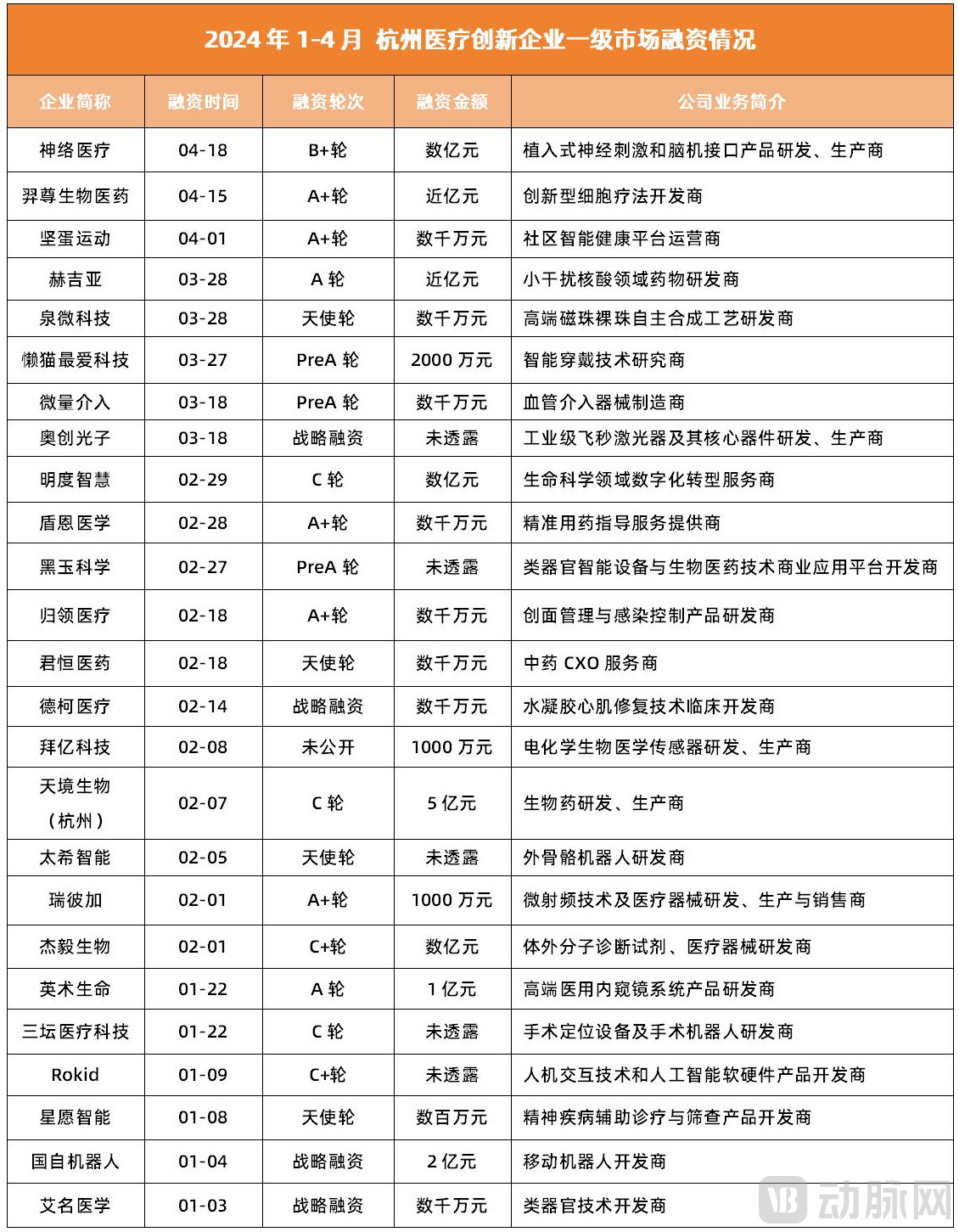
(Data source: Incomplete statistics from the VCBeat Orange Database)
Furthermore, well-known enterprises in various niche sectors have also established their presence in Hangzhou.In the pharmaceutical sector, companies such as Betta Pharmaceuticals, Huadong Medicine, Ascletis, and Sanofi have established a strong presence in Hangzhou; in the medical device sector, Venus Medtech and New Horizon Health have set up operations there; and in the pharmaceutical outsourcing services sector, Tigermed has headquartered its operations in Hangzhou’s Binjiang District...
Undoubtedly, Hangzhou at this moment has shed the stereotypical image of being merely a leading city in digital health and is progressively advancing into a historical phase of comprehensive development in medical innovation.
Hangzhou Is Receiving Increasing Attention in the Field of Medical Innovation.
“In recent years, medical innovation enterprises in Hangzhou, represented by biopharmaceuticals and innovative medical devices, have garnered increased favor from VC/PE firms.“Ding Ping (a pseudonym), investment director at a RMB-denominated fund, told VCBeat, ‘Hangzhou’s vibrant entrepreneurial atmosphere and favorable business environment are accelerating the emergence of a cohort of companies.’”
She cited an example: in early 2022, her institution invested in two biopharmaceutical companies at similar stages of development—one located in a city in western China and the other in Hangzhou. Two years later, the Hangzhou-based company has achieved breakthrough progress and begun its commercialization efforts, while the other company has progressed very slowly. A significant factor contributing to this disparity is the constraints imposed by the respective business environments.
“For instance, while both cities offer supportive policies, Hangzhou not only implements them efficiently but also proactively identifies and addresses gaps. This allows enterprises to concentrate on their core business and accelerate R&D efforts. In contrast, another locality implements favorable policies in a diluted manner and imposes additional requirements on companies, forcing them to divert resources toward tasks largely unrelated to their core operations.”
It is reported that in 2023 alone, the Hangzhou Municipal Administration for Market Regulation conducted checklist-based visits and implemented a case-closure management system to coordinate and address the numerous challenges and pain points raised by biopharmaceutical companies. The agency systematically screened major industrial projects under discussion, processing, or review within the city’s jurisdiction and compiled a list of key enterprises in the pharmaceutical, medical device, and cosmetics sectors for priority support services.
Wang Meng, General Manager of Youjia Biotech, previously told VCBeat that many operational issues are typically resolved by the relevant Hangzhou authorities on the same day, without being deferred to the next.
Hangzhou has also been continuously ramping up the intensity of its supportive policies. In the article “Funds Disbursed Upon Company Registration: How Strong Are Hangzhou’s Biopharmaceutical Policies?” VCBeat noted that Hangzhou achieved a “triple leap” in its key policies within five years, with substantial increases not only in the funding amounts provided to medical innovation enterprises but also in the scope and targets of such financial support.
It is precisely based on the aforementioned factors that Hangzhou’s medical innovation industry has reported frequent successes: Since 2021, the number of initial public offerings (IPOs) and financing events among Hangzhou’s medical innovation enterprises has ranked among the top tier across cities in China.
Furthermore, Hangzhou is also exerting significant efforts at the forefront of biomedicine. The city currently hosts four laboratories—Zhijiang, Liangzhu, West Lake, and Xianghu—along with 16 provincial key laboratories based in Hangzhou, as well as multiple innovative research platforms such as the Zhejiang University Institute for Intelligent Innovative Drugs. The output value of the city’s biomedical manufacturing industry has exceeded RMB 110 billion, while the output value of medical devices has surpassed RMB 42 billion.
Judging by the achievements, medical innovation enterprises in Hangzhou have developed quite rapidly in recent years.However, a lesser-known fact is that Hangzhou has long prioritized medical innovation.As early as 2000, Hangzhou proposed the construction of “Two Ports”—one being the “Information Port” and the other the “New Drug Port.”
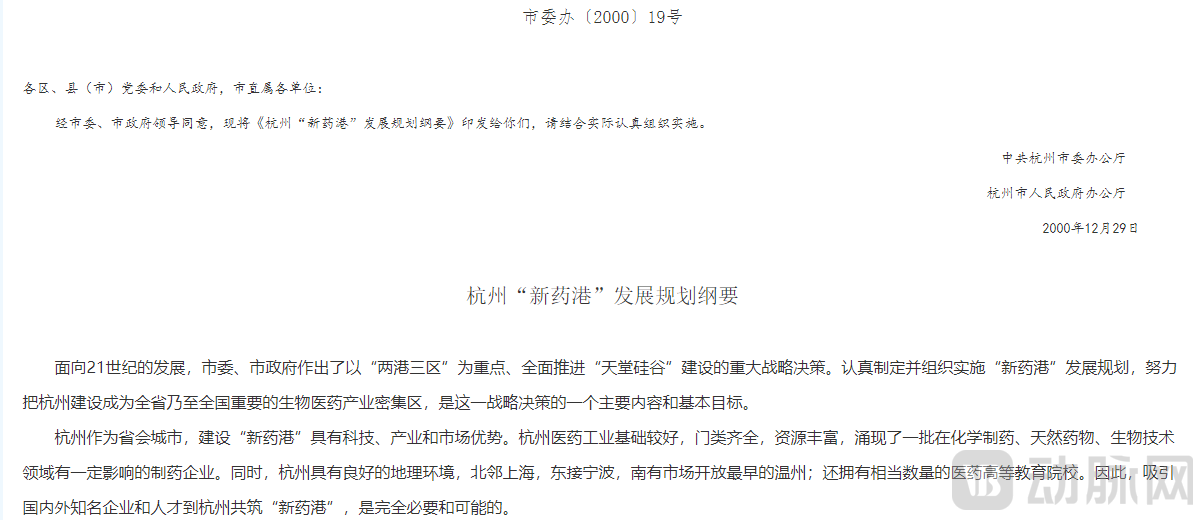
(Image source: Zhejiang Government Service Network)
“Many people are unaware that Hangzhou’s first listed company was a pharmaceutical enterprise—Tianmu Pharmaceutical, which is also China’s first publicly traded company specializing in traditional Chinese medicine preparations, having been listed on the Shanghai Stock Exchange in 1993,” said investor Ding Ping. Hangzhou has long aimed to establish itself as a key biopharmaceutical industry cluster in Zhejiang Province and across China.
To this end, since 2004, the Hangzhou municipal finance has allocated annual industrial development funds to continuously increase investment in the biopharmaceutical industry.
The subsequent story is likely familiar to everyone. The “Information Harbor” took off before the “New Drug Harbor,” becoming the primary engine driving Hangzhou’s economic development, while digital health leveraged this momentum to become a key industrial hallmark of the city.
Throughout this process, Hangzhou has not abandoned the medical innovation industry.In July 2018, Hangzhou reiterated its commitment to vigorously developing strategic emerging industries with a focus on biopharmaceuticals, aiming to establish a domestically leading hub for biopharmaceutical R&D and industrialization.
Meanwhile, in 2018, the country accelerated the deepening reform of the drug and medical device review and approval system, opening a window for the significant development of medical devices and biopharmaceuticals, with a series of top-level designs being implemented.
With both timing and momentum in place, Hangzhou’s over 20-year journey of medical innovation has finally reached the moment when its “dream” is becoming a reality.
Compared with the information industry, represented by the internet, cultivating the biopharmaceutical industry is a more long-term and arduous proposition.
In response to these industry characteristics, Hangzhou has built a tightly integrated innovation ecosystem through multi-dimensional collaboration among government, industry, academia, research institutions, and capital.A “One Core, Four Parks, Multiple Points” pattern has gradually taken shape in the biopharmaceutical industry.According to official statements, the core area is Hangzhou Medicine Port in Qiantang District; Binjiang, Xiaoshan, Yuhang, and Linping constitute the “Four Parks”; and Jiande and other areas serve as “Multiple Points.”
How to Ensure Regional Differentiation While Maintaining Close Collaboration? Hangzhou Offers Its Solution.
Specifically, Qiantang District, as the “core,” has strategically laid out a comprehensive industrial chain for biopharmaceuticals. It is home to Hangzhou Medicine Port, which was established six years ago and has gathered nearly 1,700 biopharmaceutical companies, primarilySpanning five major sectors: innovative drugs, medical devices, digital health, supply chain support services, and medical aesthetics and general wellness., seven of the world’s top ten well-known pharmaceutical companies, including Merck & Co., Abbott, and Johnson & Johnson, have also established their presence here. According to the plan, by 2025, Hangzhou Medicine Port will achieve RMB 100 billion in main business revenue from the biopharmaceutical industry, with a cumulative total of 4,000 enterprises.
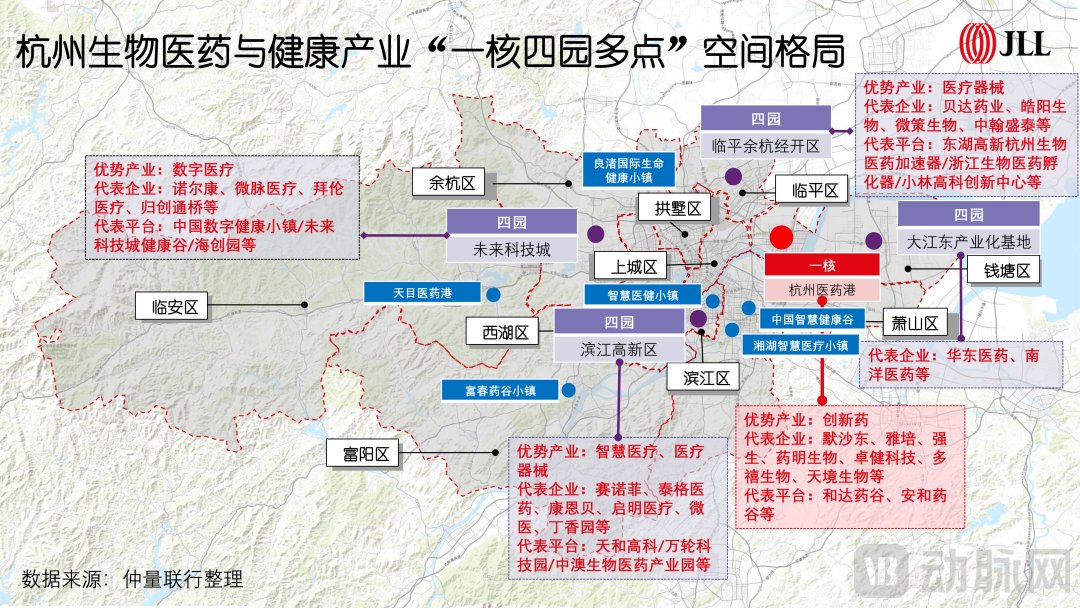
(Image source: JLL’s Zhihu account)
The High-Tech Zone (Binjiang), one of the “Four Parks,” cultivates specialized fields such as smart health, high-end medical devices, and innovative drugs; Xiaoshan District focuses on developing innovative drugs, modern traditional Chinese medicine, high-end CRO/CDMO (contract research and development/manufacturing organizations), and digital healthcare; Yuhang District concentrates on innovative drugs and Internet-plus health services; and Linping District prioritizes the development of biopharmaceuticals, small-molecule innovative drugs, and high-end medical devices.
“In Hangzhou, healthcare innovation enterprises can choose to establish operations in districts that align with their strategic positioning, thereby generating agglomeration effects with upstream and downstream partners,” said investor Ding Ping.
Within this logic,A more noteworthy detail is that Hangzhou boasts a high density of finely delineated biomedical parks, which serve as hubs for corporate clustering and growth, thereby providing critical support for the development of medical innovation enterprises., including Hangzhou Medicine Port Town, Hangzhou East Lake High-Tech Biopharmaceutical Industrial Park, Tianhe High-Tech Industrial Park, Hangzhou High-Tech Enterprise Incubation Park, and Chint Zhongzi Science and Technology Park, as well as the Hangzhou Airport Economic Zone Biopharmaceutical Park, which officially opened in March this year.
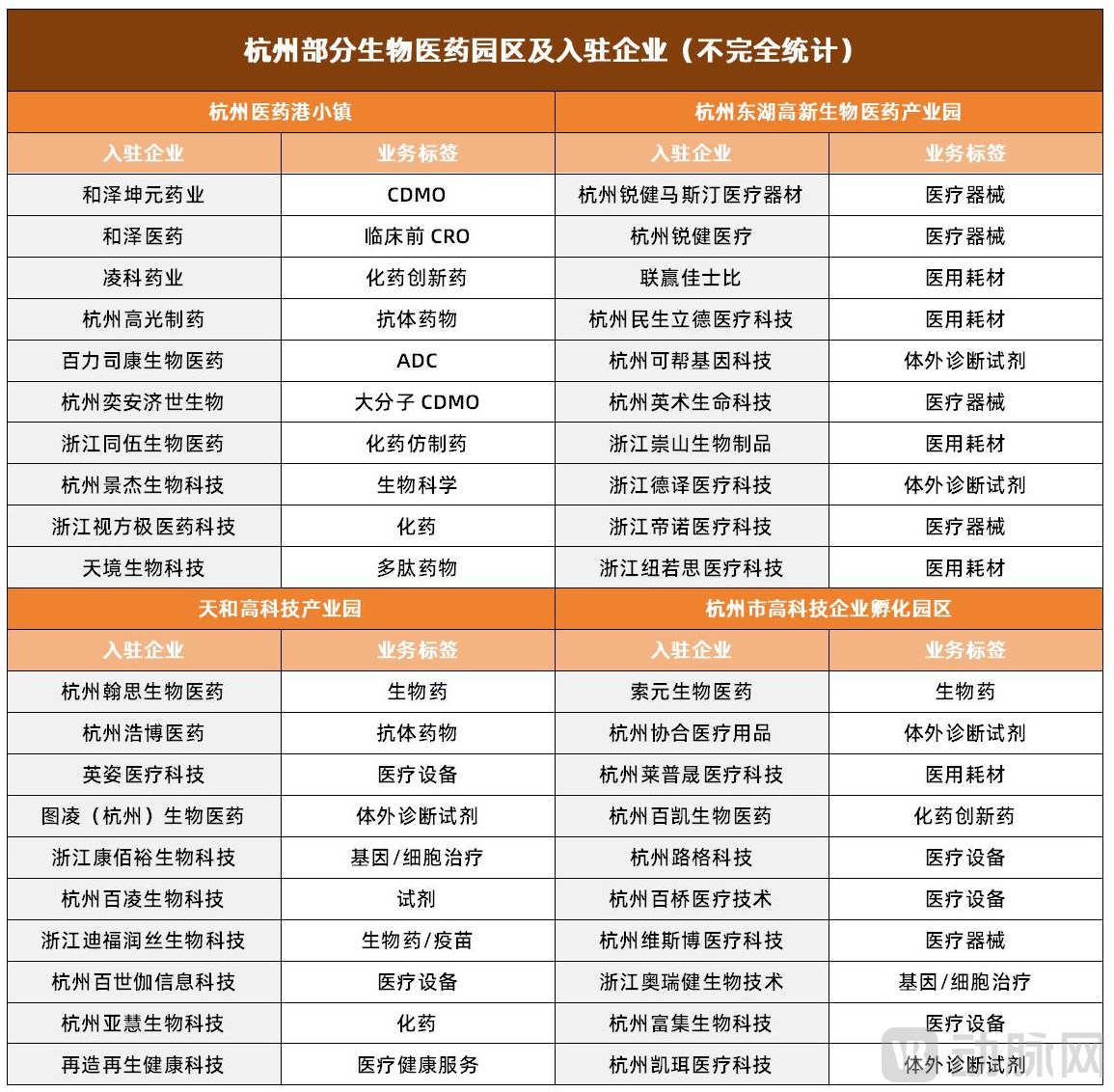
(Source: Firestone Data Chain; Chart by VCBeat)
In terms of distinctive features, each industrial park varies. Taking Tianhe High-Tech Industrial Park as an example, it is the first in ChinaFeaturing In Vitro Diagnostic (IVD) Products, a specialized science and technology park for biomedicine and smart health that integrates co-working spaces, incubators, accelerators, and industrial parks into an incubation ecosystem chain. Current tenant companies include Shangjian Biotechnology, Tangji Medical, LifeTai Biotechnology, Shipu Testing, Lianze Biology, and BestGa, among others.
Another example is the Hangzhou Airport Economic Zone Biopharmaceutical Park, which recently opened. According to official introductions, the park willHighlight features such as overseas expansion services, CXO service order policies, and green-channel approval., to build a distinctive biomedical park with chain-leading enterprises and a robust ecosystem that is “closest to the world,” attracting more than 100 biomedical ecosystem companies and R&D institutions by 2027, and achieving a regional industrial scale of hundreds of billions of yuan.
In addition to government-led industrial parks, Hangzhou has also attracted multinational pharmaceutical giants to collaborate.For example, the Hangzhou International Life Science Innovation Park, jointly established by AstraZeneca and the Hangzhou Municipal Government, was unveiled in 2020. Featuring specialties in digital health and oncology treatments such as lung cancer, it has been in operation for over three years to date.
“I recall that since 2015, supported by policy initiatives, biopharmaceutical parks across various regions have emerged rapidly, yet their operational performance has been uneven. Local parks in Hangzhou have generally performed well, featuring both differentiation and synergy, which has provided sufficient impetus for the development of medical innovation enterprises,” Zeng Yan, an industry expert who formerly served as Vice President of a life sciences accelerator, told VCBeat.
It is not difficult to find that,Benefiting from the differentiated layout of biomedical industrial parks and the continuous improvement of the overall ecosystem, Hangzhou’s soil for medical innovation is becoming increasingly fertile. This has become the key to Hangzhou’s comprehensive development in biopharmaceuticals, innovative medical devices, pharmaceutical commerce, and other fields, following its success in digital health.
From a global perspective, the biopharmaceutical industry is becoming increasingly important, with intensifying competition. Countries and regions are frequently introducing relevant policies to foster more substantial development of their local biopharmaceutical sectors.
However, the challenge lies in the fact that the biopharmaceutical industry is characterized by its knowledge-intensive, talent-intensive, and capital-intensive nature, making it highly dependent on innovation resources and the innovation ecosystem.
Therefore, to achieve a breakthrough in this fierce industrial competition, it is essential not only to introduce and cultivate outstanding medical innovation enterprises but also to prioritize talent development. Moreover, it requires the patience for long-term industry growth and an open mindset geared toward collaborative prosperity.
Centered on this,Hangzhou has been taking frequent actions, sparing no effort to deeply cultivate the biopharmaceutical industry.For instance, to attract talent, Hangzhou has established eight overseas talent recruitment hubs in cities such as Tokyo and Paris, launched a $30 million overseas biopharmaceutical fund in Boston, and set up the Hangzhou Collaborative Innovation Center in Silicon Valley.
To advance regional cooperation, the G60 Science and Technology Innovation Corridor Biopharmaceutical Industry Alliance was established at Hangzhou Medicine Port, with its industrial headquarters also located there. Nine cities, including Hangzhou, Suzhou, Wuhu, Hefei, and Jinhua, have joined forces to break down administrative barriers, enabling the free flow and efficient allocation of innovation factors such as capital and technology. As a result, a trillion-yuan biopharmaceutical industry belt has taken shape in the Yangtze River Delta, with Hangzhou Medicine Port serving as a key pivotal node.
Of course, there is still room for improvement in Hangzhou’s biopharmaceutical industry at present., for instance, in terms of biopharmaceutical parks, Shanghai has Zhangjiang and Suzhou has BioBAY, whereas Hangzhou currently lacks a park that can stand alongside these two. According to the 2023 Top 100 Biopharmaceutical Industrial Parks ranking released by CCID Consulting, only the Hangzhou High-Tech Industrial Development Zone from Hangzhou made the list, ranking ninth nationwide.
In response to this, the "Reform Plan for Environmental Impact Assessment Systems for Laboratory-Scale Production and Related Industries in Hangzhou's Biopharmaceutical Sector" was issued in August 2023. Hangzhou took the lead in Zhejiang Province in reforming the environmental impact assessment (EIA) system for "laboratory-scale production in the biopharmaceutical industry," aiming to address pain points, bottlenecks, and challenges such as constraints on planned land use for the biopharmaceutical industry, gaps compared with leading domestic industrial parks, and insufficient depth in EIA reforms for pharmaceutical manufacturing construction projects.
However, due to the complexity and diversity of medical innovation,The development of the biopharmaceutical industry is not an overnight achievement, but a “marathon” that spans years.: First, medical innovation often involves high-risk technological R&D and clinical trials, requiring substantial financial support; second, technologies and policies in the healthcare sector are continuously evolving, and the emergence and application of new technologies require time for validation and widespread adoption.
Therefore, in this long-distance race, beyond the support of local governments, it is even more critical to foster joint efforts among innovative companies, research institutes, and venture capital firms within the industry, ultimately establishing an ecosystem that enables a virtuous cycle of innovation.
References:
1: Notice of the General Office of the CPC Hangzhou Municipal Committee and the General Office of the Hangzhou Municipal People's Government on Printing and Distributing the "Outline of the Development Plan for Hangzhou's 'New Drug Port'" — Zhejiang Government Service Network
2: “Striding Toward a 100-Billion-Yuan Milestone! Hangzhou’s 18-Year Dream of a ‘New Drug Port’ Becomes Reality” — Zhejiang Daily
3: “How Can Hangzhou’s Biopharmaceutical Industry Break Through the Trillion-Yuan Mark and Achieve Strong Advancement?” – Jones Lang LaSalle (JLL)
4: “Hangzhou Biomedical Industrial Park: A New Highland for the Pharmaceutical Industry Driven by Innovation” – Huoshi Shulian