

Shenzhen Institute of Advanced Technology Unveils pH-Responsive, High-Strength Hydrogel Microneedle Platform for Safe and Efficient Drug Delivery
Recently, the Shenzhen Institute of Advanced Technology, Chinese Academy of Sciences, had one additional patent application published.This patent is for a responsive high-strength hydrogel microneedle., using acrylonitrile, acrylic acid, and polyethylene glycol diacrylate as the primary materials and introducing hydrogen bonds and dipoles to provide a new strategy for drug delivery.
According to publicly available information, this responsive high-strength hydrogel microneedle possesses sufficient transdermal mechanical strength in its hydrated state, thereby avoiding potential adverse effects on the drug that may arise from drying processes. Meanwhile, the microneedles exhibit pH responsiveness. On one hand, they swell and release the drug in the neutral environment of the skin during use without dissolving, thus maintaining microneedle integrity. On the other hand, a post-loading drug incorporation strategy is adopted to avoid potential drug degradation during fabrication, facilitate the removal of unreacted monomers and organic solvents, and enhance the safety profile of the microneedles.
Abroad, the Focus Is on Pharmaceuticals; In China, Medical Aesthetics Takes the Lead
Microneedles are a subcutaneous drug delivery method featuring micron-scale fine structures. Drugs primarily enter the skin through microchannels formed after penetrating the stratum corneum, thereby enhancing transdermal permeation. While penetrating the stratum corneum, microneedles do not stimulate pain nerves, allowing drugs to reach specified depths and be absorbed by the capillary network. This approach effectively improves drug delivery efficiency and patient compliance, making it highly favored in the market.
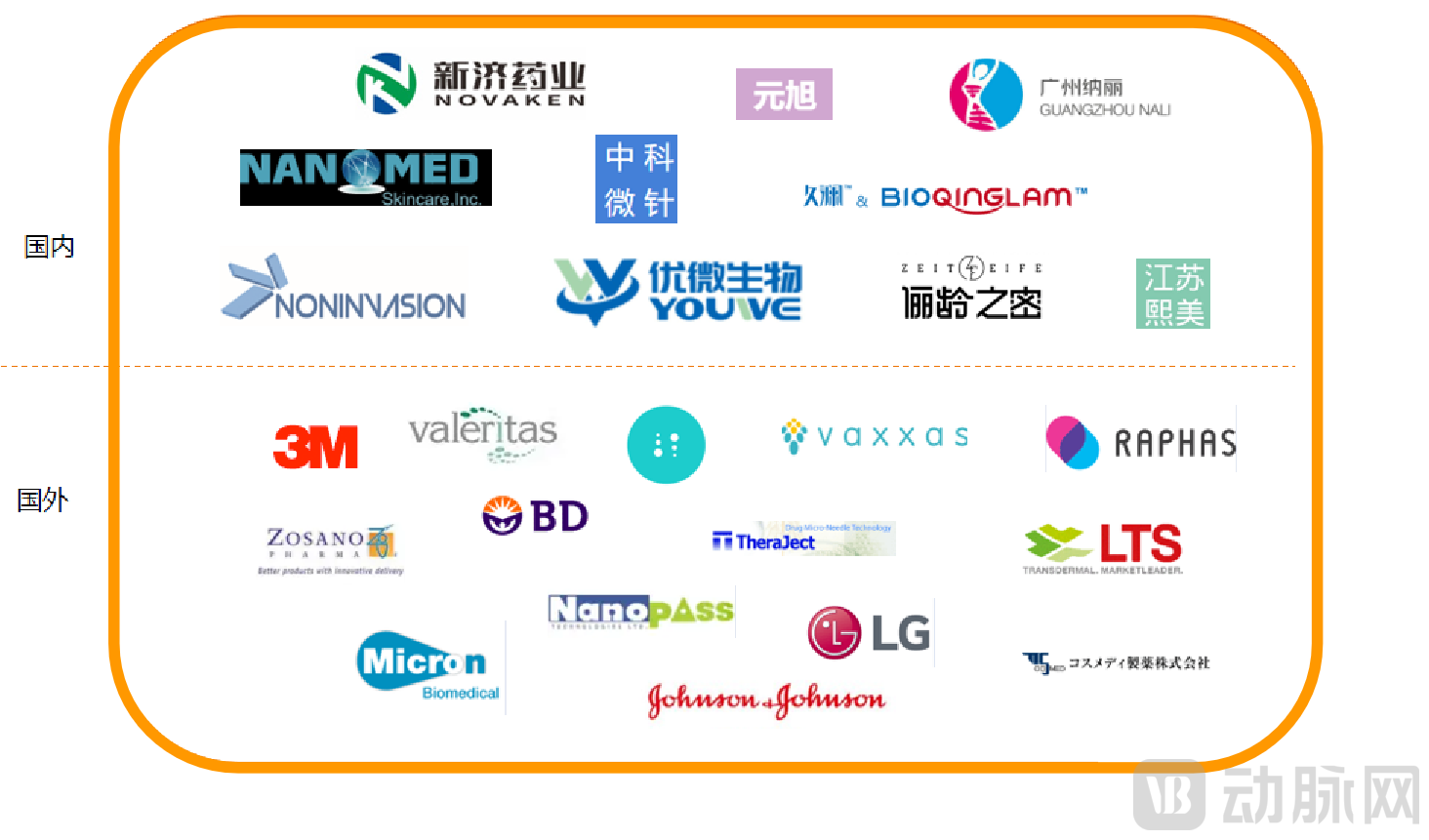
Microneedle Companies in China and Abroad
Microneedles can be broadly categorized into two application areas: the pharmaceutical sector and the non-surgical medical aesthetics sector, among whichIn European and American countries and regions, there is a tendency to apply microneedle technology in the field of biomedicine.
For example, 3M in the United States has developed a microstructured transdermal drug delivery system. During administration, the patch is applied to the skin and removed after 10 minutes, completing the drug delivery; this system is primarily used for vaccine and insulin delivery. ALZA, a major U.S. pharmaceutical formulation company, has developed the Macroflux microneedle transdermal delivery technology for the administration of growth hormone-releasing factor (GRF) and parathyroid hormone PHT1.
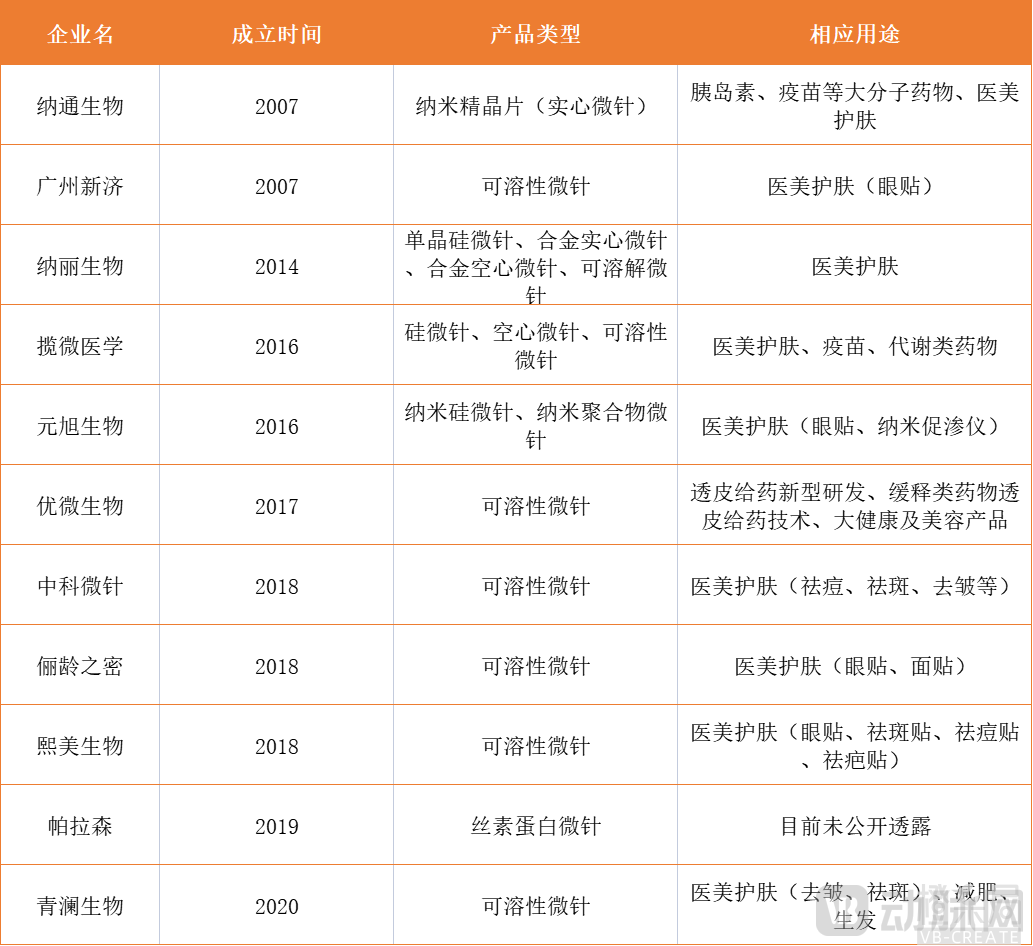
Domestic Microneedle Companies (Partial List)
As China's microneedle industry started relatively late, its application scenarios are primarily focused on the field of minimally invasive aesthetic medicine.Yuanxu Biotech has leveraged its independently developed micro- and nano-fabrication technology to create a range of beauty and skincare products, including 99.999% high-purity silicon microneedles and polymer nanomicroneedles. Qinglan Biotech, established in 2020, has launched products such as dissolvable microneedle patches for freckle removal and wrinkle reduction, dissolvable microneedle patches for weight loss, and dissolvable microneedle patches for hair regrowth, which have gained extensive entry into cosmetic sales channels, including beauty salons.
Domestic Pharmaceutical Scenarios Are Expanding One by One
According to the "Report on In-Depth Market Research and Investment Strategy Recommendations for the Microneedle Industry (2021–2025)," China's microneedle industry is currently in its early stages of development with a relatively small market size; however, it is experiencing rapid growth, and microneedles have broad applications in the medical and aesthetic industries.
According to statistics, the market size of China's non-surgical medical aesthetics industry reached RMB 54.5 billion in 2020. Among light-based and energy-based aesthetic procedures, which consistently account for a significant share of the market, radiofrequency (RF) microneedling has become one of the practical technologies in the field of dermatological aesthetics, owing to its advantages such as high efficacy, cost-effectiveness, minimal invasiveness, rapid recovery, and safety.
Meanwhile, academia and industry are also exploring more possibilities for microneedles in the medical field,Its applications in China have gradually expanded from the beauty industry to the medical field, including chronic disease management and oncology treatment.
For precision medication in chronic disease management, in 2021, a research group at Sun Yat-sen University developed an integrated wearable theranostic system based on mesoporous microneedle iontophoresis to address the closed-loop needs for minimally invasive glucose monitoring and intelligent diabetes treatment, enabling in situ monitoring and therapy for diabetes. In the field of oncology, in 2023, Professor Li Wei’s team at Wuhan University developed a wearable self-powered drug-loaded microneedle (MN) patch integrated with a flexible triboelectric nanogenerator, aiming to enhance the treatment of deep-seated melanoma.
Currently, many domestic microneedle companies are also attempting to transition into the biopharmaceutical sector.Among them, Zhongke Microneedle is based on its independently developed next-generation polymer microneedle drug delivery technology platform. Its application areas include vaccines aimed at enhancing immune responses and vaccination coverage, immunotherapeutic drugs requiring improved targeting, biologics necessitating multiple injections, pediatric medications, and dermatological treatments. Xinji Pharmaceutical is also developing multiple microneedle-based drug projects, including peptides and large-molecule biologic proteins, vaccine drugs, and small-molecule compounds.
As Xu Bai, CEO of Natong Bio, emphasized in an interview with VCBeat:“Although we started with medical aesthetics, our ultimate goal is definitely to address medical issues.”