

Goodbye to 'Carbonized Nodules': World's First Thyroid Micropapillary Carcinoma Ablation Using Micro-NanoKnife Under Local Anesthesia
Recently, the Department of Ultrasound Medicine at Zhejiang Cancer Hospital successfully performed the world’s first “micro-nano knife” ablation for thyroid papillary microcarcinoma under local anesthesia. The procedure was coordinated and carried out by Professor Xu Dong’s ultrasound intervention team from Zhejiang Cancer Hospital in the hospital’s ultrasound interventional operating room.
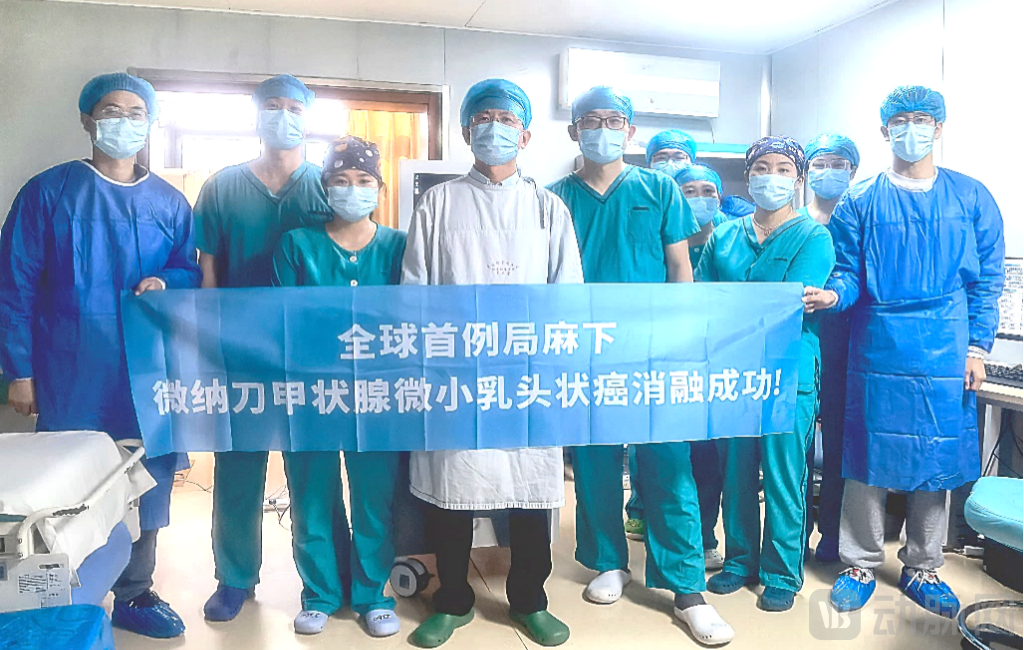
New Technologies for Minimally Invasive Treatment of Thyroid Lesions
The patient is a 58-year-old male. Preoperative ultrasound revealed a markedly hypoechoic nodule in the inferior aspect of the right thyroid lobe, measuring approximately 7 mm × 9 mm × 6 mm. Ultrasound findings were suggestive of malignancy, which was subsequently confirmed as papillary thyroid microcarcinoma by preoperative fine-needle aspiration biopsy. Taking into account the patient’s preference for minimally invasive treatment, along with his clinical condition and overall health status, the ultrasound-guided interventional team collectively decided to perform ablation therapy for thyroid cancer using the “Micro-Nano Knife” technique. This approach offers the distinct advantage of preserving critical structures such as nerves and blood vessels.
The entire ablation procedure was performed under local anesthesia. Guided by real-time B-mode ultrasound, Professor Xu used the “Micro-Nano Knife” to ablate the cancerous lesion via a single needle. The entire surgery lasted approximately 15 minutes, with the actual delivery time of ablation pulses being only 3 minutes and 20 seconds. The patient remained fully conscious throughout the procedure, enabling communication with the medical team, and reported no significant pain or discomfort. Immediate post-procedural contrast-enhanced ultrasound demonstrated that the ablation effect met expectations, with no evident damage to adjacent critical structures such as the trachea, nerves, and esophagus. The patient’s vital signs remained stable during and after the procedure, with no complaints of pain or other discomforts. The patient was discharged after an overnight observation period. Currently, the patient has completed one-month and three-month postoperative follow-ups. Imaging data revealed characteristic post-ablation changes in the lesion area. At three months post-procedure, imaging showed significant absorption and reduction of the ablation zone (a 68.97% decrease in volume compared to the pre-ablation baseline). Contrast-enhanced MRI at three months post-procedure showed no abnormal enhancement, indicating complete radiological ablation.
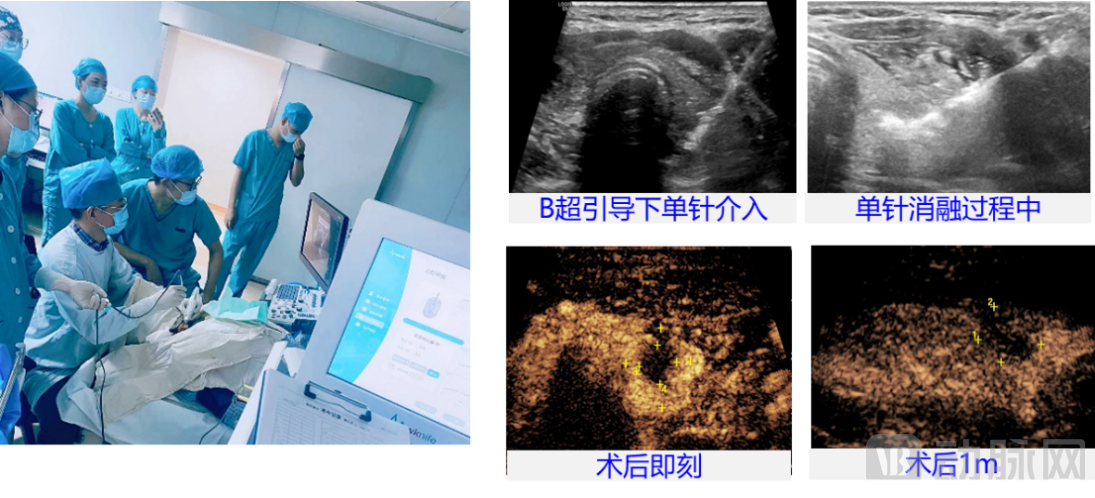
“Micro-Nano Knife” Painless Minimally Invasive Therapy
Thyroid cancer is a frequently occurring and common malignancy of the endocrine system. In China, the incidence of papillary thyroid carcinoma (PTC) has been rising year by year. PTCs with a diameter ≤10 mm are termed papillary thyroid microcarcinoma (PTMC), which represents the subtype with the greatest proportional increase among PTC cases, accounting for 50%–60% of all PTC patients. Thyroid surgery is a crucial approach for treating malignant thyroid tumors; however, due to the risk of postoperative complications and scarring, many patients prefer thermal ablation therapy. Improperly performed thermal ablation can often cause thermal injury to adjacent critical structures, such as burns to the recurrent laryngeal nerve and the superior laryngeal nerve. Therefore, during ablation of thyroid nodules, physicians commonly perform hydrodissection by injecting fluid around the nodule to prevent collateral thermal damage. Additionally, most patients develop a carbonized residual nodule after thermal ablation, which may cause discomfort and anxiety.
“Micro-Nano Knife” is the latest generation of irreversible electroporation (IRE), a non-thermal, selective physical ablation technology. During the ablation process, it destroys only the cellular structures within the ablation zone, while preserving important extracellular and structural components such as the extracellular matrix, blood vessels, nerves, trachea, and esophagus.
Due to its non-thermal characteristics, the micro-nano knife does not cause thermal injury to the ablation zone or surrounding tissues. Therefore, unlike thermal ablation techniques, it does not require hydrodissection to prevent damage. After micro-nano knife ablation, the lesion area can be naturally absorbed by the body, avoiding the formation of carbonized nodules that are difficult to resolve—a common issue with other thermal ablation methods that often causes patient anxiety. Thus, micro-nano knife ablation for thyroid lesions overcomes the limitations and deficiencies of traditional ablation methods, achieving true minimally invasive, painless lesion elimination with functional preservation, and holds promise as a new therapeutic option for thyroid diseases.
On the other hand, during this procedure, Professor Xu Dong’s medical team innovatively addressed the challenges associated with traditional IRE devices—namely, the requirement for general anesthesia with endotracheal intubation (combined with adequate muscle relaxants) and the placement of multiple parallel needles. Leveraging the Micro-Nano Knife and the newly developed single-needle ablation technology, they successfully implemented a novel IRE technique featuring true local anesthesia and single-needle ablation. This advancement significantly reduced procedural complexity, shortened overall treatment time, and made IRE ablation more efficient, safe, and convenient, thereby maximizing patient benefits.
The successful implementation of this procedure perfectly embodies the Zhejiang Cancer Hospital’s ultrasound-guided interventional team’s treatment philosophy of “replacing the scalpel with a needle, leaving no trace after ablation.” It also preliminarily demonstrates that “Micro-Nano Knife” is a safer and more efficient novel method for ablating thyroid lesions. This milestone signifies that the ultrasound-guided interventional team at Zhejiang Cancer Hospital now possesses a powerful non-thermal local treatment modality for thyroid tumors, complementing their existing thermal ablation capabilities. Furthermore, it marks a groundbreaking advancement in China in the application of irreversible electroporation (IRE) for the treatment of papillary thyroid microcarcinoma.
The “Micro-Nano Knife” technology, the latest generation of R&D achievements developed over more than 20 years by Professor Yao Chenguo’s team at Chongqing University, has been commercialized by Hangzhou Weinai Anke Medical Technology Co., Ltd. (www.wknife.cn). Since 2000, Professor Yao has been dedicated to research on electroporation of tumor cells and published the first international academic paper in this field in 2004. Since then, Professor Yao’s team has continuously developed several generations of products, establishing unique independent intellectual property rights. Recognized internationally as a pioneer and leader in electroporation-based tissue ablation technology, the team has secured core intellectual property rights for Chinese innovators in the field of irreversible electroporation.