

JD Health's Dermatology Hospital: A Leading Force in the Rapidly Advancing Internet Healthcare Sector
Urticaria, Eczema, Allergic Dermatitis... In this season of renewal and blooming flowers, along with the warmth and floral scents come various highly prevalent skin diseases.
In recent years, internet-based healthcare has provided dermatology patients with convenient access to medical services, and dermatology is considered one of the specialties most suited for online diagnosis and treatment.
Physical medical institutions, including top-tier dermatology hospitals, and numerous internet healthcare platforms have successively launched dermatological diagnosis and treatment services, with online consultations, prescription renewals for follow-up visits, and medication delivery becoming standard offerings. Beyond follow-up care and medication dispensing, practitioners have engaged in further practical applications of innovative technologies and concepts such as AI-based image recognition, image-assisted disease identification, intelligent clinical decision support, and personalized management.
Publicly available data indicate that dermatology services consistently rank among the highest in volume within the internet-based diagnosis and treatment offerings of general hospitals across many regions. Furthermore, according to the “2023 Insight Report on Internet Medical Services,” skin diseases accounted for the largest proportion among the top 15 conditions by volume of online consultations. In addition, innovative products such as AI-assisted dermatological detection and digital therapeutics have been successively launched or approved.
All signs indicate that the internet healthcare sector, which is most favored by the industry, is accelerating its growth.
In April last year, JD Health launched its Dermatology Hospital, exploring a new model for specialized internet hospitals.An analysis of JD Health’s initiatives and outcomes over the past year reveals that it has become a model for the accelerated growth of internet-based dermatology specialty care.
In 2023, at its launch, JD Health Dermatology Hospital positioned its service objectives to help more patients with skin diseases achieve “on-demand consultations for minor conditions,” “effective management of chronic diseases,” “early warning for severe conditions,” and “access to specialists for complex and refractory cases.”
Over the past year, JD Health has rolled out a series of initiatives, including launching single-disease studios and subspecialty outpatient clinics, as well as integrating large language model technologies. Compared with its established goals, certain service offerings have even exceeded expectations.
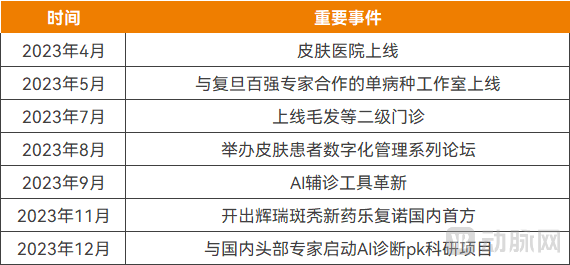
Key Milestones of JD Health Dermatology Hospital Over the Past Year, Source: Public Information
In terms of new services, JD Health Dermatology Hospital matches patients with mild conditions, chronic diseases, severe illnesses, and complex or rare disorders to the services that best meet their needs, always prioritizing treatment outcomes.
For patients with mild conditions, JD Health rapidly responds to consultation needs through its flagship product, “Instant Ask a JD Doctor.”
However, the efficacy of online consultations has long been a major challenge facing the industry. Media reports have indicated that some patients remain skeptical about the effectiveness of these services when they encounter perfunctory responses from physicians or are directed to seek in-person care.
It is reported that,JD Health Dermatology Hospital not only promptly addresses the needs of patients with mild conditions but also provides free follow-up on treatment outcomes after consultations. If patients are dissatisfied with the efficacy, the treatment plan will be adjusted to strive for results comparable to those achieved through in-person visits.
A patient experienced a sudden onset of papular urticaria at night and initiated an online consultation with JD Health Dermatology Hospital. Upon immediate acceptance of the case, the online physician inquired about the patient’s recent dietary intake, environmental exposures, and medication use, and promptly provided targeted treatment.
What delighted patients even more than the resolution of their emergency condition at night was that the doctor proactively sent a message the next day to inquire whether their condition had improved. Upon learning that the patient’s symptoms had significantly improved, the doctor once again provided instructions on medication precautions and lifestyle recommendations.
This is just a small case demonstrating JD Health Dermatology Hospital’s commitment to ensuring treatment efficacy for patients with mild conditions.
Among skin diseases, chronic conditions account for a high proportion and present complex clinical manifestations, necessitating long-term treatment and management as well as more frequent consultations with physicians.
In response to the characteristics of these chronic diseases, JD Health has established long-term and stable “doctor-patient chains” through specialized clinics to improve patient adherence to treatment and management.For instance, specialized outpatient clinics prominently highlight distinguished physicians and their respective clinical expertise to patients, thereby reducing information asymmetry. This enables patients to efficiently identify the most suitable physician for their condition, establishing a initial connection. Subsequently, through long-term interactions during chronic disease management, this “physician-patient link” is strengthened, leading to improved patient compliance with follow-up visits and allowing physicians to engage in more proactive patient management.
Meanwhile, JD Health Dermatology Hospital has developed over 30 disease-specific follow-up services, serving as the foundation for post-consultation rehabilitation management to enhance treatment outcomes.
In the management of critical and complex diseases, JD Health Dermatology Hospital precisely matches patients with high-quality resources, such as establishing single-disease expert studios in collaboration with industry specialists and ensuring seamless referrals between online and offline channels.
A patient with triple-negative breast cancer developed herpes zoster during chemotherapy while concurrently taking multiple anticancer medications, resulting in a complex clinical presentation. Upon recommendation, the patient consulted an expert from a renowned hospital in Beijing through JD Health Dermatology Hospital, enabling timely intervention. Additionally, a patient with hereditary hair loss sought assistance from Dr. Yang Dingquan, Chief Physician at China-Japan Friendship Hospital, via JD Health Dermatology Hospital and successfully scheduled an in-person consultation at a nearby facility.
The value of internet healthcare platforms in optimizing the allocation of dermatological medical resources is fully demonstrated in these cases.
On the supply side, JD Health Dermatology Hospital integrates multi-tiered medical resources, as well as medical and pharmaceutical resources, to more comprehensively enhance the accessibility of dermatological healthcare services.
To date, JD Health Dermatology Hospital has registered over 5,000 physicians, including 3,000 specialists from Grade A tertiary hospitals. Its full-time medical team works in close collaboration with external physicians. Meanwhile, the hospital has established 49 expert studios dedicated to single disease entities, covering 17 types of complex and refractory dermatological conditions. It has also set up four secondary outpatient clinics specializing in areas such as hair disorders and pediatrics, recruiting nearly 100 experts. The ultimate goal of JD Health Dermatology Hospital is effective treatment and long-term disease management, rather than merely providing prescription refills during follow-up visits or offering basic answers to patient inquiries.
In terms of product supply, JD Health offers over 3,000 physical products, including dermatological pharmaceuticals and non-pharmaceutical items, to meet the needs of patients with various common and chronic skin conditions. The Skin Hospital also collaborates with upstream supply chains to better address the demand for new drugs and novel therapies among patients with severe and complex cases. Since its launch, numerous new medications from companies such as Pfizer and Mandi have been prescribed for the first time nationwide through the Skin Hospital.
In terms of new technologies, JD Health has vigorously applied innovations in large AI models to online dermatology consultations, thereby strengthening foundational service capabilities for both patients and physicians.
After years of accumulation, JD Health Internet Hospital has amassed over 100 million doctor-patient dialogues and 8 million medical images. With the in-depth involvement of more than 200 full-time physicians and external medical experts, it has built the industry’s most professional large-scale medical model database.
Leveraging this technological foundation, the dermatology hospital has developed and deployed a suite of AI tools to enhance the patient-provider experience. For patients, assessment tools such as full-body skin self-screening, AI-powered facial skin analysis, and AI-based hair loss detection have been launched to identify potential skin conditions and provide timely alerts. For physicians, an intelligent assistant covering the entire diagnosis and treatment workflow has been introduced to improve diagnostic efficiency and quality, thereby optimizing online therapeutic outcomes.
It is evident that continuously deepening and specializing in services, supply, and technology has been the core focus of JD Health’s Dermatology Hospital over the past year.
Thanks to a year of dedicated efforts, JD Health Dermatology Hospital has achieved remarkable results.
The most direct outcome has been the expansion of service scale, coupled with substantial patient satisfaction.
According to statistics, JD Health Dermatology Hospital has cumulatively served 15 million patients since its launch. Among these services, the value proposition of "Miaowen Jingyi" (Instant Consultation with JD Doctors)—which assumes responsibility for patient outcomes through full-time coverage, efficacy evaluation, and telephone follow-ups—has become increasingly prominent. In March 2024, the average daily order volume for Miaowen Jingyi at the Dermatology Hospital increased by 150% compared to the same period in 2023.
Over the past year since its launch, JD Health Dermatology Hospital has also garnered a strong reputation, with an overall patient satisfaction rate of 98.9%.
Furthermore, by leveraging the online service experience of its full-time physicians to establish standardized diagnostic and treatment pathways, the dermatology hospital provides part-time specialists with clear, high-standard service guidelines. This ensures that services delivered by all physicians are highly standardized and regulated, thereby guaranteeing a consistently high-quality patient experience and driving an increase in the Net Promoter Score (NPS).
Based on service scale and patient satisfaction, the paid conversion rate for patients at JD Health Dermatology Hospital has reached a certain level.
As previously mentioned, the dermatology hospital has developed disease-specific follow-up services targeting specialized conditions, provided by full-time physicians. As a chargeable service, the patient payment conversion rate for these disease-specific follow-ups has reached 20%.
In the past, the lack of payers was one of the main reasons why many chronic disease management models were difficult to sustain. Patients have a low willingness to pay for pure services. On the one hand, unlike physical products with high standardization, patients have not yet developed the habit of paying for services. On the other hand, “being managed” goes against human nature, let alone paying to be managed.
Therefore, the 20% paid conversion rate achieved through follow-up services clearly demonstrates patients’ genuine demand for “paid care management” and their recognition of JD Health’s services.
Not only do patients benefit, but physicians also gain.
Since its launch, the application of this technology has helped physicians improve the efficiency and quality of diagnosis and treatment. For example, the AI-assisted diagnostic system based on large language models at JD Health Dermatology Hospital has achieved an accuracy rate exceeding 95%.
After a patient uploaded images of skin lesions, the AI-assisted diagnostic system flagged them as flat warts, which conflicted with the attending physician’s initial diagnosis. Upon magnifying and carefully examining the photos, the doctor ultimately confirmed that the AI’s assessment was correct. This effective collaboration between technology and human expertise successfully prevented a misdiagnosis.
For leading experts, the dermatology hospital has also established a research platform. Currently, more than 40 leading experts have set up single-disease studios and are conducting research projects on large models for specialized diseases based on these studios.
Over the past year, a director of dermatology from a renowned hospital has leveraged JD Health’s Dermatology Hospital research platform to conduct scientific data collection while managing patients with hair loss.
For young physicians, JD Health’s Dermatology Hospital has established a clear career development pathway. One attending physician from a top-100 hospital on the Fudan University Hospital Ranking has accumulated extensive case experience through JD Health’s Dermatology Hospital, while also earning substantial and compliant income, thereby fully realizing professional value and job satisfaction.
It is evident that, over the past year, JD Health Dermatology Hospital has facilitated the gradual realization of its own and the industry’s visions for online dermatology consultations. In the coming year, it will further focus on service innovation, technological innovation, and related initiatives.
Server-side, JD Health Dermatology Hospital will supplement the testing phase and continue to integrate online and offline full-process services.
Laboratory and diagnostic tests are also key evidence supporting the diagnosis of dermatological conditions, a critical component previously missing across all specialties in internet healthcare. In 2024, JD Health will enhance its services by leveraging its at-home rapid testing platform. For instance, for allergic dermatitis, it will establish a closed-loop service encompassing at-home allergen testing, post-test report interpretation, diagnosis, and treatment.
By leveraging both online and offline channels, the dermatology hospital extends its services to pre- and post-consultation phases, such as integrating skin assessments at JD Health Checkup Centers, online consultations at the dermatology hospital, and in-person visits at partner medical institutions.
Furthermore, the dermatology hospital will collaborate with experts from the Medical Consortium for Hair Disorders to build a new ecosystem of specialized disease services. Initiatives include launching training and promotion programs for alopecia diagnosis and treatment techniques, organizing special patient care campaigns for individuals with hair loss, and initiating large-scale real-world studies on patients with alopecia.
On the technology front, JD Health Dermatology Hospital will leverage the opportunities presented by large AI models to deeply explore the value of technology for both patients and healthcare providers.
In 2024, the dermatology hospital planned a whole-course management service, currently covering five high-incidence skin diseases: acne, psoriasis, herpes zoster, eczema, and folliculitis. This product integrates modules such as medication management, AI-based rehabilitation assessment, and treatment efficacy feedback, extending services more efficiently and effectively to post-consultation rehabilitation while establishing integrated dermatological records to serve as a hub for patients’ skin health. Throughout 2024, the whole-course management plan aims to cover ten high-incidence conditions.
Notably, full-course disease management products, empowered by large AI models, significantly reduce management costs for all stakeholders. For instance, after patients regularly upload photos, the AI can assess changes in their condition and synchronize this information with physicians; if significant changes are detected, doctors can promptly adjust treatment plans.
For patients, achieving effective doctor-patient communication requires little more than taking photos as instructed, which significantly reduces the operational burden and is expected to further enhance patient compliance and willingness to pay. For physicians, AI integration enables large-scale patient management and facilitates the collection of more regular and comprehensive disease data over extended periods, thereby laying a solid foundation for clinical studies of greater scale and higher quality.
Of course, AI tools that directly serve physicians will also undergo iterative optimization. In 2024, JD Health Dermatology Hospital will leverage AI-assisted diagnosis as its core tool to enhance capabilities in modules such as image analysis, conversational guidance, diagnostic recommendations, peer treatment plans, intelligent medical records, and post-consultation monitoring, thereby continuously improving healthcare efficiency.
A review of the development trajectory of JD Health Dermatology Hospital clearly reveals that personalized diagnosis and treatment, along with precision management, constitute its long-term objectives.
In fact, this is not a new concept within the healthcare service system. Personalized diagnosis and treatment, along with precision management, emphasize tailoring care to each patient’s individual condition. Dermatological patients often present more complex individual profiles, as variations in living environments can lead to differences in disease presentation. This approach also underscores patient engagement in treatment and management plans, placing greater emphasis on efficient, differentiated intervention processes and high-quality outcomes. Achieving true personalization and precision remains an exceptionally challenging endeavor.
JD Health closely integrates high-quality medical resources with advanced technology. Its multi-dimensional data accumulation has already yielded results and will continue to be refined, while also minimizing the cost for patients to participate in disease management. This positions JD Health to confidently transform personalized diagnosis and treatment and precision management from concepts into reality, further leading the evolution of internet-based dermatology care.
In the future, achieving instant success is unrealistic; however, by adhering to long-termism and accumulating progress day by day, month by month, and year by year, our goals will become increasingly attainable and clearly defined.