

3Daughters Submits IPO Prospectus for Its Next-Generation Frameless, Self-Assembling IUD Designed to Eliminate Insertion Pain

3Daughters
Painless Intrauterine Device Developer
“The development of products and services related to women’s health has long been neglected, and current contraceptive methods fail to meet the needs of all women,” the Bill & Melinda Gates Foundation stated.
Currently, services and research related to women's health remain severely inadequate, leaving a vast unmet need in improving global women's health and treatment protocols.
Among these, the intrauterine device (IUD) represents a “hidden and overlooked” source of pain for many women. Due to long-term use, the IUD may become embedded in the tissue and adhere to the uterus, easily leading to fibrotic lesions of the endometrium, and even uterine perforation, severe hemorrhage, and damage to other organs.
Female Contraception: An Innovative Solution Is Urgently Needed
3Daughters is a company dedicated to innovation in this field. Headquartered in Boston, Massachusetts, USA, the company focuses on women’s healthcare and has assembled an experienced team of women’s health experts and a scientific advisory board, aiming to address major gaps in the field of women’s health.
The company is addressing a common, challenging, yet often overlooked issue faced by many women—pain during intrauterine device (IUD) insertion—and is committed to providing women worldwide with more and better contraceptive options than currently available, while advancing the development of novel long-acting reversible contraception (LARC) technologies.
The earliest history of intrauterine devices (IUDs) dates back several centuries. Historical records indicate that ancient Arabs and Turks placed small stones into the uteri of camels to prevent pregnancy during long desert journeys. This method of contraception, while seemingly simple and crude, undoubtedly caused significant discomfort. Since then, IUDs have embarked on a long, storied, and turbulent history spanning hundreds of years.
The first recorded use of an intrauterine device (IUD) by humans dates back to 1909, when Dr. Richard Richter, a German physician, invented a contraceptive device made from silkworm gut that could be inserted into the uterus. In the years that followed, physicians around the world documented their successful experiences with various intrauterine contraceptive devices, most of which were coil-shaped.
Fast forward to 1969, when American physician Howard Tatum designed a T-shaped plastic frame as an alternative to existing intrauterine devices (IUDs). Although this device was well tolerated, it had a pregnancy rate of 18%. In the same year, copper was discovered to be an effective spermicide, leading to the introduction of the first copper IUD and revolutionizing the efficacy of IUDs. The following year, a new T-shaped device was developed, featuring a semi-permeable capsule filled with progesterone in the lower part of the T-frame.
Following the introduction of copper intrauterine devices (IUDs), the United States launched a levonorgestrel-releasing intrauterine system (Mirena) in 2001. Since then, the FDA has approved three additional IUDs, all of which utilize the same T-shaped frame design.
A review of this developmental trajectory reveals that T-shaped intrauterine devices (IUDs) have not undergone any breakthrough innovations over the past four to five decades. Most T-frame IUDs feature a support structure and a retrieval string, which can lead to difficult insertion, pain, and potential risks such as uterine perforation. The placement of IUDs has consistently required numerous painful and cumbersome steps, causing significant distress for many women.
During insertion, many women describe their pain as “severe and unbearable.” Therefore, although intrauterine devices (IUDs) are among the most effective forms of contraception, their adoption rate remains suboptimal.
The American College of Obstetricians and Gynecologists (ACOG) states that unintended pregnancy remains a significant public health issue. Young women aged 15–25 account for the highest number of unintended pregnancies, with approximately 42% resulting in abortion. Women in this age group, particularly nulliparous women, often have a strong aversion to intrauterine device (IUD) insertion due to widespread fear of the severe pain associated with both insertion and removal.
3Daughters aims to meet women’s demand for novel, improved intrauterine devices (IUDs), fundamentally transforming the patient experience of IUD insertion, includingNon-hormonal; alleviates pain during IUD insertion and removal; features a simplified procedure for easy insertion and removal; conforms to female anatomy and adapts to the uterine environment; requires no removal string, while maintaining equivalent efficacy, safety, and convenience.
3Daughters’ innovative intrauterine device design can be traced back to Dr. Carlos Gradil, a world-renowned veterinary reproduction specialist. Dr. Gradil is an adjunct professor, reproduction specialist, and theriogenologist at the Cummings School of Veterinary Medicine’s Tufts Equine Center, as well as an Extension Professor in Equine Reproductive Services for the Department of Veterinary and Animal Sciences at the University of Massachusetts Amherst. He aims to provide a safe and effective solution for the long-term contraceptive needs of horses, particularly performance horses.
Dr. Gradil invented and tested a frameless, magnetic self-assembling intrauterine device (IUD)—iUPOD®—which consists of three elliptical units that self-assemble into a triad after insertion into the equine uterus. He demonstrated the contraceptive efficacy, safety, and uterine retention capability of this IUD. In his study, all mares successfully conceived in the subsequent breeding season. Dr. Gradil’s findings were published in Animal Reproduction Science and the Journal of Equine Veterinary Science following peer review.
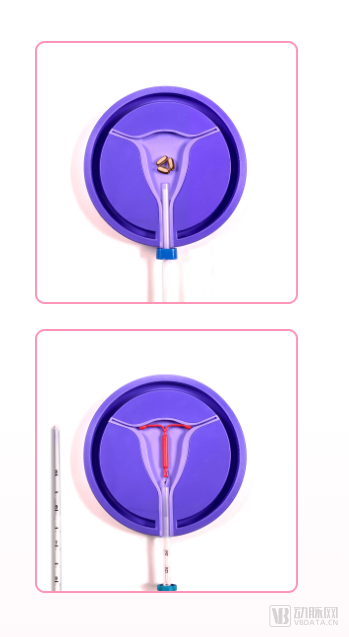
Comparison of the 3Daughters IUD (top) and the traditional T-shaped frame intrauterine device (bottom)
Currently, 3Daughters has licensed Dr. Gradil’s technology and applied its innovations to human contraception to address the limitations of current T-shaped intrauterine devices (IUDs). Leveraging Dr. Gradil’s extensive data and expertise,3Daughters has adjusted and optimized its self-assembling, frameless design for the human female anatomy. Combined with the company’s patented Slider system for insertion and removal, this approach addresses barriers that prevent women from choosing intrauterine devices (IUDs), enabling more women to have a better contraceptive experience.
Unlike current intrauterine devices (IUDs) that utilize rigid plastic T-shaped frames, 3Daughters features a newly designed, patented frameless magnetic self-assembling IUD (Product Code: 3D-001). Ergonomically contoured to align with female anatomy, it requires no retrieval strings. The 3Daughters IUD incorporates an innovative design composed of three small oval magnetic units.
Notably, 3Daughters designed a unique inserter/remover system, developed with the assistance of co-founder and Chief Strategy and Development Officer Shelley Amster, that addresses three major pain points associated with intrauterine device (IUD) insertion.
Shelley Amster has over 45 years of experience in women’s health and reproductive endocrinology, including clinical endocrinology and IVF embryology. With a deep understanding of the value of frameless magnetic technology for targeted intrauterine delivery of contraceptive agents, and leveraging her expertise and experience in embryo transfer procedures, she assisted in developing 3Daughters’ patented Slider inserter/remover system to address pain associated with intrauterine device insertion and removal.
During the traditional insertion of a T-frame intrauterine device (IUD), a rigid sound is required to measure uterine length for accurate placement. Furthermore, the T-frame IUD must be inserted to the fundus of the uterus to ensure proper positioning between the fallopian tubes. Throughout this process, any contact with the uterine fundus causes significant pain for the patient.
The Slider inserter is designed with a soft, flexible, specialized tip that can easily pass through the cervix, allowing physicians to gently place the intrauterine device (IUD) into the uterus. The self-assembling stable triangular configuration of the 3Daughters IUD requires only entry into the mid-uterine cavity after passing through the cervix.This more flexible placement method eliminates the need to use a “sound” to measure uterine length.
The simple magnetic retriever r-Slider is used to extract the magnetic unit.The r-Slider is designed with a more magnetic tip, which can quickly attract three oval-shaped magnetic units and remove them sequentially in continuous steps.Notably, the i-Slider and r-Slider systems, used for the insertion and removal of intrauterine devices (IUDs), are proprietary patented technologies exclusive to 3Daughters.
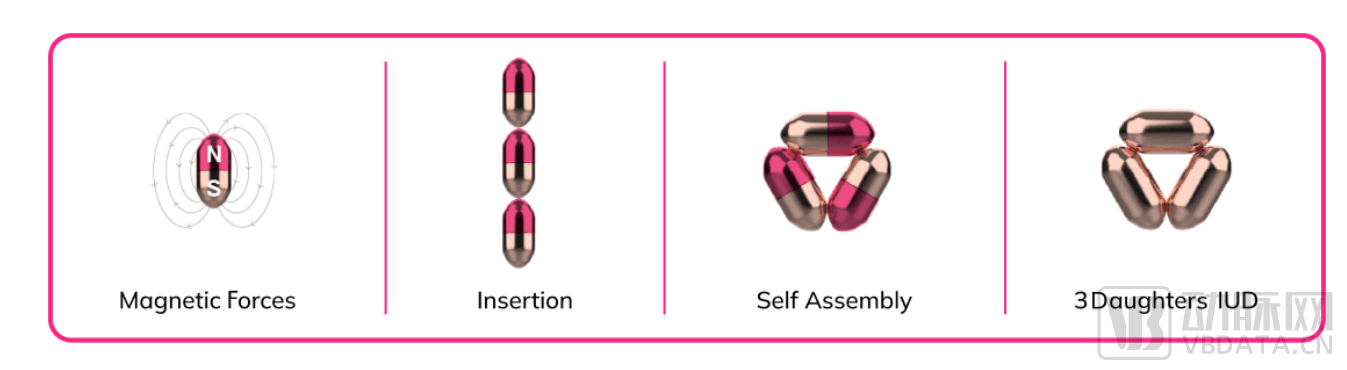
3Daughters IUD Self-Assembly Process
3Daughters IUD delivers contraceptive agents to the uterus via magnetic units. These magnetic units are coated with the active pharmaceutical ingredient copper and effectively deliver it into the uterine cavity for contraception.
On July 13, 2023, 3Daughters announced the appointment of key senior leadership and the establishment of a Scientific Advisory Board to support the research and development of its frameless intrauterine device.
Among them, Dr. Gary Shangold was appointed as Chief Medical Officer (CMO). As a reproductive endocrinology specialist, he has over thirty years of experience in medicine, science, and management, having served as CMO at Enteris BioPharma and Xanodyne Pharmaceuticals, and as CEO of NovaDel Pharma. Dr. Shangold previously held senior positions in clinical research and regulatory affairs at RW Johnson Pharmaceutical R&D (J&J), and served as Medical Director for Obstetrics/Gynecology and Infertility at Serono Labs.
Dr. Mary Mahony has been appointed as Chief Scientific Advisor (CSA). She is a senior medical affairs expert with nearly four decades of experience in reproductive medicine and endocrinology, having previously served as Vice President of Fertility and Endocrinology at EMD Serono. Her research focuses on capacitation events at the cellular level prior to human sperm fertilization, and she has published extensively in this field.
Dr. William Bracken has been appointed as Head of Toxicology, bringing extensive toxicology and preclinical experience in drug safety. He previously held senior positions at AbbVie, including Global Director of Preclinical Safety and Chair of the Drug Safety Committee. Dr. Bracken also conducted expansive research at Oak Ridge National Laboratory, the Fred Hutchinson Cancer Research Center, and the Midwest Research Institute, with a focus on carcinogenic mechanisms.
In addition, the company has appointed eight key opinion leaders in the field of women's health as members of its Scientific Advisory Board.
On January 22, 2024, 3Daughters announced that it had secured its first investment of over $2 million in a seed funding round. The round was led by Thairm Bio and a consortium of life sciences investors, with participation from the Argosy Foundation, Wexford Science and Technology, LLC, UMass Amherst, and other undisclosed investors. The proceeds from this financing will be used to advance clinical trials for its intrauterine device (IUD), with the aim of completing the Investigational New Drug (IND) application and Phase I clinical trials within the year.
On April 16, 2024, at the 2024 BioLabs Investor Day, 3Daughters was named “Startup of the Year” by top life sciences investors and venture capitalists.
Meanwhile,3Daughters’ scope of interest extends beyond contraception to exploring the potential of its uterine delivery technology for treating other uterine diseases,Attempt to incorporate other active agents into this unique system to enable targeted drug delivery to the uterus for applications beyond contraception.