

Chinese IVD Companies Profit in Emerging Markets Amid Global Retreat, Eye IPOs
Snibe
In Vitro Diagnostics (IVD) Product Developer, Manufacturer, and Supplier

Wondfo Biotech
In Vitro Diagnostics (IVD) Product Development, Manufacturing, and Sales

Yhlo
Developer, Manufacturer, and Seller of In Vitro Diagnostic Instruments and Matching Reagents

DIRUI
Developer, Manufacturer, and Distributor of Medical Diagnostic Products
Amid the wave of global expansion, many companies have generated profits overseas.
“Promoting primary care clinical diagnostics in emerging markets is easier than anticipated,” a marketing executive at a domestic IVD company told VCBeat. Unlike the earlier trend of fiercely competing in developed markets such as the United States and Europe, Chinese IVD companies have adopted more diversified overseas expansion strategies in recent years, with many generating profits in previously overlooked international markets. In an increasing number of cases, for IVD companies expanding abroad, achieving regulatory compliance and market access has served as a gateway to new growth opportunities.
However, the overseas registration and compliance process for IVD products is quite lengthy. “Regulatory requirements in most countries are relatively clear; it simply requires time and patience,” said an industry practitioner. IVD products typically do not face challenges related to regulatory innovation during overseas registration, but there are significant differences in the detailed regulatory requirements across different countries and regions. “Some jurisdictions rely more heavily on existing regulatory data, while others emphasize localized R&D, manufacturing, and sales.”
From saturated, hyper-competitive domestic markets to trial-and-error exploration in developing countries, identifying high-potential target overseas markets and achieving rapid, compliant market entry has become a core competency that IVD companies must continually refine as they expand globally.
Overseas Markets Begin to Retreat
In 2023, the global healthcare order gradually returned to normal, and the once-booming overseas IVD business could no longer sustain long-term industry growth. Among the 17 domestic IVD companies that have released their 2023 financial reports, total operating revenue decreased by nearly half compared to 2022, with overseas revenue shrinking by a similar proportion.
Data shows that companies such as Wondfo Biotech and Yhlo, which built substantial overseas business volumes during the previous wave, have experienced a precipitous drop in the proportion of their overseas revenue.
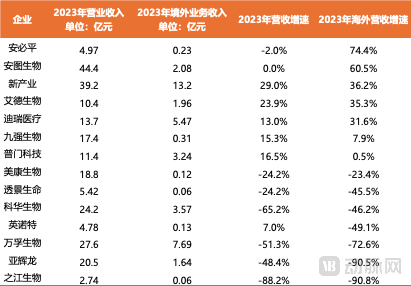
2023 Operational Data of Select Domestic IVD Companies Data Source: Calculated by VCBeat based on the Choice database
Interestingly, amidst the significant retreat of IVD companies in overseas markets, some counter-trend data have emerged. Notably, Snibe’s overseas business generated RMB 1.321 billion in revenue, a year-on-year increase of 36.23%, outpacing the growth rate of its total revenue for the same year. The proportion of overseas revenue to the company’s total revenue also expanded to approximately one-third. Meanwhile, Autobio Diagnostics’ overseas business surged in 2023, with revenue growing by over 60%, becoming the primary driver of the company’s performance. In addition, smaller-scale IVD enterprises such as AmoyDx and Rayto Medical have also achieved counter-cyclical growth during the industry downturn by aggressively expanding their overseas operations.
In 2023, Snibe sold a total of 3,564 fully automated chemiluminescence immunoassay (CLIA) instruments in overseas markets. Among these, the sales volume proportion of medium-to-large CLIA instruments rose to 56.73%, representing a year-on-year increase of 20.19%. The rapid growth in overseas installations, particularly of medium-to-large instruments, has undoubtedly laid the foundation for Snibe’s subsequent expansion of higher-margin reagent business abroad. Data shows that in 2023, Snibe’s overseas reagent revenue increased by 54.56% year-on-year, significantly outpacing the growth rate of its overseas instrument revenue. Snibe’s initial destination for its international expansion was India.
In recent years, Dirui Industrial has maintained a high growth rate in its overseas revenue. In 2023, the company generated operating revenue of RMB 1.378 billion, representing a year-on-year increase of 12.9%. Among this, overseas business revenue reached RMB 547 million, surging by 39.7% year-on-year and serving as the core driver of performance growth. Notably, Dirui Industrial’s Russian subsidiary achieved rapid growth. It is reported that Dirui Industrial has established an international technical team and an expert resource pool, leveraged its advantageous product lines to accelerate the market introduction of new products in chemiluminescence, coagulation, and gynecology, and continuously improved registration for its full product portfolio. These efforts aim to expand market share by enhancing brand influence in international markets.
Meanwhile, the IVD companies mentioned earlier that have experienced a contraction in their overseas business largely have their international strongholds in the relatively mature markets of Europe and the United States. Among them, Wondfo Biotech stands as a benchmark for Chinese IVD enterprises expanding globally, having cultivated overseas markets for over two decades and built a localized international marketing team of nearly 200 professionals. As of the first half of 2023, Wondfo Biotech held 324 overseas registration certificates, including 70 U.S. FDA product registrations, 241 EU CE product certifications, and 13 Canadian MDALL product registrations. Given that Europe and the United States are the birthplaces of global IVD giants and feature intensely competitive markets, it is understandable that Wondfo Biotech’s overseas business growth has been hindered amid a rapid decline in overall demand.
However, in response to the highly competitive overseas market, Chinese IVD companies are shifting their focus toward emerging markets. Previous media reports indicated that Yhlo has been engaging closely with South Korean IVD enterprises, possibly signaling its intention to establish a presence in the local market. Meanwhile, the rapid growth of Autobio’s overseas business is also driven by orders from the Middle East and Southeast Asia.
The Logic of Going Global Is Changing
Based on the overseas expansion practices of IVD companies over the past two years, a key underlying logic for achieving stable growth abroad is to bypass the most saturated markets and secure early entry into emerging markets ahead of competitors.
In the early stages, Chinese IVD companies expanding overseas primarily targeted the larger and rapidly growing markets of North America and Western Europe. At that time, China’s main IVD exports were POCT products for drug testing and eugenics/reproductive health, whose primary accessible markets were in North America and Western Europe. In recent years, however, core laboratory products manufactured in China—such as hematology analyzers, immunofluorescence assays, biochemical analyzers, and chemiluminescence immunoassays—have been successfully deployed in emerging markets including South Asia, Southeast Asia, the Commonwealth of Independent States (CIS), and West Asia. This shift has truly driven the global expansion of Chinese IVD products and enterprises.
For domestic IVD companies, emerging market countries characterized by high population density, heavy disease burden, and relatively underdeveloped healthcare infrastructure may all become new growth poles for overseas expansion.
Take India, where Snibe established its first overseas subsidiary, as an example. With a large population, India is projected to reach 1.4286 billion people in 2023, surpassing China to become the world’s most populous country, according to the latest data from the United Nations Population Fund. Demographic shifts driven by population growth, coupled with rapid economic development, have fueled the continuous expansion of India’s medical device market.
India bears a heavy disease burden. First, India is a country with an extremely high risk of infectious diseases. These include bacterial diarrhea, hepatitis A, hepatitis E, and typhoid fever transmitted through water and food sources, as well as vector-borne diseases such as dengue fever, Crimean-Congo hemorrhagic fever, Japanese encephalitis, and malaria. In India, more than 2.3 million people are living with HIV/AIDS, ranking second worldwide after South Africa. Additionally, there are approximately 2.5 to 3 million new tuberculosis infections annually, accounting for about one-quarter of the global total. This situation has created substantial demand for clinical testing of infectious diseases. According to a report by Kalorama Information, India is one of the largest healthcare markets in Asia. The size of India’s in vitro diagnostics (IVD) market was approximately USD 1.489 billion in 2022 and is projected to reach nearly USD 1.663 billion by 2027.
Meanwhile, India is not a traditional stronghold for global IVD leaders. Coupled with the pronounced decentralization of medical resources in the country, this landscape creates opportunities for domestically produced IVD products that offer relatively lower testing throughput and costs. Reportedly, while approximately 100,000 registered laboratories are concentrated in tier-one cities, a large number of unregulated laboratories are distributed across tier-two and tier-three cities, making them ideal application scenarios for POCT products used in infectious disease testing.
“POCT has a larger market overseas than in China,” said an industry practitioner. In recent years, his company has mainly expanded its POCT products for infectious diseases in low-income countries, where local clinics and pharmacies have strong demand for such point-of-care testing, with market penetration occurring faster than expected. In his view, besides countries like India, where population and medical needs are relatively concentrated, POCT will also be an ideal product form for achieving precise diagnosis and treatment in vast, sparsely populated regions such as Russia.
It is understood that many domestic IVD-related companies, including Shenzhen Lifotronic Technology Co., Ltd., are attempting to establish a presence in the Russian market. In fact, Russia bears a significant disease burden, with healthcare expenditure accounting for approximately 7% of its gross domestic product (GDP). According to a report by Kalorama Information, Russia has the highest incidence rates of tuberculosis, cancer, and heart disease among all industrialized nations. Meanwhile, the Russian IVD market remains largely underserved by global giants. Due to insufficient government funding, Russian hospitals and laboratories cannot afford overseas IVD products. Consequently, some high-tech manufacturers have shifted from defense production to basic routine reagents for chemistry, hematology, and immunoassays, thereby capturing a major share of the IVD market. Of course, most hospitals and clinics in Russia are currently limited to performing simple clinical biochemistry tests, resulting in substantial demand for innovative IVD products.
Furthermore, Indonesia is emerging as a key destination for Chinese in vitro diagnostics (IVD) companies expanding overseas. As the largest country in Southeast Asia and the fourth most populous nation globally, Indonesia has a population of approximately 275 million. The population is projected to reach 310 million by 2045, making it one of the fastest-aging countries in Asia. Its large population base and rapid aging trend have created a significant gap in medical supply. According to a report by Kalorama Information, Indonesia relies heavily on medical imports and is taking substantial steps to improve its healthcare infrastructure.
At the end of 2023, Indonesia hosted the Indonesian Hospital Expo, an international medical exhibition. Numerous renowned Chinese in vitro diagnostics (IVD) companies, including Jiuqiang Biotechnology, Biotime Biotechnology, TransGen Biotech, Longji Biotechnology, Jingjie Technology, Hongwei Tesi, and Giant Smarts, participated in the event in Jakarta. It is reported that in recent years, many domestic IVD enterprises have been accelerating their engagement with Indonesian healthcare institutions, businesses, and partners, or strategically positioning themselves in this high-potential market through various means such as establishing subsidiaries and participating in exhibitions.
Of course, the risks of promoting IVD products in unfamiliar markets where medical demand has not yet been fully unleashed are self-evident. How can companies develop products that meet local clinical needs? How can they ensure payment accessibility for innovative products? It is difficult to accurately gauge these factors before entering specific overseas markets, which may be one of the reasons for the highly divergent performance of Chinese IVD enterprises in their global expansion.
Inescapable Localization
For a long time, Chinese IVD companies have tended to choose OEM as a more flexible way to go global. By cooperating with large international medical device distributors, Chinese IVD companies can develop, design and produce products according to the specialized needs of their partners, and then the distributors are responsible for sales and distribution. In the market logic of this traditional model, IVD companies can focus on product research and development and production, while using their partners' market channels to quickly expand into the international market. Previously, AmoyDx established cooperation with more than 100 international distributors through this method, covering its products in more than 60 countries and regions around the world.
However, as the global expansion of the in vitro diagnostics (IVD) industry enters a more complex phase and competition intensifies across different regional markets, the traditional agency model is no longer sufficient to establish robust competitive barriers. IVD companies will undoubtedly deepen their ties with overseas markets, making localization an inevitable strategy. Existing practices show that most Chinese IVD enterprises achieve localization by acquiring overseas companies. Such acquisitions enable IVD firms to rapidly establish a local foundation, including basic sales networks and corresponding customer resources. Building brand influence and market position on this foundation enhances the efficiency with which IVD companies can navigate and learn from unfamiliar overseas markets. For instance, Mindray has established subsidiaries and offices in the United States, along with R&D centers in Silicon Valley, Seattle, and New Jersey, gradually constructing a comprehensive medical product innovation system covering planning, R&D, and regulatory registration.
For another example, as mentioned above, Snibe’s initial overseas expansion into India was achieved through the acquisition of an Indian subsidiary, enabling rapid market penetration. Building on the experience gained from its Indian subsidiary, Snibe has continued to increase support, investment, and localized operations in key target markets. It established three new wholly-owned overseas subsidiaries in Italy, Romania, and Saudi Arabia, and completed the establishment of its Indonesian subsidiary in January 2024. According to the 2023 annual report, Snibe has established a total of 10 wholly-owned overseas subsidiaries to date.
Beyond enhancing the efficiency of trial-and-error processes, localization helps overseas IVD enterprises build local brand influence and user stickiness, distinguishing itself from the mere product sales function of agency networks. For IVD solution providers whose offerings are tightly integrated with instruments and equipment, clinical market recognition is a critical competitive factor.
Taking Snibe as an example, the company has leveraged its overseas subsidiaries to establish a platform for academic exchange among domestic and international experts through academic promotion, effectively enhancing the global influence of the Snibe brand. Furthermore, Snibe segments its regional markets, implementing an integrated four-in-one model encompassing marketing, after-sales service, market development, and commercial operations for each region. This approach strengthens coordination between product sales and after-sales personnel, thereby improving the quality and capability of regional product services.
Furthermore, Amoy Diagnostics and Dirui Industrial, whose overseas businesses posted impressive growth in 2023, have also built intrinsic competitiveness in overseas markets through localization.
Among them, AmoyDx has established wholly-owned subsidiaries in Singapore, Hong Kong, and Canada, as well as a European logistics center in the Netherlands. It has built localized teams in key overseas markets such as Singapore, Japan, Europe, Latin America, and countries along the “Belt and Road” initiative, forming a comprehensive marketing system in East Asia and Europe while gradually expanding into Southeast Asia, the Middle East, Africa, and Latin America. Meanwhile, Dirui Industrial focuses its international strategy on twelve key national markets, where it has established localized sales teams, advanced registration processes for its full product portfolio, and formed project teams to promote local licensed production of instruments and reagents, thereby gradually building clear market recognition.
As the global clinical laboratory market stabilizes, IVD product development and marketing are returning to a state of refined operations. While there is less hype, the core logic remains unchanged: delivering high-performance products to markets with unmet clinical needs. For domestic IVD companies, this presents a rare opportunity, yet selecting specific target markets remains challenging.