

Peking University First Hospital Unveils Novel Kidney Organoid Patent for Disease Modeling and Drug Development
Recently, Peking University First Hospital (abbreviated as "PKU First Hospital") announced the publication of a new patent.This patent relates to kidney organoids exhibiting renal disease phenotypes similar to those of patients., providing a promising model tool for studying the pathogenesis of kidney diseases and facilitating drug development.
Human amniotic epithelial cells (hAECs) in this novel organoid exhibit embryonic stem cell-like proliferative and differentiation capacities, while simultaneously demonstrating adult stem cell-like immunomodulatory properties. Compared with other types of stem cells, hAECs offer unique advantages, including ease of isolation, abundant availability, avoidance of ethical controversies, and non-immunogenic and non-tumorigenic characteristics. The use of hAECs can effectively enhance the maturity and stability of kidney organoid products.
Upstream Organoid Companies Hold Greater Advantages
Organoids are tissue-like structures with defined three-dimensional (3D) architecture, generated through in vitro 3D culture of adult stem cells or pluripotent stem cells. They exhibit histological features highly similar to those of their corresponding human organs and can recapitulate the physiological functions of these organs.
New Technologies Spawn a Complete Industrial Chain. Currently, the upstream segment of the organoid industry chain primarily covers the research, development, and production of instruments, equipment, reagents, and consumables, providing various operational, manufacturing, and imaging devices, as well as consumables such as culture plates and kits. The midstream segment comprises enterprises that provide organoids, organ-on-a-chip systems, and related technical services. The downstream segment mainly includes pharmaceutical and biotechnology companies, contract research organizations (CROs), universities and other research institutions, cosmetics companies, hospitals, and patients.
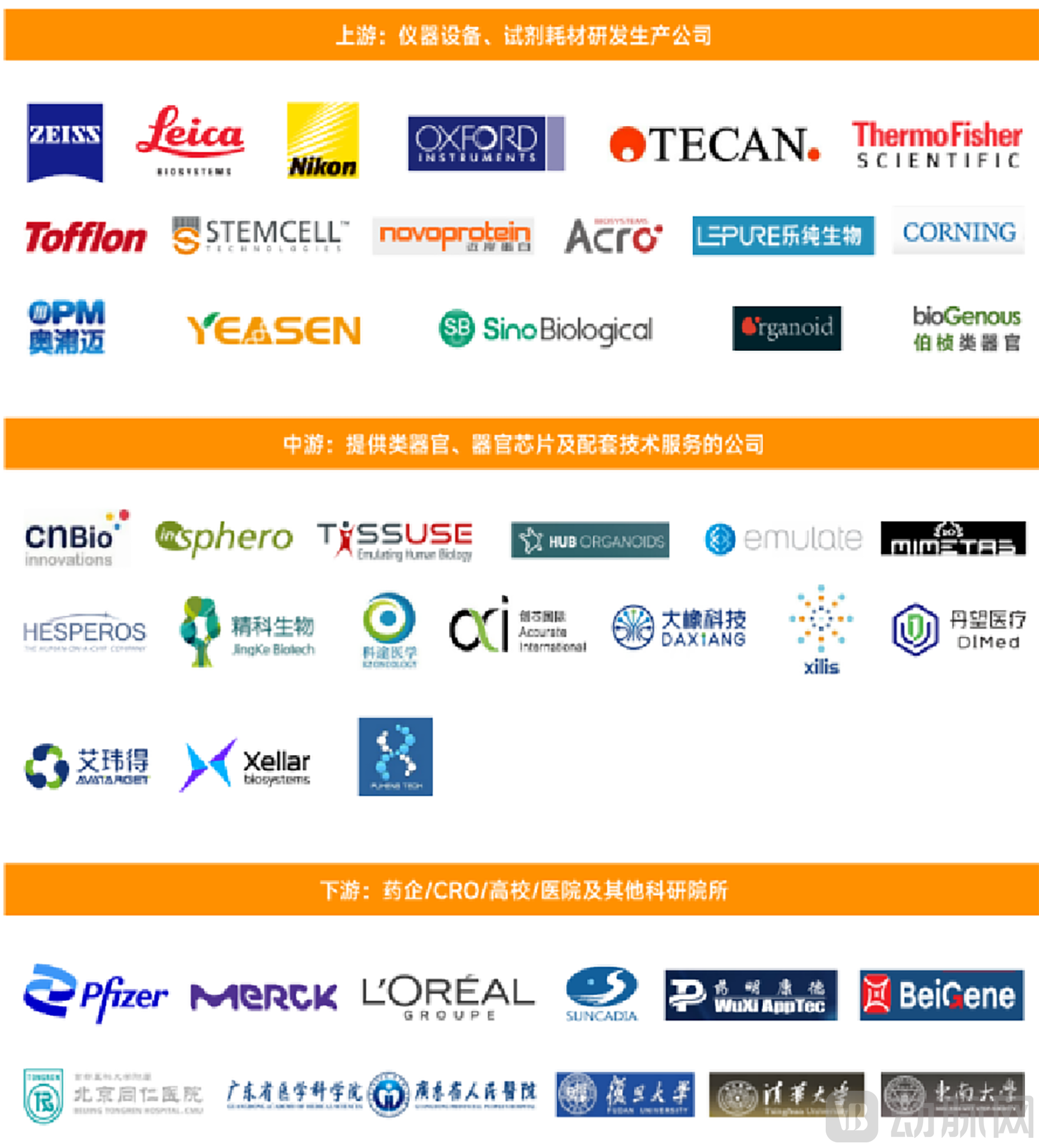 Organoid Full Industry Chain Landscape, Data Source: VCBeat
Notably,The global organoid and organ-on-a-chip industry remains in its early stages of development, with downstream demand yet to be fully realized.Therefore, many companies are not only focusing on mid- and downstream operations but also actively investing in upstream research and development to independently develop automated, high-throughput instrumentation and imaging equipment for organoids and organ-on-a-chip systems.
For example, Emulate, a U.S. company, has not only developed various organ-on-a-chip models but also successfully built a highly standardized “human body simulation system,” with its Zoe® culture module already deployed in nearly 200 laboratories worldwide.
Meanwhile, Chinese companies such as Jingke Biotech, Danwang Medical, Aiweide Biotech, and Puheng Technology are actively expanding into the development of upstream instruments and reagent consumables. Jingke Biotech has achieved standardization and automation of its high-throughput drug screening platform by establishing an automated organoid culture system, and its independently developed series of tissue sample preservation solutions and organoid culture kits have also entered the market.
With further industry development and the implementation of relevant policies, upstream demand will continue to grow, fostering the emergence of more specialized upstream enterprises and driving some organoid and organ-on-a-chip companies to undergo business transformation.In this process, companies that take the lead in deeply investing in upstream sectors will gain a significant competitive advantage.
Refinement and Systematization Are Industry Trends
Currently,Every segment of the organoid industry is evolving toward greater precision and specialization.. From product design to production processes, in-depth exploration and optimization are being conducted to meet more diverse needs.
To conduct in-depth research into the functional characteristics of specific organs, some companies have leveraged their core team expertise to focus on the development of single-organ chips, aiming to create organ-on-a-chip platforms with more biomimetic functional performance. For instance, Emulate has developed brain chips, colon chips, duodenal chips, lung chips, kidney chips, and liver chips.
Another category of companies is dedicated to developing multi-organ chips that can achieve functional connectivity and compatibility among multiple organs, aiming to gain a deeper understanding of the interactions between drugs and various organs. For instance, TissUse has collaborated with Roche to develop assays for evaluating lineage-specific hematopoietic toxicity and assessing the pharmacokinetics of therapeutic antibodies; it has also partnered with Bayer to establish liver-endocrine tissue multi-organ models, among other initiatives.
The upgrading of organoid products is reflected not only in product performance but also in manufacturing processes.Many enterprises and researchers are implementing quality control measures for organoid culture and production by monitoring their growth processes through real-time in vitro observation. Cellesce, a company based abroad, employs online sensors and real-time monitoring technologies to better control the organoid manufacturing process and ensure precise culture conditions. In China, Professor Gu Zhongze’s team at Southeast University has also developed high-content screening devices for organ-on-a-chip systems along with artificial intelligence-based evaluation methods.
Industry trends indicate that, with the increasing application of organoid products, the integration of these products with AI-driven automated and high-throughput instrumentation can further optimize workflows and enhance efficiency in sample quality control, as well as in the standardization of culture and usage processes.