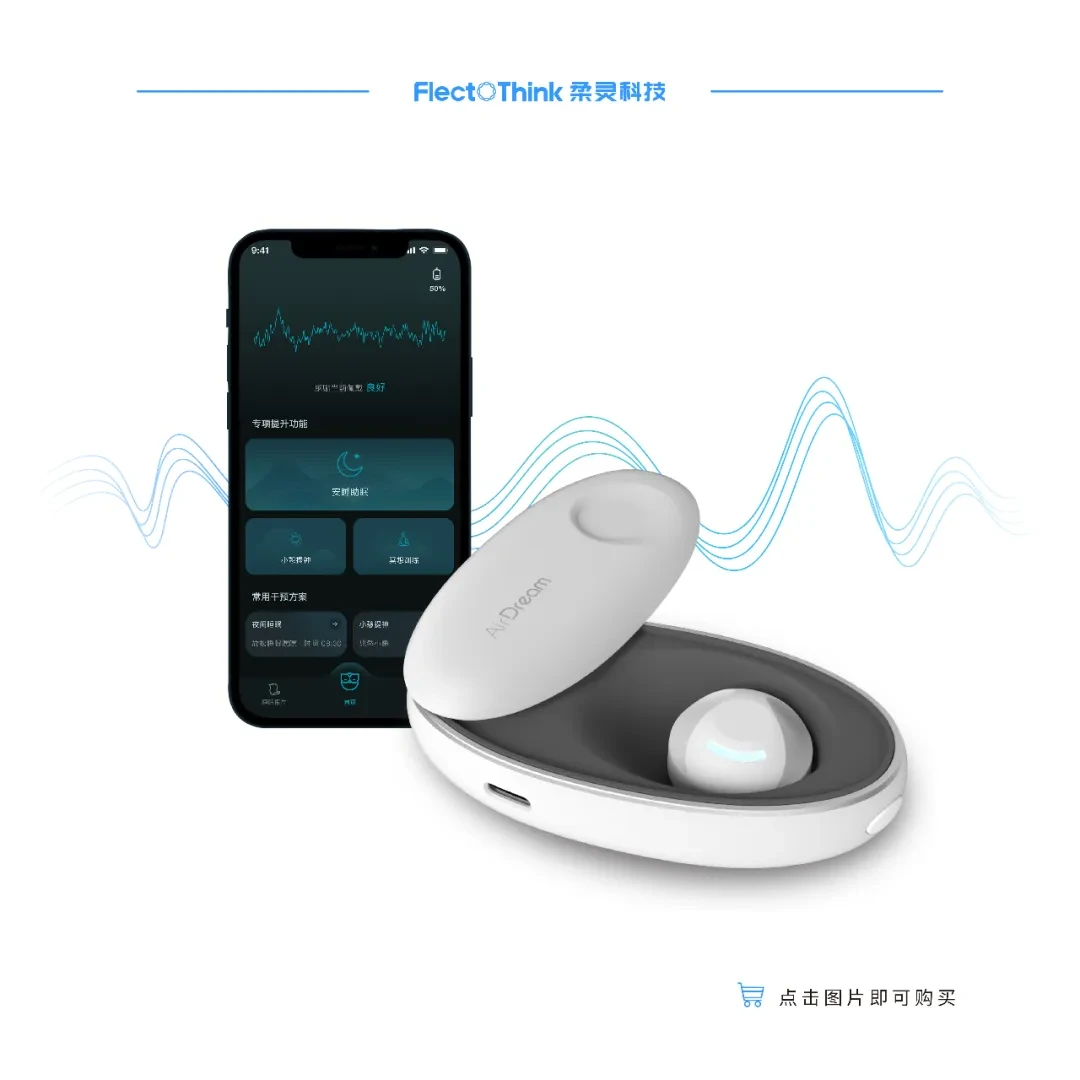
Rouling Tech's Nano-Electronic EEG Sleep Monitor Named Among Top 10 Most Commercially Promising BCI Products in 2026 Report by Dongmai Think Tank

FlectoThink
Brain-Computer Interface Field Product Developer

Recently, the "2026 Brain-Computer Interface Early Commercialization Exploration Report" jointly released by Artery Intelligence and the Brain-Computer Interface Community has attracted widespread attention in the industry. This in-depth report systematically organizes the global brain-computer interface industry ecosystem, commercialization pathways, and key breakthroughs, and重磅 released the "Most Commercially Promising Brain-Computer Interface Products" list.FlectoThink has successfully been selected into the Top 10 Non-invasive Brain-Computer Interface Products with its "Nanoelectronic EEG Sleep Monitor," being evaluated in the report as "the world's first mass-produced device capable of achieving effective closed-loop deep sleep intervention."
During the critical window period when brain-computer interfaces are moving from "technical exploration" to "early commercialization," FlectoThink has become one of the most notable benchmark companies in the non-invasive track, thanks to its solid market implementation and professional accumulation.
It is against this backdrop that,The market recognition of FlectoThink has been multiply confirmed in the report.
Medical EndFlectoThink's EEG sleep patch has entered more than 30 Class A tertiary hospitals across China, including Beijing 301 Hospital, Tiantan Hospital, and Nanjing Brain Hospital, jointly conducting sleep data collection and clinical research. The report explicitly states in the "Non-invasive Indications" section that sleep disorders, as a massive market covering over 300 million people, have seen the unique value of closed-loop neurofeedback technology in non-drug treatments — and FlectoThink is a pioneer in this field.
Commercial EndFlectoThink's products have been successfully applied in the Thai Royal Family, five-star hotels, authoritative chronic disease management institutions, and have entered markets such as Southeast Asia, the Middle East, and the United States. The report emphasizes in the "Overseas Strategy" that leading non-invasive brain-computer interface companies are breaking market boundaries through overseas certifications and global layouts, and FlectoThink’s internationalization steps are highly aligned with this.
Capital and Strategy LevelFlectoThink has completed nearly 100 million yuan in financing led by Zhejiang University Capital; successively undertaken the Ministry of Industry and Information Technology's "Brain-Computer Interface" project, participated in the national "Two Major Two New" long-term government bond defense, and attended a roundtable meeting hosted by the Minister of Industry and Information Technology as one of the ten innovative enterprise representatives in China. This national strategic-level recognition is also regarded in the report as core evidence of "technical strength and industrial standing."
The report profoundly pointed out in the preface: "The most important thing for brain-computer interfaces is to find the optimal solution between 'invasiveness and practicality,' build a clear roadmap between 'medical and consumer applications,' and always remain within the framework of ethics and regulation."
FlectoThink has always adhered to the non-invasive flexible route, using medical-grade sleep monitoring as the foundation, and then extending to consumer-grade sleep aids, cabin interaction, and gaming entertainment — without mixing or crossing boundaries, with each step supported by clinical data and compliance certifications. This "long-termist" path aligns perfectly with the report's definition of "the most anticipated company."A long-termist who can simultaneously master hardcore technological innovation, deeply understand clinical needs, and uphold the highest standards for safety and ethics.
The release of the "2026 Brain-Computer Interface Early Commercialization Exploration Report" marks the industry's official transition from "concept hype" to the "value validation" phase. FlectoThink's inclusion in the list of products with the most commercial potential is both a recognition of its capabilities by authoritative institutions and a natural outcome of its long-term commitment to a "technology + market" dual-driven approach.