

2024 VC Regrets: Previously Rejected Projects Are Back in Touch
“Any project recommendations? I’m not sure what to invest in lately.。“The green icon is jumping,” an investor I hadn’t been in touch with for a long time sent me this message.
This is not the first time this year that investors have voiced such complaints. Since last year, the market environment has seen year-on-year declines in financing, investment, and exit activities. Last year, investors were troubled by “scarce capital”; this year, they are again grappling with a “shortage of deals.”
“What are your requirements for the project?”
“Regardless of size, there is one key point: you must have a ‘prototype.’”
In the past, investors would engage directly with projects, conducting due diligence that ranged from assessing team members to evaluating technological sophistication. Today, such an approach seems somewhat “casual.” Investors cite two reasons for this shift: first, mature projects are hard to come by; some companies choose not to raise funds if they believe they can survive, fearing that the current capital winter will negatively impact their valuations. Second, investors are now hesitant to back projects with outstanding concepts but no working prototypes, as capital has become increasingly precious and cannot be risked lightly.
Hesitancy to Invest in Pure Concepts: Not Just One Investor’s Dilemma. VCBeat has compiled data on early-stage financing (pre-Series A) in 2024 (as of April 17, 2024), revealing that nearly all companies securing funding this year could demonstrate tangible products or possess advanced and mature technology platforms. Moreover, most drug-development companies had already identified effective drug molecules.
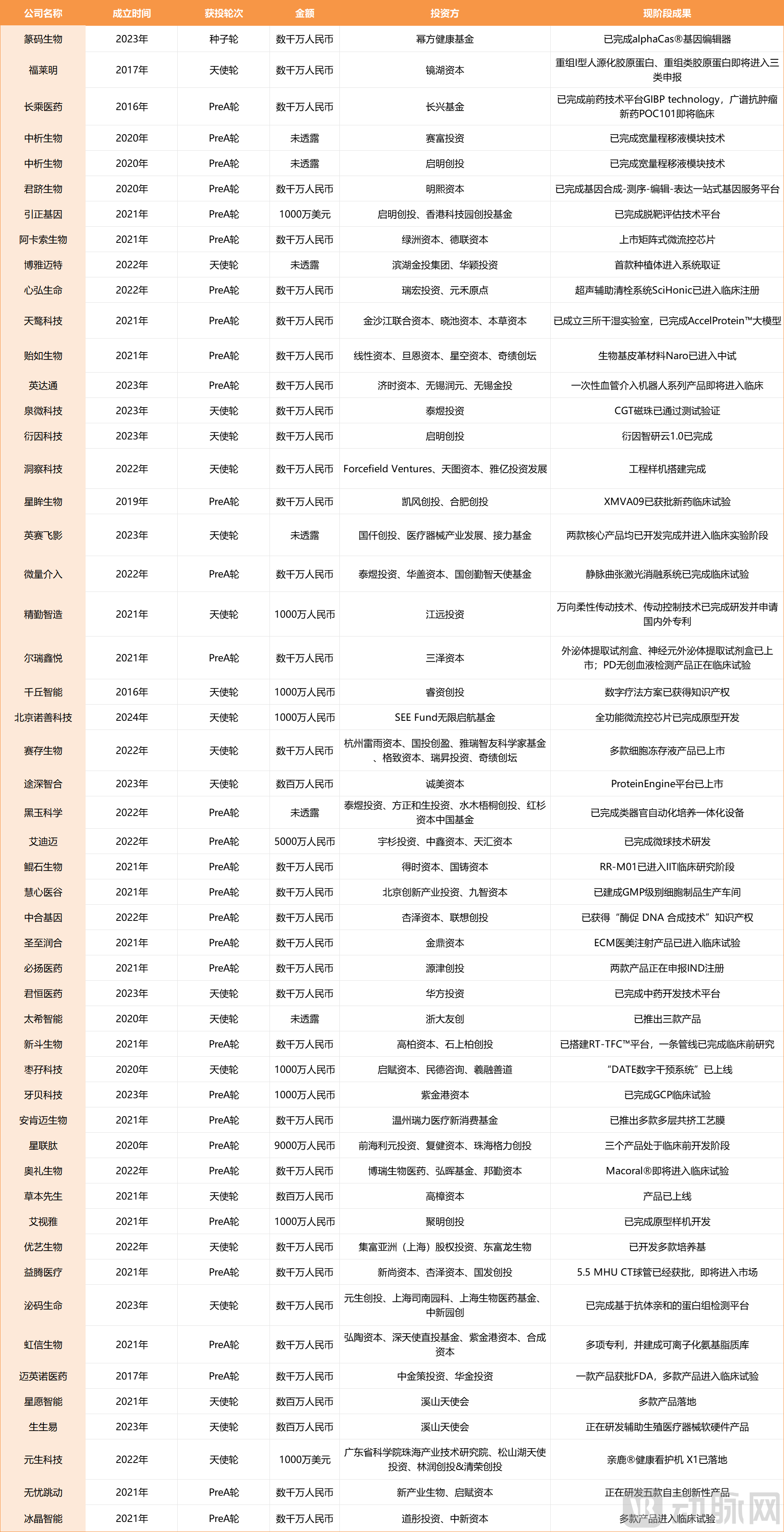
(Data source: Arterial Orange; chart by: Arterial Orange Fruit Bureau)
This has led many to exclaim, “The era of ‘product is king’ in investment has arrived.”
I. “PPT Fundraising” Is Now a Thing of the Past
This year, the ability to achieve commercial implementation has become a key focus for investors. An investor, who requested anonymity, quietly told VCBeat’s Orange Bureau,He prefers to collaborate with enterprises whose products are tangible."Although this statement is not absolute, it has indeed become a clear tendency in his project evaluation."
In fact, investors’ approach is not difficult to understand. Amid the capital winter, funding is hard-won for investors. Compared with “concept-driven” companies, product-oriented companies carry a lower risk profile, thereby providing an additional layer of security for investors’ decision-making.
Enterprises with tangible products demonstrate that the project has successfully transitioned from theory to practice, validating the technical feasibility. This is particularly true in medtech-engineering cross-disciplinary projects, where engineering prototypes represent a critical milestone. When a company has developed a product with a defined form factor, it undoubtedly facilitates subsequent market promotion and operations, offering a higher probability of revenue generation compared to projects that remain at the conceptual stage.
Furthermore, having a tangible product facilitates investor evaluation. For investors, a visible and tangible product often demonstrates a project’s potential and market prospects more intuitively than a business plan alone. This not only enables more accurate investment decisions but also attracts additional investors, thereby helping to diversify risk.
Some investors have joked, “The era of raising capital with PowerPoint presentations is over.”
In an era dominated by hard tech, technological barriers have become increasingly pronounced, and “inability to understand technology” has emerged as a major concern for investors. To address this challenge, investors have undertaken various self-help initiatives. The previously widespread trend of “investing in professors” was one such solution.
However, investors have gradually come to realize that technological maturity in the laboratory and market readiness are entirely distinct concepts. The most reliable approach is to evaluate the product itself. Many investors now choose to bridge the gap between technology and the market by assessing products.
Ultimately, investors prioritize the product.On one hand, the technical feasibility and practicality of a project have become decisive factors for enterprises to establish a foothold in the market; on the other hand, it is investors’ control over risk coefficients.In response, an investor stated, “It’s not that we are unwilling to grow alongside companies; it’s just that the risks are currently too high for us to take the plunge.”
II. Investors’ “Stability-First” Strategy
The other key player in financing activities, enterprises, has also keenly felt this shift in investor preference.
Dr. Meng Fan, founder of InSightFly, told VCBeat: “In the recently completed financing round, we clearly sensed that investors are now more inclined toward projects that emphasize both conceptual innovation and product advancement, rather than those that are purely conceptual.”Conceptual innovation creates new market opportunities, while product advancement reduces investment risk by validating the feasibility of concepts.”
Insai Feiying is an innovative enterprise founded by a doctoral team from Shanghai Jiao Tong University, focusing on the research and development, manufacturing, and sales of high-end wireless devices for minimally invasive surgery. Within just six months of its establishment, the company successfully completed its angel financing round. In summarizing this financing achievement, Dr. Meng highlighted not only the team’s professionalism and cohesion but also specifically emphasized their capability in translating product R&D into tangible outcomes.According to reports, although Insai Feiying was established only recently, it has already completed the development of two core products and advanced them into clinical trials. These products have gained clinical recognition from experts and hold promising long-term development prospects, which has further bolstered the company’s successful fundraising efforts.
During the fundraising period, the team engaged in discussions with multiple investors, who noted that investment decisions are essentially a process of product screening. This trend has favored product-centric companies, creating more opportunities for projects with original innovative capabilities.
In addition to Insilico Medicine, Junji Biotechnology, which has just completed its Pre-A financing round, also warrants attention. In this financing round, Junji Biotechnology not only achieved numerous phased milestones but also realized scaled revenue.
Cash flow also appears to have become a plus in investment activities.This not only provides companies with more opportunities for trial and error, thereby accelerating their expansion and development, but also reduces risks for investors. Consequently, enterprises with strong cash flow tend to secure more favorable financing terms and lower financing costs.
III. Some Are Still Investing in “Dreams”
Of course, the phenomenon that investors favor projects with products is not absolute. Yang Xue, an investor focused on early-stage ventures, stated, “This still depends on the individual style of the investor.”
She explained that companies with established products certainly command higher valuations, yet they carry relatively lower risks. For investors with a conservative style, this option is more suitable in today’s resource-constrained environment. Furthermore, investors favor projects with existing products primarily because their viability can be validated through the market. However, according to Yang Xue’s observations, many startups’ initial product offerings struggle to gain a foothold in the market.
When asked whether she was willing to pay for her “dream,” she gave an affirmative answer.
However, a “concept” is by no means mere fantasy; it must be underpinned by sound market logic and technical feasibility, while the market-wide applicability of the technology is also crucial.Because companies need to have a certain level of self-sustaining capability in the early stages to support their subsequent development. Under these mature conditions, investors can also appropriately relax their investment in "dreams."
However, investing in “dreams” is not as simple as providing financial support; investors also need to offer resource-based assistance. For example,Assist companies with insufficient market understanding in conducting industry matching.
Yang Xue was previously involved in a project focused on the research of restorative materials for oral and maxillofacial surgery. This project demonstrated significant innovation in both manufacturing processes and raw materials, and held considerable market potential. However, given the lengthy timeline required to achieve successful commercialization, the company’s ability to “survive” until that point became a major challenge.
After several rounds of discussions with the CEO, the company decided to enter the medical aesthetics market first. Once it achieves a certain level of self-sustaining revenue generation, it will then expand into the orthopedics sector. This strategy not only ensures the company’s operational sustainability but also helps diversify investors’ risks.
Besides this, Yang Xue had another reason for investing in “Dream”—Investing in cutting-edge hard tech is essentially about securing first-mover advantage; whoever sets industry standards will dominate the market.
As the macroeconomic environment shifts, rising market uncertainty has made investment decisions increasingly difficult, making cautious capital deployment an inevitable choice for investors during this period. However, each project follows its own rhythm. Investors must exercise sufficient patience and confidence, partnering with visionaries to bring more innovative projects to the forefront, thereby fundamentally resolving the dilemma of “a shortage of investable opportunities.”