

Qiyuan Biopharma Advances Differentiated Next-Generation JAK Inhibitor into Phase III Trials
“Debate is not the goal; better development is.” This was the viewpoint smilingly shared by Ding Shizhe, CEO of Enitiatebio, in an interview with VCBeat. The Enitiatebio team is a typical example of a group that has continuously grown and expanded during the pandemic, bringing together multiple overseas-returnee PhDs with extensive clinical and commercialization experience. Core members include those who have participated in the development of several blockbuster products at multinational pharmaceutical companies such as Abbott, Amgen, and Daiichi Sankyo. The team is young and diverse. Having navigated through the COVID-19 pandemic and the process of team formation and integration, this biotech company, founded in late 2020, is about to complete Phase II clinical trials for its two core pipelines and will soon initiate Phase III clinical trials.
In 2020, global biopharmaceutical financing exceeded the combined total for digital health and medical devices, with a significant portion of funding directed toward innovative small-molecule drugs. The U.S., A-share, and Hong Kong stock markets were highly active. In China, total healthcare financing reached a record high, with core coastal cities such as Shanghai becoming the preferred destinations for healthcare capital; for the first time in nearly a decade, the number of financing deals in these regions surpassed that of Beijing.
Despite the seemingly rosy outlook, individual companies and even individuals still face unexpected ups and downs; this holds true for Enitiatebio and Ding Shizhe as well.
Backed by Industrial Resources, Focusing on Autoimmune and Dermatological Diseases
Against the backdrop of China’s increasingly prominent population aging, the incidence of age-related diseases is gradually rising. Conditions that impair daily living experiences and reduce quality of life are receiving greater attention, revealing substantial unmet clinical needs as living standards improve. For immune-mediated skin diseases, most existing therapeutics provide only transient symptom relief, are prone to recurrence, and are unsuitable for long-term use; for example, glucocorticoids carry such limitations. Moreover, macromolecular agents require in-hospital injections, posing convenience issues, and long-term use can lead to drug resistance.
Enitiatebio is a market-oriented, fully integrated platform company dedicated to the development of innovative drugs for dermatological and autoimmune diseases. It was jointly founded by Weimou Bio and Beta Pharma’s biomedical industry fund at the end of 2020. The idea to establish Enitiatebio can even be traced back to 2016, when Beta Pharma’s biomedical industry fund was established and Weimou Bio was founded.
On the one hand, when Dr. Shen Wang founded Enitiatebio, he carefully considered and decided to focus on ophthalmic diseases, while planning to collaborate with professional teams to jointly develop product pipelines related to autoimmune diseases and dermatology. On the other hand, in recent years, while developing its own business, Beta Pharma has been actively building the Beta industrial ecosystem, leveraging Beta Fund and Beta Dreamworks as links to enhance efficiency and empower innovative enterprises. Seizing this opportunity, Enitiatebio was officially established, with Dr. Shen Wang leading the design and rapidly advancing multiple pipelines, still at the preclinical candidate compound (PCC) stage, to the investigational new drug (IND) stage. By the end of 2021, QY201’s first IND application was approved by the Center for Drug Evaluation (CDE), and the first subject was enrolled, marking Enitiatebio’s official entry into the clinical development phase.
Development of Multiple Administration Routes Including Oral and Topical Formulations; The Fastest-Advancing Pipeline Is Set to Enter Phase III Clinical Trials
At that time, multinational corporations (MNCs) such as Pfizer, Eli Lilly, and AbbVie had already established a strong presence in the JAK inhibitor space, while numerous domestic biotech companies also entered the field. As the market value of these therapies was validated, the sector faced intense competition. “However, we are highly optimistic about the ‘next-generation’ JAK inhibitor designed by Dr. Shen Wang, which is currently a key product in Enitiatebio’s pipeline,” said Ding Shizhe.
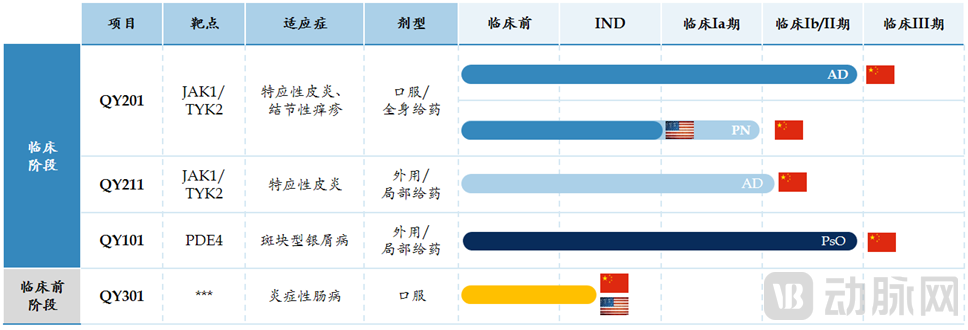
Enitiatebio’s Pipeline Progress | Image Source: Enitiatebio
Enitiatebio’s products feature improved target selectivity and potency. Its most advanced pipeline candidate, QY201, is a dual JAK1/TYK2 inhibitor. The Phase 2 clinical trial for moderate-to-severe atopic dermatitis is nearing completion, with the Phase 3 trial expected to commence shortly.
JAKs belong to the tyrosine kinase family and comprise four members: JAK1, JAK2, JAK3, and TYK2. Among these, JAK1 and JAK3 are primarily responsible for immune regulation, whereas JAK2 is mainly associated with erythropoiesis and thrombopoiesis. To address the significant adverse effects of first-generation JAK inhibitors, second-generation JAK inhibitors were developed, primarily targeting JAK1 and JAK3; however, potential safety concerns remain.
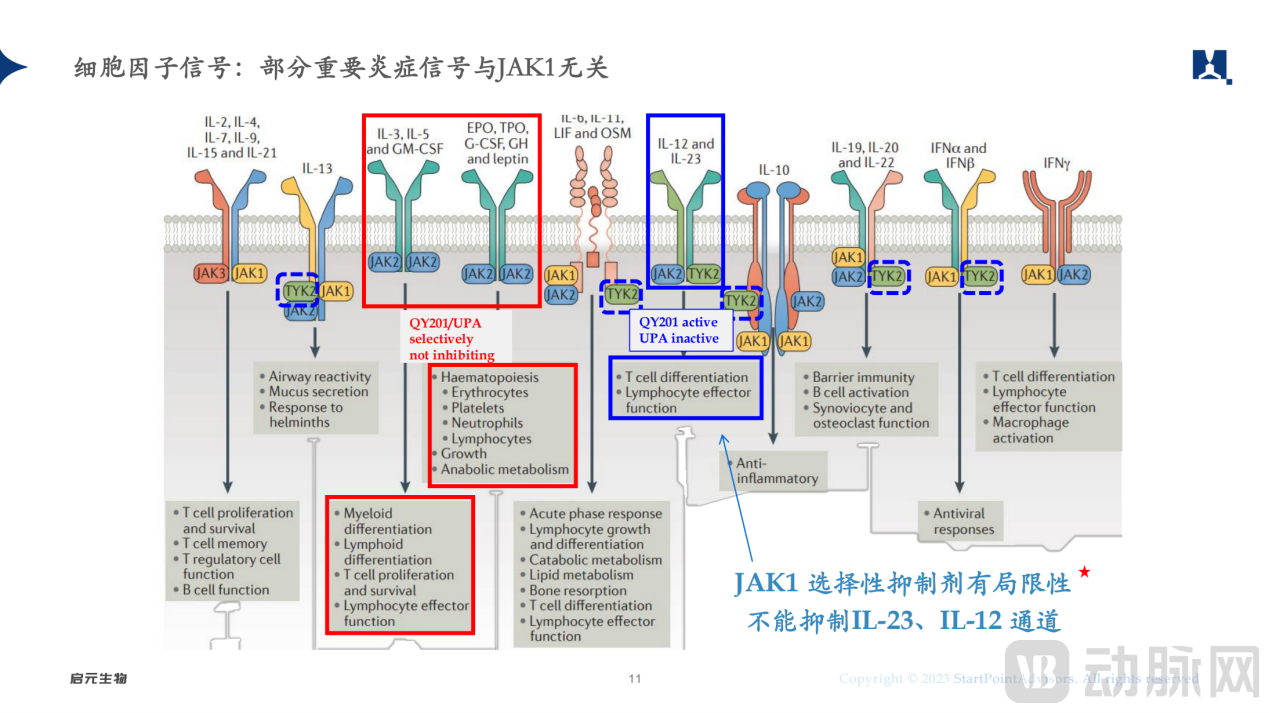
Limitations of Selectively Targeting JAK1 Image source: Enitiatebio
The biopharmaceutical industry has begun to focus on TYK2, which plays a crucial role in the immune process. Studies have shown that TYK2 exhibits a favorable safety profile in regulating cytokines such as IL-23, IL-12, and type I IFN.
Compared with other JAK inhibitors, Enitiatebio’s QY201 exhibits higher inhibitory activity and selectivity for JAK1/TYK2. At the enzymatic level, its potency against JAK1 and TYK2 reaches the picomolar range. At the cellular level, it demonstrates more than 300-fold greater selectivity for JAK1 over JAK2. Preclinical head-to-head comparisons have shown that QY201 has significantly superior activity compared to marketed drugs at equivalent doses.
In terms of safety, QY201 effectively addresses the side effects associated with non-selective JAK inhibitors (including infections, anemia, neutropenia, lymphopenia, and thrombocytopenia).
In terms of product portfolio in the field of dermatology, in addition to QY201, the first oral drug to receive an Investigational New Drug (IND) approval for clinical trials, the second drug to obtain IND approval is QY101, a topical ointment. QY101 is a non-hormonal, non-steroidal anti-inflammatory phosphodiesterase 4 (PDE4) inhibitor. Currently, the Phase II clinical trial of QY101 is nearing completion, and the Phase III clinical trial will be launched soon.
PDE4 is a high-potential target for the treatment of inflammatory skin diseases. Currently, products developed around this target struggle to achieve an optimal balance between efficacy and safety, creating an urgent need for next-generation therapies. According to Enitiatebio, QY101 demonstrates significant advantages over competitors in multiple molecular characteristics. Preclinical trial results indicate that it possesses favorable local absorption properties and the ability to undergo rapid systemic degradation.
When discussing the development processes of two pipelines, particularly the progress of QY201, Ding Shizhe described the challenges encountered as “heart-stopping.” During Phase I clinical trials of QY201, China was experiencing a COVID-19 outbreak. Thanks to the support of the principal investigators (PIs), along with the team’s efforts and experience, no patients dropped out from the Phase I trial, which was completed on schedule.
“In a highly competitive landscape, we need to obtain clinical validation as quickly and early as possible,” introduced Ding Shizhe. Benefiting from this philosophy, the company team later relied on strong execution capabilities and adhered to an efficiency-first approach, efficiently completing patient enrollment for the Phase Ib/II clinical trial of QY201 in the indication of moderate-to-severe atopic dermatitis.
Actively Expanding into Overseas Markets: QY201 Receives FDA Clinical Trial Approval
On July 26, 2023, Enitiatebio received approval from the U.S. FDA for the Investigational New Drug (IND) application of QY201. This marks Enitiatebio’s first clinical trial approval from the FDA and its first independently filed IND in the United States, signaling the official launch of Enitiatebio’s global development plan for QY201 tablets.
A review of Enitiatebio’s pipeline progress reveals that its preclinical assets are being advanced simultaneously in China and the United States. This strategy is closely tied to Ding Shizhe, who previously played a key role in multiple business development (BD) deals at Beta Pharma. “From its inception, Enitiatebio has placed significant emphasis on overseas expansion and transactions.”
However, contrary to the narratives that “it will be too late if you don’t expand into the Middle East now” or the hype surrounding the Southeast Asian expansion wave, Enitiatebio prioritizes developed markets. “Given Enitiatebio’s areas of specialization, the incidence rates of dermatological and autoimmune diseases are higher in developed countries. Moreover, as overall living standards are higher in these regions, patients place greater emphasis on their quality of daily life. Therefore, dermatology-related therapies have stronger market appeal in developed countries, represented by the United States, compared to Arab or Southeast Asian markets,” added Ding Shizhe.
Driven by its global expansion strategy, Enitiatebio must continue to address the imperatives of robust clinical validation and enhanced cost-effectiveness. Having weathered the trials of a harsh market downturn, the company is more firmly convinced that current challenges will ultimately serve as the foundation and driving force for achieving its overseas objectives and successfully commercializing its products.