

Investment Trends Shift Downward While Tech Transfer Gains Momentum: Company Files IPO Prospectus
Amid a bleak investment climate, Wang Ling (a pseudonym) remains as busy as ever, scouring for projects and making investments. This is partly because work must go on, and partly because she feels compelled to take action. Recently, most of her business trips have been aimed at “rescuing” portfolio companies by helping them secure follow-on financing.
Unlike Wang Ling, Chen Shen (a pseudonym), whose investment firm is about to launch a new fund, has been primarily responsible for post-investment management and project pipeline development in the lead-up to the fund’s establishment. He told VCBeat that multiple portfolio companies are gradually initiating their fundraising rounds.
It is worth mentioning that he is an investor focused on the commercialization of research outcomes. Another investor also told Chengguo Bureau,She has recently been focusing on the integration of medicine and engineering, with her attention shifting toward the intersection of healthcare and hard technology.
The Investment Market Bids Farewell to Impetuousness
Over the past two years, turnover in the primary market has been exceptionally high, with professionals frequently jumping from one venture capital (VC) firm to another. Many investors have voiced their frustrations to Orange Bureau, revealing that numerous peers have lost their jobs. This trend extends beyond mere personnel mobility,From the perspective of investment activity by institutional investors, domestic healthcare and medical investments in China have also declined significantly over the past two years.
According to data from Orange IT, the advancement of China’s healthcare reform initiatives and the China Securities Regulatory Commission’s phased tightening of IPO policies have directly triggered volatility in the secondary market, an effect that has also spilled over into the primary market. The healthcare sector’s ability to attract capital has further diminished, with the total number of financing deals retreating to pre-pandemic 2019 levels, while the total financing amount has fallen short of the corresponding period in 2019.
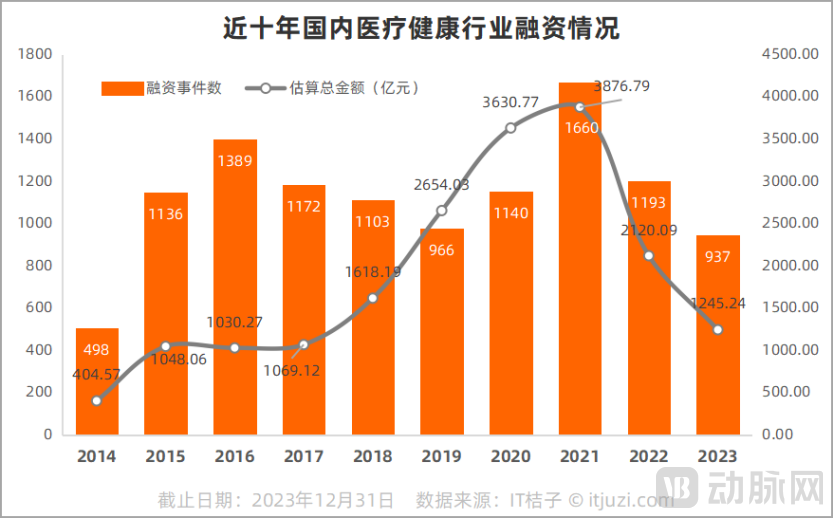 Note: The statistical scope includes public financing events in the primary and secondary markets. Image source: IT Juzi
For investors in China’s healthcare industry, the capital winter is growing increasingly severe, and “investing early and investing in small ventures” has become a consensus—except in 2020, more than half of all primary market financing deals in China’s healthcare sector occurred at early investment stages (Series A and earlier).
In early-stage investment, there is one option that deserves particular attention—Investment in Projects for the Commercialization of Scientific and Technological Achievements. At the peak, university projects with a wealth of proprietary technologies were heavily pursued by investors.
However, influenced by the broader market environment, venture capitalists who previously focused on investing in professors appear to be cooling off. An investor who once frequently visited major universities and engaged in fruitful discussions with professors remarked, “I’ve been visiting less often recently.” Nowadays, more investment firms are beginning to internally diversify their strategies: one group is prioritizing industry veterans to seek projects with clear commercialization pathways, while the other continues to focus on the translation of scientific achievements and cutting-edge research.
Having moved past the hype, investment firms are also beginning to re-evaluate the commercialization of scientific research outcomes.
Raising Investment Standards, Sustaining the Ecosystem Strategy
Shifts in funding sources and exit channels have led to changes in investment strategies. In terms of project selection, investment institutions have shifted from a broad-brush approach to meticulous curation. For these firms, investing in high-quality companies or technologies remains the most critical factor of all. An investor told VCBeat,The evaluation criteria for early-stage projects are value-based, integrating specific technologies and application scenarios; in simple terms, this refers to international competitiveness.
As the golden age of China’s venture capital circle comes to an end, it also signals the end of an era in which profits could be sacrificed for scale. Today, more investment institutions are focusing on products, users, and profitability. Chen Shen stated candidly that, from an investment perspective, he believes executability must take precedence over frontier innovation. “Even the most advanced technologies can only realize their value when widely adopted; confining them to laboratory use alone would be rather awkward.” he stated.
Enterprises with tangible products hold a significant advantage in attracting investment, particularly in the field of medical-engineering convergence. This advantage is even more pronounced in this sector, as engineering prototypes serve as key milestones in medical-engineering projects. They not only demonstrate technological maturity but also showcase the project team’s comprehensive capabilities from research and development to production. For investment institutions, the presence of an actual product indicates that the technology has undergone preliminary market validation, thereby substantially reducing investment risk.
Meanwhile, another investor focused on the commercialization of research outcomes told Chengguo Bureau,He still values the "ecosystem strategy"This strategy not only focuses on the performance of individual enterprises but also emphasizes the synergies and mutual support among various components within the entire industrial ecosystem to promote the implementation and development of translational projects.
For example, investment firms may invest in an organ-on-a-chip company while also investing in the instruments, equipment, reagents, and consumables for companies that provide organs, organ chips, and related technical services. They leverage their industrial advantages to commercially empower translational projects.
The so-called “ecosystem-based approach” also signifies that post-investment services for technology transfer investments have entered a “deep-water zone,” evolving from fragmentation to standardization, and from passive “assistance” to proactive “companionship.”
More Investment
Over the past year, at least ten new technology transfer funds have been established or launched across various regions in China, with a total scale approaching RMB 100 billion. These funds are primarily aligned with research institutes and universities, focusing mainly on incubating early-stage technology projects.
From east to west, major economic powerhouses are accelerating the transfer and commercialization of scientific and technological achievements, with central government funds having been strategically allocated well in advance. In 2014, the National Fund for Technology Transfer and Commercialization was officially launched. By the end of 2022, the fund had approved the establishment of 36 sub-funds, with a total scale of RMB 62.43 billion, investing in 616 enterprises and facilitating the commercialization of 974 scientific and technological achievements.
Universities are also well represented. The Shanghai Jiao Tong University Future Industries Fund of Funds was established in 2021 with an initial size of RMB 1 billion, dedicated to facilitating the commercialization of scientific and technological achievements by SJTU faculty and students. In July 2023, it provided capital to establish the SJTU Future Seedling Fund.
Meanwhile, YueAn increasing number of universities are no longer content with participating in venture capital as limited partners (LPs), choosing instead to step in directly and operate as venture capitalists (VCs).In December 2023, two university-affiliated venture capital funds—the Fudan Sci-Tech Innovation Fund of Funds and the Shanghai Jiao Tong University–Da Linghao Bay Sci-Tech Innovation Fund—were established to invest in the hard-tech startup sector.
Subsequently, Caixin Financial Holdings, Central South University, and Changtou Holdings jointly established the Central South Alumni Huixiang Fund. Even more notably, on January 20, 2024, the Tiankai Jiuan Haihe Haitang RMB 5 Billion Sci-Tech Innovation Fund of Funds was signed and launched, jointly established by Andon Health, Tiankai Group, Haihe Industrial Fund, the Beiyang Education Development Foundation of Tianjin University, and Beiyang Haitang Fund within the Tiankai Park.
Universities are actively and deeply integrating into the venture capital sector in the race for hard-tech entrepreneurship,Promoting the Translation and Application of Scientific and Technological Achievements. For a long time, effectively translating scientific research outcomes from universities into actual productive forces has been a common challenge faced by both academia and industry. Although scientists possess cutting-edge technological achievements, they often lack the channels to commercialize them, making it difficult for these achievements to be widely applied.
Today, amid the fierce competition in hard-tech entrepreneurship, an increasing number of universities have come to recognize that venture capital support and assistance are indispensable for translating technologies into practical applications. We observe many universities either leveraging their own resources to become limited partners (LPs) or collaborating with alumni to establish venture capital (VC) firms. These initiatives aim to capitalize on their proximity advantage to further propel the transition of scientific and technological achievements from laboratories to the market, thereby maximizing their value.
Not only from an investment perspective, but universities also have a clearer understanding of the role that ecosystems play in facilitating the commercialization of scientific and technological achievements. They are improving top-level design by issuing policies related to achievement transformation, enhancing the practical applicability of technologies by introducing concept verification, and seeking physical spaces for implementation by building industrial parks...
In “Thirteen Invitations,” an audience member asked rock musician Zhang Chu, “Do you think the world will get better?”
Zhang Chu took the microphone and replied, “Will this world be okay? That’s too big a question. Let me offer my own answer: If you are willing to believe that your friends will have a better tomorrow, then this world will be fine. That is what I believe.”