

West China Hospital's Chen Lei Team Unveils Novel Patent for Epilepsy Monitoring System Based on 3D Pose Estimation
On April 26, 2024, West China Hospital of Sichuan University had one additional patent published. This patent isA Method and System for Analyzing Fine Motor Behaviors in Patients with Epilepsy, which enables the analysis of fine-grained behaviors in epilepsy patients, thereby facilitating refined diagnostic classification of seizures and precise treatment for these patients.
This system requires only the transmission of video footage captured during a patient’s epileptic seizure to automatically generate a skeleton-based 3D pose estimation model and record body posture data at key points. By analyzing the 3D skeletal pose data, the fine-grained behaviors of patients with epilepsy can be decomposed.Facilitates refined diagnosis of seizure types and precision treatment for patients with epilepsy.
Compared with traditional EEG monitoring devices, this innovative product eliminates the need for patients to wear equipment at all times, thereby alleviating the financial and psychological burden on epilepsy patients.
The inventor of this patent isWest China Hospital, Sichuan University: Chen Lei’s TeamProfessor Chen Lei has long been engaged in research and scientific work on paroxysmal neurological disorders such as epilepsy and migraine. She led her team in developing a non-invasive rapid test device for antiepileptic drug concentrations, and served as the chief editor and translator of six monographs, including the world’s first monograph on Epilepsy in Women. She is the Director of the Institute of Plateau Health and also the Vice President of West China Hospital.
I. Epilepsy Monitoring Market: Weak Domestic Presence
Epilepsy is one of the most common chronic neurological disorders, affecting over 70 million people worldwide. According to the latest epidemiological data from China, there are approximately 9 million epilepsy patients in the country, indicating a substantial market potential.
According to Market Monitor data, the global market size for epilepsy monitoring devices reached $530 million in 2023, with North America as the primary region for development, accounting for 39.2% of the market share; Europe followed closely, holding a 29.8% market share. However, due to reasons including a lack of high-quality research and inadequate standards,The market for domestically produced epilepsy monitoring devices in China is still in a developmental stage.
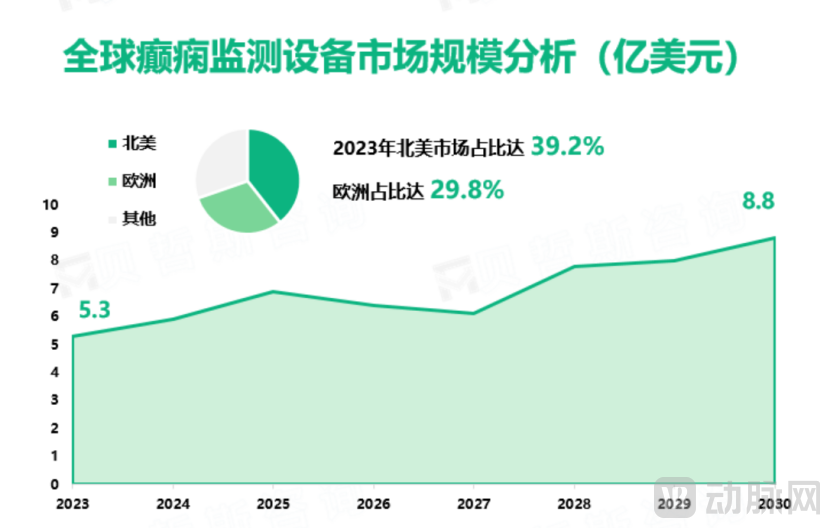 Image source: Market Monitor
Currently, the major market participants includeMedpage Ltd、Boston Scientific Corporation、Cadwell Industries、Compumedics USA inc.etc. Its monitoring products are mainly divided into two categories: wearable devices and traditional devices.
Taking Medpage Ltd's products as an example,Wearable DevicesTypically, sensors can monitor the user’s location, blood pressure, heart rate, and daily physical activities. By analyzing this monitoring data, the system can determine whether the user is experiencing a seizure or has fallen, and promptly send an emergency alert to their caregiver.
AndConventional DevicesIt uses a camera to monitor users for irregular movements, such as muscle spasms, and issues an audible alert.
II. EEG and Brain-Computer Interfaces Emerge as Hot Technologies
In recent years, as the pathogenesis of epilepsy has become increasingly clear, electroencephalogram (hereinafter referred to as EEG)Its application in epilepsy monitoring devices is becoming increasingly widespread, even emerging as a hotspot technology.
Previously, SeizAlarm, a leading company in epilepsy monitoring devices, attempted to develop a wearable EEG sensor. This device not only monitors brain activity but also has the potential to deliver focused electrical stimulation to prevent seizures.
This technology has also seen development in China. For example,GreenTech, Ningju Technology, Boreas Medical TechnologyDomestic companies have achieved breakthroughs in the field of electroencephalogram (EEG) equipment and have made attempts in epilepsy monitoring, butNo related products have been launched on the market yet.。
Furthermore, China has also completedBrain-Computer InterfaceClinical Trials for the Monitoring and Treatment of Epilepsy. In April 2021, the Second Affiliated Hospital of Zhejiang University School of Medicine performed the first implantation surgery using China’s first independently developed closed-loop neurostimulator. Reportedly, this technology can not only identify epileptic seizures at an early stage but also deliver therapeutic electrical stimulation in response to seizure activity. This represents a significant breakthrough in the clinical translation of brain-computer interface research in China, specifically in the diagnosis and treatment of refractory epilepsy.
However, it is worth noting that due toDomestic EEG Signal Acquisition Equipment Heavily Relies on Imports; There Is Still a Long Way to Go for Technological Breakthroughs. In the field of epilepsy monitoring devices, domestic enterprises still need to achieve localization of hardware manufacturing in order to further promote industry development.