

Ono Pharmaceutical Announces $2.4 Billion All-Cash Acquisition of Deciphera Pharmaceuticals to Strengthen Oncology Portfolio

Deciphera
Chemical Pharmacist

Ono
Innovative Drug Developer
On April 29, Ono Pharmaceutical Co., Ltd. announced the acquisition of Deciphera Pharmaceuticals at a price of $25.6 per share, with a total transaction value of $2.4 billion (RMB 17.35 billion), representing a 75% premium over the previous Friday’s closing price. The all-cash transaction is expected to be completed between July and September, at which point Deciphera will become a wholly owned subsidiary of Ono Pharmaceutical.
Deciphera focuses on the development of kinase inhibitors, has established commercial platforms in the United States and Europe, and possesses global clinical development capabilities. Its small-molecule inhibitor Qinlock (ripretinib) has been approved for marketing in the United States, China, and more than 40 other countries and regions, for the treatment of patients with previously treated gastrointestinal stromal tumors (GIST).
Deciphera surged 72.56% intraday amid merger and acquisition news.
Deciphera Emerges as a Hot M&A Target; Zai Lab’s Newly Licensed Drug Included in National Reimbursement Drug List
According to projections by the financial services firm Cantor Fitzgerald, 2024 is expected to be a year of robust growth in mergers and acquisitions within the oncology drug industry. Biotech companies specializing in antibody-drug conjugates (ADCs), radiopharmaceuticals, and T-cell engagers (TCEs) will attract greater attention from multinational corporations (MNCs) seeking to bolster their pipelines.
By 2029, patents on some of the top-selling drugs from major pharmaceutical companies will expire, including Bristol Myers Squibb’s Yervoy, Pomalyst, and Opdivo; Johnson & Johnson’s Imbruvica; Merck & Co.’s Keytruda; Pfizer’s Ibrance; and Roche’s Perjeta. According to Cantor Fitzgerald, approximately $182 billion in revenue for major pharmaceutical manufacturers is at risk over the next four years, with oncology drug revenues accounting for 42% of this amount. Meanwhile, the global oncology drug market size is projected to grow from $180 billion in 2022 to $323 billion in 2028.
Cantor Fitzgerald also believes that small-molecule candidate drugs will account for approximately 50% of the transactions, and it has identified several hot M&A targets, including Deciphera, a U.S.-listed company.
In June 2019, Zai Lab obtained an exclusive license from Deciphera to develop and commercialize ripretinib in the Greater China region (Mainland China, Hong Kong, Macau, and Taiwan). Under the terms of the agreement, Deciphera received a $20 million upfront cash payment and is eligible to receive up to $185 million in potential development and commercial milestone payments. Additionally, Zai Lab will pay royalties to Deciphera based on the annual net sales of ripretinib in the Greater China region.
In 2021, ripretinib was approved in China for the treatment of adult patients with advanced gastrointestinal stromal tumors (GIST) who had previously received three or more kinase inhibitors, including imatinib. In 2023, ripretinib was included in the National Reimbursement Drug List. According to Zai Lab’s financial report, the annual sales revenue of ripretinib in 2023 was $19.2 million, representing a year-on-year increase of 29%.
In addition to ripretinib, Deciphera has a diverse R&D pipeline that includes CSF-1R inhibitors, ULK inhibitors, pan-RAF inhibitors, pan-KIT inhibitors, and GCN2 activators, featuring candidates such as vimseltinib, DCC-3116 (a ULK inhibitor), and several other oncology drug candidates.
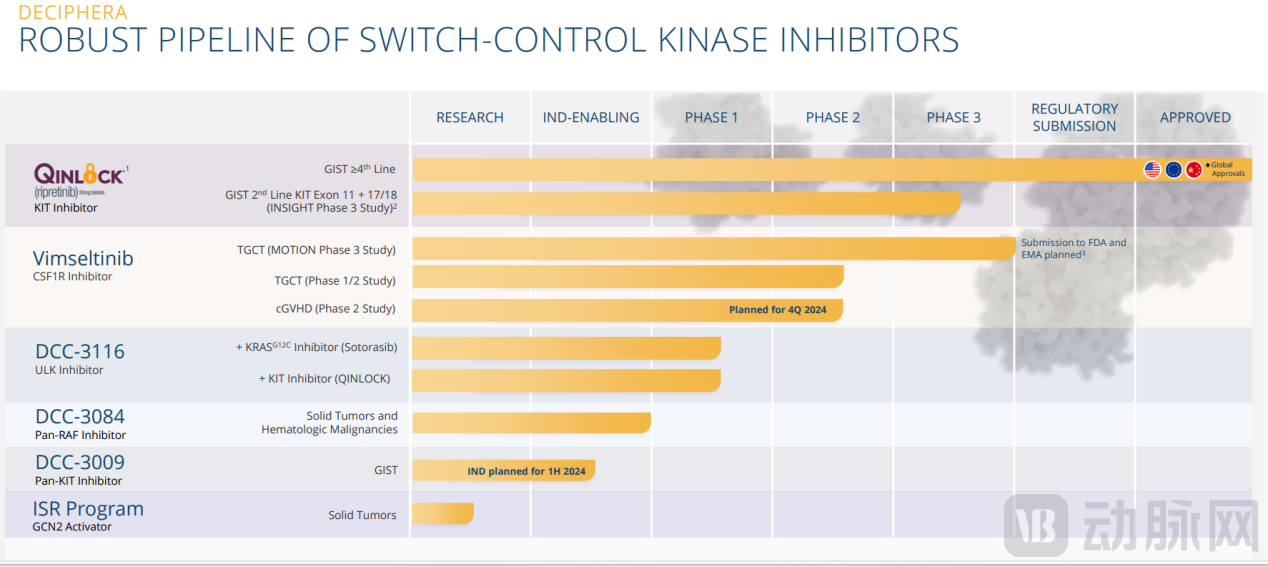
Vimseltinib is an investigational, potent, and highly selective oral CSF1R kinase inhibitor that selectively and effectively inhibits CSF1R by leveraging the unique features of the switch control region that regulates kinase conformational activation. It is being developed for the treatment of tenosynovial giant cell tumor (Phase 3), pigmented villonodular synovitis (Phase 3), and solid tumors (Phase 2).
Key results from the Phase 3 MOTION study, announced last October, demonstrated a statistically significant and clinically meaningful improvement in the objective response rate (ORR) with vimseltinib treatment. In the intent-to-treat (ITT) population, the ORR at Week 25 was 40% in the vimseltinib group versus 0% in the placebo group (p<0.0001). Deciphera expects to submit a New Drug Application (NDA) to the U.S. FDA in the second quarter of 2024 and a Marketing Authorization Application (MAA) to the European Union in the third quarter of 2024.
According to incomplete statistics, there are currently three approved CSF-1R inhibitors: Daiichi Sankyo’s pexidartinib, Novartis’s nilotinib, and Hutchmed’s surufatinib. No highly selective CSF-1R inhibitor has yet been approved for marketing in China.
Kinase Inhibitors Remain a Key Focus in Oncology Treatment as Ono Pharmaceutical Advances Its Global Strategy
Since the FDA approved the first tyrosine kinase inhibitor, imatinib, for market entry in 2001, an increasing number of small-molecule targeted therapies have been developed for the treatment of malignant tumors. Statistics show that in 2023, the FDA approved 25 small-molecule drugs, the highest number among all drug categories, accounting for 36% of total approvals.
Receptor tyrosine kinase inhibitors block the intracellular activation signals triggered by ligand binding to cell surface receptors, thereby inhibiting the ultimate biological effects of signal transduction pathways through reversible or irreversible suppression of receptor tyrosine kinase activity. According to statistics from Gongyan Wang, the global market size for tyrosine kinase inhibitors is projected to reach RMB 100 million in 2023.
According to the Yaozhi database, as of April 30, a total of 467 small-molecule targeted drugs had been approved for marketing globally, with 205 approved in China. Including those approved for marketing, the global pipeline of small-molecule targeted drugs comprised 5,814 candidates, including 5,810 chemical drugs, 4 biological drugs, and 2 radiopharmaceuticals.
In the field of oncology, kinase inhibitors have become one of the cornerstones of cancer therapy and are crucial for addressing tumor drug resistance. For instance, designing drugs that target kinase-driven mutations is a strategy to combat resistance; combination therapies can also achieve this effect, such as the use of BRAF and MEK inhibitors in combination for the treatment of melanoma. Therefore, the rational development of single-molecule drugs that inhibit multiple related kinases may replace combination therapies, offering a more durable and effective treatment approach.
Ono Pharmaceutical, a co-developer of the PD-1 antibody, is pursuing global expansion through a three-step strategy. The first step involves establishing a global marketing organization, having launched operations in South Korea and Taiwan in 2015 and 2016 respectively to strengthen its presence in Asia. The second step entails expanding marketing activities into the United States and Europe. Finally, by leveraging sales bases established in Europe and the U.S., the company aims to continue launching innovative drugs addressing unmet medical needs, while further extending its sales network to mainland China, ASEAN, and other regions—exemplified by its recent acquisition of the U.S.-based company Deciphera.
Currently, Ono Pharmaceutical’s marketed drugs include three categories: injectables, oral medications, and transdermal patches. Among these, the injectable drugs comprise the anticancer agent Opdivo, Kyprolis (carfilzomib) for the treatment of multiple myeloma, and Proemend (fosaprepitant) for chemotherapy-induced nausea and vomiting, among others.
Among oncology drugs, in addition to Opdivo, for which it holds rights in Japan, Ono Pharmaceutical has multiple oncology pipelines in Phase 3 clinical trials, including: ONO-2017 (cenobamate) for primary generalized tonic-clonic seizures and focal onset seizures, the BTK inhibitor VELEXBRU, and the anti-CD47 antibody ONO-7913 (magrolimab).
According to Ono Pharmaceutical Co., Ltd.'s financial report for the third quarter of 2023, its revenue in Q3 2023 was JPY 3.899 billion (approximately RMB 1.8 billion), representing a year-on-year increase of 15%.