China's Nuosignal Secures RMB 300 Million Strategic Funding to Advance Dual-Path Visual Brain-Computer Interface Platforms

Nanochap
Core Chip Developer in the Biomedical Field

On the global track of vision reconstruction, Nanochap is not the only player. Elon Musk's Neuralink plans to launch the Blindsight human trial in 2026, while Science Corporation’s PRIMA implant has already published 12-month clinical data in The New England Journal of Medicine, with a valuation reaching $1.25 billion.
But what makes Nanochap unique is that it is one of the few globallySimultaneously Layout Dual Routes of Retina and Visual CortexThe company, with its core indicator (1280 channels), has already reached an internationally leading level.
# Why is the current technology insufficient?
Globally, there are approximately 43 million blind people and 238 million individuals with low vision. For patients with advanced retinitis pigmentosa, age-related macular degeneration (AMD), or end-stage glaucoma, conventional treatments are largely ineffective.Artificial vision reconstruction becomes the last hope.
Current visual prosthesis technology is divided into two major routes:
Retinal Pathway: Implanting electrodes into the retina (macula or subretinal area) to stimulate residual retinal ganglion cells or bipolar cells. Representative products include Science Corporation's PRIMA (photovoltaic chip, 378 pixels) and Second Sight's Argus II (discontinued). The advantage of this approach is that the surgery is relatively minimally invasive (fundus surgery) with lower risks compared to craniotomy; the limitation is that it is only suitable for patients with partial retinal function remaining, and the resolution is limited by the number of electrodes and the accuracy of retinal mapping.
Visual Cortex Pathway: Implant electrodes directly into the occipital lobe of the brain's visual cortex, bypassing the eyeballs and optic nerves. A representative example is Neuralink's Blindsight (planned to use the N1 platform with over 1,000 electrodes). The advantage is its broad applicability — it can be used even in cases of missing eyeballs or optic nerve atrophy; the disadvantages include high risks associated with craniotomy, lack of long-term safety data, and significant ethical controversies.
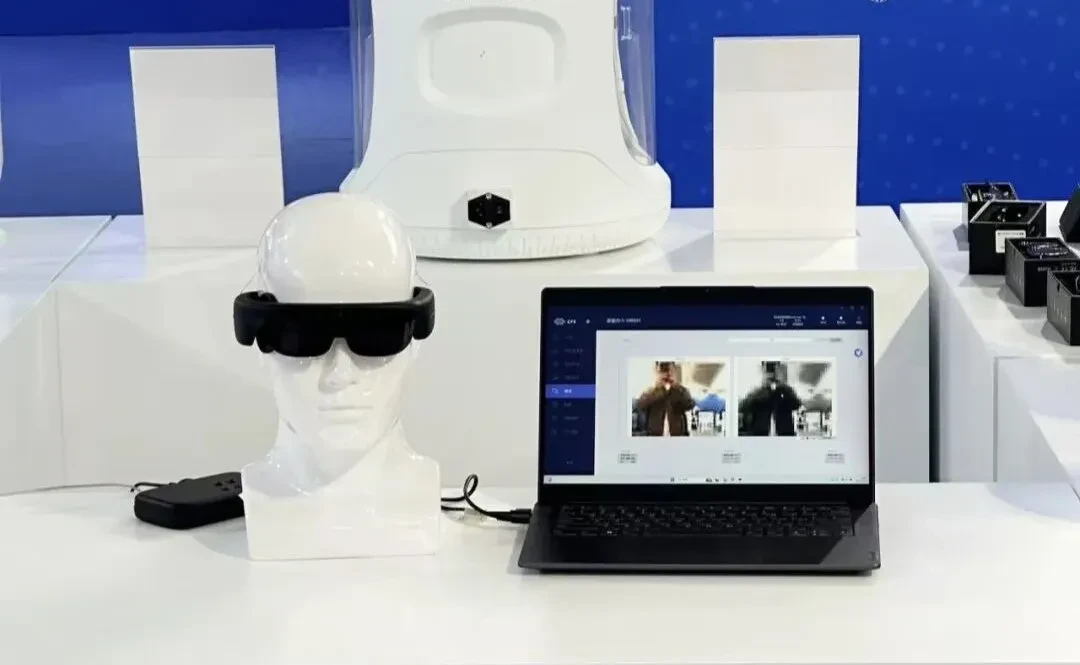
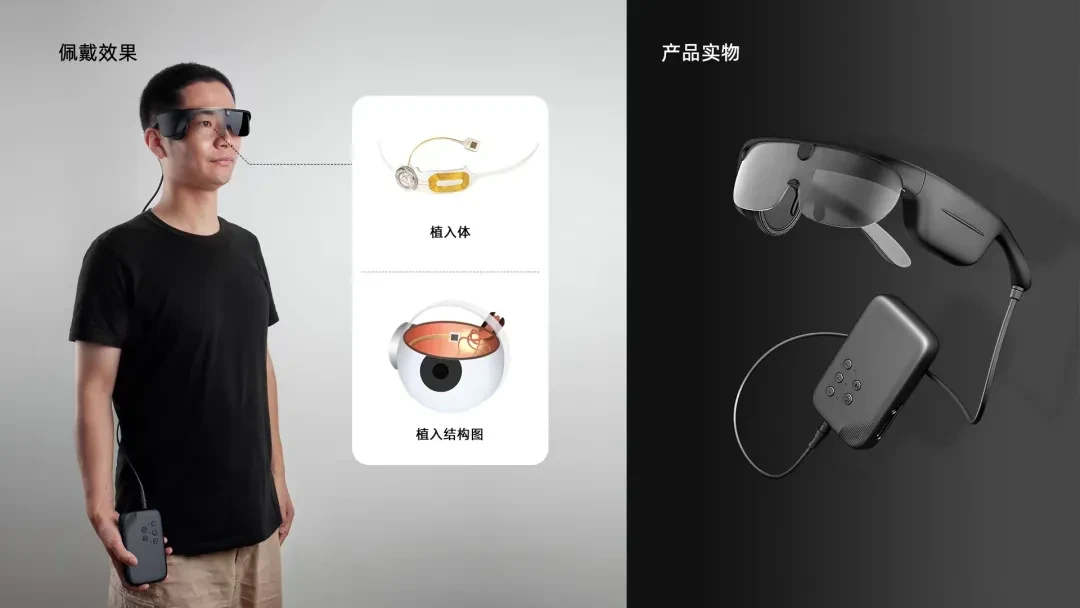
Nanochap's choice is to take both paths simultaneously.:E-BCI is for patients with functional retinas, while V-BCI is for patients with damaged optic nerves or eyeballs.This "double insurance" strategy theoretically covers the vast majority of the blind population.
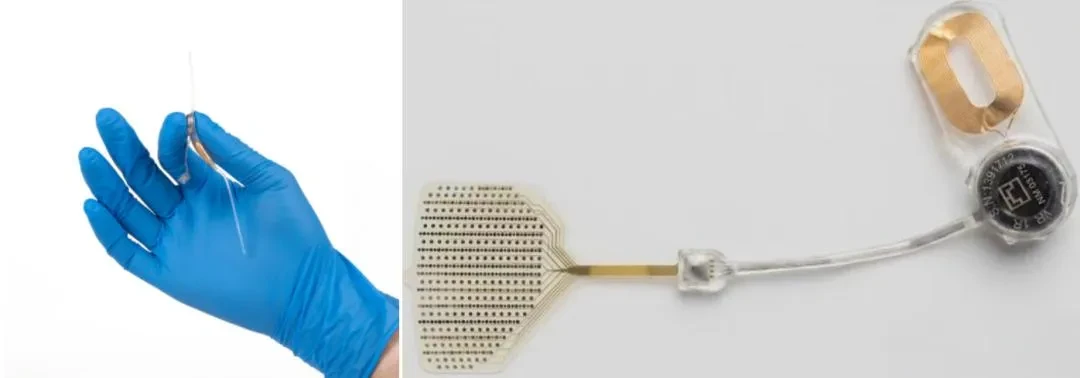
Retinal Pathway Brain-Computer Interface E-BCI (Left), Visual Cortex Pathway Brain-Computer Interface V-BCI (Right)
# What Does 1280 Channels Mean?
The core competitive metric of visual brain-computer interfaces is the number of channels.——The number of electrodes that can simultaneously stimulate neurons. The number of channels directly determines the resolution of visual reconstruction: the more channels, the more "phosphenes" can be generated, and the finer the images patients see.
What is the international level of Nanochap's current achievement of 1280 signal acquisition and stimulation channels?
PRIMA(Science Corporation): 378 photovoltaic pixels (equivalent to 378 stimulation points) activated by infrared light projected through glasses, without the need for internal power supply. A 12-month clinical trial showed that 80% of patients had vision improvement ≥0.2 logMAR, enabling them to read letters, numbers, and words.
Blindsight(Neuralink): Plan to use the 1024 electrodes (64 threads × 16 electrodes) of the N1 platform, which will be implanted into the visual cortex via the R1 surgical robot. Received FDA Breakthrough Device Designation in 2024, but human trials have not yet commenced.
Argus II(Second Sight): 60 electrodes, discontinued.
Nanochap E-BCI/V-BCI: 1280 channels, electrodes, chips, and packaging all self-developed.
1280 channels means that theoretically thousands of phosphenes can be generated.As a reference, the central vision of a normal person corresponds to approximately millions of cone cells, and 1,000 phosphenes can only form a lower-resolution image (similar to the dot matrix of early digital watches). But even so, being able to distinguish object outlines, read large print, and recognize facial expressions is already a qualitative change for the blind.
The technical highlights of Nanochap are not only in the number of channels. Its3D Electrode Array Adopts Three-Dimensional Structure and Surface Composite Coating, combined with the current steering control of the chip to form a precision-focused electric field, enhancing the targeting of nerve cells. In addition, the team's self-developed"High-Density Feedthrough Technology" and "Ultra-Small Volume Hermetic Packaging Technology"Ensures the long-term stability of the implant in the harsh environment of the body (design life exceeds 10 years), and the related technology has been granted an international patent.
# Who is closest to "going public"?
Science Corporation
Its PRIMA system adopts the subretinal implant approach, comprising 378 photovoltaic pixels activated by infrared light projected from specially designed glasses, without the need for internal power supply. A 12-month clinical trial showed that 80% of patients experienced vision improvement ≥0.2 logMAR, and 84% were able to read letters, numbers, and words.
The Data Safety Monitoring Committee has recommended it for European marketing authorization.Expected to be approved in Europe in 2026, which may become the world's first commercialized visual BCI product. However, PRIMA is aimed at AMD geographic atrophy patients, with a relatively narrow range of indications.
Neuralink
Neuralink's Blindsight project uses 1024 electrodes, implanted into the visual cortex via the R1 surgical robot. In 2024, it received the FDA Breakthrough Device Designation, but human trials have not yet commenced.The company plans to push Blindsight to the market in 2030., with a target annual surgical volume of 10,000 cases.
Nanochap
Nanochap adopts a dual-path layout of retina + visual cortex.Previously achieved 1,280 signal acquisition and stimulation channels, ranking at an internationally leading level among visually disclosed brain-computer interface products, with underlying technologies such as electrodes, chips, and packaging processes all being self-developed.E-BCI has initiated human clinical trials, and V-BCI is planned to enter the clinical stage in 2026.In 2024, a type inspection report has been obtained, covering a wider population than PRIMA.
# Policy Tailwind and Industrial Chain Advantages
The year 2026 marks the beginning of the "15th Five-Year Plan".Brain-computer interface included in national strategy. Support at the policy level has provided key assistance to companies like Nanochap:
Accelerated Review and ApprovalThe National Medical Products Administration has established a special review process for innovative medical devices, and brain-computer interface, as a "chokepoint" technology, is expected to receive priority review. The type inspection report obtained by Nanochap in 2024 is a precondition for entering clinical trials.
Self-controllable Industrial ChainNanochap has achieved full-chain self-research from electrodes, chips to packaging processes, and built a nearly 2000㎡ Class 10,000 GMP cleanroom workshop. Against the backdrop of Sino-US technology competition, this self-controlled capability is not only a technical barrier but also a guarantee of supply chain security.
Extensive clinical resourcesChina has approximately 17 million people with visual impairments, with an additional 450,000 cases each year, indicating a significant clinical demand. The conduct of local clinical trials and data accumulation have facilitated product iteration and registration.
But challenges exist as well.The Clinical Trial Design of Visual Brain-Computer Interfaces is Complex——How to define the endpoint of "functional vision"? How to balance safety and efficacy? How to manage long-term electrode degradation, tissue scarring, and infection risks? These questions have no standard answers and require joint exploration by companies and regulatory agencies.
# Implications for Ophthalmologists
For ophthalmologists, the rise of visual brain-computer interfaces signifies an expansion of professional boundaries.
From "Treating Eye Diseases" to "Rebuilding Vision"The ultimate goal of traditional ophthalmology is to preserve and restore natural vision. However, when retinal photoreceptors are irreversibly damaged, artificial visual reconstruction becomes a new dimension of treatment. Ophthalmologists need to master entirely new skills such as surgical techniques for electrode implantation, postoperative imaging evaluation, and complication management.
From "Single Discipline" to "Multidisciplinary"Visual brain-computer interfaces involve multiple fields such as ophthalmology, neurosurgery, neuroscience, electronic engineering, materials science, and AI algorithms. The future visual reconstruction center will undoubtedly be a platform for multidisciplinary collaboration.
Ethics and Patient EducationVisual brain-computer interfaces do not "restore vision" but rather provide an artificial alternative to vision. Patients need to understand the fundamental differences between this type of vision and normal vision — phosphenes appear as discrete dots of light, lack color (or are monochromatic), and have low resolution. Managing patient expectations and avoiding overpromising are crucial for clinical promotion.
# The Answer Is Still On The Way
Nanochap's 300 Million Yuan Financing Marks a Significant Milestone in the Industrialization of Visual Brain-Computer Interfaces in China.Placed in a global context, this marks that the Chinese team is competing on the same stage as international giants.Science Corporation has cumulatively raised nearly 500 million US dollars, Neuralink's valuation exceeds 9 billion US dollars, while Nanochap has achieved international leading standards in technical indicators with more efficient resource allocation.
China's unique advantages in precision manufacturing, clinical resources, and policy support provide a solid foundation for local companies to overtake competitors. Nanochap's dual-route strategy, full-chain self-research, and internationally leading technical indicators have already demonstrated the strong competitiveness of Chinese teams in this field.
For the 43 million blind people worldwide, what they look forward to is a safe, effective, and accessible visual reconstruction solution.The human trials of Nanochap have been initiated, and the answers are gradually becoming a reality.

Ophthalmology Solutions Case