XTAL Tech to Showcase Three Innovative AI-Driven Platforms at 2026 BPD Beijing Conference, Addressing Real-World Challenges in AI-Powered Drug Development
XtalPi
Computation-Driven Innovative Drug R&D Provider
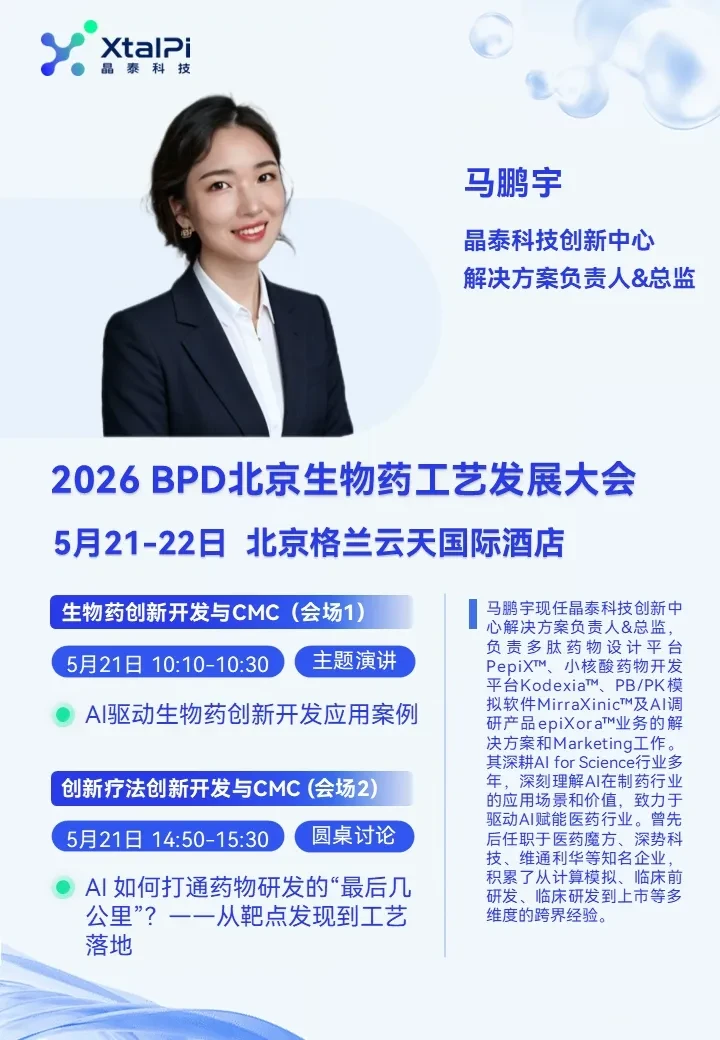
At the sincere invitation of the conference organizer,2026Year5Month21On [Date], Ma Pengyu, Director of XtalPi Innovation Center Solutions, will attend the event held in Beijing.2026 BPDBeijing Biopharmaceutical Process Development Conference. At this conference, Director Ma Pengyu will focus on the application cases of XtalPi's three major innovative technology platforms.AIThe Challenges of Pharmaceutical Implementation and Jointly Exploring Technological Innovation Pathways and Industrial Implementation Practices with Industry Peers.

Focus on XtalPi's AI R&D Achievements and AI Drug Development Implementation Approaches
During the conference, Director Ma Pengyu will deliver two presentations: a keynote speech and a roundtable discussion. Among them,5Month21Date: Morning10:10-10:30, she will appear in the biopharmaceutical innovation and development andCMCForum (Venue)1), Published an Article Titled "AICase Studies on Driving Biopharmaceutical Innovation and Development" in the afternoon of the same day.14:50-15:30Participate in the innovation and development of innovative therapies &CMCForum (Venue)2), focusing on the "AIHow to Break Through in Drug Development“The Last Few Kilometers”?——"From Target Discovery to Process Implementation" Roundtable Discussion, Deep Dive into Industry Core Pain Points and Optimization Solutions with Experts.

ThreeCore Highlights of the Major Innovation Technology Platform
1. PepiX™ Peptide Drug Discovery Platform
Focusing on the development of peptide drugs, it integrates precise AI design, high-throughput wet experimental screening, and automated synthesis capabilities, forming an efficient dry-wet experimental closed loop. In addition, the platform has a proprietary library of 2000+ non-natural amino acids (NCAA). Based on these platform capabilities, it is primarily tackling key development challenges such as brain/eye delivery peptides, oral peptides, and RDC cyclic peptide carriers, aiming to overcome the bottlenecks of traditional peptide drugs in terms of stability, penetrability, oral bioavailability, development cycle, and success rate.
2. Kodexia™ siRNA Drug Development Platform
Focusing on siRNA drug development, XtalPi is the first to apply generative AI and break through sequence space limitations, greatly shortening the design cycle for BIC siRNA candidate molecules. The platform simultaneously considers optimal modification patterns, long-acting performance, and reduced off-target toxicity during sequence design, combining wet-lab capabilities to form an efficient dry-wet lab closed-loop system. Currently, the platform is prioritizing development in metabolism, nephropathy, dual-target, and extrahepatic delivery directions.
3. Multi-Agent Application Development Platform
AI-Powered Research Product epiXora™
Using multi-agent technology, epiXora™ rapidly generates high-confidence personalized reports within 30 minutes by integrating multiple data sources such as PubMed, bioRxiv, clinical trials, patents, and personal knowledge bases. It enables comprehensive analysis across technical, regulatory, and market dimensions, supports various application scenarios, and ensures reliable and professional traceability. It accelerates early pipeline research and facilitates scientific judgment and precise decision-making in drug development.
A professional platform for small molecule and therapeutic protein physiologically-based pharmacokinetic (PBPK) modeling and simulation. It simulates the drug disposition process in the body by integrating individual physiological characteristics, drug physicochemical properties, and dosing regimens. Based on the above input parameters, MirraXinic™ can predict pharmacokinetic (PK) profile curves and perform non-compartmental analysis (NCA).