

Empowering Women's Health: The Critical Role of AI in Accelerating Cervical Cancer Screening
To date, pathological diagnosis remains the most reliable method for disease identification and is hailed as the gold standard in diagnostic medicine. How to enhance the operational efficiency of pathology departments, ensure and even elevate the diagnostic value of pathological assessments, meet the growing clinical demand for diagnostics, keep pace with technological advancements, and fulfill the need for more precise disease diagnosis are practical and contemporary challenges that pathology departments must address.
The “14th Five-Year Plan for Digital Economy Development” issued by the State Council points out that it is necessary to accelerate the development of digital health services, promote the digital and intelligent transformation of medical institutions, speed up the construction of smart hospitals, and promote telemedicine. The application of various emerging technologies has allowed many departments to ride the “east wind” of improving quality and efficiency, but pathology departments seem to still be in the “depression” of hospital digitization. On one hand, due to the lack of equipment and low level of automation in China's pathology departments, the multiple links in the pathological process have high professional requirements for medical technicians, resulting in a lower overall level of automation in department operations. On the other hand, due to the low level of automation in pathology departments, the diagnosis time is long. Routine pathological testing takes 3-5 days, and if there are more difficult diseases, additional immunohistochemistry or molecular testing may be required, extending the diagnostic time to 7-10 days. In recent years, driven by the demand for precision diagnosis and treatment, the importance attached to pathology departments has continued to increase, with most tertiary hospitals having established molecular pathology laboratories and expanding the scale of their pathology departments. The digital and intelligent transformation of pathology departments requires thorough innovation of the entire workflow and information flow.
AI-based computational pathology is an emerging technology that employs advanced machine learning and image analysis methods to quantitatively analyze high-resolution digital pathology slides. It also constructs pathomics to quantify the diagnostic experience and knowledge of pathologists, integrating them into AI-assisted pathological diagnosis and treatment systems, thereby improving the operational efficiency of pathology departments and accelerating the development of precise diagnostic capabilities in pathology.
Introducing artificial intelligence (AI) to assist with, or even replace, manual labor in routine pathological diagnosis and cancer screening can effectively address issues such as low diagnostic efficiency, a shortage of pathologists, and the lack of unified quality control management. The AI-assisted pathological diagnosis workflow primarily includes standardized slide preparation, digital slide scanning, AI algorithm-based image analysis, and manual review of AI-flagged positive slides. Key factors in implementing AI-driven pathological diagnosis include standardized slide preparation, digital processing, deep neural network models trained on massive datasets annotated and reviewed by pathology experts to extract lesion feature maps, and the provision of suggested results along with suspicious fields of view for rapid physician review. As computer AI relies on image recognition for diagnosis, it demands high standards for slide image standardization; therefore, equipment capable of ensuring consistent slide preparation and imaging standards forms the foundation for developing pathological AI algorithms. Furthermore, pathological diagnosis covers a wide range of diseases, particularly numerous cancer types. Achieving precise AI-driven diagnosis for various disease categories requires substantial case data support. Currently, the primary entry point for the industry lies in using AI-assisted diagnosis for screening common diseases to reduce repetitive tasks for pathologists and improve diagnostic efficiency. The key to this model is ensuring both high sensitivity and high specificity of the pathological AI algorithms, thereby preventing missed diagnoses due to algorithmic misjudgments and enhancing diagnostic efficiency while maintaining diagnostic validity.
Cervical cancer has been a tumor disease with a high incidence rate among urban and rural women in China in recent years. In January 2024, ten departments, including the National Health Commission, the Ministry of Education, and the Ministry of Civil Affairs, jointly issued the Action Plan for Accelerating the Elimination of Cervical Cancer (2022–2030). The plan calls for further improvement of the cervical cancer prevention and control service system, enhancement of comprehensive prevention and control capabilities, establishment of a supportive social environment, efforts to curb the rising trends in cervical cancer incidence and mortality rates, and reduction of the societal disease burden associated with cervical cancer. Meanwhile, the Outline of the Healthy China 2030 Planning and the Outline for the Development of Chinese Women (2021–2030) explicitly state that China will actively respond to the World Health Organization’s Global Strategy to Accelerate the Elimination of Cervical Cancer, accelerate the process of eliminating cervical cancer in China, and protect and promote the health of women nationwide. Localities regularly conduct free cervical cancer screening for eligible women. The large-scale, centralized screening approach places higher demands on pathology departments, making it crucial to complete screening tasks with high efficiency and high standards.
The fully automated slide preparation and artificial intelligence (AI) analysis system minimizes human intervention through automated slide preparation and staining equipment, ensuring standardized slides. By automatically detecting anomalies and errors in digital slide images, it assists pathologists in intelligent quality control, thereby ensuring the accuracy and reliability of diagnostic results. Furthermore, the AI analysis system aids physicians in diagnosis by automatically screening out negative cases, thus reducing their workload. According to authoritative statistics, by the end of 2023, 200 Grade A tertiary hospitals and nearly 700 public hospital pathology centers across China had implemented comprehensive AI digital pathology solutions. Amid the surging tide of medical digitalization, pathology departments in China must regard digital and intelligent construction as a “mandatory requirement” rather than an “optional choice” in the traditional sense if they are to keep pace with the times.
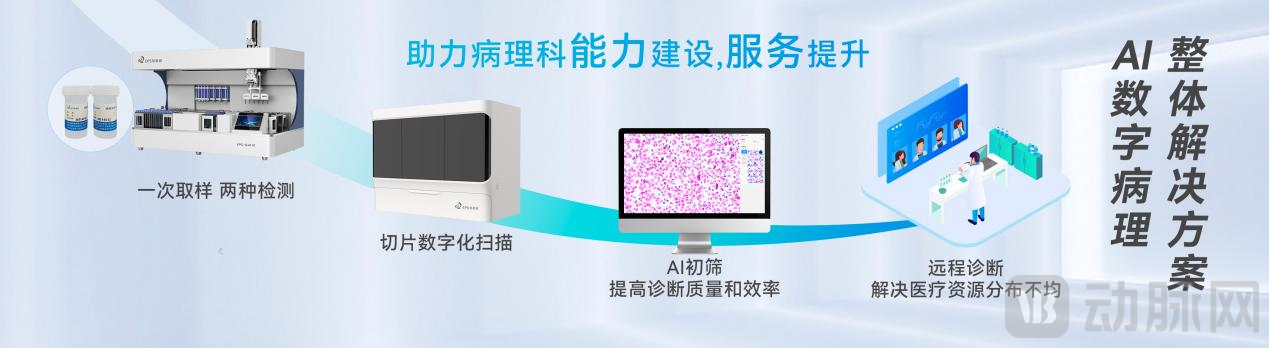
As one of the leading brands in the field of “AI + Digital Intelligent Pathology,” Epsen starts from the source, providing an integrated “four-dimensional” solution encompassing automation, standardization, digitization, and intelligence. By combining fully automated equipment, reagents, slide scanners, and AI analysis systems, Epsen has pioneered one-touch fully automated staining and slide preparation, standardized sample processing, digital pathology slides, and intelligent diagnostic reading. Leveraging AI analysis as a breakthrough, Epsen comprehensively empowers the diagnosis of cervical cancer and various other tumor diseases, covering the entire workflow from slide preparation to diagnosis. Currently, Epsen collaborates deeply with numerous large tertiary hospitals across China, having completed screening and diagnosis for millions of patients. In the future, Epsen will continue to explore the application of new technologies such as the internet and large artificial intelligence models to optimize pathological diagnosis and treatment service processes, aiming to benefit humanity worldwide with AI-powered pathological diagnostic technology.