

Lanzhou University Unveils New Patent for Boron Neutron Capture Therapy Evaluation Model
On April 16, 2024, a new patent was published by Professor Gu Long’s team at Lanzhou University.This patent describes a model, mLNDM, for evaluating the relative biological effectiveness of boron neutron capture therapy.
This model is established based on nanodosimetric quantities of short-range, low-energy charged particles and large-dose correction factors. The team improved the LNDM model, and by comparing simulation results, found that both models agree well with experimental data in the low-dose region. However, the mLNDM model effectively corrects the overestimation of cell-killing effects by the LNDM model in the high-dose region. Furthermore, the team discovered that the mLNDM model provides a nanodosimetric evaluation method for the relative biological effectiveness (RBE) in boron neutron capture therapy (BNCT), thereby enhancing the reliability of RBE assessment in BNCT.
In the field of technology transfer,Professor Gu Long also leveraged technologies related to translational nuclear medicine to establish Ruisike, which has currently deployed a portfolio of products including multi-room synchronized proton therapy systems, boron neutron capture therapy (BNCT) devices, and cyclotrons for medical isotope production.
Continued Surge in Nuclear Medicine Strategic Deployments
Radiopharmaceuticals offer advantages such as visualizability, quantifiability, and favorable performance in overcoming drug resistance. They hold broad prospects in fields including tumor diagnosis and therapy, as well as cardiovascular disease diagnosis, serving as a vital force in precision medicine.This has also prompted domestic and international companies to actively engage in mergers and acquisitions and business collaborations, thereby rapidly entering the radiopharmaceutical market.
As early as 2015, Dongcheng Pharmaceutical entered the radiopharmaceutical sector by acquiring Yunke Pharmaceutical. It has since launched multiple products, including Fluorine [18F] Deoxyglucose Injection (18F-FDG), Urea [14C] Capsules, and Iodine [125I] Sealed Seeds. Grand Pharma, meanwhile, entered the radiopharmaceutical field in 2018 through its acquisition of Sirtex. Its flagship product, SIR-Spheres Yttrium [90Y] Microspheres for Suspension, is indicated for the treatment of patients with unresectable colorectal cancer liver metastases who have failed standard therapy.
Abroad, Novartis acquired the French company Advanced Accelerator Applications (AAA) for $2.1 billion in 2017, gaining the innovative anticancer drug Lutathera and its technology platform. In 2018, it further acquired Endocyte for $3.9 billion, securing two revolutionary radiopharmaceuticals—Lutathera and Pluvicto—which achieved sales of $471 million and $271 million, respectively, in 2022. Bayer also entered the radiopharmaceutical sector in 2021 by acquiring two companies focused on developing radioligand therapies: Noria Therapeutics and PSMA Therapeutics.
As major pharmaceutical companies such as Novartis, Bayer, and Dongcheng enter the field, multiple innovative therapeutic radiopharmaceuticals have advanced into clinical trials and reached the market, driving continuous growth in the size of the radiopharmaceutical market.
In terms of the R&D pipeline, Chinese companies had 75 radiopharmaceutical candidates in development in 2022, while 6,468 candidates had entered clinical trials overseas. Regarding market size, the global radiopharmaceutical market was valued at $4.38 billion in 2021 and is projected to reach $11.93 billion by 2030. In terms of financing, radiopharmaceuticals attracted nearly RMB 900 million in funding in 2022, making it the subsector with the highest proportion of financing deals exceeding RMB 100 million within the innovative drug industry that year. The development of radiopharmaceuticals is witnessing a period of robust growth.
Exploring More Indications and Targeted Modalities
With the explosive growth of the radiopharmaceutical industry, the duplication of indications and targets has become a widespread phenomenon in the sector.Currently, the R&D focus of most domestic enterprises is on generic drugs or improved new drugs, leading to issues such as homogenization in development directions and pipelines. To change this situation, the industry is consciously injecting more vitality, fostering new concepts and pipelines, and achieving diversified development.
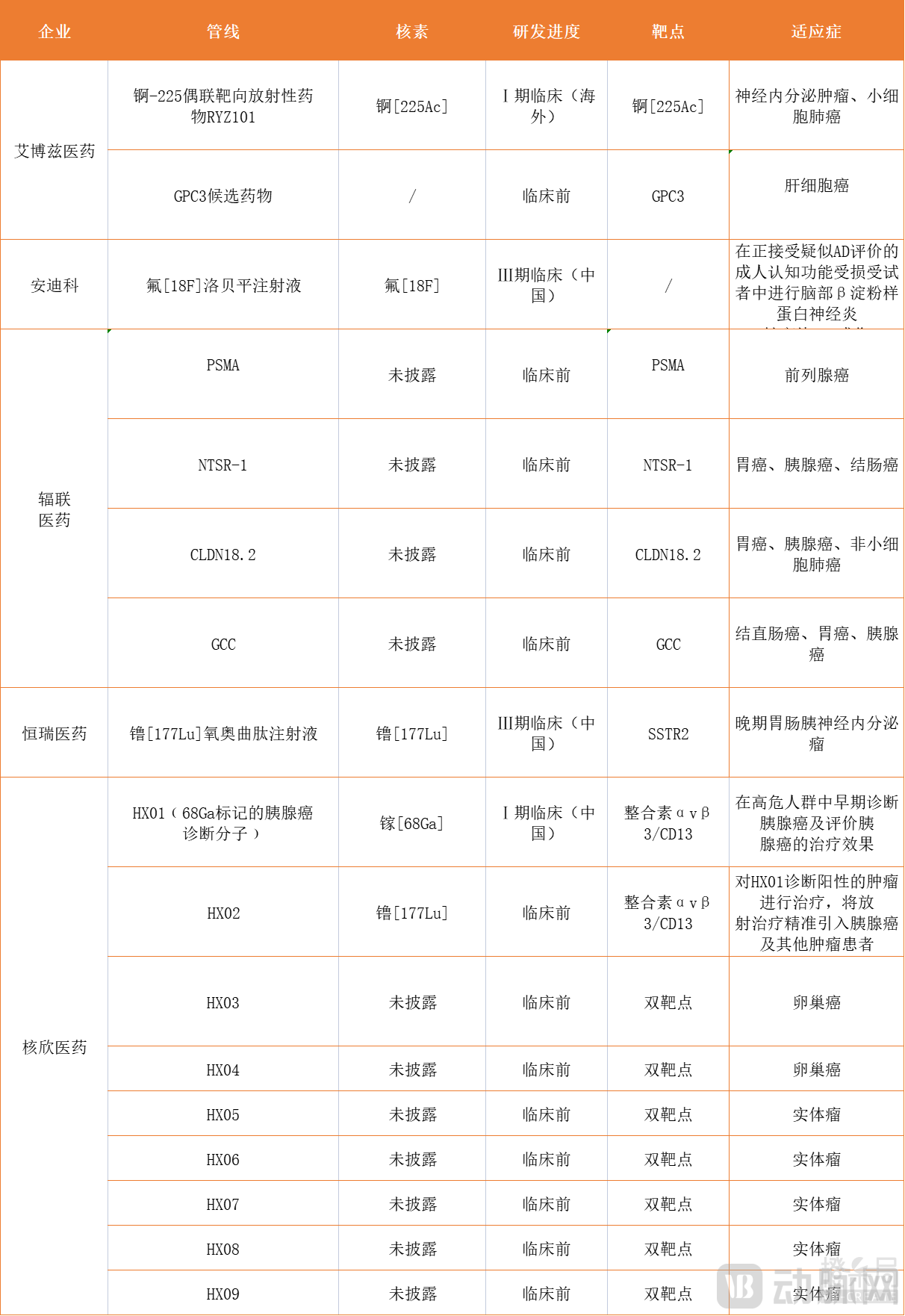 The figure shows an overview of nuclear medicine drugs under development by some Chinese companies, with data sourced from “White Paper on the Radiopharmaceutical Industry: Mapping Nearly 7,000 Global Pipelines and Competing in Target, Ligand, and Radionuclide Innovation》
In terms of indication expansion, Grand Pharma has reserved 13 innovative products in the field of radiopharmaceuticals for tumor diagnosis and treatment, covering eight types of cancer including liver cancer, prostate cancer, and brain cancer. In 2022, Grand Pharma also announced clinical studies on two expanded indications for its product TLX250-CDx, targeting triple-negative breast cancer and non-muscle-invasive bladder cancer.
In the exploration of targeted formats, Hexin Pharma’s product 68Ga-HX01 is the world’s first dual-targeting radiopharmaceutical to receive clinical trial approval. It targets tumors expressing integrin αvβ3 and/or CD13 receptors, and is used for the early diagnosis of pancreatic cancer in high-risk populations as well as for evaluating treatment efficacy in pancreatic cancer.
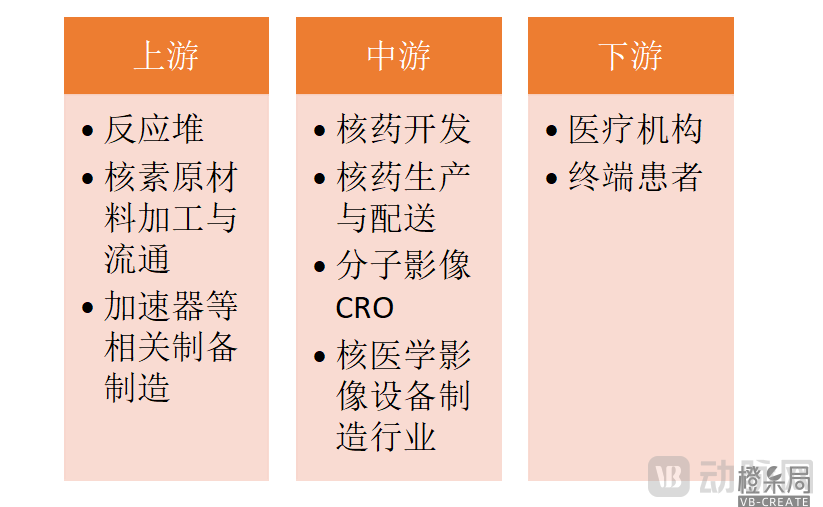 Figure: The Nuclear Medicine Industry Chain
Looking upstream in the industry, innovation in radionuclide raw materials and accelerator equipment is also a key focus.
In the realm of radionuclide innovation, in 2023, Professor Lan Xiaoli’s team from Union Hospital, Tongji Medical College, Huazhong University of Science and Technology, published an article in the European Journal of Nuclear Medicine and Molecular Imaging, detailing preclinical research findings on astatine-211 ([211At])-labeled PSMA-targeting ligand drugs and providing valuable strategies for broader safety studies. In terms of frontier exploration of accelerator equipment, Professor Wang Sheng’s team at Xi’an Jiaotong University has completed the engineering implementation of the world’s first accelerator-driven boron neutron capture therapy (BNCT) device for animal use, while the high-current accelerator-driven BNCT device for clinical applications has completed design and manufacturing, entering the stage of equipment assembly and commissioning.
In recent years, in particular, there has been increasingly deep collaboration in radionuclide supply and drug development and manufacturing, achieving a synergistic effect where 1+1>2.For example, in 2019, China Isotope & Radiation Corporation (CIRC) signed a cooperation agreement with ITM to scale up the production of GMP-grade Germanium-68/Gallium-68 generators and carrier-free Lutetium-177. Through synergy across various stages of the industry chain, collaboration among radiopharmaceutical companies will become more frequent, jointly promoting innovative development within the sector.