

Arbor Biotechnologies Acquires Serendipity Biosciences to Expand Next-Generation Gene Editing Capabilities

Arbor Biotechnologies
Gene Drug Developer

Serendipity Biosciences
Gene Editing Technology Researcher
Recently,Gene Editing Company Arbor Biotechnologies (“Arbor”) Announces Acquisition of Gene Editing Startup Serendipity Biosciences (“Serendipity”). Arbor will acquire the latter’s existing innovative assets, including programmable editing technologies based on Fanzor, IsrB, and other undisclosed platforms, thereby supplementing and expanding its current editing capabilities. The two parties did not disclose specific financial details.
Among them,Co-founder Feng Zhang can be seen in the founding teams of both Arbor Biotechnologies and Serendipity Biosciences.Arbor was co-founded by Feng Zhang and Dr. David Walt of Harvard University, while Serendipity was co-founded by Feng Zhang together with scientists from the Massachusetts Institute of Technology.
In 2016, Feng Zhang co-founded Arbor Biotechnologies together with two former members of his laboratory, David Scott and Winston Yan, as well as Dr. David Walt from Harvard University. In 2017, Arbor emerged from stealth mode and announced a $15.6 million Series A financing round. This funding accelerated the company’s R&D efforts to characterize proteins and discover novel molecules, leveraging its new CRISPR technologies and a drug development platform built around AI, genomic sequencing, gene synthesis, and screening capabilities.
Arbor’s CRISPR technology is considered a new, more versatile CRISPR technology.In 2018, David Scott and Winston Yan published a paper in *Molecular Cell*. They discovered a novel CRISPR-Cas protein, the Cas13d enzyme, which enables RNA editing without altering the genome.. The Cas13d enzyme, with an average size of approximately 2.8 kb, is easier to package into low-capacity vectors and does not produce significant off-target effects. Leveraging this breakthrough discovery, Arbor has once again become the focus of market and capital attention,and announced the completion of a $215 million Series B financing round in 2021。
According to its official website,Currently, Arbor has established the industry’s most extensive patented genome editing toolbox, enabling applications ranging from simple protein knockdown to more complex and precise genome editing. Furthermore, Arbor is capable of targeting over 90% of the human genome., enabling the discovery, screening, and design of novel editing enzymes and effectors tailored to disease mechanisms, thereby providing potential therapeutic agents for patients.
The acquisition of Serendipity Biosciences has enabled Arbor Biotechnologies to secure four new families of gene-editing enzymes discovered by Feng Zhang’s laboratory in recent years, includingA New Class of Editable DNA Systems: The Fanzor System。
Fanzor is an RNA-guided DNA endonuclease discovered in eukaryotes by the Zhang Feng laboratory.. Research from the Zhang Feng laboratory demonstrates that Fanzor is a versatile endonuclease system that can be reprogrammed for human genome engineering applications.
It is important to note that the CRISPR/Cas9 system is an RNA-guided endonuclease system discovered in prokaryotes, functioning as an adaptive immune system against exogenous genetic elements by cleaving DNA via RNA-guided Cas effector proteins.
Compared with the CRISPR/Cas9 system, the Fanzor system can more precisely target and cleave DNA through an RNA-guided mechanism. Furthermore, the Fanzor system is smaller than the CRISPR system, with a size approximately 30% that of Cas9, which facilitates its delivery into cells and tissues.Multiple characteristics endow Fanzor with greater advantages in specific editing scenarios, positioning it as a more efficient gene-editing tool following CRISPR/Cas9 and potentially enabling more precise gene editing in human cells.。
Following the acquisition, Serendipity’s novel gene-editing technology will accelerate the development of Arbor’s gene-editing tools and related therapies. Currently, Arbor is prioritizing the development of new therapies for liver and central nervous system indications, while collaborating with biopharmaceutical companies such as Vertex Pharmaceuticals in other disease areas to jointly develop innovative treatments.
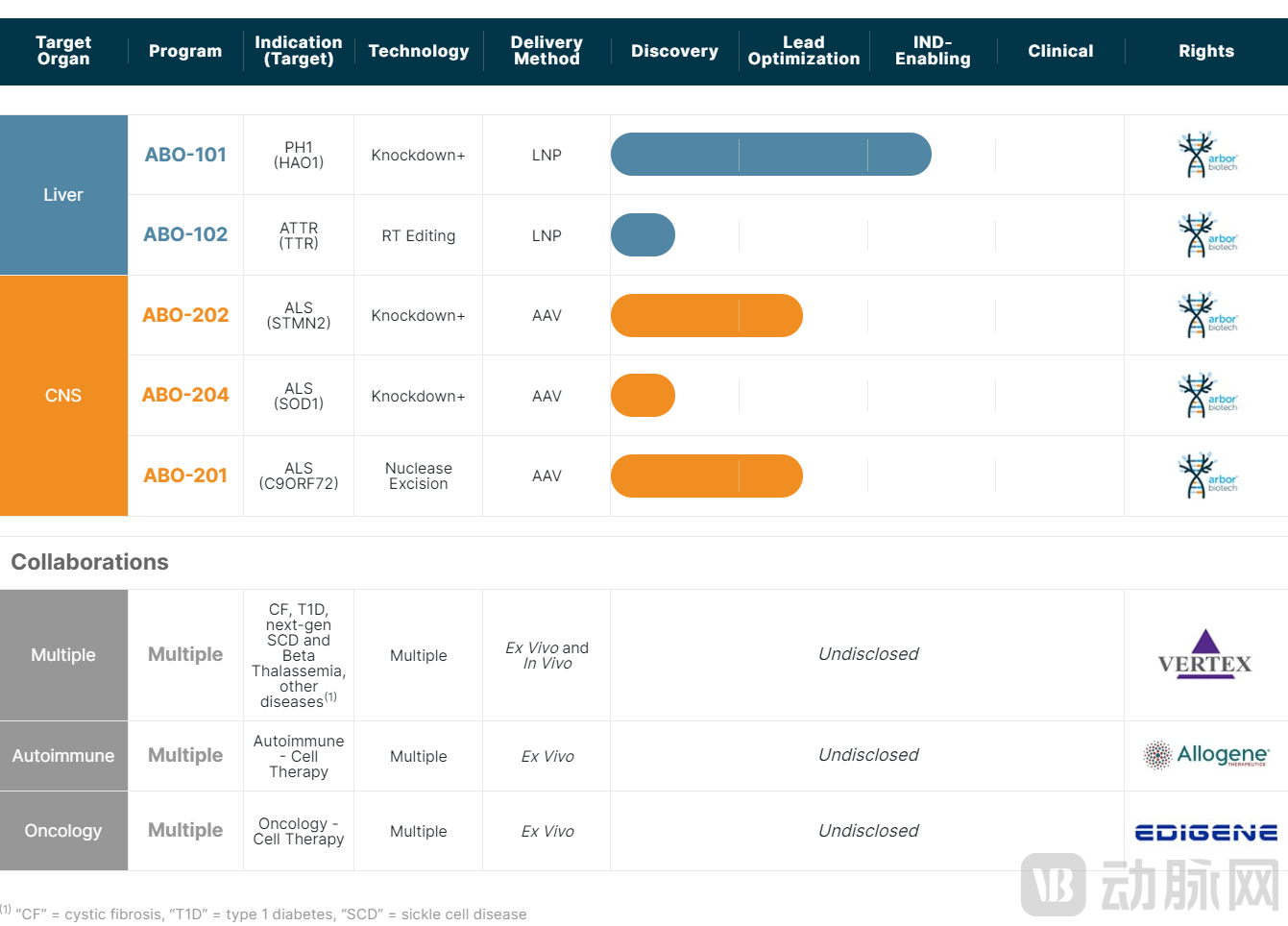
Arbor’s R&D Pipeline. Source: Arbor’s official website
This acquisition represents a “self-transcendence” for Arbor. Upon completion, Arbor’s gene-editing capabilities will reach “new heights” with the support of Serendipity’s gene-editing technology, potentially enabling the company to press the accelerator on its development trajectory and expedite the R&D progress of its candidate products.
According to the company’s official website, Arbor Biotechnologies presented preclinical data on its investigational candidate ABO-101 at the 27th Annual Meeting of the American Society of Gene & Cell Therapy (ASGCT). ABO-101 is being developed for the treatment of patients with primary hyperoxaluria type 1 (PH1), and preclinical data demonstrated that ABO-101 was well tolerated following multiple administrations in non-human primates (NHPs).Arbor is expected to submit an IND application for ABO-101 this year to initiate clinical trials.。
For Serendipity Biosciences, it was even more of a self-rescue effort.
According to incomplete statistics, Feng Zhang has co-founded nine companies since 2013, covering multiple applications of CRISPR technology, including gene editing, base editing, and molecular diagnostics.
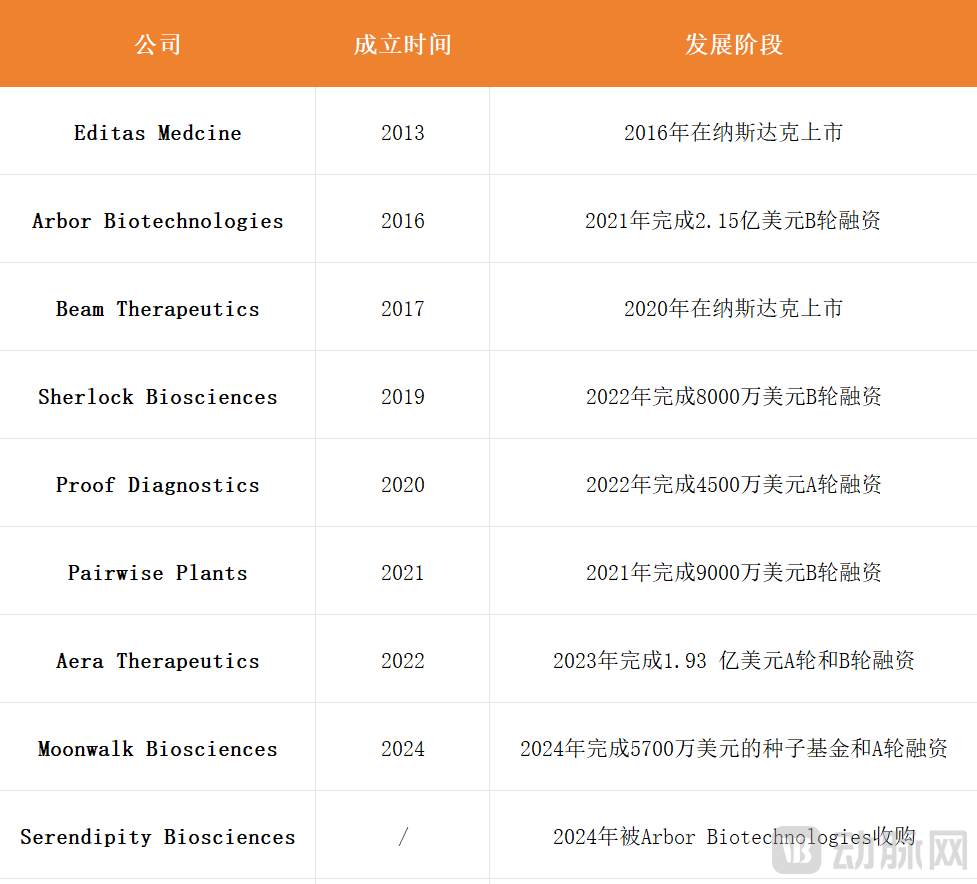
Companies Co-founded by Feng Zhang. Image source: Compiled from public data; graphic by VCBeat.
Serendipity Biosciences is also among them. A key factor supporting the establishment of Serendipity Biosciences is Fanzor, a novel nuclease discovered by Zhang Feng’s laboratory that has the potential to replace CRISPR systems. As the first gene-editing mechanism discovered in eukaryotes, its groundbreaking nature means that Serendipity Biosciences is likely to attract greater attention from capital markets and investors.
However,Although the Fanzor system demonstrates significant potential advantages, its practicality and efficacy as a genome editing tool require further validation and optimization. The widespread adoption of Fanzor as a gene editing tool will continue to face numerous technical and application-related challenges.. In contrast, although the CRISPR-Cas system is not yet fully perfected, it has been validated and applied in multiple disease areas.
Furthermore, Serendipity Biosciences operates in a market with dozens of strong competitors. For a startup, it is challenging to secure sufficient funding through financing rounds to ensure survival in such a highly competitive landscape. Feng Zhang stated in the press release, “Given the current biotechnology financing environment and the overall macroeconomic situation, it makes more sense to partner with a robust group that possesses complete infrastructure and capabilities, thereby enabling faster development of corresponding products.”1。
In 2013, the Zhang Feng laboratory developed an innovative CRISPR/Cas system that significantly improved the reliability and efficiency of gene editing, achieving breakthrough results. Since then, Zhang Feng has embarked on his exploration in the field of gene editing; however, after more than a decade of development, there are still no commercialized products to date. Furthermore, currentlyTo support the continued growth of his existing company, Zhang Feng is simultaneously launching a new venture and implementing layoffs.To date, the three companies under Feng Zhang’s umbrella—Editas Medicine, Beam Therapeutics, and Aera Therapeutics—have all implemented measures to adjust their product and personnel portfolios, extending their cash runways through layoffs and pipeline optimization.
References:
1. https://endpts.com/arbor-acquires-feng-zhang-startup-for-next-gen-gene-editing-enzymes/