

NetRain Advances as a Digital Health Enabler, Empowering B2B AI Adoption in the Greater Health Industry
As a leading digital healthcare ecosystem service provider in China, Natery has once again been listed on the 2024 Top 100 Future Healthcare Innovators list, earning the honor of “Top 100 Future Healthcare·Annual Innovative Enterprise.” This marks the third consecutive year that Natery has been included in the “Top 100 Future Healthcare” list, underscoring its technological strength and innovation capabilities.
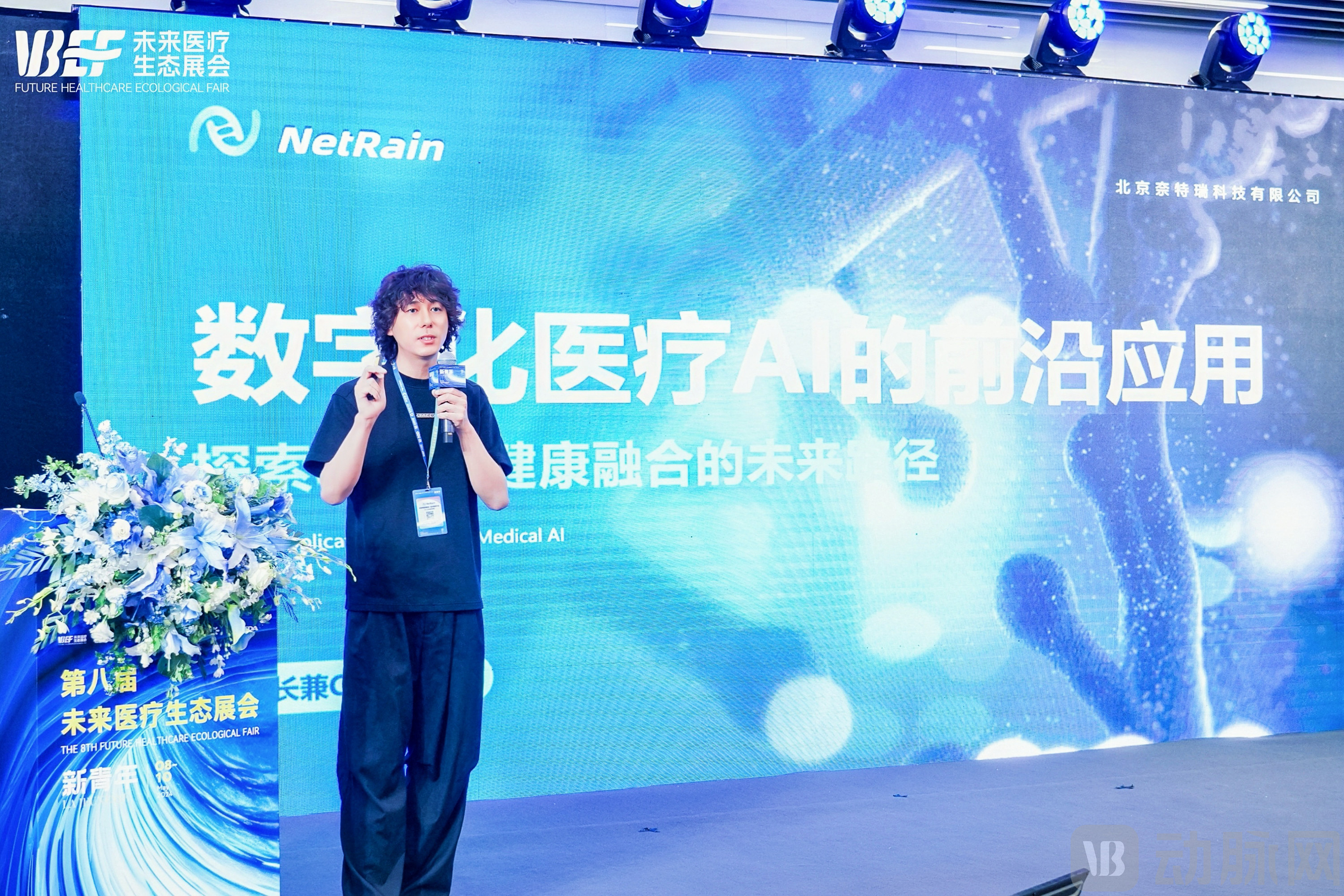
At the “VBEF Future Healthcare Ecosystem Expo – Internet Hospital and Smart Hospital Forum” held on the morning of May 9, 2024, Mr. Qu Yi, Chairman and CEO of Natrai, was invited as a keynote speaker to deliver a presentation titled “AI Applications and Exploration in Digital Healthcare,” sharing Natrai’s practical experiences in leveraging advanced technologies to deepen its engagement in the digital healthcare sector.
Medical AI technology has evolved from early rule-based algorithms to current deep learning and autonomous decision-making systems. This progression not only witnesses a tremendous leap in computational power but also deeply empowers the healthcare sector. With advancements in algorithmic computing power and computer hardware, AI applications in medicine are becoming increasingly widespread, bringing revolutionary changes to disease detection and diagnosis, treatment planning, and drug development.
“The future applications of medical AI will also become more intelligent, personalized, and ubiquitous..” Qu Yi mentioned in his speech.
Qu Yi believes that as AI technology achieves greater breakthroughs in medical image processing, natural language processing, and machine learning, medical AI will more intelligently understand and process medical information. It will also become more personalized, providing more precise and customized treatment recommendations and services based on individual patient differences and needs. Furthermore, with the widespread adoption of this technology, medical AI will no longer be confined to large hospitals and research institutions but will be increasingly integrated into routine clinical diagnosis and treatment.
In the healthcare services sector, AI technology has been integrated into the entire patient journey, including pre-consultation intelligent triage and health management, intra-consultation disease diagnosis and clinical decision support, and post-consultation rehabilitation assistance. “By focusing on internet hospitals, we found that the majority of doctor-patient interactions occur outside hospital settings, particularly those involving health management issues such as nutritional health and rehabilitation. In these areas, AI has significant potential for real-time management, rapid response, and personalized care, thereby improving service efficiency while reducing operational costs for hospitals,” said Qu Yi.
Committed to advancing digital healthcare through technology, Neterry is also optimizing and improving its offerings to meet the specific needs of internet-based healthcare, rapidly integrating AI technologies into its business ecosystem. For instance, Neterry has launched an AI-powered intelligent physician assistant, intelligent follow-up system, and intelligent scale system, providing comprehensive digital solutions for internet hospitals.
Qu Yi provided a detailed introduction to the intrinsic value of the aforementioned digital solutions during the interview. Specifically, the Intelligent Physician Assistant rapidly provides diagnostic recommendations and medication guidance by learning from extensive medical knowledge and case data. The Intelligent Follow-up System formulates personalized follow-up plans and assists in their execution based on the needs of both physicians and patients, thereby ensuring treatment efficacy while enhancing physicians’ work efficiency. Serving as a tool for refined patient management, the Intelligent Scale System helps physicians conveniently develop and adjust treatment regimens, delivering personalized diagnosis and therapy services to patients.
It should be noted that,Naiterui positions itself as a digital health ecosystem service provider, committed to leveraging its role as an industry connector to deliver more precise allocation of resource elements for physical enterprises across the broader health industry chain.Therefore, VCBeat, with its established AI business, is actively helping clients apply AI more effectively and efficiently.
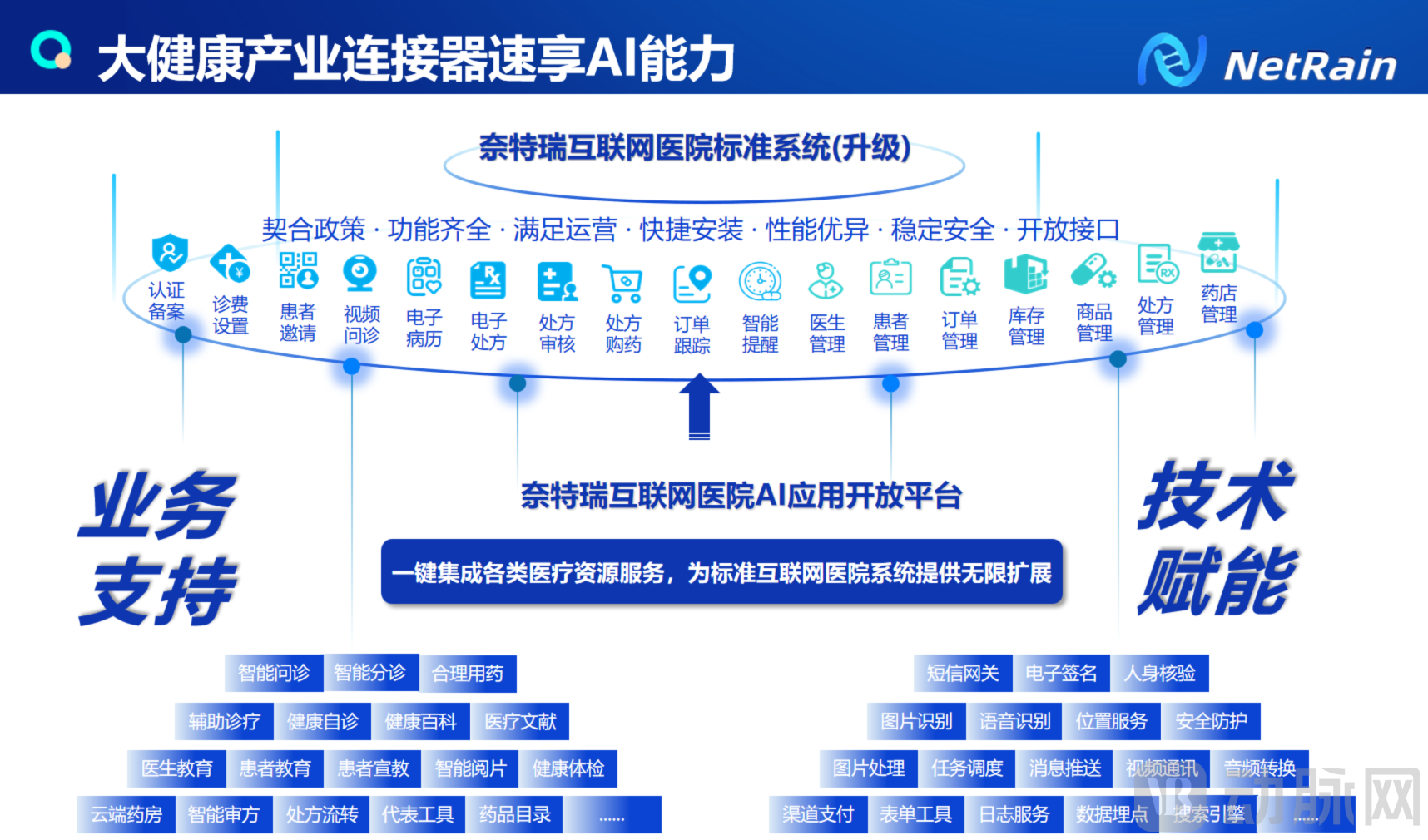
For example, Knightree has established an open platform for AI applications in internet hospitals. By providing training models within the platform, it allows enterprises to feed their valuable data into the corresponding models for training. This helps businesses meet their needs for developing proprietary AI solutions, lowers the barrier to AI adoption, and maximizes enterprise value.
Qu Yi noted that internet hospitals have entered a post-operational era, with their service scope evolving from foundational infrastructure tasks—such as obtaining licenses and building systems—to enhancing platform application capabilities and providing continuous operational services. In light of this, Knightly is continuously strengthening its technical expertise and business capabilities, leveraging its licensed status to efficiently empower the entire industry chain.Provide clients with a comprehensive, four-in-one solution encompassing qualifications, resources, operations, and compliance.。
Currently, Netray has completed digital upgrades for over 300 enterprises in the healthcare and wellness sector. Its clients include physical medical institutions, biotechnology companies, chain pharmacies, health examination centers, insurance companies, elderly care facilities, and pharmaceutical companies. Qu Yi revealed that Netray will continue to “strengthen its foundation” in 2024 by increasing technological investment while accelerating the implementation of information technology solutions. Leveraging its own digital capabilities, the company aims to help more industrial parks achieve digital industrial layout.
Qu Yi stated bluntly that, as an emerging technology, AI is still in its infancy in the healthcare sector and faces numerous challenges. Among these, data remains a major obstacle hindering the rapid development of medical AI at this stage.
First, medical AI requires vast amounts of medical data for training and learning. After acquiring massive volumes of high-quality data, it is essential to continuously strengthen data protection measures to ensure that sensitive information is not leaked or misused. Second, the deployment of medical AI must strictly adhere to ethical norms and moral principles, ensuring that its applications align with human values and comply with legal and regulatory requirements. Finally, transparency and explainability remain significant challenges. The decision-making processes of medical AI are often complex “black boxes,” necessitating the establishment of effective explanation mechanisms to enable people to better understand and trust the results and decisions generated by medical AI.
Qu Yi, who has many years of experience in the internet and IT sectors, highlighted three key trends for the future of medical AI: small models, digital humans, and cross-industry integration.
Qu Yi believes that,Training smaller, more precise models on medical expertise is actually more cost-effective, affordable, and efficient.. Training general-purpose large language models often involves scales of hundreds of billions or even trillions of parameters, imposing high demands on computational resources; moreover, not all medical scenarios require the deployment of such large models. In contrast, smaller models offer distinct advantages in training speed, operational costs, data localization, and task-specific processing, making them particularly favored in data-sensitive sectors such as healthcare, finance, and law.
Currently, Naiterui has successfully developed over ten specialized medical AI models for conditions in fields such as andrology and dermatology, demonstrating superior performance in clinical tasks. Qu Yi summarized that large and small models each have their own precision levels and application domains, and will coexist over the long term in the future. Naiterui will also actively collaborate with enterprises developing large medical models to provide industry clients with more comprehensive digital healthcare solutions.
Capable of building highly anthropomorphic, interactive digital healthcare agent systems to meet the intelligent interaction needs of diverse health-conscious users.Qu Yi shared that, with the increasingly complete policy framework, internet healthcare has become a universally accessible resource, with over 3,000 such institutions across China. Moreover, driven by the pandemic, the number of online medical users has seen leapfrog growth, and the market size of internet healthcare continues to expand. To ensure the sustainable operation of these internet hospitals, effective out-of-hospital patient management is crucial. Interactive AI, exemplified by digital human healthcare providers, can continuously deliver professional online services, facilitate doctor-patient communication, bridge information gaps for patients, and enhance their experience in seeking medical care and using medications. For hospitals, adopting digital human healthcare provider systems can also reduce operational costs.
Furthermore,Close collaboration among healthcare institutions, research organizations, and enterprises is also key to advancing the development of medical AI.. In the field of AI, medical data is no longer merely stored and recorded; its value can be fully unlocked and leveraged only when it flows efficiently. To better utilize medical data and advance medical research, cross-industry collaboration will become increasingly important.
Qu Yi ultimately emphasized that, through cross-sector integration, medical AI can break the limitations of traditional healthcare models and provide patients with more efficient, convenient, and precise medical services. Meanwhile, Naiterui also hopes to strengthen collaboration with various stakeholders in the industry to jointly promote the research, development, and application of medical AI technologies.